
 Login
Login Register
 Submit a Paper
 Propose a Special lssue
 Open Access
REVIEW

An Overview of Drag Reduction Methods in Road Cars
1 Independent Researcher, Brescia, Italy
2 Department of Engineering and Applied Sciences, University of Bergamo, Dalmine, Italy
* Corresponding Author: Silvia Ravelli. Email:
Fluid Dynamics & Materials Processing 2026, 22(2), 1 https://doi.org/10.32604/fdmp.2026.075225
Received 27 October 2025; Accepted 03 February 2026; Issue published 04 March 2026
 View Full Text
 Download PDF
Abstract
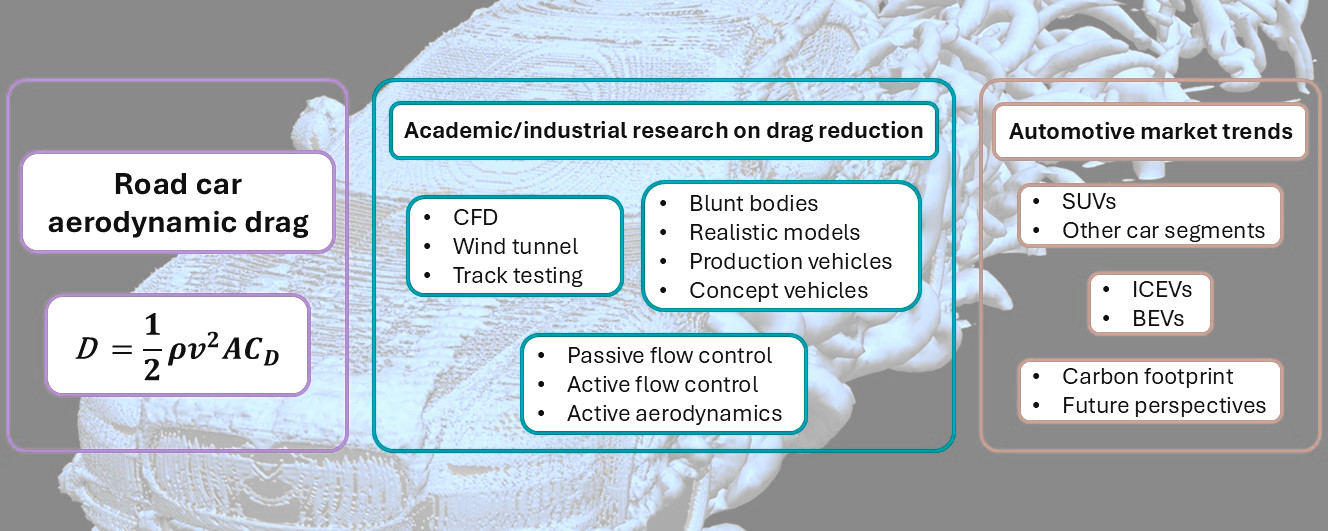
Aerodynamic research on road cars was reviewed in this work under the thread of reducing drag, with the awareness that this may succeed in effectively decreasing the carbon footprint of transportation. First, a selection of studies was presented to focus on the most important aerodynamic features of the flow around realistic car body shapes. Then, the discussion was organized around three pillars related to passive flow control, active flow control and active aerodynamics. Both experimental and numerical investigations were included to provide a comprehensive overview. A clear distinction was made between simplified and realistic car models, as well as production vehicles (within the limits of restricted access information). Moreover, a short essay was dedicated to electric vehicles, for which aerodynamics matters, especially at highway speeds. Last, the impact of aerodynamic principles on the design of current and future vehicle fleet was assessed, honestly admitting that recent market trends must be reversed to turn decarbonization goals into reality and damp the effects of global warming.Graphic Abstract
Keywords
Road cars; aerodynamics; drag coefficient; passive flow control; active flow control; active aerodynamics
Cite This Article
APA Style
Ravelli, U., Ravelli, S. (2026). An Overview of Drag Reduction Methods in Road Cars. Fluid Dynamics & Materials Processing, 22(2), 1. https://doi.org/10.32604/fdmp.2026.075225
Vancouver Style
Ravelli U, Ravelli S. An Overview of Drag Reduction Methods in Road Cars. Fluid Dyn Mater Proc. 2026;22(2):1. https://doi.org/10.32604/fdmp.2026.075225
IEEE Style
U. Ravelli and S. Ravelli, “An Overview of Drag Reduction Methods in Road Cars,” Fluid Dyn. Mater. Proc., vol. 22, no. 2, pp. 1, 2026. https://doi.org/10.32604/fdmp.2026.075225
 Copyright © 2026 The Author(s). Published by Tech Science Press.
This work is licensed under a Creative Commons Attribution 4.0 International License , which permits unrestricted use, distribution, and reproduction in any medium, provided the original work is properly cited.
 Downloads
 Citation Tools
