
 Login
Login Register
 Submit a Paper
 Propose a Special lssue
 Open Access
ARTICLE

VOF-Based Simulation of Turbulent Air-Water Flow over Gravel Beds in Open Channels
1 Dipartimento di Ingegneria, Universita’ della Campania ‘L. Vanvitelli’, Aversa, Italy
2 State Key Laboratory of Clean Energy Utilization, Zhejiang University, Hangzhou, China
3 Department of Mechanical Engineering Technology, Punjab Tianjin University of Technology, Lahore, Pakistan
* Corresponding Author: Abdullah Abdullah. Email:
(This article belongs to the Special Issue: Model-Based Approaches in Fluid Mechanics: From Theory to industrial Applications)
Fluid Dynamics & Materials Processing 2026, 22(3), 2 https://doi.org/10.32604/fdmp.2026.077023
Received 01 December 2025; Accepted 12 March 2026; Issue published 31 March 2026
 View Full Text
 Download PDF
Abstract
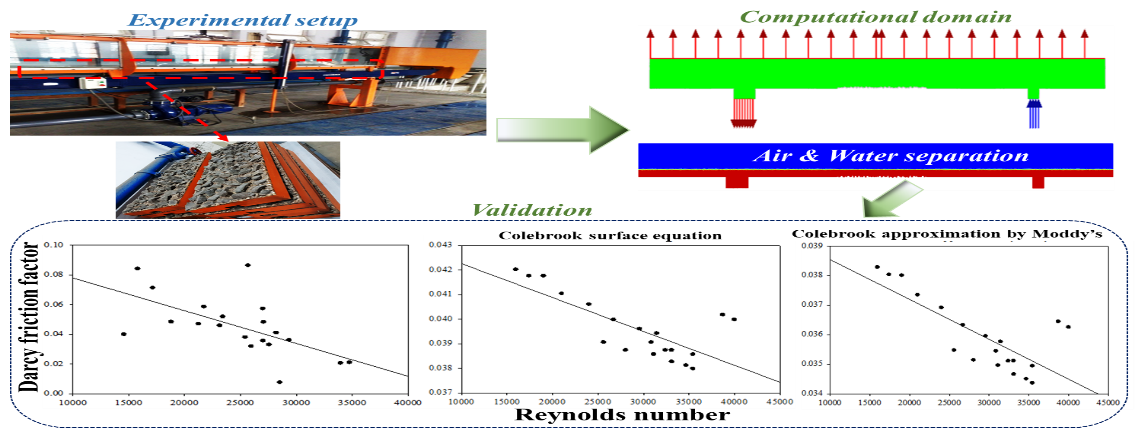
Turbulent flow over gravel beds in open channels is a fundamental yet complex problem in hydraulic engineering, as flow behavior is highly sensitive to channel geometry and bed roughness. In this study, the Volume of Fluid (VOF) method coupled with the standard k-ε turbulence model is employed to simulate air-water interactions over gravel beds, with open boundary conditions capturing realistic channel-atmosphere interactions. Numerical simulations are performed to examine how channel design influences the relationship between the friction factor (f) and the Reynolds number (RN). Velocity and VOF contours indicate peak flow near the inlet, with a maximum velocity of 0.64 m/s. The simulations show strong agreement with theoretical predictions, yielding a correlation coefficient of 0.99 for RN, while f and Chezy’s coefficient (C) reach 0.75 and 0.71, respectively. Comparison with experimental measurements shows deviations of approximately 17% for RN, 25% for f, and 12% for C. Moreover, further analysis confirms an inverse linear relationship between f and RN, in accordance with classical models such as Bazin’s curves, the Colebrook equation, and Moody’s approximation. Overall, the results demonstrate that the proposed numerical framework reliably captures flow dynamics over gravel beds, offering a robust tool for hydraulic design and performance assessment of open channels.Graphic Abstract
Keywords
Cite This Article
 Copyright © 2026 The Author(s). Published by Tech Science Press.
This work is licensed under a Creative Commons Attribution 4.0 International License , which permits unrestricted use, distribution, and reproduction in any medium, provided the original work is properly cited.
 Downloads
 Citation Tools
