
 Login
Login Register
 Submit a Paper
 Propose a Special lssue
 Open Access
ARTICLE

Adaptive Optimization of Drainage Processes in High-Water-Cut Tight Gas Reservoirs
1 Oil & Gas Technology Institute, PetroChina Changqing Oil Field Company, Xi’an, China
2 National Engineering Laboratory for Exploration and Development of Low-Permeability Oil & Gas Fields, PetroChina Changqing Oil Field Company, Xi’an, China
* Corresponding Author: Jiaming Cai. Email:
(This article belongs to the Special Issue: Fluid and Thermal Dynamics in the Development of Unconventional Resources IV)
Fluid Dynamics & Materials Processing 2026, 22(3), 8 https://doi.org/10.32604/fdmp.2026.078769
Received 07 January 2026; Accepted 09 March 2026; Issue published 31 March 2026
 View Full Text
 Download PDF
Abstract
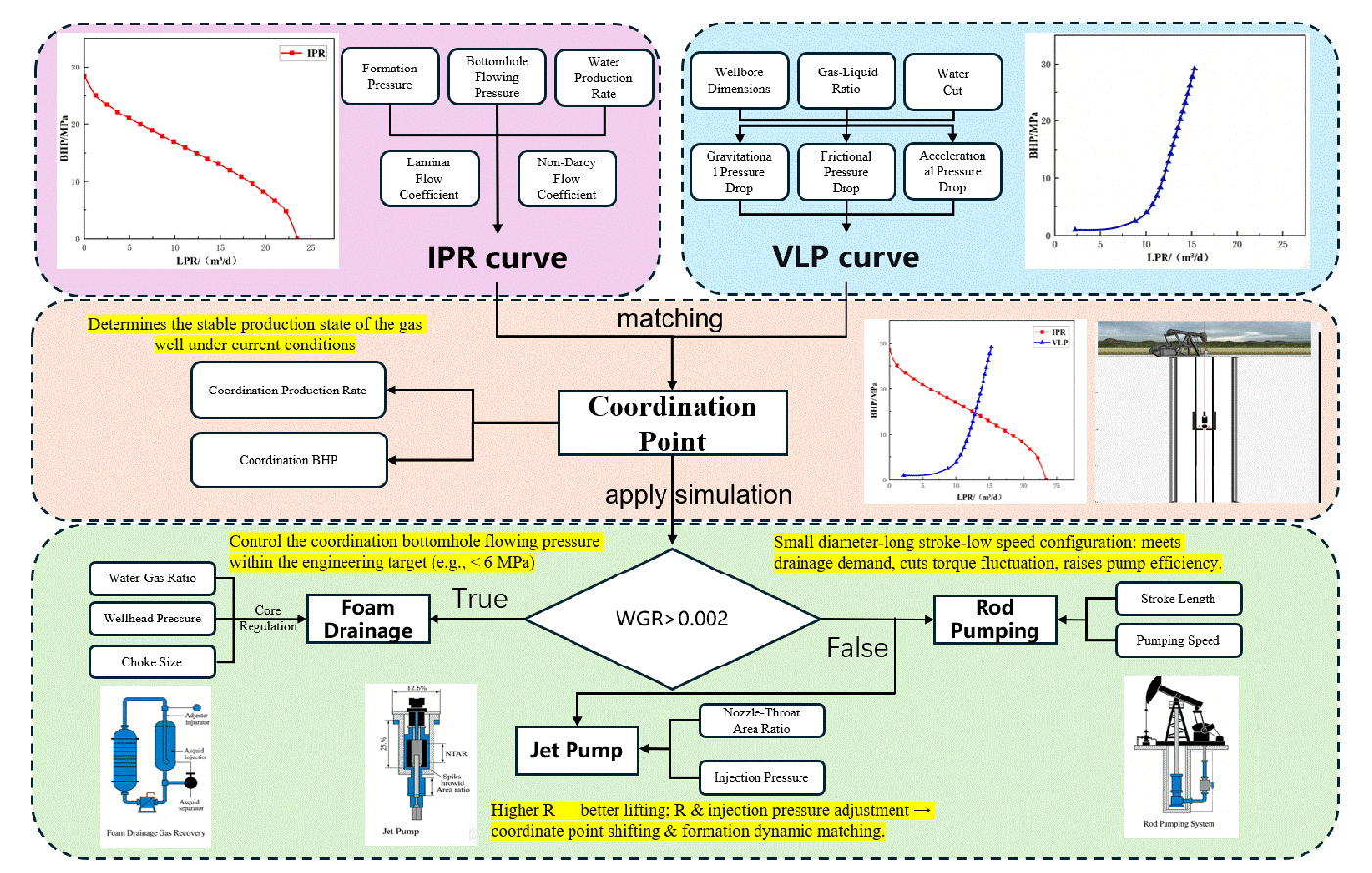
To address the persistent challenge of dynamic mismatch between wellbore lifting capacity and reservoir fluid supply, and to establish a robust optimization framework for drainage operations in high-water-cut tight sandstone gas reservoirs, this study systematically investigates the graded optimization and dynamic adaptation of drainage gas recovery technologies. Production data from a representative tight gas field were first employed to forecast reservoir performance. The predictive reliability was rigorously validated through high-precision history matching, thereby providing a quantitatively consistent foundation for subsequent wellbore optimization. Building on this characterization, a coupled simulation framework was developed that integrates wellbore multiphase flow modeling with nodal analysis based on the Inflow Performance Relationship, IPR, and the Vertical Lift Performance, VLP. This coordinated approach enables comprehensive evaluation of process adaptability and dynamic optimization of foam-assisted drainage, mechanical pumping, and jet pumping systems under evolving water–gas ratio, WGR conditions. The results reveal that a progressively increasing water–gas ratio is the dominant factor driving the transition from chemically assisted drainage methods to mechanically enhanced lifting technologies. A distinct quantitative threshold is identified at WGR ≈ 0.002, beyond which mechanical intervention becomes more effective and economically justified. For mechanical pumping and jet pumping systems, a parameter inversion optimization strategy constrained by the target bottomhole flowing pressure, Pwf, is proposed to ensure stable production while maintaining reservoir drawdown control. In particular, the nozzle-to-throat area ratio of the jet pump is identified as the key governing parameter influencing entrainment capacity and lifting efficiency. Moreover, a configuration characterized by small pump diameter, long stroke length, and low operating speed is demonstrated to satisfy drainage requirements while mitigating torque fluctuations, enhancing volumetric efficiency, and improving pump fillage stability.Graphic Abstract
Keywords
Cite This Article
 Copyright © 2026 The Author(s). Published by Tech Science Press.
This work is licensed under a Creative Commons Attribution 4.0 International License , which permits unrestricted use, distribution, and reproduction in any medium, provided the original work is properly cited.
 Downloads
 Citation Tools
