
 Login
Login Register
 Submit a Paper
 Propose a Special lssue
 Open Access
ARTICLE
CFD–DEM Investigation of Material Composition Effects on the Transportability of While-Drilling Lost Circulation Materials in Directional Tools
1 Sinopec Shanghai Offshore Oil & Gas Company, Shanghai, China
2 Hubei Key Laboratory of Oil and Gas Drilling and Production Engineering, Yangtze University, Wuhan, China
* Corresponding Author: Lei Pu. Email:
(This article belongs to the Special Issue: Fluid and Thermal Dynamics in the Development of Unconventional Resources IV)
Fluid Dynamics & Materials Processing 2026, 22(5), 8 https://doi.org/10.32604/fdmp.2026.081184
Received 25 February 2026; Accepted 28 April 2026; Issue published 27 May 2026
 View Full Text
 Download PDF
Abstract
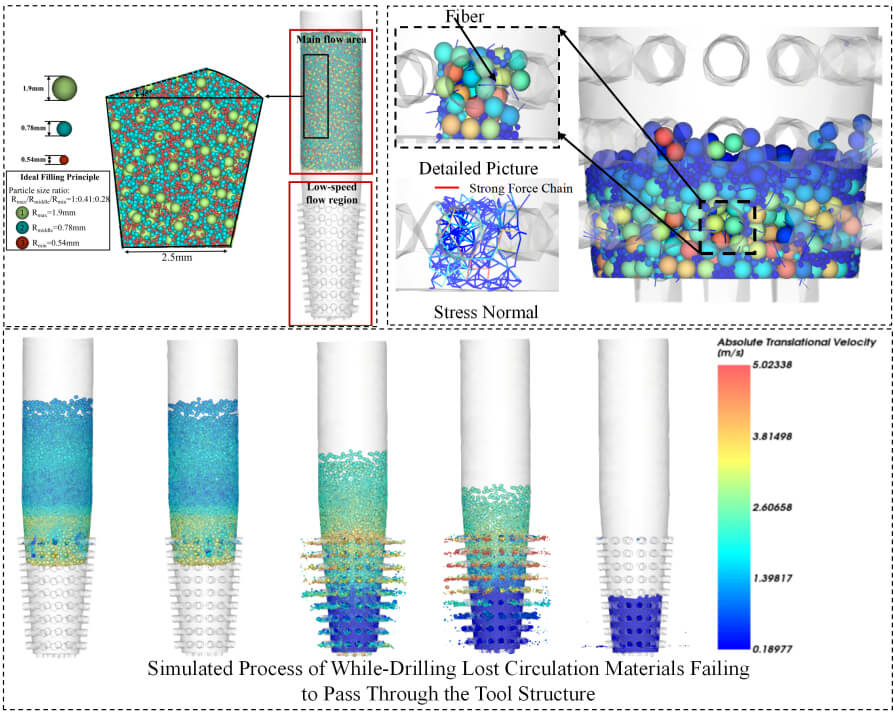
The passability (transport behavior) of while-drilling lost circulation materials (LCMs) through directional tools is strongly influenced by material composition and particle characteristics. In this study, a coupled computational fluid dynamics–discrete element method (CFD–DEM) model is developed to systematically evaluate the effects of particle size distribution, concentration, morphology, and fiber inclusion on LCM transport behavior. Visualization experiments conducted using a transparent screen section demonstrate good agreement with the simulated pressure-drop evolution, supporting the validity of the model. The results reveal that increasing particle size from 1.2–1.6 mm to above 2.8 mm shifts the system from a stable transport regime to one with a high risk of plugging, even at relatively low concentrations. Plugging risk rises markedly when particle concentration exceeds 30–35%. Multimodal particle size distributions enhance transport performance, achieving efficiencies of approximately 0.07%, compared with less than 0.035% for monomodal systems. Irregular particle shapes increase force-chain normal forces from 0.009–0.010 N to 0.017–0.020 N, while fiber inclusion significantly reduces steady-state flow velocity from about 1.6–1.7 m/s to below 0.6 m/s, thereby diminishing passability.Graphic Abstract
Keywords
Cite This Article
 Copyright © 2026 The Author(s). Published by Tech Science Press.
This work is licensed under a Creative Commons Attribution 4.0 International License , which permits unrestricted use, distribution, and reproduction in any medium, provided the original work is properly cited.
 Downloads
 Citation Tools
