
 Login
Login Register
 Submit a Paper
 Propose a Special lssue
 Open Access
ARTICLE

A Novel Multi-Step Numerical Framework for Ice Accretion Prediction Based on Unsteady Water Film Dynamics
1 School of Aviation Maintenance Engineering, Chengdu Aeronautic Polytechnic University, Chengdu, 610100, China
2 College of Aerospace Engineering, Nanjing University of Aeronautics and Astronautics, Nanjing, 210001, China
* Corresponding Author: Ke Shen. Email:
Frontiers in Heat and Mass Transfer 2025, 23(6), 1957-1980. https://doi.org/10.32604/fhmt.2025.070396
Received 15 July 2025; Accepted 17 October 2025; Issue published 31 December 2025
 View Full Text
 Download PDF
Abstract
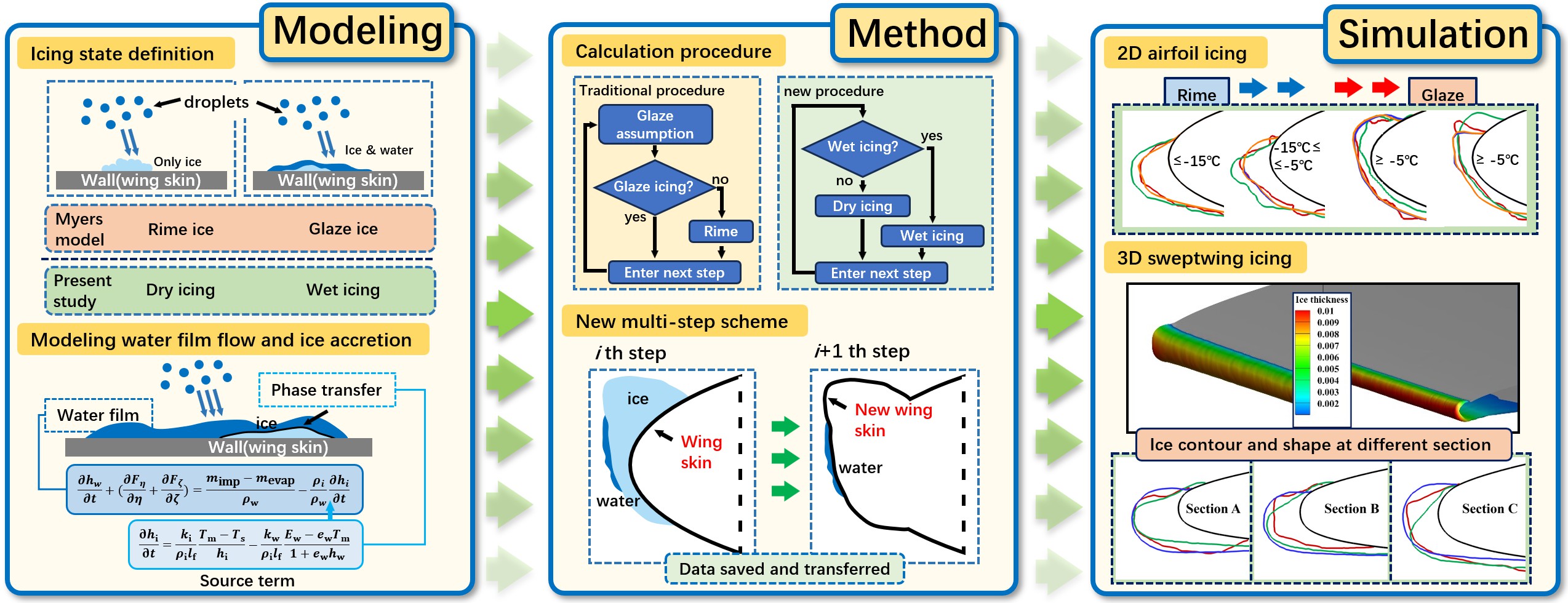
Ice accretion on aircraft poses a critical threat to flight safety by significantly altering aerodynamic performance. This study presents a novel numerical framework for ice accretion prediction, developed by extending the Myers model and incorporating an advanced multi-step approach. The proposed framework integrates ice layer growth into the modeling of unsteady water film dynamics and introduces a revised criterion for determining the icing condition. A multi-step scheme, accounting for the continuous variation of physical parameters, is implemented to enhance computational accuracy. The framework is validated through simulations on both 2D and 3D configurations. For the NACA0012 airfoil, the model demonstrates strong adaptability to both rime and glaze ice scenarios, with simulated ice shapes and thicknesses showing close agreement with experimental data, especially under low-temperature rime ice scenarios. In glaze ice cases, the framework effectively captures the leading-edge ice thickness and horn formation, albeit with minor positional deviations. For the GLC-305 swept wing, the approach accurately reproduces the primary ice shape features and overall thickness distribution. However, discrepancies in icing extent and thickness persist under rime scenarios due to the limitations of the single-step strategy. In glaze ice scenarios, the model captures the general trend of ice horn development, though positional and thickness deviations remain. Overall, the developed framework improves the precision of ice accretion simulations and offers a promising tool for advancing aircraft safety. Future research will aim to refine the multi-step framework to further improve its robustness and accuracy in complex, 3D icing environments.Graphic Abstract
Keywords
Ice accretion; numerical study; Myers model; multi-step; water film dynamics
Cite This Article
APA Style
Shen, K., Zeng, D., Wang, C., Wang, L., Dong, Y. (2025). A Novel Multi-Step Numerical Framework for Ice Accretion Prediction Based on Unsteady Water Film Dynamics. Frontiers in Heat and Mass Transfer, 23(6), 1957–1980. https://doi.org/10.32604/fhmt.2025.070396
Vancouver Style
Shen K, Zeng D, Wang C, Wang L, Dong Y. A Novel Multi-Step Numerical Framework for Ice Accretion Prediction Based on Unsteady Water Film Dynamics. Front Heat Mass Transf. 2025;23(6):1957–1980. https://doi.org/10.32604/fhmt.2025.070396
IEEE Style
K. Shen, D. Zeng, C. Wang, L. Wang, and Y. Dong, “A Novel Multi-Step Numerical Framework for Ice Accretion Prediction Based on Unsteady Water Film Dynamics,” Front. Heat Mass Transf., vol. 23, no. 6, pp. 1957–1980, 2025. https://doi.org/10.32604/fhmt.2025.070396
 Copyright © 2025 The Author(s). Published by Tech Science Press.
This work is licensed under a Creative Commons Attribution 4.0 International License , which permits unrestricted use, distribution, and reproduction in any medium, provided the original work is properly cited.
 Downloads
 Citation Tools
