
 Login
Login Register
 Submit a Paper
 Propose a Special lssue
 Open Access
ARTICLE

Operation Performance of Scroll Compressor under Different Pressure Ratio Conditions
1 School of Civil Engineering and Architecture, Xinxiang University, Xinxiang, 453003, China
2 School of Computer and Software Engineering, Sias University, Zhengzhou, 451150, China
* Corresponding Author: Yaping Liu. Email:
Frontiers in Heat and Mass Transfer 2025, 23(6), 2051-2072. https://doi.org/10.32604/fhmt.2025.070138
Received 08 July 2025; Accepted 21 October 2025; Issue published 31 December 2025
 View Full Text
 Download PDF
Abstract
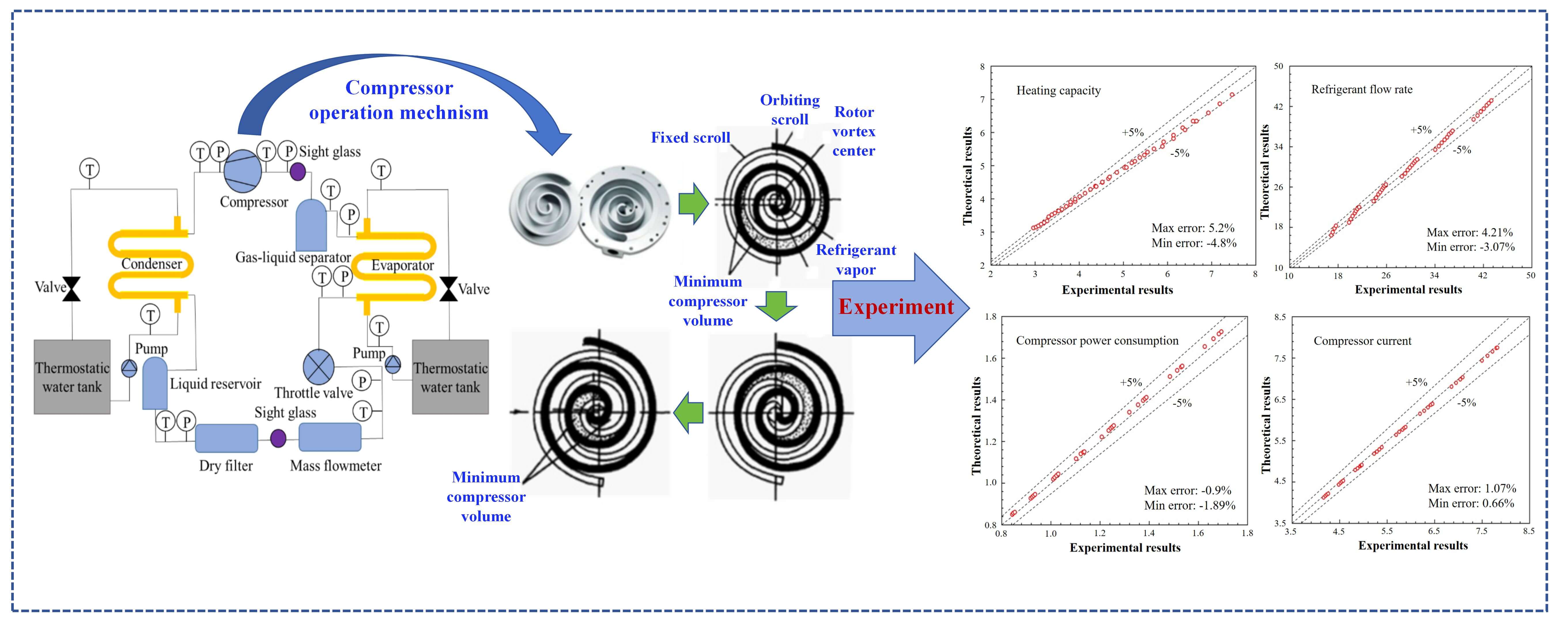
This study experimentally investigates the operational performance of a scroll compressor using R513A to expand its application range as a substitute for R134a. A vapor compression heat pump test platform was established to analyze the variation trends of heating capacity, refrigerant mass flow rate, compressor power consumption, and current by controlling the compressor inlet and outlet pressures (i.e., evaporating and condensing temperatures). The results indicate that both heating capacity and refrigerant mass flow rate decrease with increasing pressure ratio. Compressor power consumption and current initially increase and then decrease with rising evaporating temperature, whereas they exhibit an approximately linear positive correlation with condensing temperature. Based on the experimental data, a polynomial model with pressure ratio as the independent variable was developed. This model predicts heating capacity, mass flow rate, power consumption, and current with high accuracy, showing an average deviation of less than 2%. However, the model’s applicability is significantly influenced by evaporating and condensing temperatures. Therefore, an enhanced 10-coefficient polynomial model, incorporating both evaporating and condensing temperatures as independent variables, was established. This improved model eliminates operational limitations and demonstrates superior prediction performance, with an average deviation of ±1.44% for compressor performance parameters, confirming its practical value for engineering applications.Graphic Abstract
Keywords
R513a; condensing temperature; evaporating temperature; pressure ratio; polynomial model
Cite This Article
APA Style
Yang, W., Liu, Y., Gui, C., Shi, Y., Ge, M. (2025). Operation Performance of Scroll Compressor under Different Pressure Ratio Conditions. Frontiers in Heat and Mass Transfer, 23(6), 2051–2072. https://doi.org/10.32604/fhmt.2025.070138
Vancouver Style
Yang W, Liu Y, Gui C, Shi Y, Ge M. Operation Performance of Scroll Compressor under Different Pressure Ratio Conditions. Front Heat Mass Transf. 2025;23(6):2051–2072. https://doi.org/10.32604/fhmt.2025.070138
IEEE Style
W. Yang, Y. Liu, C. Gui, Y. Shi, and M. Ge, “Operation Performance of Scroll Compressor under Different Pressure Ratio Conditions,” Front. Heat Mass Transf., vol. 23, no. 6, pp. 2051–2072, 2025. https://doi.org/10.32604/fhmt.2025.070138
 Copyright © 2025 The Author(s). Published by Tech Science Press.
This work is licensed under a Creative Commons Attribution 4.0 International License , which permits unrestricted use, distribution, and reproduction in any medium, provided the original work is properly cited.
 Downloads
 Citation Tools
