
 Login
Login Register
 Submit a Paper
 Propose a Special lssue
 Open Access
REVIEW

A Survey on Token Transmission Attacks, Effects, and Mitigation Strategies in IoT Devices
1 Department of Computer Science and Information Technology, School of Computing and Mathematics, The Co-operative University of Kenya, Karen, Nairobi, P.O. Box 24814-00502, Kenya
2 School of Science and Computing, South Eastern Kenya University, Kitui, P.O. Box 170-90200, Kenya
* Corresponding Authors: Shem Mbandu Angolo. Email: ; Philemon Nthenge Kasyoka. Email:
Journal on Artificial Intelligence 2025, 7, 205-254. https://doi.org/10.32604/jai.2025.067361
Received 01 May 2025; Accepted 14 July 2025; Issue published 19 August 2025
 View Full Text
 Download PDF
Abstract
The exponential growth of Internet of Things (IoT) devices has introduced significant security challenges, particularly in securing token-based communication protocols used for authentication and authorization. This survey systematically reviews the vulnerabilities in token transmission within IoT environments, focusing on various sophisticated attack vectors such as replay attacks, token hijacking, man-in-the-middle (MITM) attacks, token injection, and eavesdropping among others. These attacks exploit the inherent weaknesses of token-based mechanisms like OAuth, JSON Web Tokens (JWT), and bearer tokens, which are widely used in IoT ecosystems for managing device interactions and access control. The impact of such attacks is profound, leading to unauthorized access, data exfiltration, and control over IoT devices, posing significant threats to privacy, safety, and the operational integrity of critical IoT applications in sectors like healthcare, smart cities, and industrial automation. This paper categorizes these attack vectors, explores real-world case studies, and analyzes their effects on resource-constrained IoT devices that have limited processing power and memory, rendering them more susceptible to such exploits. Furthermore, this survey presents a comprehensive evaluation of existing mitigation techniques, including cryptographic protocols, lightweight secure transmission frameworks, secure token management practices, and network-layer defenses such as Transport Layer Security (TLS) and multi-factor authentication (MFA). The study also highlights the trade-offs between security and performance in IoT systems and identifies key gaps in current research, emphasizing the need for more scalable, energy-efficient, and robust security frameworks to address the evolving landscape of token transmission attacks in IoT devices.Keywords
IoT has changed many industries in varying ways and leveled up the idea of connected devices that can send information to one another. Starting from interconnected homes and hospitals to industries and factories, IoT has revolutionized humans’ interface with machines, resulting in a quintessential enhancement of proactivity. But at the same time, a large number of IoT devices caused new security threats, firstly, regarding authentication and authorization procedures of devices for secure communication.
One of the significant open security issues that we identify in IoT systems involves token transmission during the authentication processes. Token-based authentication has emerged as a standard practice in making communications between IoT devices and the server secure and also to authenticate the identity of the device. However, these tokens can be easily attacked if an unauthorized party acquires them to perform a token replay attack where the token is duplicated and used to impersonate the legal device. Such attacks may lead to violation of privacy, penetration and infringement of privacy of users among other things. Ideally, to secure IoT devices, it is possible to set up profound secure procedures but this is difficult since IoT devices have restricted computational power and memory. Source of Funding: [1,2]. This is especially because IoT devices interact with unsophisticated networks and thus are likely to experience insecure multi-hop networks making token transmission crucial [3].
Recent research highlights the critical vulnerabilities associated with token-based authentication in IoT systems. For instance, Al-Refai and Alawneh propose an enhanced security framework that incorporates token authentication technology, aiming to address the shortcomings of existing frameworks [1]. This is particularly important as IoT devices are frequently targeted due to their wireless communication capabilities, which expand the attack surface beyond local networks [4].
Fig. 1 shows how data privacy emerges as the most pressing concern, accounting for 28% of the total, underscoring the critical need to protect sensitive information within IoT ecosystems. Increased security threats represent the second largest issue at 17%, reflecting the growing vulnerability of IoT systems to cyberattacks. Both identity and access management and attacks against connected devices constitute 9% each, emphasizing the challenges of securing authentication protocols and mitigating malicious activities targeting IoT devices. Compliance requirements, comprising 7%, illustrate the complexities of adhering to regulatory and legal standards, while the others category (10%) captures additional concerns not explicitly categorized. Collectively, these issues underscore the multifaceted risks associated with IoT adoption, necessitating comprehensive and strategic interventions to enhance security, privacy, and regulatory compliance in IoT networks [4].

Figure 1: Major issues surrounding IoT
The implications of token transmission attacks extend beyond mere data breaches; they can lead to significant operational disruptions, particularly in critical sectors such as healthcare and industrial control systems. For example, the unauthorized manipulation of data transmitted by IoT devices can result in erroneous outputs that affect decision-making processes. The need for robust authentication mechanisms is further emphasized by the potential for attacks that exploit the unique characteristics of IoT devices, such as their resource constraints and varying levels of security capabilities [2,5].
This study uses a comprehensive qualitative method to analyze information system security in token transmission in the Internet of Things (IoT). A qualitative method was adopted to provide a thorough understanding of many security elements of IoT, token transfer, and authentication in IoT devices, including difficulties, solutions, and best practices. This research approach was developed in the stages listed below: Data will be gathered by an in-depth literature review of primary and secondary sources related to information systems security and IoT. The material to be examined will comprise scientific journals, books, research papers, and technical documentation. The collected data will be examined qualitatively. This entails detecting trends, critical results, and correlations among various aspects of information system security in the IoT context. The data’s validity will be checked by referring to certified and trusted sources. In addition, the analysis will be verified and validated by specialists in information security and IoT. The analytic results will be evaluated to yield useful insights into information system security in the IoT era. These findings will be linked to the theoretical framework under discussion to gain a better understanding. Based on the study, research conclusions will be developed, outlining the key results, consequences, and recommendations for developing successful security methods in the IoT context. Following this methodology, it is believed that this research will contribute significantly to the knowledge and implementation of best practices for safeguarding information systems via secure token transfer in the Internet of Things age.
3 Role of Tokens in Securing IoT Communications
The role of tokens in securing IoT communications is pivotal, particularly as the number of IoT devices continues to rise and their applications expand across various sectors. Tokens serve as digital keys that facilitate secure access control, authentication, and authorization within IoT ecosystems. For authentication purposes, Tokens are frequently used to verify the identity of IoT devices when they communicate with servers or other devices. In a typical scenario, when an IoT device attempts to connect to a server, the server generates a token that uniquely identifies the device. The device stores this token and presents it in subsequent interactions, allowing the server to recognize the device without requiring the full credentials to be transmitted repeatedly. This reduces the risk of exposing sensitive information over the network [1,6]. Beyond authentication, tokens also serve as a means of defining and enforcing access control in IoT communications. Each token may contain encoded information about the permissions and privileges of the device or user in the network. This ensures that the device can only access the resources and services it is authorized to use, helping prevent unauthorized actions. Tokens are especially useful in large-scale IoT networks where different devices have varying levels of access to the system [7]. In addition, Tokens can be used to manage communication sessions between IoT devices and servers. Once a device is authenticated, a session token is generated to maintain the connection over some time without repeatedly verifying the device’s credentials. This is particularly valuable for maintaining ongoing communication in environments where IoT devices need to exchange data regularly, such as in smart homes or industrial IoT applications [8]. Tokens can also help to protect the integrity of data exchanged between IoT devices and servers. The CIA triangle of security goals—confidentiality, integrity, and availability—may be impacted by these attacks. NIST’s publication FIPS 199 describes the likely consequences of losing one of these three security goals.
In two scenarios—Smart Home Heating Control and Smart Health Monitor systems—the table contrasts a large number of simulated cyberattacks with their potential effects on the three security principles of confidentiality, integrity, and availability of user information. There are three categories for the impact levels: low, moderate, and high.
Low: has minimal impact on operations, assets, or personnel.
Moderate (Mod): Severe impact on business, assets, or personnel.
High: Has a severe or catastrophic impact on business, assets, or individuals.
Non-applicable: only pertains to confidentiality.
Depending on the specifics of an attack, the possible consequences could vary. Based on the basic type of device to which they are addressed, the table illustrates the potential effects of several attacks on the CIA triad for user information. The intensity of the impact may vary depending on the application; in one case, the attacks target a smart lightbulb, while in the other, they target a smart health monitor [9].
By using cryptographically signed tokens, it becomes possible to detect if data has been tampered with during transmission. If the token is altered, the server can reject the communication, ensuring that only valid and unaltered data is accepted. In large-scale IoT networks, where thousands of devices may be communicating simultaneously, tokens offer a scalable and efficient solution for securing communications. Traditional security methods often require extensive computational resources that IoT devices may not possess. In distributed IoT networks, tokens support decentralized security models, where authentication can be performed at the edge of the network without needing constant communication with a central server. This is particularly important in edge computing environments, where IoT devices process data locally and only send essential information back to the cloud. Tokens enable these devices to authenticate locally, increasing efficiency and reducing latency. The integration of blockchain with token systems further enhances security. This not only secures communication but also enables devices to maintain a verifiable identity, which is essential for trust in IoT ecosystems [9].
Security tokens can encapsulate user credentials and establish secure sessions through encryption, while API tokens facilitate secure interactions between software applications and services [10]. Additionally, hardware tokens, which may utilize physical unclonable functions (PUFs) for authentication, provide unique identifiers for devices that contribute to ensuring secure communications in IoT environments [11]. The IoT provides a large number of applications to enhance people’s daily lives and activities. Fig. 2 shows potential examples of IoT applications.

Figure 2: Overview of IoT applications
4 Types of Tokens Used in IoT Devices/Communication Protocols
Tokens are used for authentication, authorization, and sometimes even for ensuring the integrity of the data being exchanged. Depending on the specific IoT network and communication protocol, different types of tokens are employed to maintain secure, efficient, and reliable connections. This section explores the types of tokens commonly used in IoT devices and communication protocols, highlighting their functions and significance in preventing unauthorized access and mitigating potential transmission attacks.
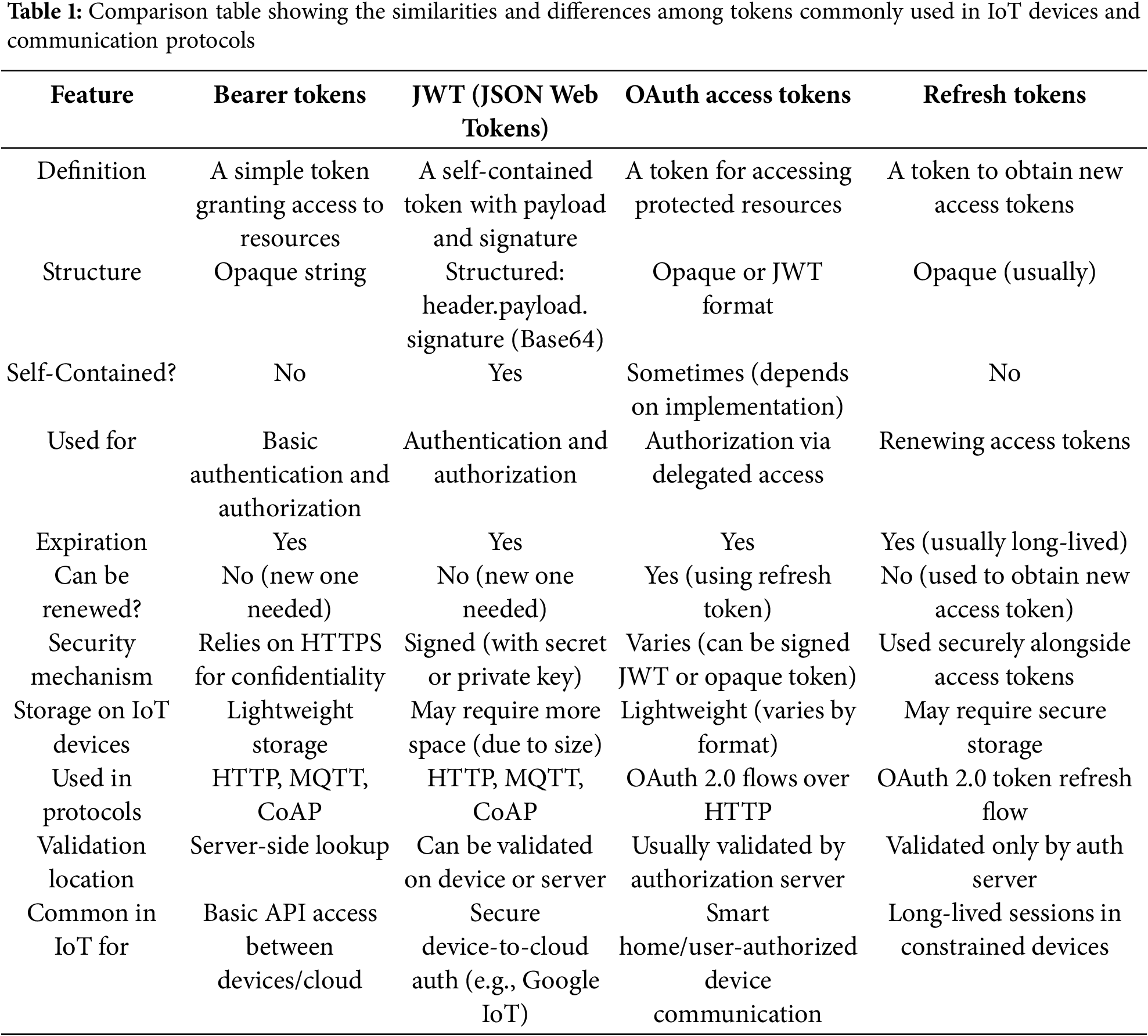
A bearer token is a security token that grants access to resources based on possession. Any entity holding a valid bearer token can gain access to the specified resource without requiring additional credentials or authentication. They are commonly used in RESTful communication protocols in IoT, where devices authenticate once and then use the token for subsequent interactions with cloud services or IoT platforms. These tokens are often included in HTTP request headers [12]. Table 1 shows a comparison of similarities and differences among tokens commonly used in IoT devices and communication protocols.
JSON Web Tokens (JWT) are a URL-safe, JSON-based format used to securely convey claims between parties. These tokens are made up of three parts: a header, a payload (which contains claims), and a signature. The signature ensures the data’s integrity and authenticity. Because of their lightweight nature, ease of integration, and ability to be quickly validated, JWTs are frequently used for authentication and authorization in IoT systems, particularly in device-to-cloud and device-to-device communication. Yang et al. present a lightweight authentication technique that uses elliptic curve cryptography and trustworthy tokens (JWT) to effectively authenticate IoT devices and backend services. This solution assures that data delivered to the server comes from legitimate devices, alleviating worries about data integrity and authenticity [12]. Furthermore, the use of bearer tokens allows for stateless authentication, which is particularly advantageous in resource-constrained IoT devices, as it reduces the need for maintaining a session state on the server side [13].
OAuth access tokens are short-lived credentials used to grant devices or applications access to resources on behalf of a user or service. These tokens contain specific permissions (or scopes) and are issued by an authorization server. OAuth are used in IoT environments to delegate secure access control to devices without revealing user credentials. They are commonly employed in scenarios where IoT devices interact with cloud-based services or A PIs. Some of the Associated Protocols include OAuth 2.0, CoAP, and HTTPS. The OAuth 2.0 framework allows IoT devices to obtain access tokens that can be used to authenticate requests to servers or other services. This mechanism is essential for ensuring that only authorized devices can access sensitive resources. For instance, García-Pozo et al. evaluated the integration of the OAuth 2.0 protocol within an IoT Publish/Subscribe architecture, demonstrating its feasibility and effectiveness in managing access control in resource-limited environments [14]. The study highlights how OAuth can facilitate secure interactions between devices and servers while accommodating the constraints of IoT devices.
Refresh tokens are long-lived tokens that allow devices to request new access tokens without requiring re-authentication. These tokens are issued alongside access tokens and can be stored securely on the IoT device for subsequent use. They are essential in maintaining long-term device connections, especially for devices that need continuous or periodic access to resources without frequent re-authentication, which would consume significant resources. Moreover, the lightweight nature of refresh tokens is particularly beneficial for IoT devices, which often have limited processing power and battery life. Furtak discusses a cryptographic key-generating and renewing system that emphasizes the importance of secure key management in IoT networks [15]. This system can be integrated with refresh token mechanisms to ensure that keys are renewed securely without excessive computational demands, thereby preserving the limited resources of IoT devices.
4.5 Security Assertion Markup Language (SAML) Tokens
SAML tokens are XML-based tokens used for exchanging authentication and authorization data between parties. These tokens contain assertions about the identity of the user or device and the permissions granted. While less commonly used in resource-constrained IoT systems due to their larger size, SAML tokens are deployed in enterprise IoT environments that require integration with existing SAML-based identity management systems. The integration of SAML tokens in IoT can enhance security by enabling mutual authentication between devices and servers. Alnahari and Quasim discuss the significance of mutual authentication in preventing unauthorized access and ensuring secure data sharing between IoT devices and servers [16].
CBOR Web Tokens (CWT) are a binary-encoded alternative to JSON Web Tokens, utilizing the Concise Binary Object Representation (CBOR) format. CWT tokens are specifically designed for constrained environments, where efficiency is critical. CWTs are particularly well-suited for resource-limited IoT devices, such as sensors and actuators, due to their smaller size and reduced computational overhead. They are often used for secure communications in constrained networks. CWTs are closely related to JWTs but offer a more efficient serialization format that reduces the overhead associated with token transmission. This compactness is crucial in IoT scenarios where bandwidth and processing power are limited, allowing devices to communicate securely without incurring significant resource costs. The use of CWTs also enhances interoperability among heterogeneous IoT devices. The ACE (Authentication and Authorization for Constrained Environments) framework, which utilizes CWTs, facilitates secure token generation and transmission across diverse IoT platforms [17]. This interoperability is essential in IoT ecosystems where devices from different manufacturers must communicate seamlessly while maintaining security.
4.7 Physically Unclonable Functions
Physically Unclonable Functions (PUFs) represent an innovative type of token that leverages unique physical characteristics of hardware to enhance security. PUFs can generate cryptographic keys and serve as authentication tokens, providing a robust defense against cloning and unauthorized access. For instance, Ebrahimabadi et al. propose a PUF-based authentication protocol that is resilient to modeling attacks, showcasing the potential of PUFs in securing IoT devices [18]. This hardware-based approach is particularly advantageous in resource-constrained environments, where traditional cryptographic methods may be impractical.
Comparison table showing the similarities and differences among tokens commonly used in IoT devices and communication protocols (Table 1).
5 Privacy Concerns across IoT Architecture Layers
Token transmission attacks in IoT environments exploit vulnerabilities in token-based authentication mechanisms, leading to significant security breaches. These include replay attacks, where intercepted tokens are reused to gain unauthorized access, as well as man-in-the-middle (MitM) attacks, token hijacking, and forgery. The root causes of these vulnerabilities stem from the use of weak or non-encrypted communication channels, improper token lifecycle management (e.g., lack of expiration or renewal mechanisms), and inadequate session control. These attacks exploit vulnerabilities in token-based authentication mechanisms, which are commonly employed to secure communications between IoT devices and servers. Al-Refai and Alawneh highlighted that such attacks could lead to unauthorized access to servers, potentially resulting in data breaches or service disruptions [1]. The use of insecure communication channels in IoT environments exacerbates this risk, as attackers can easily intercept tokens if they are not encrypted or adequately secured during transmission. The nature of these attacks can vary, but they generally involve the interception, replay, or manipulation of authentication tokens, leading to unauthorized access and potential exploitation of the devices involved. This incident underscores the critical need for robust security measures, particularly in environments where IoT devices are deployed in sensitive applications, such as healthcare and critical infrastructure [1].
Fig. 3 illustrates the interaction between users, IoT devices, and potential attackers, highlighting the dual nature of authentication processes and malicious activities targeting IoT systems.

Figure 3: Attack vectors on IoT devices
By enabling devices to send tokens that verify their identity, it prevents unauthorized access to sensitive data and functions. Tokens also facilitate the enforcement of access permissions, ensure data integrity through signing or encryption, and improve scalability by simplifying the authentication process in large networks. As IoT continues to grow, the significance of secure and effective token transmission becomes increasingly vital to maintaining robust security and reliability in IoT communications [9].
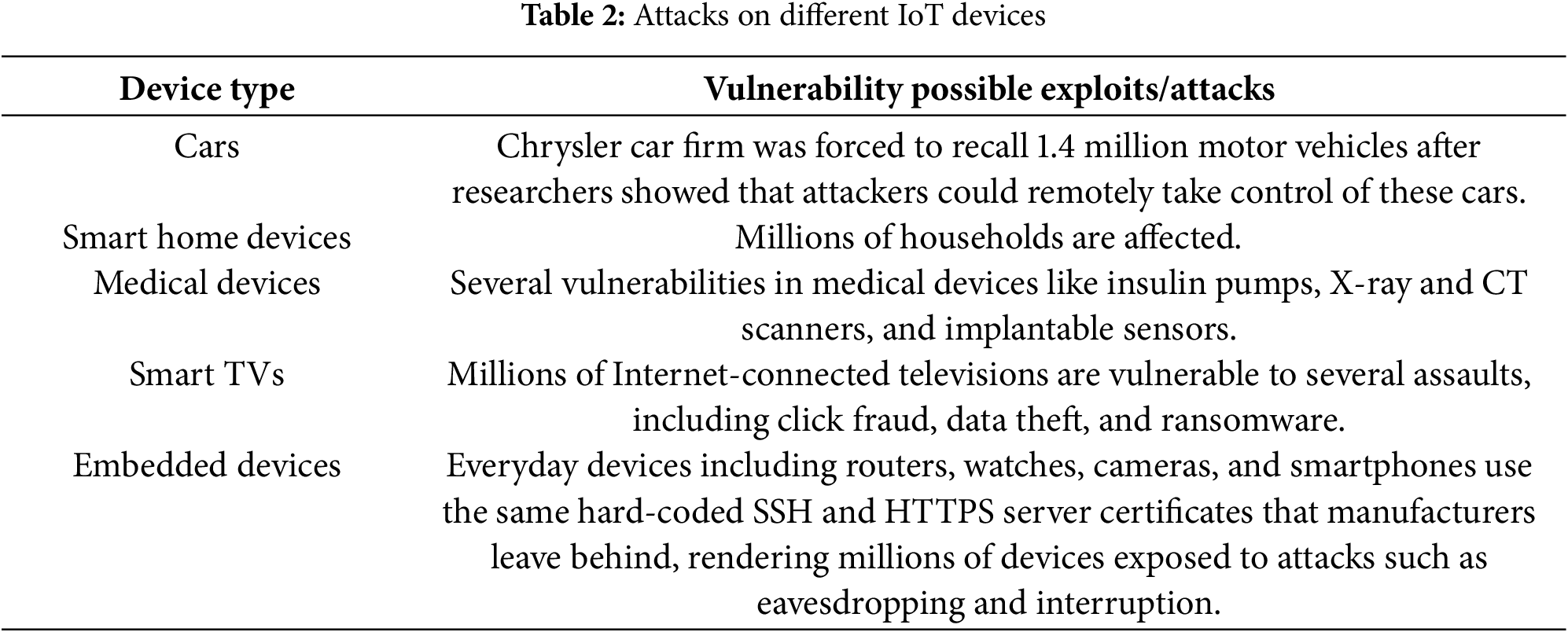
Table 2 below highlights vulnerabilities in various connected devices, illustrating the risks they pose and potential exploits. For cars, vulnerabilities can allow attackers to remotely control vehicles, threatening safety. Smart home devices, prevalent in millions of homes, can be exploited for network breaches, eavesdropping, or DDoS attacks. Medical devices like insulin pumps and scanners face risks of tampering, data breaches, and ransomware, endangering patient lives. Smart TVs are vulnerable to data theft, surveillance, and malicious content injection, while embedded devices, such as routers and cameras, are often compromised through outdated software or hard-coded credentials, enabling large-scale attacks. These vulnerabilities emphasize the need for robust security practices, regular updates, and regulatory oversight to mitigate risks across all device types.
Generally speaking, Internet of Things devices are simple and made to work with and adapt to the gadgets we use daily. Unexpected design flaws and new vulnerabilities will arise as the number of IoT devices rises, raising the likelihood of system compromise. In light of this, it is imperative to avoid sacrificing the essential safeguards of our networks’ and our data’s privacy, confidentiality, integrity, and availability in favor of adopting new technologies quickly [19]. A recent study by [9] found that during 2017 and 2018, there were a significant amount of assaults on IoT devices, with an average of about 5200 attacks per month. The attacks are dangerous and spreading globally. Fig. 4 shows top countries identified as the sources of most cyberattacks by adversarial actors in 2023.

Figure 4: The figure displays the leading source nations for these IoT attacks
The necessity to protect privacy and security is typically outweighed by the ease of new technology and the desire to embrace it. But in the realm of IoT, the privacy concern is too important to overlook. The advantages of big data may cause IoT technology to be adopted before it is completely matured. The amount and variety of data that IoT devices gather is immense. We must consider several basic security issues, including the methods used for data collection, processing, transportation, and storage.
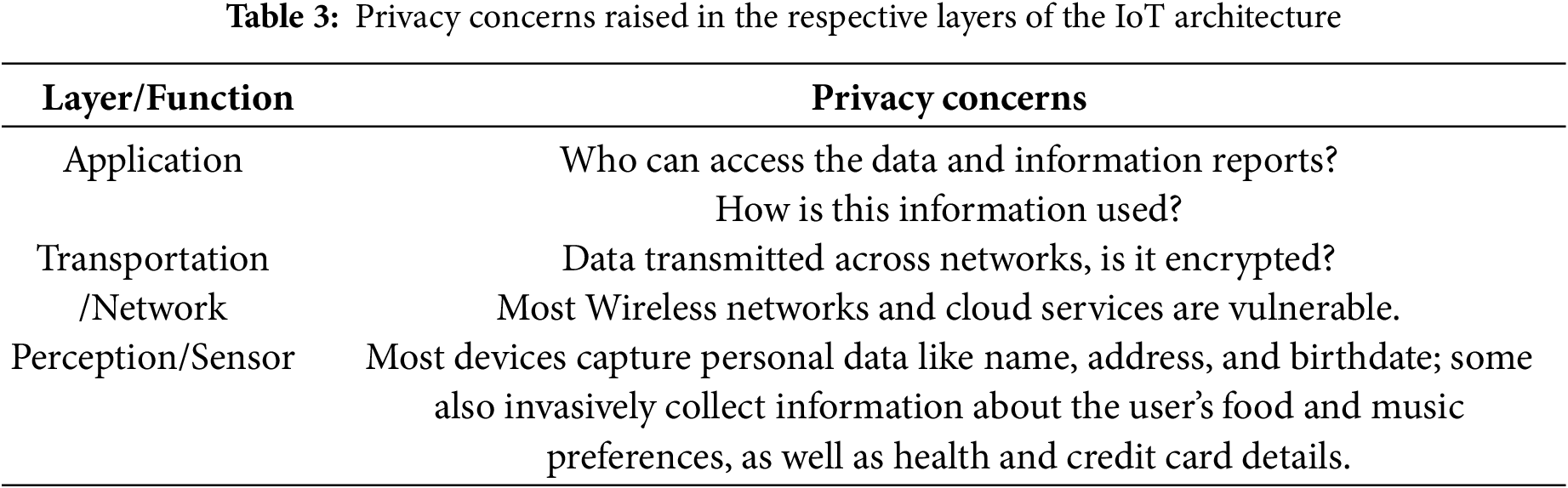
Each layer of the Internet of Things architecture raises privacy concerns. As indicated in Table 3, efforts to reduce these security issues have resulted in the identification of security issues based on the IoT tier in which they are located.
Fortunately, the standard C-I-A triad (Confidentiality, Integrity, and Availability) makes it possible to organize how we tackle the problem of security [20]:
Confidentiality: It guarantees that data and information reports are only accessible to authorized individuals and only to the degree necessary.
Integrity: It guarantees that during transmission, processing, and storage, data is safe, encrypted, and strictly modified by authorized users.
Availability: While protecting data and information is crucial, we also need to ensure that it is promptly accessible to prevent it from losing its value, as in emergency and medical applications.
IoT devices are vulnerable to attacks as they are being designed as well as during the data collecting, exchange, and transmission stages, as was previously mentioned. This provides only a limited amount of assurance and confidence regarding the confidentiality, availability, and integrity of data on the Internet of Things. Our security and privacy concerns will only get worse if those problems are not fixed. IoT is still in its infancy, fortunately, despite its explosive expansion. If security is given the proper attention and increased effort during the design and development phase as well as over the product life cycle, IoT may realize its full potential and genuinely assist people without endangering anyone’s security, particularly privacy [9].
The primary objective of this study is to conduct a comprehensive survey of token transmission attacks in Internet of Things (IoT) devices, focusing on their mechanisms, effects, and potential mitigation strategies. The research aims to systematically identify vulnerabilities in token transmission mechanisms that can be exploited by malicious actors, assess the ramifications of such attacks on IoT systems, and investigate both existing and emerging mitigation strategies, including encryption and token expiration policies. Additionally, the study seeks to promote awareness among IoT stakeholders about the risks associated with token transmission attacks and contribute to policy formulation regarding IoT security. Ultimately, this research aspires to enhance the understanding of token transmission attacks and improve the overall security practices within IoT ecosystems.
7 The General Architecture of IoT and Communication Patterns
The Internet of Things (IoT) general architecture is made up of several layers: The three main levels of the Internet of Things architecture are the perception layer, the network layer, and the application layer. The perception layer is made up of Internet of Things devices that have sensors and actuators that gather information from the surroundings and take appropriate action. The network layer uses a variety of communication protocols and technologies to send the data that the devices have collected to the cloud or other processing units. The software programs that evaluate the data and offer services to end users, enabling features like automation, control, and monitoring, are a final component of the application layer [21].
7.1 General Architecture of IoT
7.1.1 Perception Layer (Sensor Layer)
The Perception Layer, also known as the sensor layer, includes all the IoT devices, such as sensors and actuators, that gather data from the physical world. Sensors measure various environmental parameters, including temperature, humidity, motion, or light. Actuators then use this data to perform actions, such as turning on a fan or adjusting the temperature. The perception layer is composed of sensors and actuators that collect and transmit data, while the network layer enables connectivity and transport of data using communication protocols like Wi-Fi and Zigbee [22,23]. For instance, a smart thermostat collects data on the room’s temperature and sends this information to higher layers of the system. When the temperature reaches a predefined threshold, the thermostat triggers an actuator to adjust the heating or cooling system.
7.1.2 Network Layer (Connectivity Layer)
The Network Layer handles the communication of data between IoT devices and other systems, such as the cloud or central servers. It is responsible for selecting and utilizing appropriate communication protocols such as Wi-Fi, Bluetooth, ZigBee, LoRaWAN, and cellular networks like LTE and 5G. This layer ensures that devices can exchange data over both short and long distances. For example, smart home devices like light bulbs, locks, and thermostats may use Wi-Fi or ZigBee to communicate with a central hub or cloud service, enabling remote management and control of the devices.
7.1.3 Data Processing Layer (Middleware Layer)
The Data Processing Layer, or Middleware Layer, processes the raw data collected by IoT devices. This layer often utilizes cloud computing or edge computing systems to aggregate, analyze, and store data. In an industrial setting, sensors attached to machinery may monitor temperature, vibration, and pressure. The data from these sensors is processed either in the cloud or on an edge server, enabling real-time analysis and decision-making. This layer is vital for converting raw sensor data into valuable insights that drive automated actions, such as predictive maintenance or system optimization.
The Application Layer is where IoT services are delivered to end-users. It includes software applications that enable users to interact with IoT devices and access the insights derived from processed data. This layer provides user interfaces, dashboards, and control mechanisms. The application layer utilizes this data to provide useful services across various fields such as healthcare, smart homes, and industrial automation [24,25]. For instance, a smart home app allows users to remotely control devices like thermostats, security cameras, and lights. The application layer ensures that users can take action based on the data from IoT devices, such as adjusting the temperature or viewing security footage.
The Security Layer is designed to protect the integrity, confidentiality, and availability of data within the IoT system. Given the vast number of connected devices, this layer incorporates various security mechanisms, including encryption, authentication, access control, and threat detection. For example, a smart home security system may require multi-factor authentication (MFA) to ensure that only authorized users can access surveillance footage. It also ensures secure communication between devices and cloud services, preventing unauthorized access and ensuring the confidentiality of sensitive data. The use of lightweight frameworks and collaborative intrusion detection systems attempts to address these vulnerabilities while maintaining the integrity and reliability of IoT networks [26]. Security concerns dictate that IoT architectures must not only support large-scale connectivity but also adapt to dynamic threats and ensure user data privacy. These structures improve resource allocation and data processing capabilities while prioritizing security measures such as encryption and access control [27]. As illustrated in the in Fig. 5, authentication and verification plays a major role in IOT security by bridging the gap to the gateway such as a router or server, to send data to the cloud or another device using relevant protocols like http or MQTTP-Message Queuing Telemetry Transport.

Figure 5: IoT device architecture
7.2.1 Communication Patterns in IoT
Communication patterns in IoT refer to the manner devices interact and exchange data. These patterns are crucial for ensuring efficient, reliable, and secure data transfer across IoT systems. Communication patterns within IoT systems are also vital for understanding how devices interact. Various protocols like HTTP, MQTT, and CoAP are commonly used to facilitate data exchanges between devices, allowing for real-time communication and control [27].
In Device-to-Device (D2D) communication, IoT devices communicate directly with each other without the need for an intermediary, such as a central server or cloud. This communication pattern is particularly useful for real-time applications that require low latency. For example, in a smart home, a motion sensor may detect movement and communicate directly with a light bulb to turn on. The direct communication minimizes delays and allows for immediate action, making it ideal for applications that demand rapid response times.
Device-to-Cloud (D2C) communication involves IoT devices sending data to a cloud platform for storage, processing, and analysis. This communication pattern is often used when centralized data management and processing power are required. A common example is wearable fitness trackers that upload data, such as steps or heart rate, to a cloud service. The cloud platform processes the data and provides feedback to the user, often through a mobile app. This pattern is beneficial when large-scale data analysis, integration with other services, or long-term data storage is necessary.
Device-to-Gateway (D2G) communication occurs when IoT devices send their data to a local gateway device, which then forwards the information to the cloud or other systems. This is especially useful for devices with limited resources, such as low-power IoT sensors that cannot directly connect to the cloud. In industrial IoT, for example, multiple sensors in a factory might send their data to a gateway, which aggregates the information before sending it to the cloud for further processing. This reduces bandwidth and computing requirements for individual devices and enables more efficient data management.
7.2.5 Machine-to-Machine (M2M)
Machine-to-Machine (M2M) communication refers to the autonomous exchange of data between machines or devices. It is often used in industrial and commercial settings where devices need to operate independently of human intervention. For instance, a manufacturing robot may communicate with a central controller to report operational status and request maintenance when needed. M2M is typically used in environments that require automation, continuous monitoring, and system optimization without human input [28].
In Cloud-to-Device (C2D) communication, the cloud sends data, updates, or instructions to IoT devices. This pattern is commonly used when the cloud needs to control or update the operation of IoT devices. For example, a smart thermostat may receive a temperature adjustment instruction from the cloud based on weather predictions or user preferences. C2D communication ensures that devices can be managed remotely, allowing for dynamic changes to device behavior based on external conditions.
Broadcast Communication is used when one device needs to send data to multiple devices at once. This is particularly useful in scenarios where many devices need to receive the same information simultaneously. For example, in a smart city application, traffic management systems might broadcast traffic alerts to all connected vehicles in a region. Broadcast communication helps disseminate critical information efficiently across a large number of devices, ensuring timely and synchronized responses.
These communication patterns are fundamental to the design and operation of IoT systems, determining how data is exchanged and processed. The choice of communication model depends on the specific needs of the IoT application, such as latency requirements, power constraints, and data volume.
8 Resource-Constrained Nature of IoT
The resource-constrained nature of Internet of Things (IoT) devices significantly influences their design and functionality. Many IoT devices utilize low-power microcontrollers with limited processing capabilities, restricting their ability to perform complex calculations or run resource-intensive applications. This constraint, coupled with minimal memory and storage capacity, necessitates the use of lightweight protocols and data formats for efficient communication and data handling, often relying on cloud-based solutions for extensive processing and storage. Additionally, power efficiency is a critical concern, especially for battery-operated devices, leading to trade-offs in performance and reduced data transmission frequency. Network connectivity challenges further complicate matters, as devices may operate in environments with variable network reliability, requiring robust protocols capable of functioning in low-bandwidth scenarios. Consequently, IoT devices face difficulties in managing high-bandwidth data transmissions, especially in environments requiring real-time data processing [29,30]. The lack of computational power exacerbates issues related to data transmission efficiency, as devices must optimize data packets to fit within the constraints of their bandwidth—the narrower the bandwidth, the more critical data minimization becomes [31]. These limitations necessitate the development of lightweight protocols and algorithms that can operate efficiently within the confines of these resources. For instance, Lian et al. discuss the importance of self-triggered control mechanisms that minimize unnecessary resource consumption, thereby extending the operational life of IoT devices. This method is mostly relevant in scenarios where IoT gadgets must balance responsiveness with energy efficiency. Traditional resource management strategies, which often rely on fixed rules and predefined policies, may not be effective in such dynamic environments. Instead, adaptive and context-aware resource management techniques are necessary to optimize performance across varied device capabilities and operational contexts. Lightweight cryptographic algorithms and scalable consensus mechanisms are being explored to enhance security without imposing significant computational burdens on devices. This is particularly important in applications such as the Internet of Medical Things (IoMT), where security and privacy are paramount [31,32]. IoT devices are often designed to operate under strict resource limitations, which can hinder their ability to implement traditional security measures. Limited resources available in IoT environments complicate the implementation of robust security protocols, leading to vulnerabilities during data aggregation and transport encryption [33], this is particularly concerning as IoT devices frequently handle sensitive information, making them lucrative targets to attackers. The resource-starved nature of many IoT devices makes it challenging to maintain reliable systems, as these devices are prone to errors and security issues. Efficient resource management is critical in addressing the challenges posed by the resource-constrained nature of IoT devices. Techniques such as data aggregation and in-network processing can significantly reduce the amount of data transmitted, thereby conserving bandwidth and energy [34].
9 Common Token Transmission Attacks in IoT Devices
Adversarial attacks mostly target the process of token exchange, especially when devices exchange tokens to verify their identities and grant access to resources. Due to the often-constrained nature of IoT devices—such as limited processing power, memory, and network security, attackers can exploit vulnerabilities in token transmission protocols. This section will explore these prevalent attack types, their potential impact on IoT ecosystems, and the challenges involved in safeguarding token exchanges in these resource-limited environments.
A replay attack is a network attack where a valid transaction in a network is maliciously or fraudulently repeated. A common target in these attacks is token transmission, where tokens are used to authenticate devices to servers or other systems. In a replay attack on token transmission, the attacker captures a legitimate token sent by an IoT device during communication with a server. This token could represent a digital signature, an authentication code, or a session identifier. Once captured, the attacker replays this token, often to impersonate the original device. Since many IoT systems do not have strong mechanisms to differentiate between new and replayed tokens, the server may accept the replayed token as valid, granting the attacker access to sensitive systems or data. For example, an attacker might intercept the token used to unlock a smart home device and reuse it to gain unauthorized access to the property. This can lead to unauthorized access, data forgery, and various other malicious activities, particularly in resource-constrained environments typical of IoT systems. The vulnerability of IoT devices to replay attacks is underscored by the fact that many systems transmit data in plaintext, making them susceptible to interception and misuse. For instance, Hwang and Lee highlight that unprotected communications in large network systems, such as Industrial IoT (IIoT), can result in substantial financial losses due to data forgery and replay attacks [35]. The implications of such attacks are particularly concerning in the context of IoT, where devices often operate with limited computational resources and may lack robust security mechanisms.
Token hijacking typically occurs when an attacker intercepts a token during its transmission between the IoT device and a server or other device. This can happen due to weak security protocols or unencrypted communications, which are common vulnerabilities in IoT systems because of their limited computing power and energy constraints. Many IoT devices rely on lightweight protocols, making them easier targets for attackers. The reliance on token-based authentication in IoT systems makes them vulnerable to various attacks, including session hijacking and unauthorized access. When an attacker successfully hijacks a token, they can impersonate legitimate devices, leading to unauthorized operations and data breaches [1,2]. This vulnerability is exacerbated by the resource-constrained nature of many IoT devices, which often lack robust security measures [2]. The implications of token hijacking extend beyond individual devices to the broader IoT ecosystem. For instance, compromised devices can be integrated into botnets, facilitating large-scale Distributed Denial of Service (DDoS) attacks that disrupt services and compromise network integrity [36]. These attacks can leverage hijacked devices, such as routers and cameras, to amplify their impact, making it crucial to develop effective countermeasures. The interconnectedness of IoT devices means that the failure of one device can lead to cascading failures across the network, highlighting the need for comprehensive security strategies.
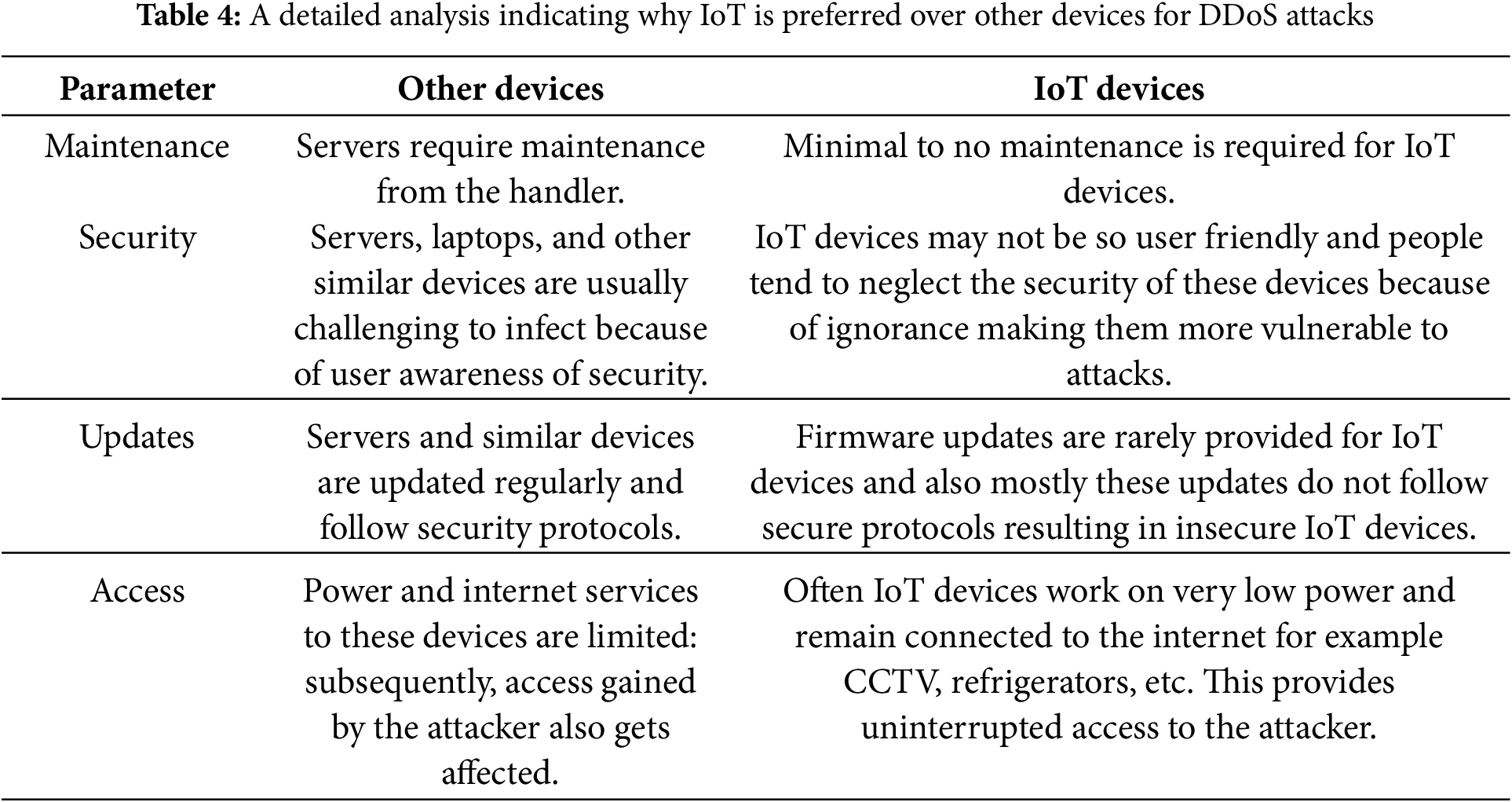
Conventional devices are usually secure as compared to IoT devices because of traditional security practices as indicated in Table 4. This specifies the reason behind the drastic increase in IoT attack surface.
When an attacker gains access to these devices, they may transform them into bots; this group of devices is known as a botnet [37].
These attacks allow attackers to intercept, modify, or impersonate messages between devices without detection. MitM attacks are particularly concerning in IoT environments due to the reliance on wireless communication protocols, which are inherently susceptible to eavesdropping and interception. Research indicates that various types of attacks, including MitM, replay, and impersonation attacks, are prevalent in IoT systems, especially in applications such as e-commerce, healthcare, and data transmission [38]. The use of software-enabled access points (SoftAP) has further increased the risk of MitM attacks, as attackers can easily position themselves between the IoT devices and their intended communication endpoints [39]. The MQTT protocol, commonly used in IoT communications, is also vulnerable to MitM attacks. Attackers often target central communication devices, such as brokers, to intercept messages. This vulnerability is compounded by the fact that many IoT devices utilize outdated or inconsistent encryption standards, which can facilitate downgrade attacks and further expose the system to MitM threats [40]. Many IoT devices utilize protocols that are not designed with robust security features, such as the Modbus Transmission Control Protocol, which is commonly used in smart grids and industrial IoT applications. These protocols can be vulnerable to various kinds of cyber attacks, including IP spoofing and ARP poisoning, which facilitate MITM attacks [41].
Token injection attacks on token transmission in IoT (Internet of Things) devices refer to security vulnerabilities where malicious actors insert unauthorized tokens or manipulate legitimate tokens during communication between IoT devices and their network. As highlighted by Xiao, the use of access tokens can lead to token compromise attacks, where attackers can steal tokens and impersonate devices to perform malicious operations [2]. This vulnerability is exacerbated by the resource-deprived nature of many IoT gadgets, which limits their ability to implement complex security measures. Furthermore, the study by Purnama emphasizes the importance of secure access control mechanisms, noting that encrypted token theft remains a critical concern in IoT environments [42]. As highlighted by Muzammil et al., these attacks can effectively sever the original communication line and establish a new one, enabling the attacker to overhear sensitive conversations, including the transmission of access tokens [43]. The critical nature of the attack stems from its ability to compromise the integrity and confidentiality of the transmission, potentially allowing the attacker to impersonate the legitimate user or device.
In the context of emerging technologies such as the Internet of Things (IoT), the risks associated with MitM attacks are pronounced. Fereidouni et al. point out that IoT systems are particularly vulnerable to such threats, where devices often use insecure protocols for token transmission. Their research confirms that weaknesses in IoT infrastructure can be exploited by MitM attacks, making these systems especially precarious [44].
Crossing request attacks on token transmission in IoT devices involve manipulating or exploiting concurrent requests to mislead or compromise the system’s handling of tokens. It is often related to Cross-Site Request Forgery (CSRF) or Cross-Site Scripting (XSS) in web applications but adapted for IoT contexts. In a crossing request attack, the attacker manipulates two or more concurrent token transmission processes. This could involve sending unauthorized requests alongside legitimate ones or exploiting how a system processes multiple requests simultaneously. The goal is to either inject a malicious token while a legitimate one is being processed or confuse the system into treating an unauthorized request as legitimate by leveraging a valid session or token or both. This type of attack can lead to unauthorized access and data breaches [45].
Eavesdropping attacks on token transmission in IoT devices involve interception between IoT devices and their network or backend servers to steal or monitor tokens being transmitted. These attacks take advantage of unencrypted or poorly secured communication channels to gain access to the tokens in transmission, which are often used for authentication, session management, or authorization. This can allow the attacker to gain unauthorized access to the system. The literature highlights that IoT devices, often operating with limited computational resources, are particularly susceptible to such attacks, as they may lack robust security protocols to protect against eavesdropping and other forms of intrusion [46]. The Mirai malware incident exemplifies the risks associated with eavesdropping in IoT environments, where compromised devices were used to launch distributed denial-of-service (DDoS) attacks, illustrating how attackers can exploit vulnerabilities in token transmission to gain unauthorized access to networks [46]. Furthermore, the physical accessibility of many IoT devices allows attackers to easily intercept communications, thereby facilitating eavesdropping attacks that can compromise the integrity and confidentiality of data being transmitted [47]. The research by Yang et al. emphasizes that when attackers infiltrate factory networks, they can manipulate data transmission, thereby compromising the entire operational environment [12].
Brute force attacks on token transmission in IoT devices involve attackers systematically attempting to guess or compute valid tokens used for authentication, session management, or access control. It involves systematically attempting all possible combinations of passwords or tokens until the correct one is found [48]. This type of attack targets weak token generation methods, such as predictable or short tokens, allowing attackers to flood the system with multiple token guesses in hopes of finding a valid one. IoT devices frequently utilize various communication protocols, including File Transfer Protocol (FTP), which may be improperly configured, thereby exposing them to brute-force attacks. Moreover, the reliance on SMS-based authentication for IoT devices has been criticized for its inherent vulnerabilities. Research indicates that such systems can be easily manipulated, allowing attackers to gain control over devices without needing to analyze firmware directly [1]. For instance, the integration of two-factor authentication schemes has been proposed as a viable solution to enhance security in IoT environments. These schemes can greatly reduce the risk of unauthorized intrusion by requiring additional verification steps beyond simple password entry.
The communication between IoT devices and their companion applications is often inadequately secured, which can facilitate token transmission attacks in IoT devices [1]. Many companion apps do not implement proper encryption or authentication measures, allowing attackers to intercept and manipulate data transmissions. Fig. 6 displays a clustered bar chart displaying the Privacy and Security Publication Statistics on IoT from IEEE, Springer, and Elsevier. Each document type (Books, Journals, Series, Web Pages) is represented by the number of publications related to both privacy and security concerns in IoT, categorized by publisher.

Figure 6: Privacy and security publication statistics on IoT from various sources
Key Observations:
Books have the highest publication count, especially under IEEE and Springer, with privacy concerns dominating.
Journals show moderate publications for privacy with smaller counts in security, mainly from Elsevier.
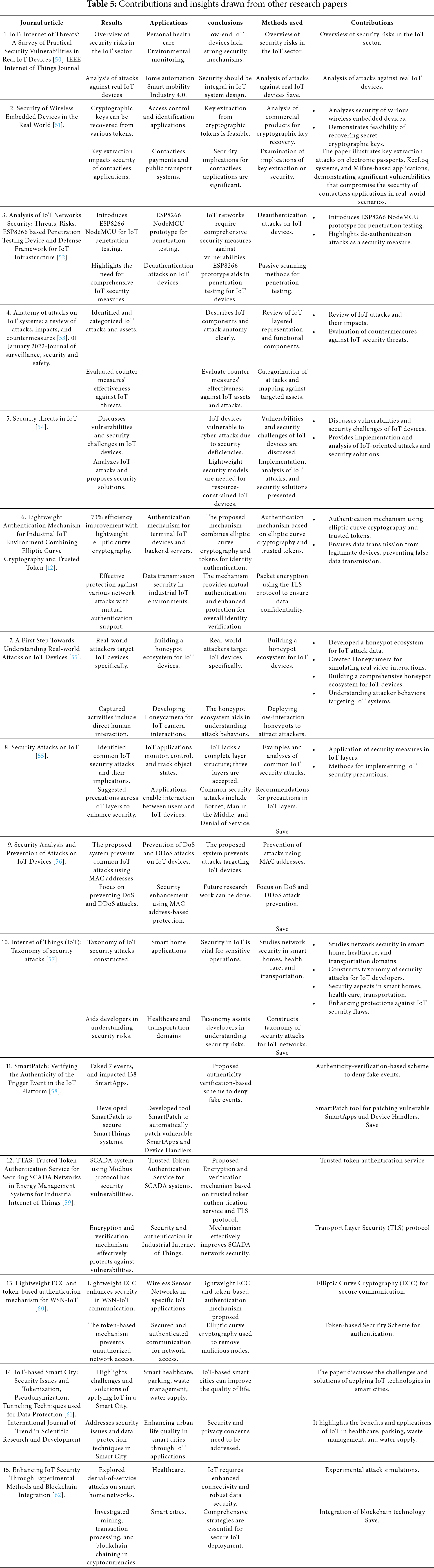
Web pages (for Elsevier) show a balanced interest in both privacy and security concerns [49]. In addition, Table 5 below illustrates a summary of other contributions and insights drawn from other research papers that have contributed to this survey.
In a side-channel attack, the attacker monitors physical or behavioral aspects of the IoT device or its communication environment while tokens are being generated, transmitted, or validated. These attacks often exploit vulnerabilities in hardware or software implementations of cryptographic processes, where devices unintentionally emit signals that reveal partial or full information about the token or cryptographic keys.
1. Timing Attacks: An attacker measures the time it takes for an IoT device to process a token or cryptographic operation. By carefully observing how long different operations take, they can deduce parts of the cryptographic key or token being transmitted.
2. Power Analysis Attacks: By measuring the power consumption of an IoT device while it processes tokens, an attacker can extract patterns that correspond to specific operations, helping to reconstruct cryptographic keys or other sensitive data.
3. Electromagnetic Emissions: Some IoT devices emit electromagnetic signals while performing computations, including token generation or validation. Attackers with the right equipment can capture these emissions and use them to infer the token or cryptographic operations.
4. Fault Injection Attacks: Attackers deliberately introduce small faults (such as voltage spikes, electromagnetic pulses, or laser pulses) into the IoT device to cause it to behave abnormally. This may cause the device to leak critical information about tokens or cryptographic processes.
One of the primary concerns regarding Side-Channel Attacks (SCAs) is their ability to compromise token-based authentication mechanisms. Myridakis et al. highlight that SCAs can be employed to analyze power dissipation patterns, which can reveal critical information about the cryptographic operations performed by IoT devices [63]. This risk is compounded in IoT environments where devices often communicate over insecure channels, making them susceptible to interception and manipulation. The vulnerabilities inherent in IoT devices, often due to their limited computational resources and simplistic designs, make them particularly susceptible to such attacks [63,64].
The mechanisms of side-channel attacks can be broadly categorized into two types: those targeting symmetric key algorithms and those targeting asymmetric key algorithms. In both cases, attackers analyze variations in power consumption or electromagnetic emissions while the device processes cryptographic operations. For instance, power analysis attacks can reveal the encryption keys by observing the power fluctuations during the encryption process [65]. This highlights the necessity for robust countermeasures, such as randomized voltage regulation systems that can obscure the power consumption patterns of IoT devices, thereby complicating the attacker’s ability to glean sensitive information [66].
A comparison table that outlines the similarities and differences among common token transmission attacks in IoT devices (Table 6):
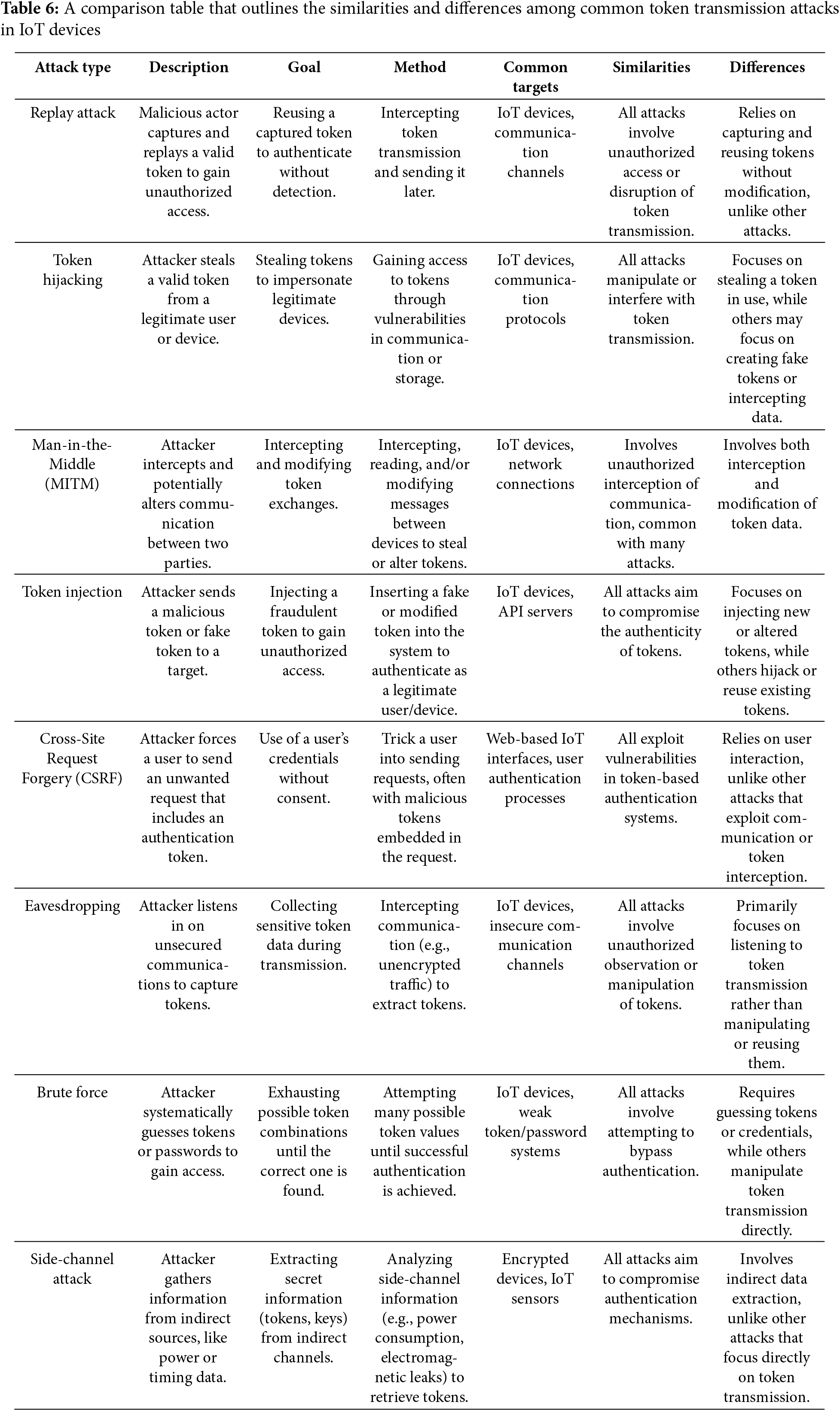
Token transmission attacks in IoT systems—such as replay attacks, token hijacking, man-in-the-middle (MITM) attacks, token injection, crossing requests, eavesdropping, brute force, and side-channel attacks—share a common goal: compromising the security of authentication and authorization mechanisms as depicted in Table 6. These attacks typically target the confidentiality, integrity, or validity of tokens transmitted between IoT devices and services. Most of them exploit weak or unencrypted communication channels, poor token management, or insufficient validation practices. They often result in unauthorized access, data leakage, or disruption of services. Despite these similarities, they differ in method and complexity. For instance, replay and token injection attacks are relatively simple and focus on reusing or manipulating valid tokens, whereas MITM and side-channel attacks are more sophisticated, involving interception or physical analysis. Some attacks, like brute force and token hijacking, operate over networks without requiring direct device access, while side-channel attacks often demand physical proximity to the device. Passive attacks like eavesdropping contrast with active ones like brute force or injection, highlighting the diverse nature of threats in IoT environments.
10 Other Security Challenges in IoT
One of the primary security challenges in IoT devices is the management of privacy and access control. As noted by Dodson et al., manufacturers must adhere to best practices in security throughout the lifecycle of their devices, which includes understanding the security and privacy risks associated with their products [67]. This is echoed by Gebresilassie et al., who highlight the inadequacies of existing identity management systems that rely on centralized authorities, which can lead to identity theft and other security breaches [68]. The dynamic nature of IoT environments complicates these challenges, as devices often operate in unstandardized and diverse ecosystems, making consistent security enforcement difficult [69]. Ahmed points out that various communication protocols used in IoT networks, such as Wi-Fi and Bluetooth, are susceptible to attacks. The vulnerability is further exacerbated by the lack of robust security features in many low-end IoT devices, as highlighted by the findings of the ASM project, which indicates that many commercial devices fail to provide even basic security services [70]. Many IoT devices are designed with minimal processing power and memory, which restricts their ability to implement robust security measures. This often leads to poor security practices, such as the use of default passwords and lack of firmware updates, making them susceptible to various attacks [71]. The rapid proliferation of IoT devices has exacerbated these vulnerabilities; for instance, it was reported that over 8.4 billion IoT devices were connected to the internet as of 2017, creating a vast attack surface for cybercriminals [72]. Further, the “functionality first, security second” mentality prevalent in IoT device development contributes to the introduction of insecure devices into networks, which has been linked to significant denial-of-service (DoS) attacks [72]. In addition to device-level vulnerabilities, the IoT ecosystem faces significant challenges related to data security and privacy. The interconnected nature of IoT devices means that a breach in one device can compromise the entire network, leading to unauthorized access to sensitive data and disruption of services [73]. The lack of standardized security protocols further complicates the situation, as different devices may employ varying levels of security, making it difficult to establish a cohesive security framework. Table 7 shows a summary of other common security attack types with their descriptions of IoT devices.
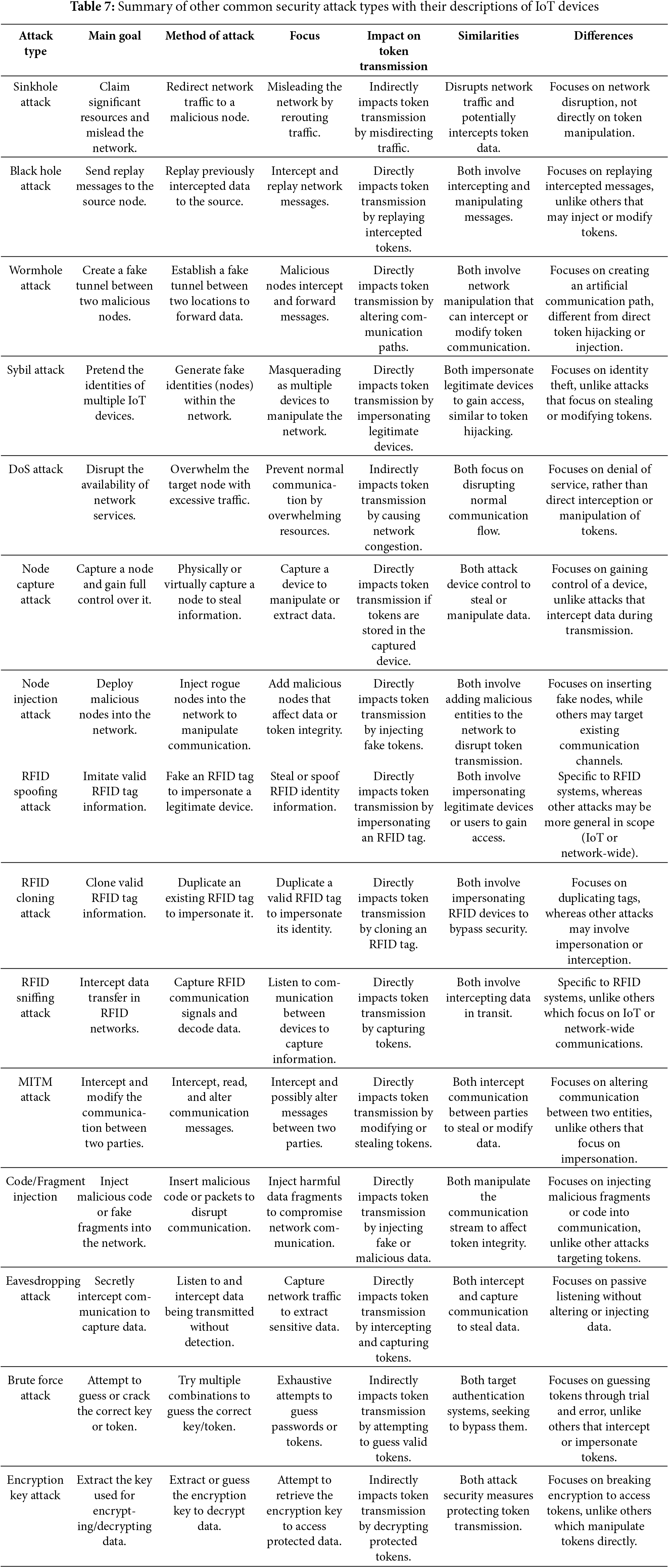
Relationship between other security challenges and token transmission attacks.
The attacks discussed share several commonalities, primarily their goal of gaining unauthorized access to data, credentials, or devices. Many exploit vulnerabilities in communication channels, aiming to intercept, redirect, or modify tokens or other sensitive information. Attacks like Sybil, RFID Spoofing, and Node Injection often focus on impersonating devices or users, while MITM, Eavesdropping, and Brute Force attacks target the token or authentication mechanisms themselves. These attacks can either disrupt network infrastructure (e.g., DoS, Sinkhole) or compromise the security measures protecting token transmission (e.g., Encryption Key Attacks). The direct impact on token transmission is seen in attacks like MITM and Eavesdropping, where tokens are intercepted or modified, while others such as DoS or Brute Force exert indirect influence by blocking legitimate communication or attempting to crack credentials. In summary, while these attacks may target different layers of the network or communication process, they all ultimately aim to undermine the security of token-based authentication systems in IoT networks. Wireless IoT technologies are crucial for enabling communication in the Internet of Things ecosystem, offering low-power, wide-area, and short-range connectivity options. These technologies include ZigBee, Bluetooth Low Energy (BLE), 6LoWPAN, and LoRaWAN, each designed for specific IoT applications like home automation, industrial monitoring, and smart cities. Despite their advantages, they are vulnerable to various security threats. Common attacks on these wireless protocols include Denial of Service (DoS), Man-in-the-Middle (MITM) attacks, eavesdropping, encryption key vulnerabilities, and code injection, among others as illustrated in Table 8.

11 Real-World Examples of Token Attacks in IoT
Real-world token attacks in IoT devices have emerged as a critical concern, where malicious actors exploit vulnerabilities to intercept, replicate, or manipulate tokens, gaining unauthorized access to sensitive data and control over connected devices. This subtopic explores prominent instances of token-related attacks in IoT environments, highlighting the methods employed by attackers and the consequences of such breaches.
One notable instance is the Carna botnet, discovered in 2012 and highlighted the widespread issue of default and weak passwords in IoT devices. This botnet scanned the internet and identified over 1.2 million devices that allowed logins with empty or default credentials, effectively demonstrating how attackers can exploit token-based authentication systems that lack robust security measures. The implications of such vulnerabilities are profound, as they enable attackers to gain unauthorized access to a vast array of IoT devices, leading to potential data theft and manipulation. In addition to these examples, the Denial-of-Sleep attack represents a specific type of token attack where adversaries exploit wake-up tokens used by energy-constrained IoT nodes. By continuously sending wake-up tokens, attackers can deplete the device’s battery, rendering it inoperative
In 2016, the Mirai botnet launched a huge Distributed Denial of Service (DDoS) attack against Dyn, a significant DNS provider, using compromised IoT devices. Twitter, Netflix, Reddit, and many other well-known websites were unavailable due to this attack.
By taking advantage of IoT devices’ weak default passwords, the Mirai software transformed them into a remotely controllable botnet. This attack demonstrated the flaws in IoT devices and the possibility of token-related attacks once attackers take control of them, even if its main goal was to interfere with services rather than steal tokens. The malware’s operational model involves scanning the internet for devices with default usernames and passwords, enabling easy compromise. Once compromised, these devices can be orchestrated to perform coordinated actions that contribute to massive DDoS attacks, such as the one launched against Dyn [74].
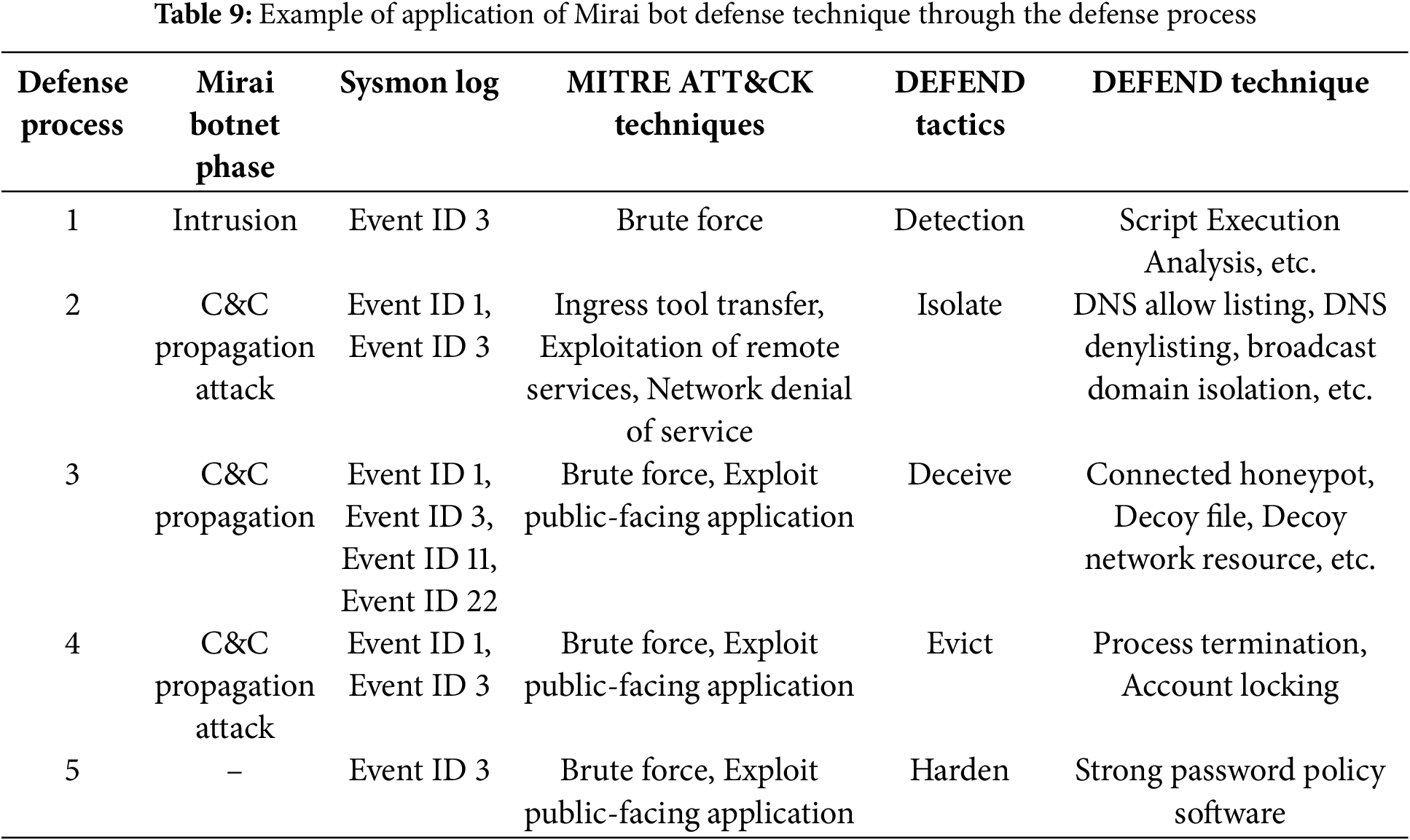
One may argue that the Mirai bot is the ancestor of the IoT bots that are currently in use. This is because the majority of bots are disseminated following the publication of the Mirai bot’s source code. The Mirai bot targets any Internet of Things device with an exposed Telnet port and a Linux operating system. The Mirai bot first used the Linux OS to infiltrate Internet of Things devices. But since then, it has broadened the scope of its operations to encompass other operating systems, indicating the possibility of extensive cyberattacks utilizing Internet of Things devices [75]. The first step uses D3FEND’s detection technique to check if a pre-mapped log is generated. If the log is generated, the second step in the protection process is to isolate the IoT device that generated it to a different network. Using the log collected during the observation, the third stage determines if the device has been infected by the Mirai bot. To eliminate the malware and lift the network isolate, continue to the fourth step if an infection has been verified. Lastly, fortify the account using the log found in the first step to eradicate the root cause of the malware problem. Response to a Mirai bot is made possible by this defense mechanism. In smart cities, security guards can identify tactics at specific times—and when to exchange defense strategies with other infrastructure. To counter the Mirai bot, the defense procedure is created with elements used at each stage, as shown in Table 9 below.
The following are the Mirai botnet formation phases:
1. Target Scan: Use ports 23 and 2323 to generate a random IP address and look for running Telnet services.
2. Intrusion: Using pre-set default credentials, launch a dictionary attack against the Telnet service.
3. C&C: Use information about IoT device architecture to download and execute more malware.
4. Propagation: The IoT devices scan the network for susceptible IoT devices and spread the malware appropriately after sending the infection status to the reporting server.
5. DDoS attack: Use the received attack option to launch a DDoS attack after receiving an attack command via C&C.
Network gateways and digital video recorders are among the IoT devices infected by the Mozi bot, a botnet that exploits networks like BitTorrent. Mozi repurposed the Gafgyt bot’s source code that had been previously distributed. A P2P botnet made up of nodes that traverse a Distributed Hash Table (DHT) is the Mozi bot. Because it passes through DHT disguised as regular traffic, it becomes challenging to track. Furthermore, there are two categories into which Mozi bot’s IoT device penetration technique can be separated. A dictionary attack is carried out if the remote port on Telnet is open, and if it is unsuccessful, it uses an IoT device’s weakness to gain access. Malicious activities like DDoS attacks and token data leaks will be carried out if the intrusion is successful [75].
The Mozi botnet’s formation phases are as follows:
1. Target Scan: Determine the attack target (an Internet of Things device) by using the Transmission Control Protocol (TCP) Synchronization (SYN) Reply.
2. Intrusion: Use HTTP command injection or launch a dictionary attack on the telnet port to get access to the IoT device.
3. Load: Makes a connection to a pre-designated server, after which malware is downloaded and run to carry out actual malicious operations.
4. C&C: After the P2P network has been registered, check it periodically to update the configuration file and the list of nearby nodes.
5. Propagation: Constant spread via intrusion detection and device scanning tools.
6. Attack: Get a command from an attacker and carry out an attack using that command.
The first step uses D3FEND’s detection technique to see if a pre-mapped log is generated. The defense process advances to the second step, when the IoT device that produced the log is isolated to a different network, depending on whether the log is generated. The third phase is reached if quarantine is implemented, and the resulting log is used to determine whether the Mozi bot is infected. Proceed to the fourth step to eliminate the virus and release the isolate of the IoT device if it is found that the Mozi bot has infected it. Lastly, fortify the account using the log found in the first step to eliminate the root source of the malware invasion. In contrast to a centralized framework, the Mozi bot’s P2P structure allows it to communicate with numerous devices and carry out malevolent tasks like DDoS attacks and radio waves. By completing an isolation step right after gathering logs, botnets that use this P2P framework can also be stopped from spreading. In smart cities, security guards can identify tactics at specific times—and when to exchange defense strategies with other infrastructure. Examples of logs used to counter the Mozi bot using the D3FEND defense tactics, MITRE ATT&CK attack techniques, and the developed defense procedure are displayed in Table 10 below.
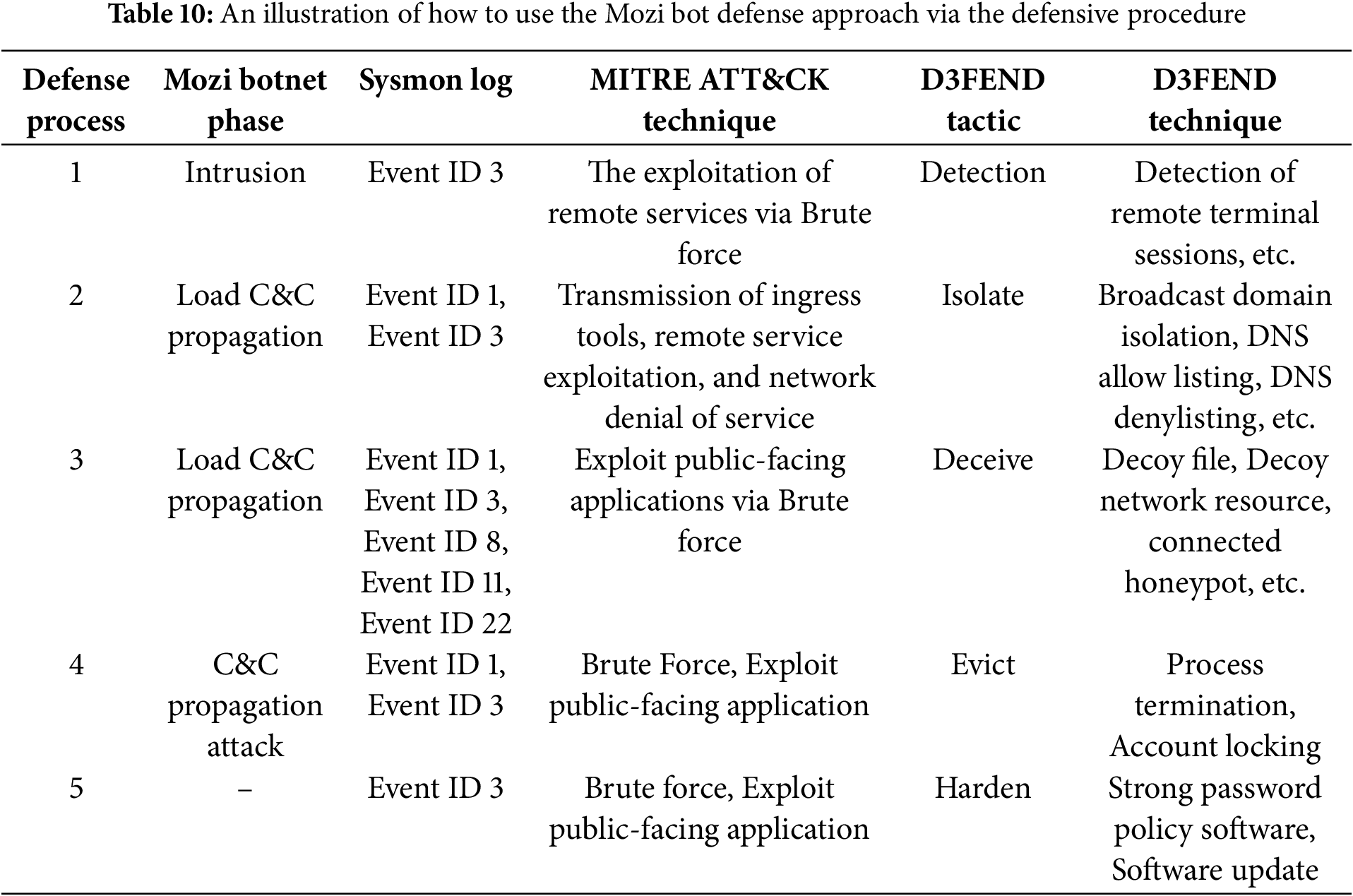
The attack on smart home devices serves as another illustration. In this instance, hackers gained illegal access to home networks by taking advantage of flaws in the token authentication procedure. The communication between a smart thermostat and its related mobile application was intercepted and manipulated by a hacker in one documented instance. Potential privacy violations and unapproved energy use could result from the attacker controlling the thermostat remotely by taking advantage of flaws in the token exchange procedure [2].
Moreover, in healthcare IoT applications, there have been instances where attackers targeted medical devices that utilized token-based authentication for access control. For example, vulnerabilities in the token management of insulin pumps allowed attackers to gain unauthorized access, potentially endangering patients’ lives by altering dosage settings remotely. Such attacks not only compromise patient safety but also raise significant ethical and legal concerns regarding the security of medical IoT devices [76].
There have also been reports of token transmission attacks in industrial IoT environments. To obtain sensitive operational data, for example, attackers can take advantage of flaws in industrial IoT devices’ authentication systems. Significant threats to operational integrity and safety may arise from data manipulation or illegal influence over vital systems. Yang et al.’s research demonstrates how attackers might influence data transmission in industrial settings by exploiting token vulnerabilities, which can have detrimental effects on operational effectiveness and security [12].
12 Trends in Token-Based Attacks Targeting IoT Devices (Emerging Threats)
One prominent trend is the increasing sophistication of attacks leveraging machine learning and artificial intelligence. Adversaries are now employing advanced techniques to target the machine learning algorithms used in IoT communications. For instance, adversaries can conduct poisoning attacks on federated learning-based intrusion detection systems, implanting backdoors that allow them to misclassify malicious traffic as [77]. This trend emphasizes how important it is to have strong security systems that can evolve with the threats.
Another significant trend is the exploitation of weak token management practices in IoT devices. Many devices utilize token-based authentication, which can be vulnerable to compromise due to hard-coded credentials or insufficient encryption. For example, the use of hardware fingerprints has been proposed as a means to enhance the security of token-based authentication, mitigating the risks associated with token theft [2]. However, the widespread adoption of insecure token practices continues to expose IoT devices to attacks, emphasizing the need for improved security protocols and practices.
Moreover, the rise of botnets specifically targeting IoT devices has become a critical concern. The Bot-IoT dataset illustrates how attackers exploit the vulnerabilities of interconnected devices to create large-scale botnets capable of executing DDoS attacks and other malicious activities. This tendency can jeopardize entire networks in addition to affecting individual devices, resulting in serious disruptions and data breaches. Blockchain technology, with its inherent decentralized and immutable characteristics, offers a promising solution to enhance the security of token authentication systems [78]. It operates as a decentralized ledger that records transactions across multiple nodes in a network. The tamper-resistant nature of blockchain ensures that once a token is recorded, it cannot be altered or deleted, significantly mitigating risks associated with unauthorized changes [79,80]. In integration with access control protocols, blockchain enables secure token issuance and verification processes that uphold the integrity of access tokens throughout their lifecycle [2,81]. To provide a more secure framework for IoT authentication, this strategy seeks to solve the flaws in conventional token management techniques.
Furthermore, the emergence of adversarial deep learning techniques poses new challenges for IoT security. Attackers can directly target the algorithms used for spectrum sensing in IoT communications, manipulating the outcomes of transmissions and potentially leading to unauthorized access. This trend underscores the necessity for IoT systems to incorporate robust defenses against adversarial attacks, ensuring integrity for both data and authentication processes. The increase of file-less attacks is another emerging threat in the IoT landscape. According to Raman and Varadharajan, these attacks do not rely on traditional malware but instead exploit existing vulnerabilities in IoT devices, making them harder to detect [82]. This trend indicates a shift in attack strategies, where adversaries leverage legitimate functionalities of devices to execute malicious actions without the need for external malware, complicating the detection and prevention of such attacks.
The vulnerability of federated learning-based IoT intrusion detection systems to poisoning attacks is another emerging threat. Nguyen et al. demonstrate how attackers can manipulate the training data used in these systems to implant backdoors, allowing them to misclassify malicious traffic as benign [77]. This highlights the risks associated with relying on machine learning models for security, particularly when the integrity of the training data can be compromised.
13 Mitigation Strategies on Token Transmission Attacks in IoT Devices
Adversarial attacks can lead to data breaches, unauthorized device control, and security compromises within IoT ecosystems. To address these risks, effective mitigation strategies are critical in ensuring secure token transmission. These strategies aim to safeguard the confidentiality, integrity, and availability of tokens, preventing malicious actors from exploiting vulnerabilities in IoT networks. This section will explore various mitigation techniques designed to enhance the security of token transmission, focusing on their effectiveness in IoT environments.
13.1 Strong Encryption Standards
The implementation of robust encryption mechanisms is essential to safeguard the integrity and confidentiality of tokens during transmission. One effective approach to enhance security is the use of hybrid signcryption schemes, which combine encryption and signature processes into a single operation. This method not only improves computational efficiency but also provides better security for data transmission in resource-constrained IoT environments. For instance, Wu et al. propose a certificateless hybrid signcryption mechanism that significantly reduces resource consumption while enhancing security, making it particularly suitable for IoT applications [83]. Similarly, the LiSP-XK signcryption method has been shown to be efficient and effective in resource-limited settings, achieving better performance compared to traditional methods [75].
In addition to encryption and hardware-based solutions, the implementation of comprehensive authentication frameworks is crucial. Al-Refai and Alawneh propose an enhanced authentication and authorization framework that incorporates identity verification and sender verification mechanisms to protect IoT protocols from various attack vectors [1]. When considering authentication, encryption, and device integrity all at once, this framework emphasizes the value of a comprehensive approach to security.
The integration of advanced cryptographic techniques, such as Elliptic Curve Cryptography (ECC), has been shown to advance authentication and encryption processes in IoT systems [12], highlight a lightweight authentication mechanism that combines ECC with trusted tokens, ensuring that only authenticated devices can communicate, thus mitigating the risk of token theft and impersonation. This is further supported by the work of Zhao and Ding [84], who propose a dual-server identity-based encryption scheme that allows for secure data transmission and authorized equality testing without exposing sensitive information.
13.2 Hash-Based Message Authentication Codes (HMAC) for Integrity
Hash-based message Authentication Codes (HMACs) serve as a critical mitigation strategy against token transmission attacks in Internet of Things (IoT) devices. The inherent vulnerabilities of token-based authentication systems, particularly in resource-constrained environments typical of IoT, necessitate robust security measures. HMACs provide a mechanism to ensure both the integrity and authenticity of messages transmitted between devices, thereby mitigating risks associated with token compromise. HMACs utilize a cryptographic hash function combined with a secret key to produce a unique message digest that can be appended to the original message. This process ensures that any alteration of the message during transmission can be detected, as the hash value will not match if the message is tampered with [85]. The National Institute of Standards and Technology (NIST) endorses the use of HMACs, particularly with hash functions from the SHA-2 family, to guarantee message integrity and authentication [86].
This endorsement provides a standardized approach to implementing HMACs across various IoT applications. In the context of IoT, where devices mostly communicate over insecure channels, the implementation of HMACs can significantly enhance security. NIST’s statistical test suite (NIST SP 800-22) is crucial for assessing the randomness of cryptographic systems, including the hash functions employed in HMACs. This suite serves as a measure to evaluate the security of generated hash values against potential vulnerabilities [87].
Further, NIST has recognized the SHA-2 family, particularly SHA-256 and SHA-512, as robust hash functions suitable for constructing HMACs. These functions exhibit properties such as collision resistance and pre-image resistance, which are essential for maintaining the integrity of data. The work of Lahraoui et al. underscores the necessity of evaluating hash functions through rigorous frameworks like NIST’s statistical tests to ensure their resistance against various attack vectors [88].
By leveraging the efficiency and speed of hash functions, HMAC provides a mechanism that allows devices to authenticate data with minimal computational overhead, which is crucial for battery-operated IoT devices (Mansour et al., 2024). The underlying robustness of HMAC demonstrates high level security when paired with secure hash functions, particularly SHA-256, making it suitable for applications requiring stringent confidentiality and integrity measures [89].
This is particularly relevant in scenarios where devices must operate continuously and securely, such as in smart home systems or industrial IoT applications. The implementation of such methods is critical in addressing the vulnerabilities associated with traditional token-based authentication, which can be susceptible to replay and impersonation attacks.
13.3 Lightweight Security Protocols for IoT
In the context of mitigating token transmission attacks in Internet of Things (IoT) devices, lightweight security protocols play a crucial role. These protocols are designed to operate efficiently within the constraints of IoT devices, which often have insufficient computational power and memory. Token transmission attacks, which can involve interception or unauthorized access to communication tokens, necessitate robust yet lightweight security measures to ensure the integrity and confidentiality of data.
Mutual authentication frameworks tailored for RFID devices are vital for instance, the research by Alhasan et al. proposes an ultra-lightweight mutual authentication protocol to prevent replay attacks in low-cost RFID tags. Their protocol employs secret key rotation, T-functions, and timestamps to ensure that authentication remains robust against various attack vectors [90]. The performance of such protocols demonstrates the feasibility of maintaining security while operating within the resource constraints typical of IoT devices.
Similarly, Fathy and Ali introduce a lightweight cryptographic framework that encompasses encryption, authentication, and key management, specifically tailored for IoT applications. Their comparative analysis with IPsec highlights the efficiency and security advantages of their proposed protocols, making them suitable for resource-constrained environments [91]. The use of Physical Unclonable Functions (PUFs) has emerged as a promising solution for lightweight security in constrained IoT devices. Idriss et al. discuss a PUF-based authentication protocol that leverages challenge-response mechanisms to enhance security. However, they also note that many existing PUF solutions lack essential features such as mutual authentication and message encryption, which are critical in defending against various attack vectors [92]. This highlights the need for continuous improvement and adaptation of lightweight protocols to address emerging threats effectively. The integration of lightweight digital signatures has also been explored as a means to secure communication in wireless sensor networks.
13.4 Multi-Factor Authentication (MFA) and Contextual Authentication
Multi-Factor Authentication (MFA) and contextual authentication are increasingly recognized as effective mitigation strategies against token transmission attacks in IoT devices. Token transmission attacks exploit vulnerabilities in the authentication process, particularly in systems relying solely on single-factor authentication methods. IoT device security can be significantly increased by using MFA, which asks users to give several forms of verification. By requiring the usage of at least two distinct authentication factors—which could be something the user knows (like a password), something they own (like a smart card or mobile device), or something they are (like biometric data)—MFA contributes to improving security [13,93]. This layered approach makes it considerably more difficult for attackers to gain unauthorized access, as they would need to compromise multiple factors simultaneously. For instance, the use of One-Time Passwords (OTPs) in conjunction with traditional passwords has been shown to bolster security in cloud computing environments, which is analogous to IoT applications [94]. Contextual authentication adds another layer of security by analyzing various contextual factors such as user location, device type, and historical access patterns to assess the risk associated with a login attempt [95]. This approach allows for dynamic adjustments in authentication requirements based on the perceived risk level. For instance, if the user attempts to access a system from an unusual location or device, the system can trigger additional authentication steps, thereby mitigating the risk of token theft or misuse [95]. The combination of MFA and contextual authentication not only enhances security but also improves usability by reducing friction in low-risk scenarios while maintaining robust defenses in high-risk situations.
13.5 CoAP (Constrained Application Protocol) with DTLS
Constrained Application Protocol (CoAP) is a thin application layer protocol created especially for Internet of Things (IoT) devices with limited resources. It is appropriate for applications including industrial automation, smart home devices, and environmental monitoring because of its architecture, which is tuned for low-power and low-bandwidth networks [96].
The integrity and confidentiality of sensitive data transferred between devices may be jeopardized by token transmission attacks, which raise serious concerns about the security of CoAP connections. It is often advised to combine Datagram Transport Layer Security (DTLS) with CoAP in order to reduce token transfer threats. This protocol employs encryption methods that safeguard the data transmitted between devices, reducing the risk of unauthorized access and eavesdropping, thereby ensuring the confidentiality of sensitive information exchanged within IoT networks [97,98].
The lightweight nature of DTLS makes it a fitting choice for CoAP, as it can operate effectively within the constraints of low-power devices while still providing robust security measures. Moreover, the combination of CoAP and DTLS allows for secure data transmission while maintaining the efficiency required by resource-constrained environments. Recent advancements have led to the development of energy-efficient variants of DTLS, such as the Energy-Efficient DTLS (eeDTLS), which optimizes the handshake process and reduces message overhead. This is particularly beneficial for IoT devices that rely on battery power, as it minimizes energy consumption during secure communications.
Additionally, the Lithe protocol, which combines CoAP with DTLS features, exemplifies how lightweight security can be achieved without sacrificing performance. Research indicates that conventional security mechanisms often fail under resource constraints, making protocols like Lithe crucial for IoT applications [99]. For instance, lightweight cryptographic techniques integrated into Lithe ensure that even devices with limited computational power can perform secure exchanges without succumbing to vulnerabilities associated with heavyweight security protocols [100]. The successful application of Lithe achieves a crucial balance: it satisfies the need for robust security against threats, such as man-in-the-middle attacks and eavesdropping, while simultaneously respecting the operational limitations of the underlying hardware [101].
This approach not only enhances security against token transmission attacks but also improves overall system efficiency. Furthermore, the implementation of intrusion detection systems (IDS) can complement the security measures provided by DTLS. By monitoring network traffic for unusual patterns indicative of token transmission attacks, these systems can provide an additional layer of protection. The integration of machine learning techniques into IDS can further enhance their effectiveness by enabling them to adapt to evolving attack vectors [96]. This multifaceted approach not only addresses the immediate security concerns but also aligns with the operational constraints typical of IoT environments.
Many researchers have explored mechanisms such as attribute-based encryption and blockchain technology to enhance the security and management of tokens. One promising approach is the use of ciphertext policy attribute-based encryption (CP-ABE), which allows for fine-grained access control by encrypting tokens based on user attributes [42]. This method not only secures the tokens but also facilitates streamlined management through one-to-many encryption, enabling a single token to grant access to multiple subjects. Such an approach mitigates the need for issuing separate tokens for each user, thus simplifying token management. Furthermore, the integration of blockchain technology into token management has been shown to enhance security by implementing token operations as blockchain transactions, which can provide an immutable record of token usage and enhance accountability [102]. In addition to encryption and blockchain, the incorporation of hardware fingerprints into the authentication process has emerged as a viable strategy to bolster token security. By binding tokens to unique hardware identifiers, the risk of token compromise can be significantly reduced, as attackers would need to replicate the hardware fingerprint to successfully impersonate a device [2]. This method complements traditional token management by adding an additional layer of security that is particularly beneficial for resource-constrained IoT devices. Moreover, frameworks that combine enhanced token authentication with identity verification mechanisms have been proposed to further protect against various attacks, including man-in-the-middle and replay attacks [1]. Such frameworks often utilize timestamps and sender verification methods to ensure that tokens are only valid for a limited time and are issued by authenticated devices. This dynamic approach to token management not only improves security but also addresses the challenges posed by the static nature of traditional token systems.
13.7 Token Expiration and Revocation Strategies
Token expiration serves as a proactive measure to limit the window of opportunity for attackers who may compromise tokens. By implementing short-lived tokens, the potential damage from a stolen token is minimized, as the token becomes invalid after a specified period.
Zhang et al. propose a cryptographic accumulator technique for managing the issuance and revocation of verifiable credentials, which ensures user privacy during the revocation process [103]. This approach allows institutions to maintain secure records of credential status without compromising user anonymity. Utilizing similar mechanisms in broader token management strategies can facilitate effective revocation while upholding privacy rights and considering the energy constraints of IoT devices. This approach not only addresses security concerns but also optimizes the energy consumption of IoT devices, which is crucial for their operational longevity. Revocation strategies are equally important, particularly in scenarios where a token is compromised or when a user’s access rights change. The challenge of effectively propagating credential revocation in shared IoT ecosystems has been highlighted by Janes et al., who found that many devices fail to revoke access properly, allowing unauthorized access even after credential changes [104]. This underscores the necessity for robust revocation mechanisms that can promptly and effectively update access controls across devices. Techniques such as verifier-local revocation (VLR) have been proposed, which allow for efficient member revocation in group signature schemes, although they may rely on weaker security notions [105]. Moreover, blockchain technology offers promising solutions for token management, including revocation. For example, the BlendCAC framework utilizes smart contracts to manage token registration, propagation, and revocation, thus decentralizing control and enhancing security. More robust access control systems in IoT contexts are made possible by this decentralized method, which also reduces the dangers connected with a single point of failure.
13.8 Token Binding to Prevent Reuse and Hijacking
Token binding enhances security by associating a token with a specific session or request, thereby preventing its reuse and reducing the risk of hijacking. Gupta and Narayan proposed a key-based mutual authentication framework that binds tokens to specific point-of-sale (POS) machines, thereby preventing unauthorized access and token reuse during mobile transactions [106]. This concept can be extended to IoT devices, where binding tokens to specific devices or sessions ensures that even if a token is intercepted, it cannot be reused by an attacker on a different device. Moreover, continuous authentication protocols can further strengthen token-binding strategies. Badhib et al. highlight the necessity of continuous authentication to prevent session hijacking, which is particularly relevant in IoT scenarios where devices may operate in untrusted environments [107]. By continuously verifying the legitimacy of devices during a session, the risk of token misuse is significantly reduced.
Mondal et al. highlight how lightweight cryptographic algorithms, such as elliptic curve cryptography (ECC), can be utilized alongside dynamic key generation to provide a robust security framework suitable for the unique constraints of IoT devices [108]. In addition, the integration of time-sensitive protocols can further benefit from utilizing hybrid cryptographic approaches as seen in the work of Munshi and Alshawi, a three-phase authentication protocol that combines ECC with Advanced Encryption Standard (AES). Here, dynamic key generation is coupled with an optimization strategy, allowing the system to effectively manage key lifecycles while ensuring secure token exchanges [109]. This combination strikes a balance between security and efficiency, particularly in resource-limited scenarios typical of IoT applications.
13.9 Network-Level Security Approaches
Network-level security approaches are critical for mitigating token transmission attacks in Internet of Things (IoT) devices. By implementing robust network security strategies, companies can improve the resilience of their IoT environment against such threats. One effective strategy is the deployment of Intrusion Detection Systems (IDS). Ferrag et al. emphasize the necessity of purpose-built cybersecurity solutions, such as IDS, which can monitor network traffic for malicious behavior and provide real-time alerts [110]. These systems can detect anomalies in token transmission patterns, enabling prompt responses to potential attacks. Moreover, IDS can be integrated with machine learning algorithms to improve detection accuracy and adapt to evolving threats, as highlighted by Vutukuru, who discusses the application of advanced machine learning techniques for IoT security [111].
Network segmentation can also be used to separate IoT devices from other network segments. By keeping a token transmission attack inside a designated section, this tactic reduces its possible impact. The attack surface can be decreased by companies limiting communication between IoT devices and external networks through the use of firewalls and access controls. Employing intrusion detection systems (IDS), encryption protocols, network segmentation, secure authentication frameworks, and ongoing monitoring can help enterprises improve the security of their IoT ecosystems and guard against unwanted access and control. The work of Lahraoui et al. underscores the necessity of evaluating hash functions through rigorous frameworks like NIST’s statistical tests to ensure their resistance against various attack vectors [88]. Their study emphasizes that employing strong hash functions within HMAC can lead to enhanced security for message transmission.
13.10 Incorporate the Use of More Secure Communication Protocols (e.g., TLS, HTTPS)
To prevent token transmission attacks in Internet of Things (IoT) devices, it is essential to employ secure communication protocols. Enforcing strong communication protocols can prevent such problems and greatly improve token transmission security. IPsec, which offers a framework for protecting Internet Protocol (IP) communications via encryption and authentication, is one practical method.
While traditional IPsec utilizes the Internet Key Exchange (IKE) for establishing security associations, Othmen et al. advocate for enhanced key management approaches that improve security in low-power, lossy network environments [112]. Their work emphasizes the necessity of optimized routing protocols that prioritize secure data transmission while integrating with IPsec’s framework. Additionally, configurations employing group key management can streamline the secure transmission of tokens between multiple devices, minimizing delays and maintaining efficiency [112]. Combinations of IPsec with application-layer security protocols can provide comprehensive protection, especially for sensitive token transmission scenarios within IoT settings [98]. This layered approach aids in defending against a broader array of threats, including eavesdropping and man-in-the-middle attacks.
Tokens sent between devices are shielded from interception and manipulation thanks to DTLS, which in particular offers a secure channel for datagram-based applications. Attacks involving tokens can be considerably decreased by putting these protocols into place. IoT applications frequently use the Message Queuing Telemetry Transport (MQTT) protocol because of its portability. Due to the necessity for attackers to get around several security mechanisms, this can greatly lower the chance that token transmission attacks would be successful. To prevent token transmission attacks in Internet of Things devices, it is essential to adopt appropriate secure communication protocols. Lightweight authentication techniques, MFA, and protocols like IPsec, DTLS, and TLS can all greatly improve the security of token transfer. These tactics can be used to improve the security of IoT systems against unwanted access and guarantee the integrity of communications. Secure communication will become increasingly important as the IoT environment develops to protect user data and preserve the integrity of IoT devices.
13.11 AI-Powered Strategies for Countering Cyberattacks
Scientists have recently proposed several ways that use AI techniques to identify domains generated by domain generation algorithms (DGAs), detect or classify malware, and detect network intrusions, phishing, and spam attacks on IoT devices. The literature is divided into four major categories in this section: malware identification, network intrusion detection, phishing and SPAM identification, and others, which include recognizing DGAs and thwarting APT.
Fig. 7 illustrates crucial areas in AI can be used in anomaly detection to prevent attacks [113].

Figure 7: Areas AI can be used in anomaly detection to prevent attacks
13.12 Applying Appropriate Cybersecurity Framework
The use and selection of an appropriate cybersecurity framework is critical for mitigating risks associated with token-based authentication, which is prevalent in IoT environments. Table 11 highlights critical cybersecurity frameworks and standards and their applications across various industries. Each framework serves a specific purpose in protecting digital assets, ensuring regulatory compliance, and mitigating cyber risks. These frameworks are tailored to address the unique challenges of specific sectors while maintaining flexibility for broader organizational adoption.
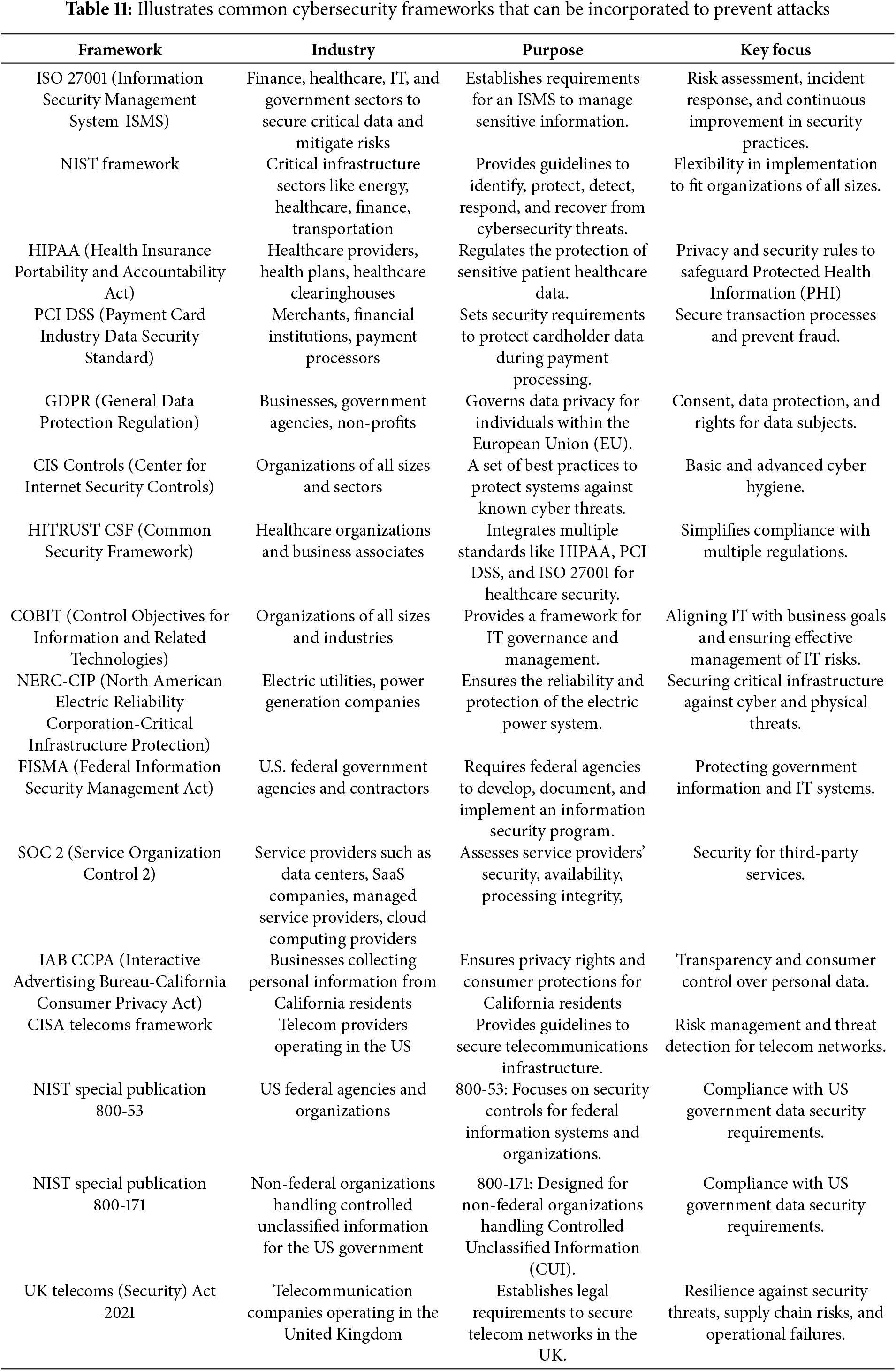
13.13 Context-Aware Authentication in Dynamic IoT Environments
Context-aware authentication in dynamic IoT environments is a promising approach to mitigate token transmission attacks, which are prevalent due to the vulnerabilities inherent in token-based authentication mechanisms. Context-aware authentication uses contextual data, including user behavior, device attributes, and ambient conditions, to improve security and lower the possibility of unwanted access. This framework addresses the limitations of traditional authentication techniques by continuously validating user identities based on their context, thereby reducing the likelihood of token theft or misuse. The continuous nature of this authentication process ensures that even if a token is compromised, the system can detect anomalies in user behavior and respond accordingly. In addition, Fard et al. discuss the application of machine learning for dynamic authentication, emphasizing how contextual data, such as surrounding MAC addresses, can be utilized to establish a secure authentication process for IoT devices [114]. This method not only ensures better security but also allows for a more adaptive response to potential threats, making it more difficult for attackers to exploit token vulnerabilities. By understanding the mobility patterns and contextual factors affecting device interactions, systems can implement more robust authentication measures that adapt to changing conditions, thereby mitigating risks associated with token transmission attacks. Sylla et al. propose a blockchain-based context-aware authorization management system, which extends traditional authentication frameworks by incorporating context-awareness capabilities [17]. This decentralized approach improves security by ensuring that authentication tokens are contextualized, making it harder for attackers to exploit static tokens that may be intercepted during transmission. This capability can be leveraged to enhance authentication processes, ensuring that only trusted devices are allowed to communicate, thus reducing the risk of token-related attacks. Context-aware authentication strategies offer a robust framework for mitigating token transmission attacks in IoT devices. By leveraging contextual information, continuous monitoring, and adaptive responses, these strategies can significantly improve the security of IoT environments.
A summary of mitigation strategies on token transmission attacks in IoT devices is shown in Table 12:
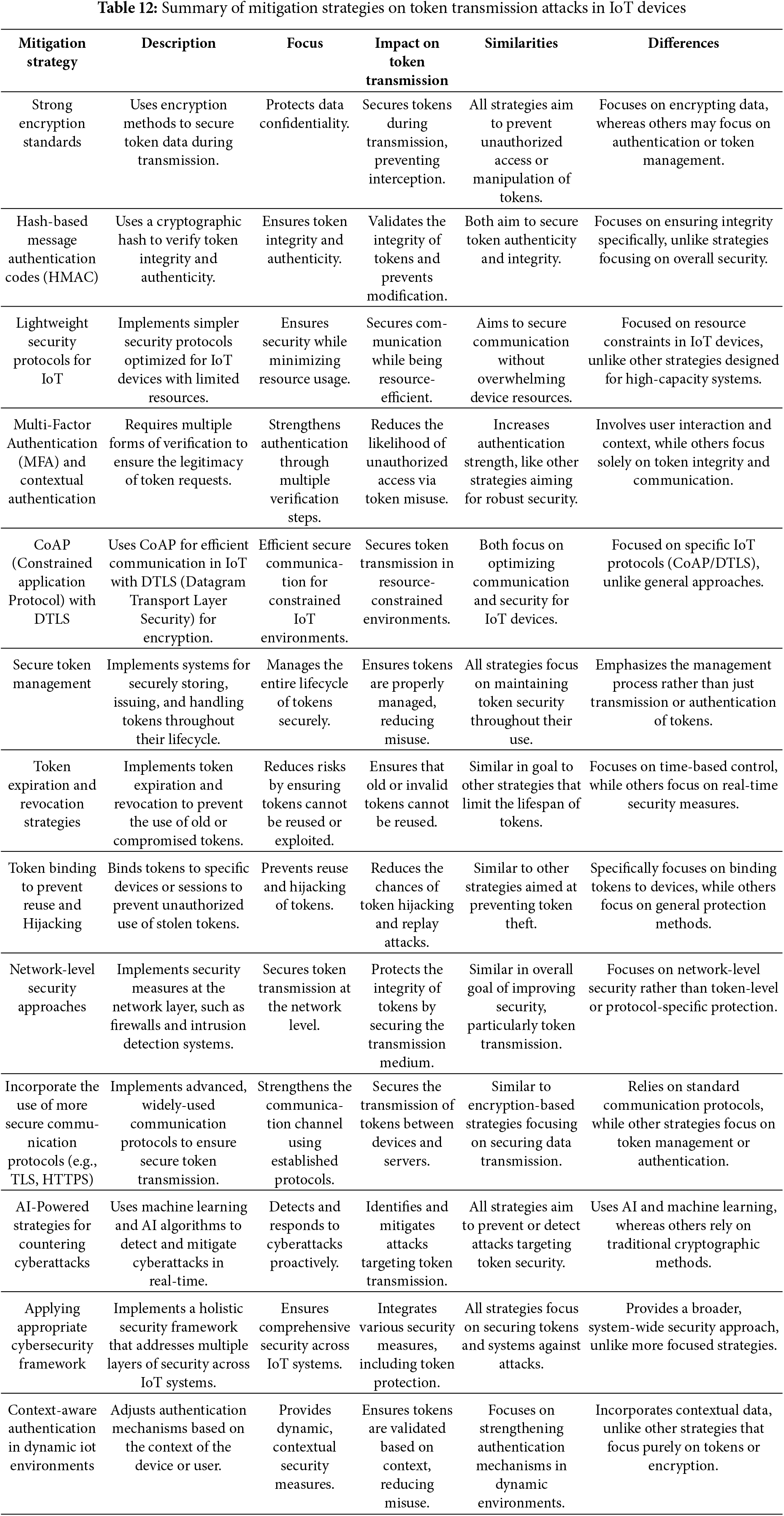
As the deployment of IoT devices expands across sectors such as healthcare, manufacturing, and smart homes, the risk of exploitation through token-based authentication vulnerabilities continues to rise. These vulnerabilities can lead to significant data breaches, unauthorized control over IoT networks, and exploitation of weaknesses in token management protocols. Therefore, addressing token transmission security is crucial for safeguarding IoT systems.
Several recommendations have been proposed to mitigate these risks. First, enhanced encryption mechanisms specifically designed for the resource limitations of IoT devices are essential. Lightweight encryption algorithms, such as Elliptic Curve Cryptography (ECC) and optimized Advanced Encryption Standards (AES), can effectively protect token transmission from eavesdropping and tampering. Additionally, ensuring regular firmware updates to address vulnerabilities, particularly in token management protocols, is critical for maintaining security [12].
The use of machine learning for anomaly detection based on baseline device behaviors can also be highly effective. Machine learning systems can analyze traffic patterns to detect and respond to abnormal activities in real time, enhancing the overall security posture. Moreover, the integration of Artificial Intelligence (AI) for predictive analytics can significantly improve the detection and response capabilities for token transmission attacks. AI-driven systems learn from past incidents and adapt to new threats, providing more resilient defenses for IoT networks.
Adherence to established cybersecurity guidelines, such as those from NISTIR 8228, which emphasizes cybersecurity and privacy management throughout the device lifecycle, will strengthen token security. IoT device manufacturers should collaborate to establish common security standards, creating protocols that ensure secure communication between heterogeneous devices while safeguarding user privacy [67].
14.1 Future Directions for Improving Token Security in IoT
To further enhance token security in IoT devices and systems, several future research directions should be explored. These can be grouped into three key aspects: Emerging Technologies, Quantum Computing, and User Education and Awareness.
14.1.1 Emerging Technologies for Enhanced Security
With the continuous evolution of IoT, emerging technologies offer promising solutions for improving token security. Technologies such as Fog Computing, Edge Computing, and Blockchain have great potential. Fog and Edge Computing can support decentralized security models, which are critical for reducing the risks associated with centralized token management systems. These technologies enable token-based communication to take place closer to the devices, enhancing response times and reducing the attack surface. In addition, challenges such as trust management and fault resilience must also be addressed [115].
Blockchain technology, with its decentralized structure, can also play a pivotal role in improving token security by eliminating the reliance on vulnerable centralized servers. Blockchain-based solutions could offer enhanced authentication, access control, and trust mechanisms, though concerns related to computation complexity and privacy must be resolved. Similarly, lightweight cryptographic methods tailored to the specific needs of IoT devices will be essential, especially for managing keys in constrained environments.
14.1.2 Quantum Computing and Post-Quantum Security
The advent of Quantum Computing presents a new frontier in cryptography, which will undoubtedly impact the future security of IoT systems. As quantum computers become more powerful, traditional cryptographic techniques may become vulnerable to attacks, especially in terms of encryption key-breaking. In this context, quantum-resistant encryption algorithms are needed to future-proof IoT systems against the cryptographic threats posed by quantum computing. Research into Quantum Key Distribution (QKD) and quantum signatures offers promising solutions for ensuring secure data transmission in the post-quantum era. These quantum-based techniques could revolutionize how tokens are secured, providing new, robust methods for safeguarding communication against eavesdropping and tampering [116]. In addition to quantum computing, emerging technologies are revolutionizing various industries, but they also introduce new security challenges. Fog Computing and Edge Computing enhance data processing by bringing it closer to the source, reducing latency and minimizing risks associated with transmitting sensitive data. SDN offers flexible, dynamic control over network traffic, enabling rapid response to security threats. To secure resource-constrained IoT devices, Lightweight Cryptography provides efficient encryption solutions. Homomorphic Encryption (HE) and Secure Enclaves (SE) ensure that sensitive data remains protected even during processing, providing enhanced privacy and security. Machine Learning plays a crucial role in identifying anomalies and potential threats in real time, bolstering proactive security measures. As shown in Table 12, these emerging solutions are vital for strengthening security in increasingly complex and interconnected systems.
A summary table showing security purposes and challenges of the studied emerging technologies is shown in Table 13.
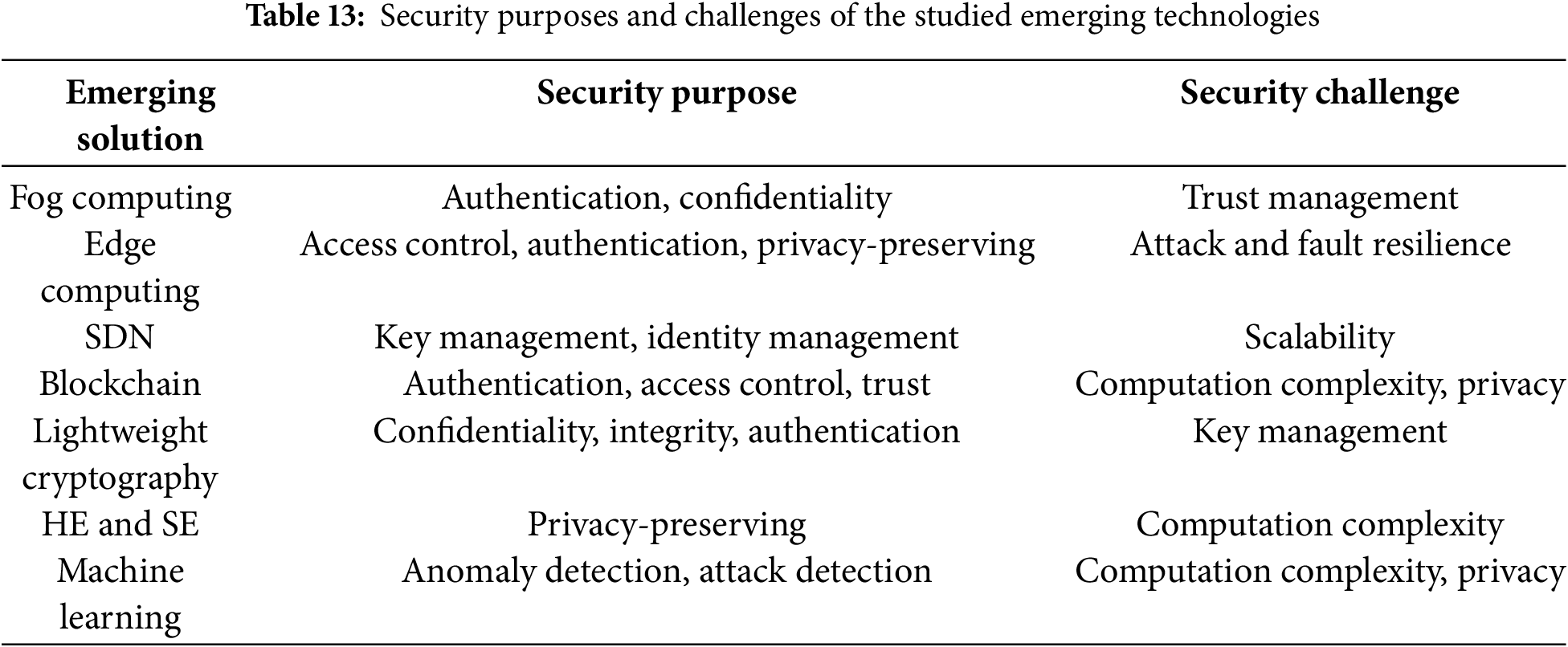
14.1.3 User Education and Awareness
One of the often-overlooked aspects of securing IoT devices is User Education and Awareness. Many IoT vulnerabilities stem from user behaviors, such as the failure to change default passwords or enable multi-factor authentication (MFA). Manufacturers must take a proactive role in educating users about the potential security risks and the best practices for securing their IoT devices. Clear guidelines should be provided for users, especially in areas such as token management, password configuration, and enabling advanced security measures like MFA. By raising awareness, users will be better equipped to secure their devices, reducing the overall attack surface for token-related vulnerabilities [117].
14.2 Conclusion and Collaboration for Future Security
Looking forward, addressing token transmission threats in IoT devices requires collaboration among cybersecurity experts, regulatory authorities, and IoT manufacturers. By exploring these future directions—leveraging emerging technologies, preparing for the quantum computing era, and prioritizing user education—we can significantly enhance the security of IoT networks and mitigate the risks associated with token-based authentication vulnerabilities. A comprehensive approach, incorporating technological advancements and best practices, is essential to ensuring the resilience and security of future IoT systems.
Acknowledgement: We sincerely thank all the individuals and the institution whose support and contributions have made this work possible.
Funding Statement: The authors received no specific funding for this study.
Author Contributions: Research work was conducted by Michael Juma Ayuma, reviewed, supervised and validated by Shem Mbandu Angolo and Philemon Nthenge Kasyoka. All authors reviewed the results and approved the final version of the manuscript.
Availability of Data and Materials: The data used in this study is publicly available on papers published in the relevant journals as recorded in this manuscript.
Ethics Approval: Not applicable.
Conflicts of Interest: The authors declare no conflicts of interest to report regarding the present study.
References
1. Mohammad A, Al-Refai H, Alawneh AA. User authentication and authorization framework in IoT protocols. Comput Sci Forthcoming. 2022. doi:10.20944/preprints202208.0188.v1. [Google Scholar] [CrossRef]
2. Xiao Y, He Y, Zhang X, Wang Q, Xie R, Sun K, et al. From hardware fingerprint to access token: enhancing the authentication on IoT devices. In: Proceedings of the 2024 Network and Distributed System Security Symposium; 2024 Feb 26–Mar 1; San Diego, CA, USA. doi:10.14722/ndss.2024.241231. [Google Scholar] [CrossRef]
3. Rawal D, Murugan R. Emerging threats and defensive strategies on the Internet of Things. Int Res J Mod Eng Technol Sci. 2024;6(5):2244–50. doi:10.56726/irjmets56144. [Google Scholar] [CrossRef]
4. Sharma R, ud din Mohi S, Sharma N, Kumar A. Enhancing IoT botnet detection through machine learning-based feature selection and ensemble models. ICST Trans Scalable Inf Syst. 2023;11(2):1–6. doi:10.4108/eetsis.3971. [Google Scholar] [CrossRef]
5. Lin IC, Tseng PC, Chen PH, Chiou SJ. Enhancing data preservation and security in industrial control systems through integrated IOTA implementation. Processes. 2024;12(5):921. doi:10.3390/pr12050921. [Google Scholar] [CrossRef]
6. Zhang Y, Luo Y, Chen X, Tong F, Xu Y, Tao J, et al. A lightweight authentication scheme based on consortium blockchain for cross-domain IoT. Secur Commun Netw. 2022;2022(6):9686049. doi:10.1155/2022/9686049. [Google Scholar] [CrossRef]
7. Sivaselvan N, Bhat KV, Rajarajan M, Das AK, Rodrigues JJPC. SUACC-IoT: secure unified authentication and access control system based on capability for IoT. Clust Comput. 2023;26(4):2409–28. doi:10.1007/s10586-022-03733-w. [Google Scholar] [CrossRef]
8. Arcenegui J, Arjona R, Román R, Baturone I. Secure combination of IoT and blockchain by physically binding IoT devices to smart non-fungible tokens using PUFs. Sensors. 2021;21(9):3119. doi:10.3390/s21093119. [Google Scholar] [PubMed] [CrossRef]
9. Obaidat MA, Obeidat S, Holst J, Al Hayajneh A, Brown J. A comprehensive and systematic survey on the Internet of Things: security and privacy challenges, security frameworks, enabling technologies, threats, vulnerabilities and countermeasures. Computers. 2020;9(2):44. doi:10.3390/computers9020044. [Google Scholar] [CrossRef]
10. Deepak, Gulia P, Gill NS, Yahya M, Gupta P, Shukla PK. Exploring the potential of blockchain technology in an IoT-enabled environment: a review. IEEE Access. 2024;12(37):31197–227. doi:10.1109/access.2024.3366656. [Google Scholar] [CrossRef]
11. Alhamarneh RA, Mahinderjit Singh M. Strengthening Internet of Things security: surveying physical unclonable functions for authentication, communication protocols, challenges, and applications. Appl Sci. 2024;14(5):1700. doi:10.3390/app14051700. [Google Scholar] [CrossRef]
12. Yang YS, Lee SH, Wang JM, Yang CS, Huang YM, Hou TW. Lightweight authentication mechanism for industrial IoT environment combining elliptic curve cryptography and trusted token. Sensors. 2023;23(10):4970. doi:10.3390/s23104970. [Google Scholar] [PubMed] [CrossRef]
13. Diaz Rivera JJ, Akbar W, Ahmed Khan T, Muhammad A, Song WC. Secure enrollment token delivery mechanism for zero trust networks using blockchain. IEICE Trans Commun. 2023;106(12):1293–301. doi:10.1587/transcom.2022tmp0005. [Google Scholar] [CrossRef]
14. Pozo A, Alonso Á, Salvachúa J. Evaluation of an IoT application-scoped access control model over a publish/subscribe architecture based on FIWARE. Sensors. 2020;20(15):4341. doi:10.3390/s20154341. [Google Scholar] [PubMed] [CrossRef]
15. Furtak J. Cryptographic keys generating and renewing system for IoT network nodes—a concept. Sensors. 2020;20(17):5012. doi:10.3390/s20175012. [Google Scholar] [PubMed] [CrossRef]
16. Alnahari W, Quasim MT. Authentication of IoT device and IoT server using security key. In: Proceedings of the 2021 International Congress of Advanced Technology and Engineering (ICOTEN); 2021 Jul 4–5; Taiz, Yemen. doi:10.1109/icoten52080.2021.9493492. [Google Scholar] [CrossRef]
17. Sylla T, Mendiboure L, Chalouf MA, Krief F. Blockchain-based context-aware authorization management as a service in IoT. Sensors. 2021;21(22):7656. doi:10.3390/s21227656. [Google Scholar] [PubMed] [CrossRef]
18. Ebrahimabadi M, Younis M, Karimi N. A PUF-based modeling-attack resilient authentication protocol for IoT devices. IEEE Internet Things J. 2022;9(5):3684–703. doi:10.1109/JIOT.2021.3098496. [Google Scholar] [CrossRef]
19. Al Hayajneh A, Bhuiyan MZA, McAndrew I. Improving Internet of Things (IoT) security with software-defined networking (SDN). Computers. 2020;9(1):8. doi:10.3390/computers9010008. [Google Scholar] [CrossRef]
20. Singh D, Pati B, Panigrahi CR, Swagatika S. Security issues in IoT and their countermeasures in smart city applications. In: Advanced computing and intelligent engineering. Singapore: Springer Singapore; 2020. p. 301–13. doi:10.1007/978-981-15-1483-8_26. [Google Scholar] [CrossRef]
21. Afzaal R, Jan S, Ponum M, Sana S, Adnan K, Jameel A. Efficient metrics for data recovery at perception layer: e-health case study. Forthcoming. 2022;36(1):41. doi:10.21203/rs.3.rs-2047297/v2. [Google Scholar] [CrossRef]
22. Abdulazeez S, Nawar AK, Hassan NB, Tariq E. Internet of Things: architecture, technologies, applications, and challenges. AlKadhim J Comput Sci. 2024;2(1):36–52. doi:10.61710/kjcs.v2i1.67. [Google Scholar] [CrossRef]
23. Nisha N, Gill NS, Gulia P. A review of intrusion detection system and security threat in Internet of Things enabled environment. Indones J Electr Eng Comput Sci. 2024;35(1):428. doi:10.11591/ijeecs.v35.i1.pp428-435. [Google Scholar] [CrossRef]
24. Abuseta Y. Towards a generic software architecture for IoT systems. Int J Softw Eng Appl. 2024;15(6):1–16. doi:10.5121/ijsea.2024.15601. [Google Scholar] [CrossRef]
25. Tariq U, Ahmed I, Bashir AK, Shaukat K. A critical cybersecurity analysis and future research directions for the Internet of Things: a comprehensive review. Sensors. 2023;23(8):4117. doi:10.3390/s23084117. [Google Scholar] [PubMed] [CrossRef]
26. Wardana AA, Kołaczek G, Sukarno P. Lightweight, trust-managing, and privacy-preserving collaborative intrusion detection for internet of things. Appl Sci. 2024;14(10):4109. doi:10.3390/app14104109. [Google Scholar] [CrossRef]
27. Adam M, Hammoudeh M, Alrawashdeh R, Alsulaimy B. A survey on security, privacy, trust, and architectural challenges in IoT systems. IEEE Access. 2024;12(4):57128–49. doi:10.1109/access.2024.3382709. [Google Scholar] [CrossRef]
28. Zhao Y. Internet of things technology in smart furniture: an overview. J Electrotechnol Electr Eng Manag. 2024;7(1):107–12. doi:10.23977/jeeem.2024.070114. [Google Scholar] [CrossRef]
29. Yuan B, Yang M, Xu Z, Chen Q, Song Z, Li Z, et al. Leakage of authorization-data in IoT device sharing: new attacks and countermeasure. IEEE Trans Dependable Secure Comput. 2024;21(4):3196–210. doi:10.1109/tdsc.2023.3323713. [Google Scholar] [CrossRef]
30. Helmschmidt F, Hosseyni P, Küsters R, Pruiksma K, Waldmann C, Würtele T. The grant negotiation and authorization protocol: attacking, fixing, and verifying an emerging standard. In: Proceedings of the 28th European Symposium on Research in Computer Security; 2023 Sep 25–29; The Hague, The Netherlands. doi:10.1007/978-3-031-51479-1_12. [Google Scholar] [CrossRef]
31. Ramani R, Rosline Mary A, Edwin Raja S, Arun Shunmugam D. Optimized data management and secured federated learning in the Internet of Medical Things (IoMT) with blockchain technology. Biomed Signal Process Control. 2024;93(1):106213. doi:10.1016/j.bspc.2024.106213. [Google Scholar] [CrossRef]
32. Dhinakaran D, Srinivasan L, Udhaya Sankar SM, Selvaraj D. Quantum-based privacy-preserving techniques for secure and trustworthy Internet of Medical Things an extensive analysis. Quantum Inf Comput. 2024;24(3–4):227–66. doi:10.26421/qic24.3-4-3. [Google Scholar] [CrossRef]
33. Alluhaidan ASD, Prabu P. End-to-end encryption in resource-constrained IoT device. IEEE Access. 2023;11:70040–51. doi:10.1109/access.2023.3292829. [Google Scholar] [CrossRef]
34. Abhijith HV. Efficient and secure data aggregation for resource-constrained IoT environments. Int J Saf Secur Eng. 2024;14(3):999–1006. doi:10.18280/ijsse.140329. [Google Scholar] [CrossRef]
35. Hwang YW, Lee IY. A lightweight certificate-based aggregate signature scheme providing key insulation. Comput Mater Contin. 2021;69(2):1747–64. doi:10.32604/cmc.2021.018549. [Google Scholar] [CrossRef]
36. Khan ZA, Namin AS. A survey of DDOS attack detection techniques for IoT systems using Blockchain technology. Electronics. 2022;11(23):3892. doi:10.3390/electronics11233892. [Google Scholar] [CrossRef]
37. Vishwakarma R, Jain AK. A survey of DDoS attacking techniques and defence mechanisms in the IoT network. Telecommun Syst. 2020;73(1):3–25. doi:10.1007/s11235-019-00599-z. [Google Scholar] [CrossRef]
38. Mohamed NN, Mohd Yussoff Y, Ahmed Saleh M, Hashim H. Hybrid cryptographic approach for Internet ofhybrid cryptographic approach for Internet of Things applications: a review. J Inf Commun Technol. 2020;19:279–319. doi:10.32890/jict2020.19.3.1. [Google Scholar] [CrossRef]
39. Alterazi HA, Kshirsagar PR, Manoharan H, Selvarajan S, Alhebaishi N, Srivastava G, et al. Prevention of cyber security with the internet of things using particle swarm optimization. Sensors. 2022;22(16):6117. doi:10.3390/s22166117. [Google Scholar] [PubMed] [CrossRef]
40. Lau CH, Yeung KH, Yan F, Chan S. Blockchain-based authentication and secure communication in IoT networks. Secur Priv. 2023;6(6):e319. doi:10.1002/spy2.319. [Google Scholar] [CrossRef]
41. Tertytchny G, Karbouj H, Hadjidemetriou L, Charalambous C, Michael MK, Sazos M, et al. Demonstration of man in the middle attack on a commercial photovoltaic inverter providing ancillary services. In: Proceedings of the 2020 IEEE CyberPELS (CyberPELS); 2020 Oct 13; Miami, FL, USA. doi:10.1109/cyberpels49534.2020.9311531. [Google Scholar] [CrossRef]
42. Purnama H, Mambo M. IHIBE: a hierarchical and delegated access control mechanism for IoT environments. Sensors. 2024;24(3):979. doi:10.3390/s24030979. [Google Scholar] [PubMed] [CrossRef]
43. Muzammil MB, Bilal M, Ajmal S, Shongwe SC, Ghadi YY. Unveiling vulnerabilities of web attacks considering man in the middle attack and session hijacking. IEEE Access. 2024;12(7):6365–75. doi:10.1109/access.2024.3350444. [Google Scholar] [CrossRef]
44. Fereidouni H, Fadeitcheva O, Zalai M. IoT and man-in-the-middle attacks. Secur Priv. 2025;8(2):e70016. doi:10.1002/spy2.70016. [Google Scholar] [CrossRef]
45. Chiadighikaobi IR, Katuk N, Osman B. DMUAS-IoT: a decentralised multi-factor user authentication scheme for IoT systems. Int J Comput. 2022;424–34. doi:10.47839/ijc.21.4.2777. [Google Scholar] [CrossRef]
46. Alharbi IA, Almalki AJ, Alyami M, Zou C, Solihin Y. Profiling attack on WiFi-based IoT devices using an eavesdropping of an encrypted data frames. Adv Sci Technol Eng Syst J. 2022;7(6):49–57. doi:10.25046/aj070606. [Google Scholar] [CrossRef]
47. Arpaia P, Caputo F, Cioffi A, Esposito A. The role of metrology in the cyber-security of embedded devices. Acta IMEKO. 2023;12(2):1–6. doi:10.21014/actaimeko.v12i2.1455. [Google Scholar] [CrossRef]
48. Neto ECP, Dadkhah S, Ferreira R, Zohourian A, Lu R, Ghorbani AA. CICIoT2023: a real-time dataset and benchmark for large-scale attacks in IoT environment. Sensors. 2023;23(13):5941. doi:10.3390/s23135941. [Google Scholar] [PubMed] [CrossRef]
49. Neeli J, Patil S. Insight to security paradigm, research trend & statistics in Internet of Things (IoT). Glob Transitions Proc. 2021;2(1):84–90. doi:10.1016/j.gltp.2021.01.012. [Google Scholar] [CrossRef]
50. Meneghello F, Calore M, Zucchetto D, Polese M, Zanella A. IoT: internet of threats? A survey of practical security vulnerabilities in real IoT devices. IEEE Internet Things J. 2019;6(5):8182–201. doi:10.1109/JIOT.2019.2935189. [Google Scholar] [CrossRef]
51. Kasper T, Oswald D, Paar C. Security of wireless embedded devices in the real world. In: Proceedings of the Information Security Solutions Europe 2011 Conference; 2011 Nov 22–23; Prague, Czech Republic. doi:10.1007/978-3-8348-8652-1_16. [Google Scholar] [CrossRef]
52. Shailendra, Joseph KT. Analysis on IoT networks security: threats, risks, ESP8266 based penetration testing device and defense framework for IoT infrastructure. In: Proceedings of the 2023 3rd International Conference on Intelligent Technologies (CONIT); 2023 Jun 23–25; Hubli, India. doi:10.1109/CONIT59222.2023.10205679. [Google Scholar] [CrossRef]
53. Msgna M. Anatomy of attacks on IoT systems: review of attacks, impacts and countermeasures. J Surveill Secur Saf. 2022;3(4):150–73. doi:10.20517/jsss.2022.07. [Google Scholar] [CrossRef]
54. Georgiana Dorobantu O, Halunga S. Security threats in IoT. In: Proceedings of the 2020 International Symposium on Electronics and Telecommunications (ISETC); 2020 Nov 5–6; Timisoara, Romania. doi:10.1109/isetc50328.2020.9301127. [Google Scholar] [CrossRef]
55. Tabari AZ, Ou X. A first step towards understanding real-world attacks on IoT devices. arXiv:2003.01218. 2020. doi:10.48550/arXiv.2003.01218. [Google Scholar] [CrossRef]
56. Raghuprasad A, Padmanabhan S, Arjun Babu M, Binu PK. Security analysis and prevention of attacks on IoT devices. In: Proceedings of the 2020 International Conference on Communication and Signal Processing (ICCSP); 2020 Jul 28–30; Chennai, India. doi:10.1109/iccsp48568.2020.9182055. [Google Scholar] [CrossRef]
57. Nawir M, Amir A, Yaakob N, Lynn OB. Internet of Things (IoTtaxonomy of security attacks. In: Proceedings of the 2016 3rd International Conference on Electronic Design (ICED); 2016 Aug 11–12; Phuket, Thailand. doi:10.1109/ICED.2016.7804660. [Google Scholar] [CrossRef]
58. Yuan B, Wu Y, Yang M, Xing L, Wang X, Zou D, et al. Smartpatch: verifying the authenticity of the trigger-event in the IoT platform. IEEE Trans Dependable Secure Comput. 2023;20(2):1656–74. doi:10.1109/tdsc.2022.3162312. [Google Scholar] [CrossRef]
59. Yang YS, Lee SH, Chen WC, Yang CS, Huang YM, Hou TW. TTAS: trusted token authentication service of securing SCADA network in energy management system for industrial Internet of Things. Sensors. 2021;21(8):2685. doi:10.3390/s21082685. [Google Scholar] [PubMed] [CrossRef]
60. Sasirega L, Shanthi C. Lightweight ECC and token based authentication mechanism for WSN-IoT. Sci Tech J Inform Technol Mech Optics. 2022;22(2):332–8. doi:10.17586/2226-1494-2022-22-2-332-338. [Google Scholar] [CrossRef]
61. Pawar CR, Mandlik RS. IoT based smart city: security issues and tokenization, pseudonymization, tunneling techniques used for data protection. Int J Trend Sci Res Dev. 2020;4(4):946–9. [Google Scholar]
62. Velamakanni RS, Patwal DPS. Enhancing IoT security through experimental methods and blockchain integration. Eatp. 2024;30(5):8859–70. doi:10.53555/kuey.v30i5.4468. [Google Scholar] [CrossRef]
63. Myridakis D, Papafotikas S, Kalovrektis K, Kakarountas A. Enhancing security on IoT devices via machine learning on conditional power dissipation. Electronics. 2020;9(11):1799. doi:10.3390/electronics9111799. [Google Scholar] [CrossRef]
64. Krishna RR, Priyadarshini A, Jha AV, Appasani B, Srinivasulu A, Bizon N. State-of-the-art review on IoT threats and attacks: taxonomy, challenges and solutions. Sustainability. 2021;13(16):9463. doi:10.3390/su13169463. [Google Scholar] [CrossRef]
65. Khan M, Chen Y. A randomized switched-mode voltage regulation system for IoT edge devices to defend against power analysis based side channel attacks. In: Proceedings of the 2021 IEEE Intl Conf on Parallel & Distributed Processing with Applications, Big Data & Cloud Computing, Sustainable Computing & Communications, Social Computing & Networking (ISPA/BDCloud/SocialCom/SustainCom); 2021 Sep 30–Oct 3; New York, NY, USA. doi:10.1109/ispa-bdcloud-socialcom-sustaincom52081.2021.00238. [Google Scholar] [CrossRef]
66. Xenofontos C, Zografopoulos I, Konstantinou C, Jolfaei A, Khan MK, Choo KR. Consumer, commercial, and industrial IoT (in)security: attack taxonomy and case studies. IEEE Internet Things J. 2022;9(1):199–221. doi:10.1109/JIOT.2021.3079916. [Google Scholar] [CrossRef]
67. NIST SP 1800-15A. Securing small-business and home Internet of Things (IoT) devices. Gaithersburg, MD, USA: National Institute of Standards and Technology; 2021. [Google Scholar]
68. Gebresilassie SK, Rafferty J, Morrow P, Chen L, Abu-Tair M, Cui Z. Distributed, secure, self-sovereign identity for IoT devices. In: Proceedings of the 2020 IEEE 6th World Forum on Internet of Things (WF-IoT); 2020 Jun 2–16; New Orleans, LA, USA. doi:10.1109/wf-iot48130.2020.9221144. [Google Scholar] [CrossRef]
69. Lee I. Internet of Things (IoT) cybersecurity: literature review and IoT cyber risk management. Future Internet. 2020;12(9):157. doi:10.3390/fi12090157. [Google Scholar] [CrossRef]
70. Son H, Kim BS, Cho J, Lee B. ASM: augmented security module for commercial IoT devices. Teh Vjesn. 2024;31(1):48–55. doi:10.17559/tv-20230608000709. [Google Scholar] [CrossRef]
71. Bakır Ç. New hybrid distributed attack detection system for IoT. Bitlis Eren Üniversitesi Fen Bilim Derg. 2024;13(1):232–46. doi:10.17798/bitlisfen.1380547. [Google Scholar] [CrossRef]
72. Bryant B, Saiedian H. Key challenges in security of IoT devices and securing them with the blockchain technology. Secur Priv. 2022;5(5):e251. doi:10.1002/spy2.251. [Google Scholar] [CrossRef]
73. Alkhamisi K. An analysis of security attacks on IoT applications. Int J Inf Syst Comput Technol. 2023;2(1):44–9. doi:10.58325/ijisct.002.01.0053. [Google Scholar] [CrossRef]
74. Gelgi M, Guan Y, Arunachala S, Rao MSS, Dragoni N. Systematic literature review of IoT botnet DDOS attacks and evaluation of detection techniques. Sensors. 2024;24(11):3571. doi:10.3390/s24113571. [Google Scholar] [PubMed] [CrossRef]
75. Kim D, Jeon S, Shin J, Seo JT. Design the IoT botnet defense process for cybersecurity in smart city. Intell Autom Soft Comput. 2023;37(3):2979–97. doi:10.32604/iasc.2023.040019. [Google Scholar] [CrossRef]
76. Huraj L, Šimon M, Horák T. Resistance of IoT sensors against DDoS attack in smart home environment. Sensors. 2020;20(18):5298. doi:10.3390/s20185298. [Google Scholar] [PubMed] [CrossRef]
77. Nguyen TD, Rieger P, Miettinen M, Sadeghi AR. Poisoning attacks on federated learning-based IoT intrusion detection system. In: Proceedings of the 2020 Workshop on Decentralized IoT Systems and Security; 2020 Feb 23; San Diego, CA, USA. doi:10.14722/diss.2020.23003. [Google Scholar] [CrossRef]
78. Ahakonye LAC, Nwakanma CI, Kim DS. Tides of blockchain in IoT cybersecurity. Sensors. 2024;24(10):3111. doi:10.3390/s24103111. [Google Scholar] [PubMed] [CrossRef]
79. Anitha R, Murugan M. Privacy-preserving collaboration in blockchain-enabled IoT: the synergy of modified homomorphic encryption and federated learning. Int J Commun Syst. 2024;37(18):e5955. doi:10.1002/dac.5955. [Google Scholar] [CrossRef]
80. Al-Nbhany WANA, Zahary AT, Al-Shargabi AA. Blockchain-IoT healthcare applications and trends: a review. IEEE Access. 2024;12(3):4178–212. doi:10.1109/access.2023.3349187. [Google Scholar] [CrossRef]
81. Sharma S, Sharma T, Tiwari A, Gupta S. Streamlining IoT-driven data using blockchain. Int Res J Adv Engg Mgt. 2024;2(5):1509–14. doi:10.47392/irjaem.2024.0204. [Google Scholar] [CrossRef]
82. Raman JA, Varadharajan V. HoneyNetCloud investigation model, a preventive process model for IoT forensics. Ingénierie Des Systèmes D Inf. 2021;26(3):319–27. doi:10.18280/isi.260309. [Google Scholar] [CrossRef]
83. Wu J, Zhang J, Ji Y. DCEC: D2D-enabled cost-aware cooperative caching in MEC networks. Electronics. 2023;12(9):1974. doi:10.3390/electronics12091974. [Google Scholar] [CrossRef]
84. Zhao M, Ding Y. Dual-server identity-based encryption with authorized equality test for IoT data in clouds. Secur Commun Netw. 2022;2022(4):4905763. doi:10.1155/2022/4905763. [Google Scholar] [CrossRef]
85. Upadhyay D, Gaikwad N, Zaman M, Sampalli S. Investigating the avalanche effect of various cryptographically secure hash functions and hash-based applications. IEEE Access. 2022;10(6):112472–86. doi:10.1109/access.2022.3215778. [Google Scholar] [CrossRef]
86. Ngo CT, Eshraghian JK, Hong JP. An area-optimized and power-efficient CBC-PRESENT and HMAC-PHOTON. Electronics. 2022;11(15):2380. doi:10.3390/electronics11152380. [Google Scholar] [CrossRef]
87. Kumari T, Singh D, Singh B. Multi-chaotic maps and blockchain based image encryption. Concurr Comput. 2024;36(14):e8092. doi:10.1002/cpe.8092. [Google Scholar] [CrossRef]
88. Lahraoui Y, Lazaar S, Amal Y, Nitaj A. Securing data exchange with elliptic curve cryptography: a novel hash-based method for message mapping and integrity assurance. Cryptography. 2024;8(2):23. doi:10.3390/cryptography8020023. [Google Scholar] [CrossRef]
89. Uriawan W, Ramadita R, Putra RD, Siregar RI, Addiva R. Authenticate and verification source files using SHA256 and HMAC algorithms. Comput Sci. Forthcoming. 2024. doi:10.20944/preprints202407.0075.v1. [Google Scholar] [CrossRef]
90. Alhasan AQA, Rohani MF, Abu-Ali MS. Ultra-lightweight mutual authentication protocol to prevent replay attacks for low-cost RFID tags. IEEE Access. 2024;12:50925–34. doi:10.1109/access.2024.3386100. [Google Scholar] [CrossRef]
91. Fathy C, Ali HM. A secure IoT-based irrigation system for precision agriculture using the expeditious cipher. Sensors. 2023;23(4):2091. doi:10.3390/s23042091. [Google Scholar] [PubMed] [CrossRef]
92. Idriss TA, Idriss HA, Bayoumi MA. A lightweight PUF-based authentication protocol using secret pattern recognition for constrained IoT devices. IEEE Access. 2021;9:80546–58. doi:10.1109/access.2021.3084903. [Google Scholar] [CrossRef]
93. Bamashmos S, Chilamkurti N, Shahraki AS. Two-layered multi-factor authentication using decentralized blockchain in an IoT environment. Sensors. 2024;24(11):3575. doi:10.3390/s24113575. [Google Scholar] [PubMed] [CrossRef]
94. Okeke RO, Orimadike SO. Enhanced cloud computing security using application-based multi-factor authentication (MFA) for communication systems. Eur J Electr Eng Comput Sci. 2024;8(2):1–8. doi:10.24018/ejece.2024.8.2.593. [Google Scholar] [CrossRef]
95. Preuveneers D, Joos S, Joosen W. AuthGuide: analyzing security, privacy and usability trade-offs in multi-factor authentication. In: Trust, privacy and security in digital business. Berlin/Heidelberg, Germany: Springer; 2021. p. 155–70. doi:10.1007/978-3-030-86586-3_11. [Google Scholar] [CrossRef]
96. Almeghlef SM, AL-Ghamdi AA, Ramzan MS, Ragab M. Machine learning-based DoS amplification attack detection against constrained application protocol. Appl Sci. 2023;13(13):7391. doi:10.3390/app13137391. [Google Scholar] [CrossRef]
97. Beniwal R, Kumar V, Sharma V. A multi-cluster security framework for healthcare IoT: the synergy of redundant Byzantine fault tolerance with extensions and coati-based network. Trans Emerg Telecommun Technol. 2025;36(3):e70098. doi:10.1002/ett.70098. [Google Scholar] [CrossRef]
98. Hossain M, Kayas G, Hasan R, Skjellum A, Noor S, Riazul Islam SM. A holistic analysis of Internet of Things (IoT) security: principles, practices, and new perspectives. Future Internet. 2024;16(2):40. doi:10.3390/fi16020040. [Google Scholar] [CrossRef]
99. Kim TH. A study on impact of lightweight cryptographic systems on Internet of Things-based applications. Asia Pac J Convergent Res Interchange. 2024;10(1):49–59. doi:10.47116/apjcri.2024.01.05. [Google Scholar] [CrossRef]
100. El Hadj Youssef W, Abdelli A, Khriji L, Machhout M. Perspective chapter: lightweight ciphers for IoT data protection. In: Online identity—an essential guide. London, UK: IntechOpen; 2024. doi:10.5772/intechopen.1002608. [Google Scholar] [CrossRef]
101. Quincozes VE, Quincozes SE, Kazienko JF, Gama S, Cheikhrouhou O, Koubaa A. A survey on IoT application layer protocols, security challenges, and the role of explainable AI in IoT (XAIoT). Int J Inf Secur. 2024;23(3):1975–2002. doi:10.1007/s10207-024-00828-w. [Google Scholar] [CrossRef]
102. Hu T, Yang S, Wang Y, Li G, Wang Y, Wang G, et al. N-accesses: a blockchain-based access control framework for secure IoT data management. Sensors. 2023;23(20):8535. doi:10.3390/s23208535. [Google Scholar] [PubMed] [CrossRef]
103. Zhang T, Wang Y, Gong B, Xu J, Wu J, Wan C. Privacy protection during the issuance and revocation of verifiable credentials in self-sovereign identity. Concurr Comput Pract Exp. 2025;37(9–11):e70084. doi:10.1002/cpe.70084. [Google Scholar] [CrossRef]
104. Janes B, Crawford H, OConnor TJ. Never ending story: authentication and access control design flaws in shared IoT devices. In: Proceedings of the 2020 IEEE Security and Privacy Workshops (SPW); 2020 May 21; San Francisco, CA, USA. doi:10.1109/spw50608.2020.00033. [Google Scholar] [CrossRef]
105. Perera MNS, Koshiba T. Almost fully secured lattice-based group signatures with verifier-local revocation. Cryptography. 2020;4(4):33. doi:10.3390/cryptography4040033. [Google Scholar] [CrossRef]
106. Gupta BB, Narayan S. A key-based mutual authentication framework for mobile contactless payment system using authentication server. J Organ End User Comput. 2021;33(2):1–16. doi:10.4018/joeuc.20210301.oa1. [Google Scholar] [CrossRef]
107. Badhib A, Alshehri S, Cherif A. A robust device-to-device continuous authentication protocol for the Internet of Things. IEEE Access. 2021;9:124768–92. doi:10.1109/access.2021.3110707. [Google Scholar] [CrossRef]
108. Mondal B, Arif I, Barua T, Chowdhury MRI. Data security in iot devices and sensor networks for robust threat detection and privacy protection. Acad J Sci Technol Eng Math Educ. 2024;1(1):19. doi:10.69593/ajieet.v1i01.116. [Google Scholar] [CrossRef]
109. Munshi A, Alshawi B. Hybrid encryption model for secured three-phase authentication protocol in IoT. J Sens Actuator Netw. 2024;13(4):41. doi:10.3390/jsan13040041. [Google Scholar] [CrossRef]
110. Ferrag MA, Friha O, Hamouda D, Maglaras L, Janicke H. Edge-IIoTset: a new comprehensive realistic cyber security dataset of IoT and IIoT applications for centralized and federated learning. IEEE Access. 2022;10:40281–306. doi:10.21227/mbc1-1h68. [Google Scholar] [CrossRef]
111. Vutukuru SR, Lade SC. SecureIoT: novel machine learning algorithms for detecting and preventing attacks on IoT devices. J Electr Syst. 2024;19(4):315–35. doi:10.52783/jes.641. [Google Scholar] [CrossRef]
112. Othmen S, Mansouri W, Asklany S. Robust and secure routing protocol based on group key management for Internet of Things systems. Eng Technol Appl Sci Res. 2024;14(3):14402–10. doi:10.48084/etasr.7115. [Google Scholar] [CrossRef]
113. Truong TC, Diep QB, Zelinka I. Artificial intelligence in the cyber domain: offense and defense. Symmetry. 2020;12(3):410. doi:10.3390/sym12030410. [Google Scholar] [CrossRef]
114. Hazratifard M, Gebali F, Mamun M. Using machine learning for dynamic authentication in telehealth: a tutorial. Sensors. 2022;22(19):7655. doi:10.3390/s22197655. [Google Scholar] [PubMed] [CrossRef]
115. Harbi Y, Refoufi A, Aliouat Z, Harous S. Improved bio-inspired security scheme for privacy-preserving in the Internet of Things. Peer Peer Netw Appl. 2022;15(6):2488–502. doi:10.1007/s12083-022-01372-x. [Google Scholar] [CrossRef]
116. Liu G, Li W, Fan X, Li Z, Wang Y, Ma H. An image encryption algorithm based on discrete-time alternating quantum walk and advanced encryption standard. Entropy. 2022;24(5):608. doi:10.3390/e24050608. [Google Scholar] [PubMed] [CrossRef]
117. Kolay S, Hiwarkar T. IoT security: issues, the best practices and open challenges. Int J Inf Secur Eng. 2023;1(2):7–13. doi:10.37591/ijise.v01i02.124811. [Google Scholar] [CrossRef]
Cite This Article
 Copyright © 2025 The Author(s). Published by Tech Science Press.
This work is licensed under a Creative Commons Attribution 4.0 International License , which permits unrestricted use, distribution, and reproduction in any medium, provided the original work is properly cited.
 Downloads
 Citation Tools
