
 Login
Login Register
 Submit a Paper
 Propose a Special lssue
 Open Access
ARTICLE

AI-Based Power Distribution Optimization in Hyperscale Data Centers
Computer Engineering, California State University, Fullerton, CA 92831, USA
* Corresponding Author: Chirag Devendrakumar Parikh. Email:
Journal on Artificial Intelligence 2025, 7, 571-584. https://doi.org/10.32604/jai.2025.073765
Received 25 September 2025; Accepted 10 November 2025; Issue published 01 December 2025
 View Full Text
 Download PDF
Abstract
With the increasing complexity and scale of hyperscale data centers, the requirement for intelligent, real-time power delivery has never been more critical to ensure uptime, energy efficiency, and sustainability. Those techniques are typically static, reactive (since CPU and workload scaling is applied to performance events that occur after a request has been submitted, and is thus can be classified as a reactive response.), and require manual operation, and cannot cope with the dynamic nature of the workloads, the distributed architectures as well as the non-uniform energy sources in today’s data centers. In this paper, we elaborate on how artificial intelligence (AI) is revolutionizing power distribution in hyperscale data centers, making predictive load forecasting, real-time fault detection, and autonomous power optimization possible. We explain how ML (machine learning) and RL (reinforcement learning)-based models have been introduced in PDN (power delivery networks) for load balancing in three-phase systems, overprovisioning reduction, and energy flow optimization from the grid to the rack. The paper considers the architectural pieces of the AI-led systems, such as data ingestion pipelines, anomaly detection frameworks, and control algorithms to manage the power switching, cooling synchronization, and grid/microgrid interaction. Practical use cases show the value of these systems on PUE, infrastructure reliability, and environmental footprint. Key implementation challenges, including data quality, legacy system integration, and AI decision-making governance, are also discussed. Last, the paper speculates on the future of autonomous DC power infrastructure where AI becomes not only an assistive resource to the operator but really takes control over infrastructure behavior end-to-end, from procuring energy, to phase balancing, to predicting maintenance. Integrating technology innovation with operational sustainability, AI-powered power distribution is emerging as a core competence for the Smart Digital Power Facility of the Future.Keywords
Hyperscale data centers are the engines behind the connected world in which we live, providing connectivity for cloud and AI models, enterprise workloads, and social platforms. Powering these facilities, which sometimes span hundreds of thousands of square feet and can consume tens to hundreds of megawatts of power, equivalent to small cities, is no small task. In this setting, power dissemination is not only a means to an end, but is also a fundamental enabler of performance, resiliency, and sustainability. Historically, data centers managed power via static provisioning, over-provisioning for peak demand, and scheduled maintenance windows. Although these techniques provide computational security, they add significant overhead. Power distribution may be uniform even if the load is not, cooling systems may function at fixed settings regardless of the thermo-dynamic condition, and failures may be unknown until they cause downtime [1]. But such deficiencies are no longer tolerable in a world where energy prices are rising, carbon reduction targets are becoming stricter, and workloads are more dynamic than ever. One such opportunity to transform these challenges is through Artificial Intelligence (AI). AI is a broad field aimed at developing systems capable of performing tasks that typically require human intelligence. This encompasses methods like machine learning (ML), where algorithms are trained to recognize patterns in data and make predictions or decisions based on that data, and deep learning (DL), which is a subset of machine learning that uses multi-layered neural networks to model complex relationships in large datasets. AI has the potential to revolutionize power distribution in hyperscale data centers by offering a more flexible and data-driven approach. Through techniques like predictive analytics, machine learning, and intelligent control algorithms, AI can predict demand at much more granular levels, balance load distribution across power phases, detect real-time anomalies, and direct energy flows based on operational and environmental needs. This enables hyperscale data centers to not only prevent energy waste and avoid failures but also comply with sustainability goals and optimize the total cost of ownership.
This paper systematically introduces the concepts and applications of AI-driven power distribution in hyperscale data centers. It begins by reviewing the landscape of traditional power infrastructure and highlighting its limitations. We then explore how AI, powered by optimization techniques, is transforming how power is monitored, forecasted, routed, and governed. With case studies, technical analysis, and forward-facing ideas, this paper examines how AI is evolving as a key foundation for intelligent, self-operating systems in the age of hyperscale computing.
2 Power Distribution Architecture in Hyperscale Data Centers
As per Fig. 1, Power distribution in hyperscale data centers is a carefully engineered ecosystem designed to deliver high availability, fault tolerance, and scalability. At the macro level, energy enters the facility through high-voltage utility connections or on-site renewable sources, then passes through substations that step down voltage for internal use [2]. From there, power is routed to uninterruptible power supplies (UPS), which act as a buffer during outages or fluctuations, and to power distribution units (PDUs) that deliver electricity to server racks, cooling systems, and networking equipment. This type of architecture typically has layers of redundancy, for example, N + 1 or 2N configurations, so that a single point of failure cannot cause unavailability. But redundancy has its downsides: it involves increased capital costs, underuse of capacity, and the consumption of more energy. Telemetry data like power, current, voltage, and temperature, gathered by smart PDUs and circuit breakers, are essential for real-time monitoring and long-term planning. Despite technological advancements, traditional power systems remain siloed, with facility systems, IT systems, and energy monitoring platforms operating independently. This fragmentation prevents the generation of actionable insights, forcing operators to rely on basic thresholds and checks, which limits efficiency and flexibility. The lack of dynamic coordination is a growing bottleneck in hyperscale environments where compute demands and thermal loads fluctuate constantly.

Figure 1: Hyperscale data center
To truly get power efficiency at scale, data centers need to evolve from passive monitoring to active, intelligent control. This involves reimaging power architecture as less of a physical infrastructure, more of a data-rich, decision-making system. This article examines how AI can help unlock that potential, enabling real-time telemetry, demand forecasting, and organization of power flow at a level of precision and agility that has never been possible before.
3 Challenges in Traditional Power Management
Decades of evolution have brought only incremental improvements to the power management of these classes of data centers. This is mainly due to static infrastructure, siloed control, and reactive operations. In a hyperscale world of workloads in constant motion and uptime in the non-negotiable category, those limits can be operational problems. Load imbalance, where circuits or transformers are either underutilized or pushed to their limits, leads to thermal stress, inefficiency, and potential system failure, exacerbating operational challenges. Power delivery is also typically [3]. Power delivery is also typically over-engineered to handle peak loads, wasting a significant amount of energy and capacity that is stranded, or TCO (Total Cost of Ownership) is already installed but underutilized. Detection and diagnosis of faults are also slower than the rate of operation. Myopic; some circuits, or transformers, are underutilized while others are pushed to their limits, increasing the likelihood of thermal stress, inefficient operation, and/or failure. Its downsides involve increased capital costs, underuse of capacity, and the consumption of more energy. Telemetry data such as power, current, voltage, frequency, power factor, and temperature are gathered by intelligent circuit breakers, smart PDUs, and branch circuit monitoring systems. These are markers that both real-time monitoring and long-range planning will require. Yet, despite these technological breakthroughs, the ‘old’ power still mainly functions in silos. Facility systems, IT systems, and energy monitoring platforms typically occupy different dimensions and varying visibility levels across the whole power continuum. This means there are no actionable insights, and the operator is reduced to dumb thresholds and checks. This lack of dynamic coordination is becoming an increasing bottleneck in an environment where compute demand, thermal loads, and energy markets fluctuate on an hourly basis.
To truly get power efficiency at scale, data centers need to evolve from passive monitoring to active, intelligent control. This involves reimaging power architecture as less of a physical infrastructure, more of a data-rich, decision-making system [4]. This study examines how AI can help unlock that potential, enabling real-time telemetry, demand forecasting, and organization of power flow at a level of precision and agility that has never been possible before. Decades of evolution have brought only incremental improvements to the power management of these classes of data centers. This is mainly due to static infrastructure, siloed control, and reactive operations. In a hyperscale world of workloads in constant motion and uptime in the non-negotiable category, those limits can be operational problems. Load imbalance is a critical challenge in data center power systems, where some circuits are overburdened while others remain underutilized. This imbalance leads to thermal stress, inefficiency, and increased risk of failure, highlighting the need for intelligent control systems to dynamically manage load distribution. Power systems are often over-engineered to meet peak load requirements, leading to wasted energy and underutilized capacity.
As per Fig. 2, the detection and diagnosis of faults are also slower than the rate of operation. Here, sensors might get you some alarms, but backtracking to investigate the root cause is often a manual process that is slow and error-prone. This reactive methodology extends mean time to repair (MTTR) and the danger of cascading failures, such as when correlated events occur unobserved in electrical and IT systems. Data silo is yet another major challenge. UPS systems, power distribution units, IT racks, and cooling system telemetry are commonly aggregated and stored in disparate systems with minimal integration. Since then, these workers lack a complete, contextual picture of what is occurring in the building at all times. This leaves much less room for making sense or optimizing across systems or to act in the moment with certainty. Finally, existing power management systems often lack flexibility, as noted in [5]. They also don’t learn from patterns, nor can they adapt to new patterns or account for external factors like electricity pricing or the availability of renewable energy. Without AI, data centers are limited to conservative estimates and pre-programmed rules, sacrificing performance, efficiency, and resilience. We discuss in the subsequent sections how A-based methods tackle the abovementioned difficulties by turning power systems into dynamic, predictive, autonomous, rather than static, reactive systems.

Figure 2: The challenges of traditional energy systems
4 AI Techniques for Power Distribution Optimization
With the integration of a predictive, adaptive & self-optimizing intelligence layer, Artificial Intelligence adds an exceptional dimension to the power distribution systems. At its core, the system must ingest and process telemetry data (voltage, current, temperature, load) to make real-time decisions for efficient power distribution. Different techniques in AI have been proposed in this domain:
4.1 Machine Learning for Load Forecasting
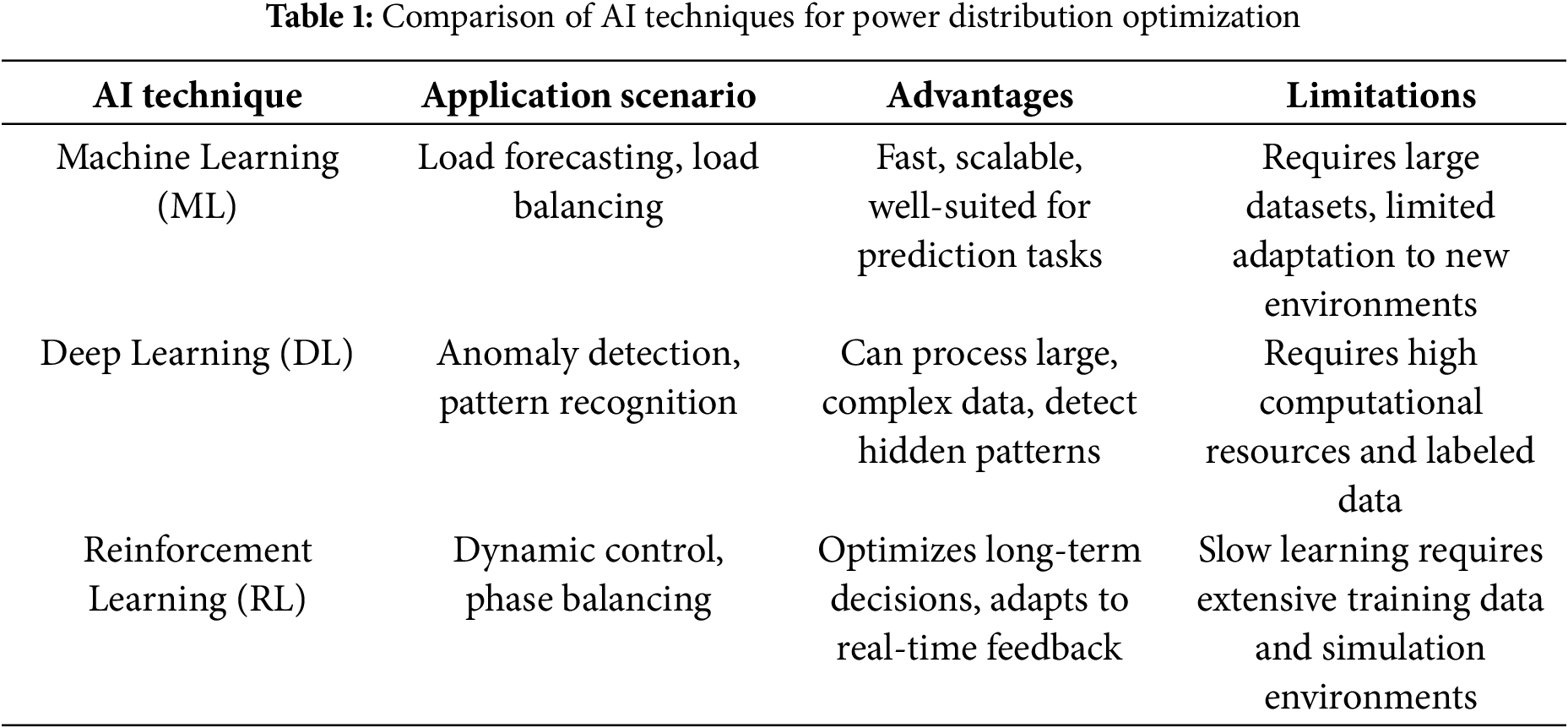
Load forecasting is a critical aspect of power distribution optimization in hyperscale data centers. Machine learning techniques, such as Gradient Boosted Trees (GBT), Random Forests, and Support Vector Machines (SVM), are widely used to predict power consumption patterns based on historical data. These supervised learning models are trained on past power usage data, resource patterns, and external factors such as time of day, weather conditions, and seasonal fluctuations. The training process involves using labeled datasets, where the model learns to recognize patterns in historical data. Once trained, the model can predict future energy demands with high accuracy. By providing accurate predictions, machine learning models enable data centers to optimize their energy usage, reduce overprovisioning, and ensure that sufficient capacity is available during peak demand periods [6]. In particular, Gradient Boosted Trees (GBT) and Random Forests have been shown to be effective in capturing complex relationships between multiple variables, making them well-suited for short-term and long-term load forecasting. These models allow for anticipatory adjustments in power distribution, ensuring that data centers can manage fluctuating workloads efficiently and avoid energy waste.
4.2 Deep Learning for Pattern Recognition
Deep learning models, particularly Long Short-Term Memory (LSTM) networks and Convolutional Neural Networks (CNNs), are powerful tools for analyzing large-scale, high-dimensional time-series data in power distribution systems. LSTMs are specifically designed for sequential data, making them ideal for tasks like forecasting load demands and detecting anomalies in power systems. LSTMs can capture temporal dependencies in power usage, identifying trends and patterns in real-time data. For example, by analyzing historical data on voltage, current, and frequency, LSTM networks can predict upcoming spikes in demand or potential failures in power infrastructure. These predictions allow operators to take preemptive action, reducing downtime and preventing system failures. CNNs, on the other hand, are typically used for spatial pattern recognition in power systems. When combined with data visualizations like thermal maps, CNNs can detect anomalies such as equipment overheating or power surges that may not be immediately visible in raw time-series data. This capability is particularly useful in identifying hidden connections between thermal and electrical data, which could indicate underlying problems in the system. The use of deep learning models enables real-time monitoring and anomaly detection, improving the resilience of power systems and reducing operational risks in data centers. Fig. 3 provides an overview of the AI Power Control system, highlighting how AI-driven control strategies manage real-time adjustments in the power distribution process, enabling greater efficiency and resilience.

Figure 3: AI power control
4.3 Reinforcement Learning for Dynamic Control
Reinforcement Learning (RL) introduces a layer of dynamic control in power distribution systems by learning from real-time interactions with the environment. In RL, an agent makes decisions based on feedback received from the system, with the goal of optimizing a reward function that reflects system performance, such as energy efficiency or uptime. In the context of power distribution, RL agents can optimize various aspects of the system, such as phase balancing, load rebalancing, and energy routing. For example, an RL agent can determine the most efficient time to switch between power sources (e.g., grid power, battery backup) or adjust the load distribution across different circuits. The agent learns to balance energy usage across the system by interacting with the environment and receiving rewards for actions that minimize energy consumption while maintaining system stability. RL allows data centers to operate autonomously, adjusting their power systems in real-time based on dynamic inputs such as energy prices, grid conditions, and internal load requirements. This makes it possible to adapt to fluctuating energy demands and optimize energy usage without human intervention, significantly improving energy efficiency.
4.4 Anomaly Detection for Reliability and Resilience
Unsupervised learning techniques, such as k-means clustering, autoencoders, and isolation forests, are used in power systems to detect anomalies that could indicate potential failures in the infrastructure. These models learn from historical data without labeled examples, identifying outliers or unusual patterns that could signal impending issues. For instance, autoencoders are trained to reconstruct input data, and anomalies are detected when the reconstruction error exceeds a certain threshold. This technique is useful for identifying faults in power distribution equipment, such as failing transformers or overloaded circuits, before they lead to larger failures. By detecting anomalies early, predictive maintenance can be performed, avoiding costly downtime and extending the lifespan of equipment. These models enable a proactive approach to power management, ensuring that potential failures are addressed before they affect system performance.
4.5 AI for Phase Balancing and Loss Reduction
AI techniques are increasingly being used to optimize phase balancing in power distribution networks. In traditional systems, phase imbalance occurs when power loads are not evenly distributed across the three phases, leading to inefficient energy usage, increased losses, and potential damage to equipment. AI models can monitor phase imbalance in real time and suggest or even automatically implement countermeasures such as dynamic phase switching or load redistribution to balance the load more effectively. By optimizing phase distribution, AI can help reduce line losses and improve overall power quality, resulting in better energy efficiency and extended equipment life. Moreover, AI-driven power factor correction techniques are used to minimize utility penalties associated with poor power factor. By continuously adjusting power factor in real time, AI systems help data centers align more effectively with the grid and reduce the costs associated with inefficient power usage.
To better understand the application of these AI techniques in power distribution optimization, the following Table 1 summarizes their respective advantages, limitations, and application scenarios.
5 Real-Time Demand Forecasting and Energy Planning
Having trained and validated AI models, the next challenge is to use them in real time to affect decisions on energy planning and distribution. But real-time demand prediction is what this capability is built on, which allows operators to predict the power requirements across zones and subsystems and schedule energy delivery. Rather than responding to the need, the system indeed anticipates power flow, according to expected consumption, enhancing efficiency, robustness, and stability. AI-driven forecasting systems are ingesting telemetry data from server racks (including weight and electrical usage), cooling systems, and electrical panels, even external data like grid pricing feeds or weather APIs. The models crunch this input on a high-frequency basis, often every minute, to create future-focused load profiles for each section of the plant. Such predictions may be of total demand, phase demand sharing, trend of reactive power, and even battery discharge scheduling for hybrid energy systems. Several use cases are available for energy source efficient purchasing and distribution by enabling facilities to leverage the data, as shown in:
5.1 Power Provisioning That Knows the Workload
AI can associate IT workload types with power draw and schedule jobs into particular servers’ banks based on power efficiency and thermal characteristics [7]. For instance, AI can optimize compute-heavy jobs to be run in low ambient temperatures or high renewable energy availability.
5.2 Microgrid and Renewable Integration
At a facility having solar arrays, wind turbines, or on-site fuel cells, AI can predict generation levels and check them against predicted demand. So the system can choose to use clean energy first and minimize the draw on the grid when prices are at peak.
5.3 Peak Shaving and Demand Response
AI predictions can be linked to demand response initiatives where data centers dial back power draws during grid stress in return for monetary rewards. You meet your obligations and enable load shifting or prior pre-cooling to ensure temperature is maintained while minimizing curtailment.
Route power at the substation, at the UPS level, or at the PDU level to balance the usage and avoid hot spots, based on predictions of load. Current workload in the transformers, breaker conditions, and historical faults are considered to derive the most cost-effective routing scheme by AI algorithms with the minimal risk of failure and loss of power.
Being able to predict 15–30 min gives you a massive advantage in high-load situations. It lowers demand for a sudden intervention, stabilizes thermal conditions more reliably, and supports the health of the electrical infrastructure. In the section that follows, we will look at applications of these AI-informed strategies in practice and their real-world impact on operational efficiency, uptime, and sustainability. As illustrated in Fig. 4, real-time demand energy planning is crucial for balancing energy supply and demand in hyperscale data centers. By leveraging AI and predictive models, power systems can make dynamic adjustments based on immediate consumption patterns, ensuring optimal energy usage and reduced waste.

Figure 4: Real-time demand energy planning
6 Case Studies and Real-World Implementations
A few hyperscale operators have already embraced AI-enabled power distribution optimization, leading to enhanced efficiency, uptime, and energy savings. These are prime examples of how AI-driven models are being used beyond the labs and integrated into daily operations, setting a benchmark for the industry to follow.
6.1 Google DeepMind—Smart Cooling and Energy Saving
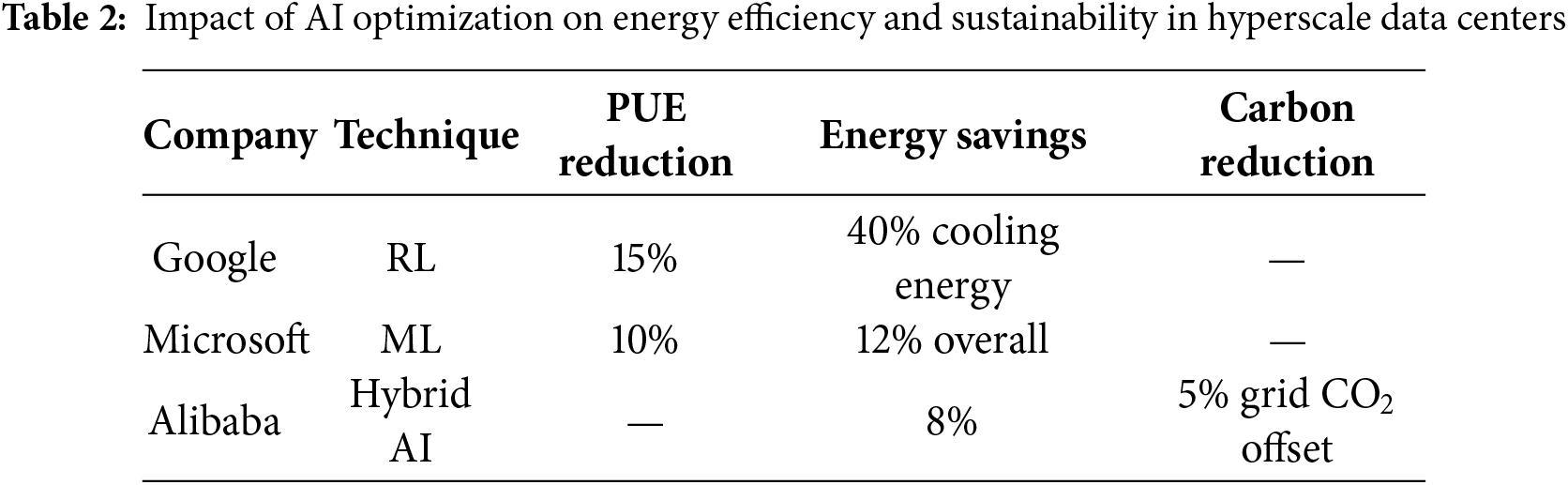
Google applied DeepMind’s reinforcement learning (RL) model to optimize cooling in its data centers. The RL agent learned from real-time telemetry data including server load, temperature of the water, power consumption, and cooling water flow to determine the most efficient settings for cooling. The model uses exploration-exploitation techniques, constantly adjusting settings based on dynamic conditions to minimize energy use without compromising server performance. As a result, Google achieved a 40% energy saving in cooling and improved its Power Usage Effectiveness (PUE) by 15%. Initially focused on cooling, the RL model was later expanded to handle power routing and energy delivery, allowing the system to dynamically adjust based on server heat signatures and workload variations.
• AI Model Used: Reinforcement Learning (RL)
• Application: Cooling optimization, power routing, energy delivery
• Results: 40% energy saving in cooling, 15% improvement in PUE.
6.2 Microsoft Azure—Load Balancing with Prediction
Microsoft Azure’s data centers utilize machine learning (ML) models, including Gradient Boosted Trees (GBT) and Random Forests, for load forecasting and load balancing across server farms and geographies. These supervised learning models predict workload patterns ahead of time, ensuring that energy is efficiently distributed based on real-time conditions. The models incorporate power distribution forecasts, detecting underutilized zones in the data center. Energy consumption is then shifted to these zones during off-peak hours or times of lower energy prices. Furthermore, the AI models account for the variability of the power grid, making it possible to transition loads smoothly between different zones, thereby enhancing demand response capacity and ensuring grid stability.
• AI Model Used: Machine Learning (ML)
• Algorithms Used: Gradient Boosted Trees (GBT), Random Forests
• Application: Load forecasting, load balancing, energy optimization
• Results: 10% reduction in energy use, optimized grid interaction.
6.3 Alibaba Cloud—AI in Grid Interaction and Battery Management
Alibaba Cloud has integrated AI models to balance energy usage between the grid, internal battery reserves, and renewable energy sources. These neural network-based models predict spikes in power demand and automatically switch to battery reserves during high grid prices or when grid carbon intensity is high. The training process involves feeding the model with historical data on energy consumption, grid pricing, and renewable energy availability. The model continuously adjusts charging cycles and usage to optimize performance and extend battery life. This AI-powered optimization allows for better alignment with sustainability goals, particularly during peak periods like national holidays or high-traffic e-commerce seasons.
• AI Model Used: Neural Networks
• Application: Battery management, grid interaction, energy optimization
• Results: 8% energy savings, 5% carbon emissions reduction.
6.4 Impact of AI Technologies in Real-World Data Center Operations
The impact of AI-driven power distribution optimization in hyperscale data centers is summarized in Table 1. The following quantitative results highlight the effectiveness of various AI techniques in improving Power Usage Effectiveness (PUE), reducing energy consumption, and lowering carbon emissions across data centers. As shown in Table 2, Google’s reinforcement learning (RL) model achieved a 40% energy saving in cooling systems and improved PUE by 15%. Microsoft’s machine learning (ML) techniques optimized load distribution, resulting in a 10% reduction in energy use. Alibaba’s hybrid AI approach saved 8% on energy consumption and contributed to a 5% reduction in grid-related carbon emissions.
7 Sustainability and Cost Impacts
Hyperscale data centers are power-hungry, typically drawing tens or hundreds of megawatts per facility. As worldwide attention to energy conservation, carbon neutrality, and corporate sustainability goals continues to expand, power distribution can no longer solely be an engineering problem but becomes a business imperative. AI-based power optimization is a key to minimizing energy consumption and operating costs while helping address larger ESG (Environmental, Social, and Governance) concerns.
7.1 Reducing Power Usage Effectiveness (PUE)
A key measure of sustainability in a data center, probably the best understood, is PUE, the total facility energy divided by IT equipment energy. The lower the PUE, the more efficient the power and cooling systems are. To optimize power distribution for forecasted IT loads, AI can dynamically adjust where power is provided, so that cooling and power are distributed according to the real-time need, preventing waste. AI also makes zone-based optimization possible—spotting and adjusting overcooling and overvolting the static-based system would not have been possible.
7.2 Optimizing for Renewable Energy Availability
Many of today’s hyperscale operators operate hybrid energy models using grid power alongside their own solar, wind, or biofuel systems. AI can predict renewables output using weather forecasts and modulate power draw to match charging battery storage when solar is abundant or schedule non-critical workloads when clean energy is plentiful. This maximizes the utilization of low-carbon energy sources and allows sites to join virtual power plants or green energy credit programs.
7.3 Participating in Demand Response Programs
Grid operators normally motivate larger consumers to decrease consumption at peak load periods, thereby mitigating the peak of a demand curve by use of demand response (DR) programs. AI-powered prediction can enable data centers to confidently “bid” on DR events where they proactively (albeit temporarily) decrease temperatures and preload workloads to move to battery without affecting the mission-critical uptime [8]. This generates a new revenue stream, which reduces the pressure on the grid and can lower the center’s carbon intensity.
7.4 Financial Impact: Reducing CapEx and OpEx
Intelligent power routing will also prevent unnecessary overbuild in infrastructure. AI doesn’t have to accommodate worst-case load scenarios; let us dole out right-sized distribution and expansion where it can do the job. This reduces capex spend on multiple dedicated circuits, UPS systems, and transformers. From an operations standpoint, improved phase balancing and real-time correction of loading minimize line losses, extend the life of equipment, and reduce electricity costs by minimizing peak demand charges. According to some facilities, they have seen OpEx slashed by double digits upon deploying AI-powered optimization.
7.5 Supporting Net-Zero Commitments
Many hyperscale’s including Google and Microsoft have committed to being carbon neutral within the next decade. Power optimization AI directly contributes to these goals by reducing the energy use necessary for each unit of compute, decreasing the dependence on fossil-based grid power, and scheduling at times with the least carbon intensity. These are also creating robust sustainability audit trails that satisfy regulatory reporting and transparency demands. In brief, AI does not just repurpose power optimization as a backend efficiency initiative, but rather a front-line weapon for profitability, resiliency, and environmental stewardship. In the following, we examine the new paradigm of autonomous energy management and how it might shape the next generation of hyperscale infrastructure.
7.6 Challenges in AI Deployment for Power Distribution Optimization
While AI-driven solutions offer significant potential in optimizing power distribution in hyperscale data centers, several real-world challenges need to be addressed for effective deployment:
Data Quality—AI models rely heavily on data quality, and poor data quality can significantly undermine the performance of AI systems. In power distribution, missing, inconsistent, or noisy data often from sensors or legacy systems can lead to inaccurate predictions and inefficient operations. For example, inconsistent voltage or temperature readings could result in incorrect power load forecasts or inadequate responses to cooling needs. Therefore, ensuring high-quality, accurate, and consistent data across all endpoints in the system is crucial for the AI models to function optimally.
System Integration—Integrating AI models into existing power infrastructure can be a complex and time-consuming process, particularly in environments with legacy systems. Many hyperscale data centers operate with outdated power management and monitoring systems that were not designed to work with AI-driven solutions. For instance, integrating AI models for dynamic load balancing or cooling optimization with legacy power distribution units (PDUs), UPS systems, or power monitoring equipment can present significant compatibility issues. As AI solutions become more advanced, their integration into existing infrastructure must be seamless, requiring careful planning, testing, and continuous monitoring to ensure smooth and reliable operation.
Model Interpretability—One of the primary barriers to deploying AI solutions in safety-critical environments like data centers is the interpretability of the models used. Many advanced AI techniques, particularly deep learning and reinforcement learning, operate as black boxes, making it difficult for operators to understand how decisions are made. This lack of transparency can lead to hesitation in adopting AI systems, especially in environments where decisions need to be explainable for regulatory compliance, safety, or operational reliability. Explainable AI (XAI) is crucial in these cases, enabling operators to understand why a specific decision was made, such as why a cooling system was adjusted or why a particular energy routing strategy was chosen. By making AI systems more interpretable, data centers can gain the trust of operators and regulatory bodies, ensuring safer and more effective deployment.
8 The Future of Autonomous Energy Management
With advances in AI technology and the increasing ease of data center integration, fully autonomous energy management is no longer a futuristic concept. Hyperscale data centers are now on the verge of operating with minimal human intervention, using AI to predict, respond to, and optimize power distribution dynamically. These systems will adjust in real-time based on fluctuating internal loads, external grid conditions, and corporate sustainability goals, leading to more efficient operations.
8.1 Self-Optimizing Infrastructure
At the core of autonomous systems, AI agents monitor data from thousands of endpoints such as PDUs, UPSs, HVAC (Heating, Ventilation, and Air Conditioning) systems, renewable inputs, and IT load balancers. These agents work together to modify power paths, phase distribution, and battery utilization, learning over time to optimize these functions further. The self-reinforcing feedback loop means that decisions lead to results, which are evaluated, and the system then adjusts accordingly. As demand increases, the infrastructure can scale autonomously, without relying on manual thresholds or static policies. This self-regulation forms the foundation of a truly dynamic system that reacts in real-time to operational needs.
8.2 Digital Twins and Simulation-Driven Decision-Making
Building on the concept of self-optimizing infrastructure, AI-enabled digital twins create virtual replicas of data center systems, including electrical and thermal components. These digital models simulate various power routing alternatives, failure scenarios, and energy efficiency strategies without impacting live operations. Paired with reinforcement learning, these models enable AI agents to learn in a safe, simulated environment before deploying changes to production systems. This approach minimizes risks and accelerates the optimization process [9].
8.3 Edge Intelligence and Federated Learning
As hyperscale data centers expand geographically, edge intelligence plays an increasingly important role, particularly for low-latency applications. Local AI models deployed at edge sites will make decisions related to energy routing, load balancing, and fault management [10]. These models can communicate with centralized systems via federated learning, which ensures that data remains secure and private while enabling collective learning across the infrastructure [11]. This decentralized approach enhances both performance and data privacy.
8.4 Integration with Smart Grids and Decentralized Markets
An important component of autonomous energy management is its integration with smart grids and decentralized markets [12]. AI systems within data centers can dynamically interact with energy markets, adjusting workload schedules based on factors like energy prices, carbon emissions, or grid stability. For instance, data centers could negotiate energy contracts or adjust power consumption during peak hours to help stabilize regional or national grids. This capability makes data centers not just consumers of energy but active participants in managing grid stability, potentially offering services such as fast frequency response or reserve power during emergencies [13].
8.5 Human Oversight and Explainability
Despite the increasing autonomy of these systems, human oversight remains crucial, particularly in regulated environments or critical operations. As AI systems become more complex, the need for explainable AI (XAI) grows. Future systems will allow operators to understand the reasoning behind AI decisions, fostering trust, compliance, and accountability [14]. Dashboards will evolve beyond simply monitoring metrics; they will track AI decisions and validate the application of integrated systems. Rather than eliminating humans from the loop, the goal is to empower operators to transition from reactive troubleshooters to strategic supervisors, overseeing systems that are context-aware, self-learning, and capable of executing decisions at machine scale [15].
9 Conclusion: Strategic Imperative for the AI-Powered Data Center
Power distribution optimization with AI is not pie in the sky; it is becoming prevalent in the modern hyperscale data center. As compute demand soars and sustainability mandates tighten around the world, old-school manual, reactive energy management is a model that just does not fit. Operators need to shift towards systems that are predictive, self-managing, and built adaptively. In this paper, we showcased how AI reshapes the power infrastructure at all layers, from real-time demand prediction to load balancing, from anomaly detection to renewable sources integration. Case studies from the likes of Google, Microsoft, and Alibaba demonstrate that these strategies are already delivering tangible improvements in power efficiency, cost predictability, and grid flexibility. AI benefits resilience in addition to efficiency by identifying failures before they occur, reacting to changing loads more quickly than human operators, and controlling power flows subject to a host of complex, interrelated constraints. The strategic importance of AI in power optimization does not stop at the data center walls. It extends to ESG reporting, business continuity planning, and long-term capital expenditure. Businesses that innovate in this way will not just be greener, but more competitive. They will have more insourced employees consistently working smarter, not harder, with a smaller footprint and more insights. In the future, AI will be the lodestone for this next class of autonomous infrastructure: autonomous infrastructure that is self-aware, that self-regulates, and that is seamlessly connected to the grid, and indeed global energy markets. Human teams will be free to move from repetitive firefighting to high-level governance, innovation, and strategic thinking. In a word, distributing power with AI is not merely a tool; it is a strategic imperative. Leaders in its adoption will be the leaders in the future of data center operations, cloud infrastructure, and global digital resilience
Acknowledgement: Not applicable.
Funding Statement: The author received no specific funding for this study.
Availability of Data and Materials: All data used in this study are available within the manuscript. Additional datasets or simulation models used during the current study are available from the corresponding author upon reasonable request.
Ethics Approval: Not applicable.
Conflicts of Interest: The author declares no conflicts of interest to report regarding the present study. This work was conducted independently and does not represent the views, policies, or positions of any current or past employers. All analyses, opinions, and conclusions are solely based on the author’s personal research and professional experience.
References
1. Thangavel S, Sunkara KC, Srinivasan S. Software-defined networking (SDN) in cloud data centers: optimizing traffic management for hyper-scale infrastructure. Int J Emerg Trends Comput Sci Inf Technol. 2022;3(3):29–42. [cited 2025 Jan 1]. Available from: https://www.ijetcsit.org/index.php/ijetcsit/article/view/142. [Google Scholar]
2. Shabka Z. Optimization for optical data center switching and networking with artificial intelligence [doctoral dissertation]. London, UK: UCL (University College London); 2023. [cited 2025 Jan 1]. Available from: https://discovery.ucl.ac.uk/id/eprint/10172308/. [Google Scholar]
3. Ruci X. Capacity management in hyper-scale datacenters using predictive modeling; 2019. [cited 2025 Jan 1]. Available from: https://www.diva-portal.org/smash/record.jsf?pid=diva2%3A1276314&dswid=-7922. [Google Scholar]
4. Patel PD. Artificial intelligence in datacenters: optimizing performance, power, and thermal management. J Comput Sci Technol Stud. 2025;7(4):952–63. [cited 2025 Jan 1]. Available from: https://al-kindipublishers.org/index.php/jcsts/article/view/9671. [Google Scholar]
5. Katiraei F, Morovati S, Chuangpishit S, Ghorashi SA. Virtual power plant empowerment in the next generation of data centers: outlining the challenges. IEEE Electrif Mag. 2023;11(3):35–44. [cited 2025 Jan 1]. Available from: https://ieeexplore.ieee.org/abstract/document/10255514. [Google Scholar]
6. Davenport C, Singer CFA, Mehta N, Lee N, Mackay B. AI, data centers, and the coming US power demand surge. New York, NY, USA: Goldman Sachs; 2024. [cited 2025 Jan 1]. Available from: https://www.spirepointpc.com/documents/FG/spirepoint/resource-center/629373_Generational_Growth__AI_data_centers_and_the_coming_US_power_demand_surge.pdf. [Google Scholar]
7. Karamchand G. Sustainable cybersecurity: green AI models for securing data center infrastructure. Int J Humanit Inf Technol. 2025;7(2):6–16. [cited 2025 Jan 1]. Available from: https://ijhit.info/index.php/ijhit/article/view/44. [Google Scholar]
8. Chandrakumara S. Optimizing data center site selection using AI: a power infrastructure and real estate investment approach. 2025 [cited 2025 Jan 1]. Available from: https://ssrn.com/abstract=5129687. [Google Scholar]
9. Al Kez D, Foley A, Hasan Wong FWBW, Dolfi A, Srinivasan G. Ai-driven cooling technologies for high-performance data centers: state-of-the-art review and future directions. Sustain Energy Technol Assess. 2025;82:104511. [cited 2025 Jan 1]. Available from: https://papers.ssrn.com/sol3/papers.cfm?abstract_id=5148380. [Google Scholar]
10. Ogunsanmi A. Artificial intelligence and machine learning for data center operations; 2023 [cited 2025 Jan 1]. Available from: https://ssrn.com/abstract=5158189. [Google Scholar]
11. Xie L, Zheng X, Sun Y, Huang T, Bruton T. Massively digitized power grid: opportunities and challenges of use-inspired AI. Proc IEEE. 2022;111(7):762–87. [cited 2025 Jan 1]. Available from: https://arxiv.org/abs/2205.05180?utm_source. [Google Scholar]
12. Hota A. AI-enhanced cooling systems: innovations in heat management for hyperscale data centers. Int J Eng Res Technol. 2024;13(11):6. [cited 2025 Jan 1]. Available from: https://www.researchgate.net/profile/Ashish-Hota/publication/386460442_AI-Enhanced_Cooling_Systems_Innovations_in_Heat_Management_for_Hyperscale_Data_Centers/links/6751f61bad10b614ef3175b2/AI-Enhanced-Cooling-Systems-Innovations-in-Heat-Management-for-Hyperscale-Data-Centers.pdf. [Google Scholar]
13. Kabir MH, Islam MN, Khan MRAA, Newaz ASS, Mahamud MS. Optimizing data center operations with artificial intelligence and machine learning. Am J Sch Res Innov. 2022;1(1):53–75. [cited 2025 Jan 1]. Available from: https://researchinnovationjournal.com/index.php/AJSRI/article/view/6. [Google Scholar]
14. Ademilua DA. Intelligent data centers: leveraging AI and automation for process optimization and operational efficiency. Int J Adv Trends Comput Sci Eng. 2025;14(2):89–107. [cited 2025 Jan 1]. Available from: https://www.academia.edu/129092880/Intelligent_Data_Centers_Leveraging_AI_and_Automation_for_Process_Optimization_and_Operational_Efficiency. [Google Scholar]
15. Cao Z, Li M, Lin F, Jia J, Wen Y, Yin J, et al. Transforming future data center operations and management via physical AI. arXiv:2504.04982. 2025. [cited 2025 Jan 1]. Available from: https://arxiv.org/abs/2504.04982. [Google Scholar]
Cite This Article
 Copyright © 2025 The Author(s). Published by Tech Science Press.
This work is licensed under a Creative Commons Attribution 4.0 International License , which permits unrestricted use, distribution, and reproduction in any medium, provided the original work is properly cited.
 Downloads
 Citation Tools
