
 Login
Login Register
 Submit a Paper
 Propose a Special lssue
 Open Access
ARTICLE

Job satisfaction mediation in the relationship between work-family conflict and life satisfaction among Turkish academics
1 Social Work Department, Sivas Cumhuriyet University, Sivas, TR58000, Turkey
2 Child Protection and Care Services Department, Sinop University, Sinop, TR57900, Turkey
3 Sociology Department, Munzur University, Tunceli, TR62000, Turkey
* Corresponding Author: Ahmet Türk. Email:
Journal of Psychology in Africa 2025, 35(3), 377-384. https://doi.org/10.32604/jpa.2025.068043
Received 16 February 2025; Accepted 08 July 2025; Issue published 31 July 2025
 View Full Text
 Download PDF
Abstract
This study examined the mediating role of job satisfaction in explaining the relationship between work-family conflict and life satisfaction among Turkish academicians. Employing a cross-sectional study design 645 academicians aged between 24 and 65 (male = 45.1%, female = 54.9%; professors = 12.1%, associate professors = 17.7%, assistant professors = 28.2%, lecturers = 17.8%, research assistants = 24.2%; mean age and SD = 39.72 ± 8.94) completed the Job Satisfaction Scale, Life Satisfaction Scale, and the Work-Family Conflict Scale. They also self-reported their demographics. The findings from PROCESS MACRO analysis indicated work-family conflict to predict lower job satisfaction among academicians. Those with higher job satisfaction were also self-reported with higher life satisfaction. Lob satisfaction mediated the relationship between the academician’s work family conflict and life satisfaction for higher life satisfaction. The findings of this study indicate a need to implement work-family and life satisfaction measures to enhance job satisfaction among academics.Keywords
Balancing the demands of conflict between family and job demands is a challenge to many academics. The academic profession entails a broad spectrum of responsibilities, including conducting research, engaging in creative activities, teaching, mentoring and advising students, offering community service, and fulfilling professional obligations. These responsibilities frequently extend beyond standard working hours, with academics often working more than 50 h per week, which hinders the establishment of a healthy work-life balance (O’Laughlin & Bischoff, 2005; Yılmaz & Memişoğlu, 2019). A study conducted in the United States found that only 32% of academics reported being able to maintain a balance between their professional and personal lives, indicating that the majority may experience significant conflict between these domains (Rahman et al., 2020). This suggests that work-family conflict may have detrimental effects on life satisfaction.
Life satisfaction, defined as individuals’ overall evaluation of their lives (Diener, 1984), is a crucial indicator of well-being among academics in higher education (Badri, 2019). While numerous studies have consistently illustrated that work-family conflict negatively affects life satisfaction (e.g., Mustafayeva & Bayraktaroğlu, 2014; Nehir et al., 2021), the mediating role of variables in this relationship remains insufficiently explored (El Keshky & Sarour, 2024). Job satisfaction or positive emotions towards ones’s occupation (Spector, 1997) is one such variable, as it is closely linked to both life satisfaction and work-family conflict. Therefore, the present study seeks to examine the mediating role of job satisfaction in the relationship between work-family conflict and life satisfaction among Turkish academics. The limited number of studies addressing this issue within the Turkish context underscores the significance and originality of the current research.
Work-family conflict and job satisfaction
A high level of job satisfaction has been associated with a number of positive organizational outcomes such as productivity, performance and organizational commitment, while low job satisfaction has been linked to tardiness, poor performance, resignation, detachment from work, depression and psychological distress (Sis-Atabay & Naktiyok, 2017; Spector, 1997).
Role Stress Theory (Buonocore & Russo, 2013) posits that a misalignment between the demands of work and family roles poses a threat to the successful fulfillment of family responsibilities and impedes individuals’ ability to concentrate on work tasks, thereby escalating emotional distress. This, in turn, leads to a decline in job satisfaction. However, the evidence is still meagre on the role of job satisfaction in the family-work conflict and life satisfaction relationship, hence this study.
Work-family conflict and life satisfaction
Conflict between work and family may arise when individuals face difficulties in fulfilling their responsibilities in one domain due to the pressures or demands of the other. For instance, employees may 1) be unable to dedicate time to one role while fulfilling the other, 2) experience stress or tension in one area hinders performance in the other, or 3) confront behavior demanded in one domain is incongruent with the necessary behavior in the other (Greenhaus & Beutell, 1985). Also, family-work conflict emerges when familial factors, such as childcare needs, care for elderly or disabled family members, or the demands of having dual-career spouses, interfere with professional obligations. Research has consistently demonstrated that work-family conflict is more commonly observed than family-work conflict (Mustafayeva & Bayraktaroğlu, 2014; Öztürk & Türk, 2020) and has a greater impact on life satisfaction among academics (Gao & Jin, 2015; Öngel & Tatlı, 2020; Rode et al., 2007; Şentürk & Bayraktar, 2018).
Job satisfaction and life satisfaction
The interplay between life satisfaction and job satisfaction may be explained by the spillover hypothesis, which suggests that satisfaction in one domain of life can positively affect satisfaction in other areas, with or with no compensatory behavior. Based on this assumption, there would be a correlation between job satisfaction and life satisfaction, the direction of which may vary by nature and extent of the spillover. For instance, job satisfaction had a positive notable impact on general life satisfaction (Adams et al., 1996; Bell et al., 2012), and perhaps only a moderate level effect (Rice et al., 1980). Some job satisfaction studies have reported a minimal effect on life satisfaction (Johansson & Bernspång, 2003).
There is a relatively limited number of studies investigating the mediating effect of job satisfaction specifically on the relationship between work-family conflict and life satisfaction. For example, job satisfaction partially mediated the relationship between work-family conflict and life satisfaction among university professors (Simkhah & Mohamadkhani, 2022). Similarly, job satisfaction predicted life satisfaction among teachers, perhaps by level or extent of family-work conflict (Türker & Çelik, 2019). Work content matters to how these relationships may pan out, and few studies have been implemented.
In recent years, there has been a substantial increase in the number of universities in Turkey. The total number of universities in Turkey has reached 209 as of 2024. These institutions currently host 7,081,289 students, with a total of 181,498 academic staff members (Council of Higher Education, 2024). However, this increase in the number of universities and students has not been met with a proportional rise in the number of academics, leading to an increased workload for the academic staff. A study conducted on the workload of academics in Turkey yielded interesting findings: Almost 45% of the academics participating in the study have a weekly course load of 21 h or more. In addition, 75% can only spend up to 5 h on academic work and publication (Çalışkan, 2024). Some academics have administrative duties (management, conducting investigations, organizing events, relations with external institutions, etc.) that create a serious workload in addition to their courses and academic work. On the other hand, the family in Turkey continues to hold significant importance, with family members, particularly women, traditionally expected to fulfill key familial duties (Erkul, 2002). In Turkish society, traditional gender roles and the responsibilities assigned to men and women have been shown to play a significant role in shaping the experience of work-family conflict (Ece et al., 2024). Therefore, conducting this study within the Turkish context is particularly valuable, as it offers unique insights into the specific dynamics of work-family conflict faced by Turkish academics.
The present study examines the mediating impact of job satisfaction on the relationship between work-family conflict and life satisfaction among Turkish academics. Figure 1 presents the conceptual model for investigating the mediating influence of job satisfaction in the relationship between work-family conflict and life satisfaction. Based on this conceptual model, we tested the following hypotheses.
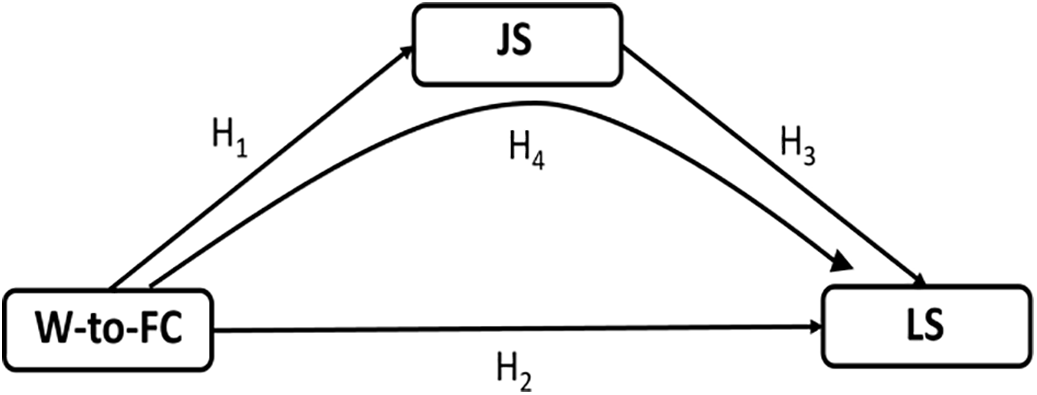
Figure 1: Study conceptual model. Note. W-to-FC = Work to Family Conflict, JS = Job Satisfaction, LS = Life Satisfaction.
H1: Work-family conflict negatively predicts job satisfaction.
H2: Work-family conflict negatively predicts life satisfaction.
H3: Job satisfaction positively predicts life satisfaction.
H4: Work-family conflict decreases life satisfaction via job satisfaction.
A total of 658 academicians in public universities in Turkey, and a random sampling method was employed to obtain the participants. Turkey has 129 public universities located across 7 geographical regions: Marmara, Aegean, Mediterranean, Southeast Anatolia, East Anatolia, Central Anatolia, and Black Sea. Three universities from each region were selected through random sampling for this research. The participants were aged between 24 and 65 years, with a mean age of 39.72 ± 8.94. Of the participants, 291 (45.1%) were male and 354 (54.9%) were female. 468 (72.6%) were married and 177 (27.4%) were single. There were 78 (12.1%) professors, 114 (17.7%) associate professors, 182 (28.2%) assistant professors, 115 (17.8%) lecturers and 156 (24.2%) research assistants. Regarding professional experience, 233 (36.1%) were 10 years or less, 253 (39.2%) had 11 to 20 years and 159 (24.7%) had 21 years or more.
Job satisfaction was measured by the 5-item Job Satisfaction Scale (JSS), as developed by Judge et al. (1998) and adapted into Turkish by Başol and Çömlekçi (2020). Sample items are “I am satisfied with my current job.” “I find real enjoyment in my work.” This scale utilizes a 5-point Likert-type response format (1 = strongly disagree, 5 = strongly agree), with no reverse-coded items. Higher values are indicative of higher levels of job satisfaction. The scale exhibited a Cronbach’s alpha reliability coefficient of α = 0.92.
Life satisfaction was measured utilizing the Life Satisfaction Scale (LSS), a tool initially created by Diener et al. (1985) and subsequently translated into Turkish by Dağlı and Baysal (2016). The scale comprises five items, with responses given on a 5-point Likert scale ranging from 1 (strongly disagree) to 5 (strongly agree). Sample items are “In most ways my life is close to my ideal.” “If I could live my life over, I would change almost nothing.” Scores on the scale that are elevated are indicative of elevated life satisfaction. In the original study by Diener et al. (1985), the Cronbach’s alpha was α = 0.85, while Dağlı and Baysal (2016) reported a Cronbach’s alpha of α = 0.88 for the revised Turkish version.
The measurement of work-family conflictc was conducted employing the Work-to-Family Conflict Scale (WFCS). A scale originally developed by Netemeyer et al. (1996) and adapted into Turkish by Aycan and Eskin (2005). This scale consists of five items, with responses provided on a 5-point Likert scale (1 = strongly disagree, 5 = strongly agree), with higher scores indicating greater work-family conflict. Sample items are “The demands of my work interfere with my home and family life.”, “My job produces strain that makes it difficult to fulfill family duties.” In the original study, the Cronbach’s alpha for the work-family conflict subscale was α = 0.88 (Netemeyer et al., 1996), and the Turkish adaptation by Aycan and Eskin (2005) also reported a Cronbach’s alpha of α = 0.88.
Ethical approval was granted by the Social and Human Sciences Ethics Committee of Sivas Cumhuriyet University. The participants consented to the study. They completed the surveys online via their official e-mail addresses obtained from the Council of Higher Education Academic website.
The mediating role of job satisfaction was tested using Model 4 of PROCESS macro for SPSS. Then, a bootstrapping procedure with bias-corrected accelerated confidence intervals (CI) based on 5000 bootstrap samples was used to calculate the indirect effect. The statistical significance of the indirect effect was determined by examining the 95% CI; if the CI did not contain zero, the indirect effect was considered significant (Hayes, 2013). The multicollinearity check yielded no issues, with tolerance values for the predictors ranging from 0.67 to 0.93 (all greater than 0.10). Additionally, the variance inflation factors (VIF) ranged from 1.07 to 1.48, all falling below the 10-threshold.
The linear relationship between the dependent and independent variables was evaluated using a scatter plot, which revealed a clear linear pattern. The Durbin-Watson statistic was calculated to test for autocorrelation, and the resulting value, which was close to 2, suggested no significant autocorrelation in the data. Homoscedasticity was tested by analyzing a scatterplot of the residuals, and the absence of any discernible pattern in the residuals indicated that the data met the assumption of homoscedasticity (Field, 2005). Common method bias (CMB) was examined using Harman’s single-factor test. As asserted by Podsakoff et al. (2003), if a single factor accounts for over 50% of the total variance, CMB may become a concern. In the present study, a single factor explained 41.76% of the variance, indicating that CMB did not significantly influence the results. The largest component accounted for 36.76% of the variance, falling below the critical threshold of 40%.
To evaluate the internal consistency of the measures, Cronbach’s alpha coefficients were calculated. The reliability coefficients for the scales were α = 0.83 for the JSS, α = 0.83 for the WFCS, and α = 0.87 for the LSS.
This study aimed to explore the mediating role of job satisfaction in the relationship between work-family conflict and life satisfaction among Turkish academics. The results provide full support for Hypotheses 1, 2, and 3, whereas Hypothesis 4 was found to be only partially supported.
Descriptive statistics and correlations among variables
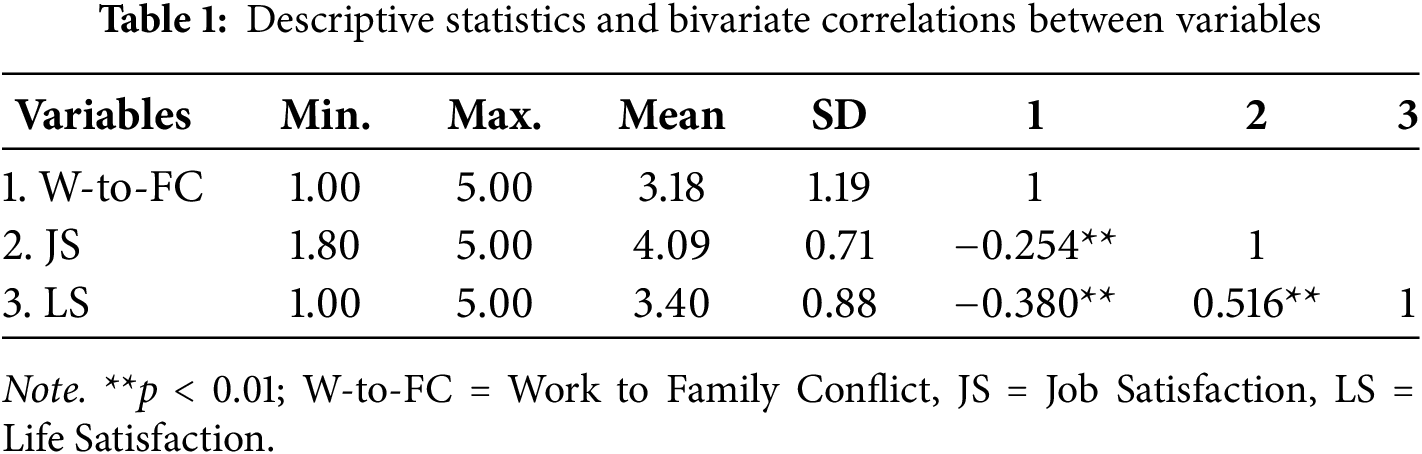
Descriptive statistics, including means, standard deviations, and correlations between the variables, were computed. Pearson’s correlation coefficient was used to explore the relationships among job satisfaction, work-family conflict, and life satisfaction. As shown in Table 1, significant correlations were found between job satisfaction and work-family conflict (r = –0.254, p < 0.01), job satisfaction and life satisfaction (r = 0.516, p < 0.01), and work-family conflict and life satisfaction (r = –0.380, p < 0.01).
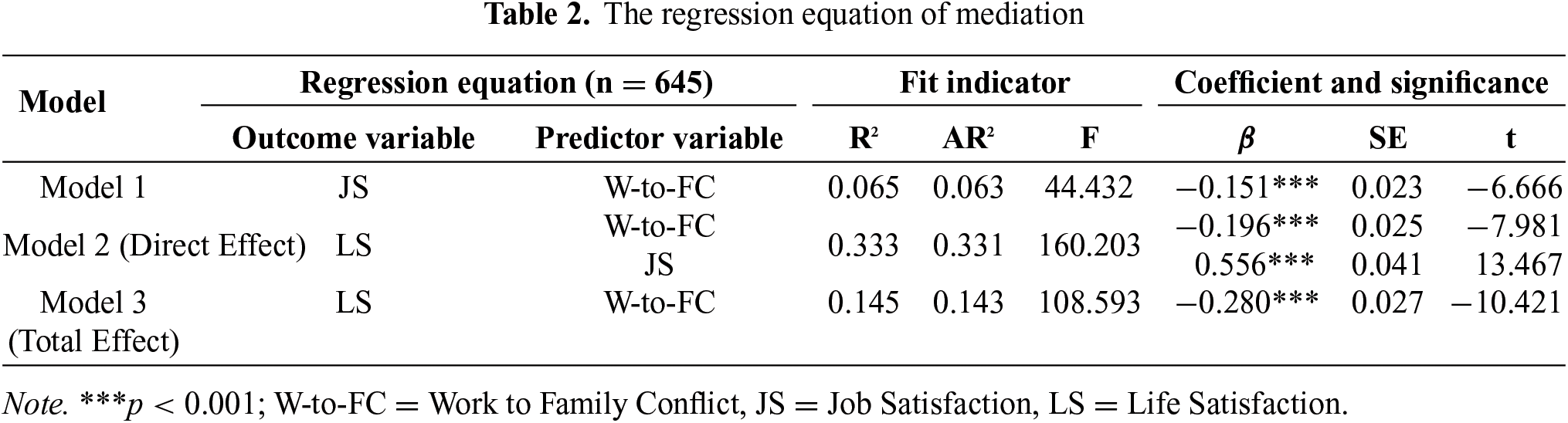
To examine the effect of work-family conflict on life satisfaction and the potential mediating role of job satisfaction, PROCESS v4.2 MACRO was employed. Three separate regression models were tested as part of the analysis. Model 1 assessed the impact of the independent variable on the mediator, Model 2 examined both the direct effect of the independent variable on the dependent variable and the mediator’s effect, and Model 3 evaluated the overall effect of the independent variable on the dependent variable. The results of Model 1 revealed a significant negative relationship between work-family conflict and job satisfaction (β = −0.151, SE = 0.023, p < 0.001). In Model 2, both work-family conflict (β = −0.196, SE = 0.025, p < 0.001) and job satisfaction (β = 0.556, SE = 0.041, p < 0.001) showed significant direct effects on life satisfaction. Model 3 demonstrated a significant total effect of work-family conflict on life satisfaction (β = −0.280, SE = 0.027, p < 0.001). Therefore, Hypotheses 1, 2, and 3 were all supported, and the necessary conditions for mediation were confirmed (see Table 2).
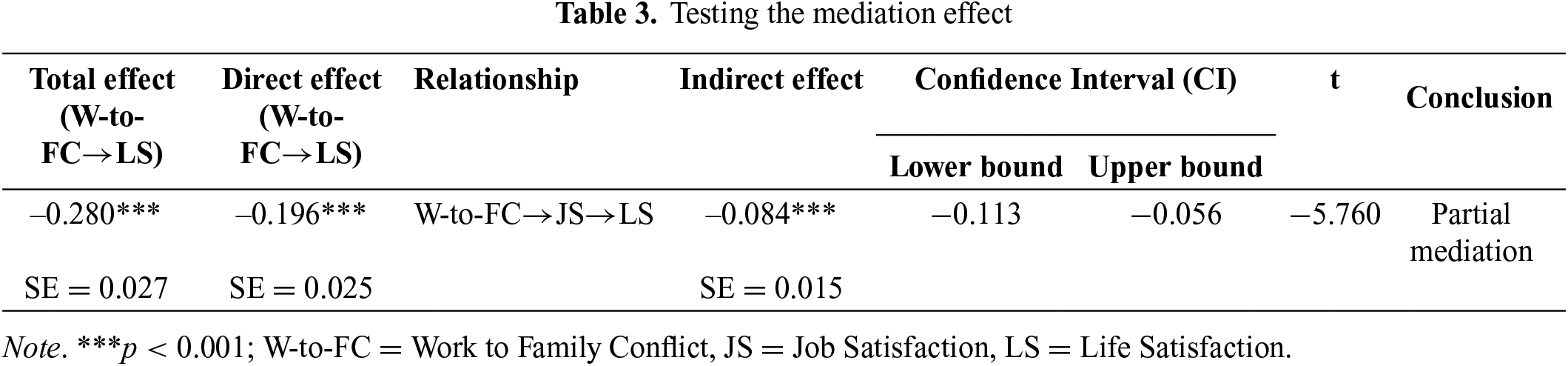
PROCESS MACRO analysis provided bias-corrected bootstrap confidence intervals based on 5000 bootstrap samples to assess each indirect effect. Following Hayes (2013), an indirect effect is deemed significant if the confidence interval does not include zero. Table 3 presents the result of the mediation analysis, which indicates that the mediation effect of job satisfaction (Y = −0.084, SE = 0.015, 95% CILower Bound = 0.113, CIUpper Bound = 0.056) was statistically significant. The total effect of work-family conflict on life satisfaction was sound to be –0.280, which reduced to –0.196 when the mediator was included in the model, suggesting a partial mediation effect, and supporting H4.
The results are summarized in Figure 2.

Figure 2: Summary of the results of the conceptual model. W-to-FC = Work to Family Conflict, JS = Job Satisfaction, LS = Life Satisfaction
First, the study found that work-family conflict negatively impacts life satisfaction, indicating that higher levels of work-family conflict are associated with a decline in overall life satisfaction. This finding is consistent with previous research (Gao & Jin, 2015; Rode et al., 2007). It is particularly significant as it underscores the challenges faced by Turkish academics in managing the balance between their professional and personal lives. As mentioned earlier, although the number of universities and students in Turkey has increased, the number of academic staff has not kept pace, leading to an increased workload for academics. Academics devote much of their time to teaching and advising responsibilities. Moreover, since 2016, academic promotion criteria have been made more stringent, requiring faculty members to accumulate at least 100 points from various activities such as publishing articles, writing books, presenting papers, and completing projects. These professional pressures often spill over into academics’ personal lives, reducing the time and energy they can devote to family matters (Yılmaz & Memişoğlu, 2019).
The reduced time available for family can strain domestic roles and relationships, potentially leading to a decrease in family satisfaction and marital quality. Given that marital satisfaction is closely linked to individual well-being (Johnson & Booth, 1998), a decline in family quality may lead to a reduction in overall life satisfaction. This finding illustrates the detrimental effects of work-family conflict on well-being, while also highlighting the particular importance of managing such conflict for academics, whose careers are often marked by long hours and considerable pressure to succeed in multiple domains.
Second, the study found that work-family conflict negatively predicts job satisfaction, a result that aligns with previous research (Lim et al., 2021; Rahman & Ali, 2021; Rode et al., 2007). This finding supports the tenets of Role Stress Theory, which posits that when employees experience less role conflict, they are less likely to encounter role ambiguity and stress, leading to higher job satisfaction. In this context, reducing work-family conflict can help academics experience less stress in their professional roles, which could lead to improved job satisfaction (Katz & Kahn, 1977). This finding implies that the ability to separate work from family life, or at least manage their interactions, can lead to better mental and emotional well-being, fostering a more positive attitude toward their work environment. As a result, addressing work-family conflict is essential not only for improving job satisfaction but also for ensuring that academics maintain a healthier and more sustainable work-life balance. This, in turn, could have broader implications for enhancing the productivity, engagement, and well-being of academics, as well as the academic environment.
Third, the finding that job satisfaction has a positive effect on life satisfaction is consistent with the existing literature (Adams et al., 1996; Bell et al., 2012; Nehir et al., 2021; Rice et al., 1980). The academic profession entails managing multiple responsibilities -research, teaching, student supervision, and community service- simultaneously. In this context, intrinsic motivators such as serving the community, self-actualization, and knowledge creation are proposed to enhance job satisfaction (Pen, 2024). It has also been suggested that individuals who achieve high levels of job satisfaction tend to experience greater overall life satisfaction (Özdevecioğlu, 2003). The fulfillment and positive experiences gained at work may accumulate in one’s cognitive appraisals and emotional states, thereby nurturing satisfaction in one’s personal life. Moreover, high job satisfaction is believed to equip individuals with psychological energy, effective time -management skills, and motivation- resources (Hobfoll, 1989), that can be leveraged to address challenges in family and social domains, ultimately boosting overall life satisfaction. Finally, employees with high job satisfaction are reported to experience less stress and burnout, which further strengthens their psychological well-being and life satisfaction (Sis-Atabay & Naktiyok, 2017; Spector, 1997). Taken together, this finding supports the assumptions of the spillover hypothesis—namely, that positive emotions generated at work “spill over” into personal life-within the academic context.
Finally, the results of this study revealed that job satisfaction partially mediates the relationship between work-family conflict and life satisfaction. This suggests that work-family conflict influences life satisfaction both directly and indirectly through its impact on job satisfaction. Specifically, while work-family conflict negatively affects life satisfaction directly by generating stress and dissatisfaction, its influence is further compounded by its adverse effect on job satisfaction, which subsequently reduces life satisfaction. This dual influence underscores the complexity of the relationship between work-family conflict and life satisfaction. The findings highlight the need for interventions aimed at reducing the negative effects of work-family conflict. Moreover, as proposed by Baron & Kenny (1986), it is essential to consider other potential mediators when exploring the connection between independent and dependent variables. Future research could investigate additional factors, such as organizational commitment, social support, and individual personality traits, that might further shape the relationship between work-family conflict and life satisfaction.
Implications for research and practice
The results offer important contributions to understanding the intricate interactions between these variables and carry both theoretical and practical significance. First, the results of this study demonstrate that work-family conflict negatively impacts both life satisfaction and job satisfaction, while job satisfaction, in turn, positively affects life satisfaction. These findings contribute to existing literature by reaffirming that work-family conflict is a significant predictor of behaviors both within and outside of the work domain. Specifically, the study indicates that work-family conflict influences life satisfaction, with job satisfaction acting as a mediator in this relationship.
Second, this study represents the first investigation of this issue among Turkish academics, offering new insights into the consequences of work-family conflict in this context. Based on these findings, university administrators could consider implementing strategies to improve job satisfaction, which could, in turn, reduce work-family conflict and enhance life satisfaction. For example, restructuring workloads and offering flexible work options, such as telecommuting or flexible hours, could help academics balance their professional and personal responsibilities. These adjustments are likely to improve job satisfaction by reducing the strain associated with work-family conflict, creating a more supportive and positive work environment. By mitigating work-family conflict in this manner, universities would not only enhance the professional well-being of their academic staff but also contribute to their overall life satisfaction, which is essential for fostering a motivated and productive academic workforce.
Limitations and future directions
This study has several limitations. First, the cross-sectional design limits the ability to draw causal conclusions between the variables. Future research should adopt a longitudinal design to better address this issue (Büyükşahin-Sunal et al., 2022). Second, the reliance on self-report data restricts the generalizability of the findings. Although self-report measures are commonly used to assess subjective constructions like job satisfaction and life satisfaction (van den Broeck et al., 2016), they are vulnerable to common method bias (Unanue et al., 2017). Third, the study utilized a global measure of work-family conflict, which may limit the depth of the analysis. Future studies could benefit from examining the specific sub-dimensions of work-family conflict, such as strain-based, time-based, and behavior-based conflicts, and their respective effects on life satisfaction (Büyükşahin-Sunal et al., 2022).
In conclusion, this study has significantly advanced our understanding of the complex interactions between work-family conflict, life satisfaction, and job satisfaction within the context of Turkish academics. The findings indicate that job satisfaction plays a critical mediating role in the relationship between work-family conflict and life satisfaction, suggesting that work-related stressors not only directly affect employees’ overall life satisfaction but also influence it indirectly through their impact on job satisfaction. These insights underline the importance of considering both work and non-work domains when addressing employee well-being. It is evident from the results that improving job satisfaction could serve as a key strategy in mitigating the adverse effects of work-family conflict on life satisfaction. Therefore, it is recommended that university management adopt a more holistic approach to employee well-being by addressing work-related challenges within the broader life context of academics, rather than treating work issues in isolation (Ahmad & Ngah, 2009). By recognizing the interconnected nature of work and personal life, institutions can create more effective support systems that not only enhance job satisfaction but also contribute to the overall well-being and life satisfaction of their academic staff.
Acknowledgement: Not applicable.
Funding Statement: The authors received no specific funding for this study.
Author Contributions: The authors confirm contribution to the paper as follows: study conception and design: Meral Öztürk, Ahmet Türk; data collection: Olcay Tire; analysis and interpretation of results: Meral Öztürk, Ahmet Türk; draft manuscript preparation: Meral Öztürk, Ahmet Türk, Olcay Tire, Burak M. Gönültaş. All authors reviewed the results and approved the final version of the manuscript.
Availability of Data and Materials: You may request the research data from the corresponding author at aturk@sinop.edu.tr
Ethics Approval: All procedures performed in studies involving human participants were in accordance with the ethical standards of the institutional or national research committee. Informed consent was obtained from all individual participants included in this study.
Conflicts of Interest: The authors declare no conflicts of interest to report regarding the present study.
References
Adams, G. A., King, L. A., & King, D. W. (1996). Relationships of job and family involvement, family social support, and work-family conflict with job and life satisfaction. Journal of Applied Psychology, 81(4), 411–420. https://doi.org/10.1037/0021-9010.81.4.411 [Google Scholar] [CrossRef]
Ahmad, A., & Ngah, N. (2009). Role conflict, work-family conflict and job satisfaction among single mother employees. The Journal of Global Business Management, 5(2), 268–273. [Google Scholar]
Aycan, Z., & Eskin, M. (2005). Relative contributions of childcare, spousal support, and organizational support in reducing work-family conflict for men and women: The case of Turkey. Sex Roles: A Journal of Research, 53(7–8), 453–471. https://doi.org/10.1007/s11199-005-7134-8 [Google Scholar] [CrossRef]
Badri, S. K. Z. (2019). Affective well-being in the higher education sector: Connecting work-life balance with mental health, job satisfaction and turnover intention issues inside the academia setting. International Journal of Happiness and Development, 5(3), 225–241. https://doi.org/10.1504/ijhd.2019.103382. [Google Scholar] [CrossRef]
Baron, R. M., & Kenny, D. A. (1986). The moderator-mediator variable distinction in social psychological research: Conceptual, strategic, and statistical considerations. Journal of Personality and Social Psychology, 51(6), 1173–1182. https://doi.org/10.1037//0022-3514.51.6.1173. [Google Scholar] [PubMed] [CrossRef]
Başol, O., & Çömlekçi, M. F. (2020). Adaptation of the job satisfaction scale: Validity and reliability study. The Journal of Kırklareli University School of Social Sciences, 1(2), 17–31. [Google Scholar]
Bell, A. S., Rajendran, D., & Theiler, S. (2012). Job stress, wellbeing, work-life balance and work-life conflict among Australian academics. E-Journal of Applied Psychology, 8(1), 25–37. https://doi.org/10.7790/ejap.v8i1.320 [Google Scholar] [CrossRef]
Buonocore, F., & Russo, M. (2013). Reducing the effects of work-family conflict on job satisfaction: The kindof commitment matters. Human Resource Management Journal, 23(1), 91–108. https://doi.org/10.1111/j.1748-8583.2011.00187.x [Google Scholar] [CrossRef]
Büyükşahin-Sunal, A., Ok, A. B., Kaynak-Malatyalı, M., & Taluy, N. (2022). Relationship between work family conflict and marital satisfaction: Marital power as a mediator. Nesne, 10(24), 204–215. https://doi.org/10.7816/nesne-10-24-02 [Google Scholar] [CrossRef]
Council of Higher Education (2024). Higher Education Information Management System. Retrieved from: https://istatistik.yok.gov.tr/. [Google Scholar]
Çalışkan, O. (2024). Determination of healthy lifestyle behaviors of academic staff working at Nigde Ömer Halisdemir University [Unpublished master thesis]. Turkey: Nigde Ömer Halisdemir University. [Google Scholar]
Diener, E. (1984). Subjective well-being. Psychological Bulletin, 95(3), 542–575. https://doi.org/10.1037/0033-2909.95.3.542 [Google Scholar] [CrossRef]
Diener, E., Emmons, R. A., Larsen, R. J., & Griffin, S. (1985). The satisfaction with life scale. Journal of Personality Assessment, 49(1), 71–75. https://doi.org/10.1207/s15327752jpa4901_13. [Google Scholar] [PubMed] [CrossRef]
Ece, S., Arslan, N., & Hazırbaş, H. (2024). A research study on the effect of gender inequality on work-family and family-work conflict. Journal of Politics Economy and Management, 7(2), 45–58. [Google Scholar]
El Keshky, M. E. S. E., & Sarour, E. O. (2024). The relationships between work-family conflict and life satisfaction and happiness among nurses: A moderated mediation model of gratitude and self-compassion. Frontiers in Public Health, 12, 1340074. https://doi.org/10.3389/fpubh.2024.1340074. [Google Scholar] [PubMed] [CrossRef]
Erkul, A. (2002). Türk toplumunda aile [Family in Turkish society]. In: H. C. Güzel, K. Çiçek, S. Koca (Eds.Türkler: İlk Çağ [Turks: Antiquity] (pp. 159–175). Yeni Türkiye Publishing. [Google Scholar]
Field, A. (2005). Discovering statistics using SPSS. 2nd ed. London, UK: Sage Publications. [Google Scholar]
Gao, L., & Jin, W. (2015). Work-family conflict mediates the association between job demands and life and job satisfaction in Chinese middle-level managers. Current Psychology, 34(2), 311–320. https://doi.org/10.1007/s12144-014-9259-9 [Google Scholar] [CrossRef]
Greenhaus, J. H., & Beutell, N. J. (1985). Sources and conflict between work and family roles. The Academy of Management Review, 10(1), 76–88. https://doi.org/10.2307/258214 [Google Scholar] [CrossRef]
Hayes, A. F. (2013). Introduction to mediation, moderation, and conditional process analysis: A regression-based approach. Guilford Press. [Google Scholar]
Hobfoll, S. E. (1989). Conservation of resources: A new attempt at conceptualizing stress. American Psychologist, 44(3), 513–524. https://doi.org/10.1037/0003-066X.44.3.513. [Google Scholar] [PubMed] [CrossRef]
Johansson, U., & Bernspång, B. (2003). Life satisfaction related to work re-entry after brain injury: A longitudinal study. Brain Injury, 17(11), 991–1002. https://doi.org/10.1080/0269905031000110508. [Google Scholar] [PubMed] [CrossRef]
Johnson, D. R., & Booth, A. (1998). Marital quality: A product of the dyadic environment or individual factors? Social Forces, 76(3), 883–904. https://doi.org/10.2307/3005697 [Google Scholar] [CrossRef]
Judge, T. A., Locke, E. A., Durham, C. C., & Kluger, A. N. (1998). Dispositional effects on job and life satisfaction: The role of core evaluations. Journal of Applied Psychology, 83(1), 17–34. https://doi.org/10.1037/0021-9010.83.1.17. [Google Scholar] [PubMed] [CrossRef]
Katz, D., & Kahn, R. L. (1977). The social psychology of organizations. New York: Wiley. [Google Scholar]
Lim, T. L., Omar, R., Ho, T. C. F., & Tee, P. K. (2021). The roles of work-family conflict and family-work conflict linking job satisfaction and turnover intention of academic staff. Australian Journal of Career Development, 30(3), 177–188. [Google Scholar]
Mustafayeva, L., & Bayraktaroğlu, S. (2014). The relationship between work-family conflicts and life satisfaction: A comparison of academics in Turkey and the UK. The Journal of Business Science, 2(1), 127–145. https://doi.org/10.22139/ibd.43303 [Google Scholar] [CrossRef]
Nehir, S., Durgu, N., Ozcan, F., & Taskin, E. O. (2021). Examination of job and life satisfaction of academicians. Annals of Medical Research, 28(2), 275–280. https://doi.org/10.5455/annalsmedres.2020.04.365 [Google Scholar] [CrossRef]
Netemeyer, R. G., Boles, J. S., & McMurrian, R. (1996). Development and validation of work-family conflict and family-work conflict scales. Journal of Applied Psychology, 81(4), 400–410. https://doi.org/10.1037/0021-9010.81.4.400 [Google Scholar] [CrossRef]
Öngel, V., & Tatlı, H. S. (2020). Investigation of work-related factors affecting academics’ life satisfaction and job satisfaction. Journal of Higher Education and Science, 10(3), 461–473. https://doi.org/10.5961/jhes.2020.406 [Google Scholar] [CrossRef]
O’Laughlin, E. M., & Bischoff, L. G. (2005). Balancing parenthood and academia: Work/family stress as influenced by gender and tenure status. Journal of Family Issues, 26(1), 79–106. https://doi.org/10.1177/0192513X04265942 [Google Scholar] [CrossRef]
Özdevecioğlu, M. (2003). Research to determine the relationship between job satisfaction and life satisfaction. In: Çonkar, K. (Eds.11th National Management and Organisation Congress (pp. 695–710Afyon Kocatepe University Publishing. [Google Scholar]
Öztürk, M., & Türk, A. (2020). The effect of sociodemographic variables and work-family conflict on perceived job stress: The case of social work organizations. Sivas Cumhuriyet University Faculty of Letters Journal of Social Sciences, 44(1), 187–202. [Google Scholar]
Pen, D. (2024). Examining intrinsic motivation and job satisfaction among academic staff at Svay Rieng University in Cambodia. Journal of General Education and Humanities, 3(2), 103–116. https://doi.org/10.58421/gehu.v3i2.212 [Google Scholar] [CrossRef]
Podsakoff, P. M., MacKenzie, S. B., Lee, J.-Y., & Podsakoff, N. P. (2003). Common method biases in behavioral research: A critical review of the literature and recommended remedies. Journal of Applied Psychology, 88(5), 879–903. https://doi.org/10.1037/0021-9010.88.5.879. [Google Scholar] [PubMed] [CrossRef]
Rahman, M. M., & Ali, N. A. (2021). Does work-family balance mediate the relationship between work-family conflicts and job satisfaction of academicians? Journal of Community Psychology, 49(2), 361–374. https://doi.org/10.1002/jcop.22464. [Google Scholar] [PubMed] [CrossRef]
Rahman, M. M., Ali, N. A., Jantan, A. H., Mansor, Z. D., & Rahaman, M. S. (2020). Work to family, family to work conflicts and work family balance as predictors of job satisfaction of Malaysian academic community. Journal of Enterprising Communities: People and Places in The Global Economy, 14(4), 1–22. https://doi.org/10.1108/jec-05-2020-0098 [Google Scholar] [CrossRef]
Rice, R. W., Near, J. P., & Hunt, R. G. (1980). The job-satisfaction/life-satisfaction relationship: A review of empirical research. Basic and Applied Social Psychology, 1(1), 37–64. https://doi.org/10.1207/s15324834basp0101_4 [Google Scholar] [CrossRef]
Rode, J. C., Rehg, M. T., Near, J. P., & Underhill, J. R. (2007). The effect of work/family conflict on intention to quit: The mediating roles of job and life satisfaction. Applied Research in Quality of Life, 2(2), 65–82. https://doi.org/10.1007/s11482-007-9030-6 [Google Scholar] [CrossRef]
Şentürk, F. K., & Bayraktar, E. (2018). The effects of work-family life conflict on job and life satisfaction. Journal of Labour Relations, 9(1), 24–41. [Google Scholar]
Simkhah, M., & Mohamadkhani, E. (2022). The effect of work- family conflict (wfc) on life satisfaction: The mediation roles of job stress and job satisfaction in face-to-face and virtual teaching from the perspective of professors. Business Intelligence Management Studies, 10(39), 1–39. https://doi.org/10.21511/ppm.20(2).2022.05 [Google Scholar] [CrossRef]
Sis-Atabay, E., & Naktiyok, A. (2017). The relationship between job-family conflict and job satisfaction and the effect of family-job conflicts as a mediator role on this relationship: A research on bank employees. Global Journal of Economics and Business Studies, 6(12), 30–45. https://doi.org/10.31979/etd.2x82-58pg [Google Scholar] [CrossRef]
Spector, P. E. (1997). Job satisfaction: Application, assessment, causes, and consequences. Sage Publications. [Google Scholar]
Türker, Y., & Çelik, K. (2019). Mediating role of job satisfaction in the effect of work and family conflict on teachers’ satisfaction with life. Hacettepe University Journal of Education, 34(1), 242–258. https://doi.org/10.16986/HUJE.2018037287 [Google Scholar] [CrossRef]
Unanue, W., Gómez, M. E., Cortez, D., Oyanedel, J. C., & Mendiburo-Seguel, A. (2017). Revisiting the link between job satisfaction and life satisfaction: The role of basic psychological needs. Frontiers in Psychology, 8, 680. https://doi.org/10.3389/fpsyg.2017.00680. [Google Scholar] [PubMed] [CrossRef]
Van den Broeck, A., Ferris, D. L., Chang, C. H., & Rosen, C. C. (2016). A review of self-determination theory’s basic psychological needs at work. Journal of Management, 42(5), 1195–1229. https://doi.org/10.1177/0149206316632058 [Google Scholar] [CrossRef]
Yılmaz, Ö., & Memişoğlu, S. P. (2019). Academicians’ views on academic performance evaluation in higher education institutions. Journal of Higher Education and Science, (3), 542–554. [Google Scholar]
Cite This Article
 Copyright © 2025 The Author(s). Published by Tech Science Press.
This work is licensed under a Creative Commons Attribution 4.0 International License , which permits unrestricted use, distribution, and reproduction in any medium, provided the original work is properly cited.
 Downloads
 Citation Tools
