
 Login
Login Register
 Submit a Paper
 Propose a Special lssue
 Open Access

Correction: Recent Advancements in Nanocomposites-Based Antibiofilm Food Packaging
1 Department of Biotechnology, School of Life Science and Biotechnology, Adamas University, Kolkata, West Bengal, 700126, India
2 Integrated Science and Engineering Division (ISED), Underwood International College, Yonsei University, Incheon, 21983, Republic of Korea
3 Department of Biological Sciences, School of Life Science and Biotechnology, Adamas University, Kolkata, West Bengal, 700126, India
4 Key Laboratory of Equipment and Informatization in Environment Controlled Agriculture, Ministry of Agriculture, Hangzhou, 310007, China
5 College of Biosystems Engineering and Food Science, Zhejiang University, Hangzhou, 310058, China
6 Department of Chemistry and Nanoscience, Ewha Womans University, 52 Ewhayeodae-gil, Seodaemun-gu, Seoul, 03760, Republic of Korea
* Corresponding Authors: Joyjyoti Das. Email: ; Madhumita Patel. Email:
Journal of Polymer Materials 2025, 42(2), 569-570. https://doi.org/10.32604/jpm.2025.069514
Issue published 14 July 2025
This article is a correction of:
Recent Advancements in Nanocomposites-Based Antibiofilm Food Packaging
Read original article
 View Full Text
 Download PDF
Abstract
This article has no abstract.In the article “Recent Advancements in Nanocomposites-Based Antibiofilm Food Packaging” by Bandana Padhan et al. (Journal of Polymer Materials, 2025, Vol. 42, No. 2, pp. 411–433. doi:10.32604/jpm.2024.059156), originally published online on December 9, 2024, and formally included in Vol. 42, No. 2 (published on July 11, 2025), Table 1 contained incorrect information regarding antimicrobial effects of materials incorporating silver and ethyl lauroyl arginate (LAE®). The corrected version of Table 1 is provided below.
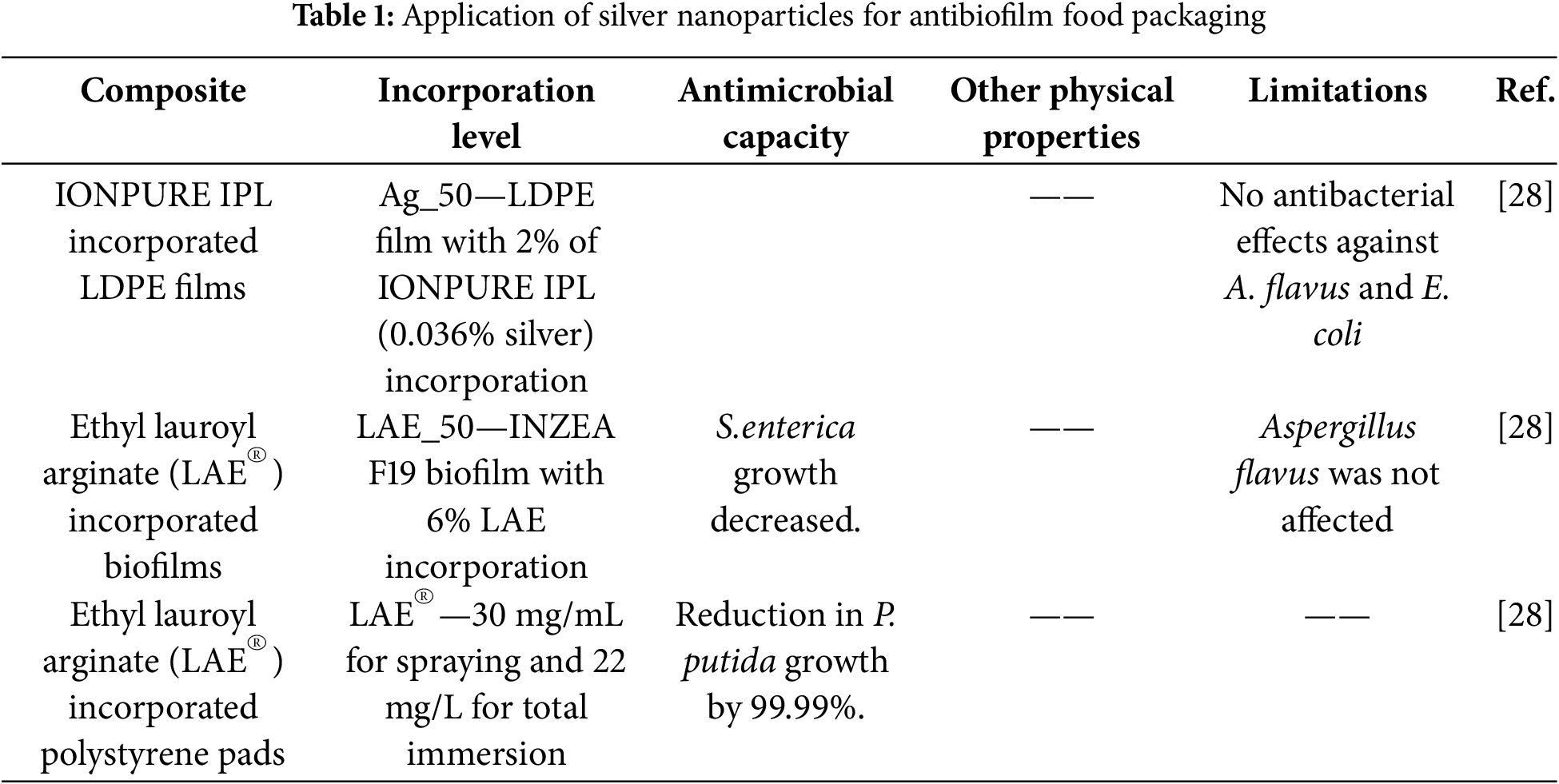
A correction has also been made to the text in Section: Silver Nanoparticles against Biofilm, Paragraph 5, which previously misrepresented the antimicrobial effects of the materials.
Corrected Paragraph
“In a study conducted by [28], the antibacterial activity of two novel active films with silver, as IONPURE IPL, and ethyl lauroyl arginate (LAE®) respectively was assessed. One of these films was fabricated by incorporating silver in a low-density polyethylene (LDPE) matrix while the other was fabricated using an LAE® incorporated biofilm material INZEA F19. While silver incorporated LDPE films showed no antibacterial activity against E. coli and Aspergillus flavus, LAE® incorporated INZEA F19 reduced the growth of Salmonella enterica (S. enterica) but did not inhibit the growth of Aspergillus flavus. Interestingly, a 99.99% reduction in growth of Pseudomonas putida was observed when active polystyrene (PS) pads incorporated with LAE® were used. Notably, LAE® retained its antibacterial action against S. enterica even after thermal treatment at 180°C for 6 and 15 min (Fig. 1) [28].”
The authors apologize for any inconvenience caused and state that the scientific conclusions are unaffected. The original article has been updated.
Cite This Article
 Copyright © 2025 The Author(s). Published by Tech Science Press.
This work is licensed under a Creative Commons Attribution 4.0 International License , which permits unrestricted use, distribution, and reproduction in any medium, provided the original work is properly cited.
 Downloads
 Citation Tools
