
 Login
Login Register
 Submit a Paper
 Propose a Special lssue
 Open Access
REVIEW

Recent Advancements in Biochar Functionalization from Crop Residues for a Green Future
1 Department of Mechanical and Industrial Engineering Technology, University of Johannesburg, Johannesburg, 2092, South Africa
2 Center for Industrial Biotechnology Research, Siksha ‘O’ Anusandhan (SOA) Deemed to be University, PO: Khandagiri, Bhubaneswar, 751030, India
* Corresponding Author: Omojola Awogbemi. Email:
(This article belongs to the Special Issue: Biochar Based Materials for a Green Future)
Journal of Renewable Materials 2025, 13(11), 2191-2233. https://doi.org/10.32604/jrm.2025.02025-0112
Received 13 June 2025; Accepted 08 August 2025; Issue published 24 November 2025
 View Full Text
 Download PDF
Abstract
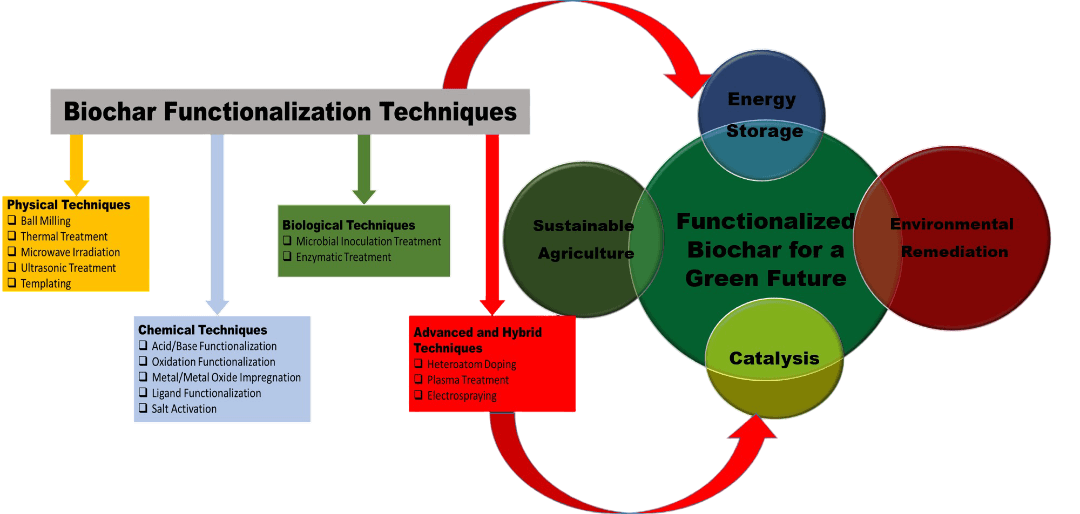
Increased human and industrial activities have exacerbated the release of toxic materials and acute environmental pollution in recent times. Biochar, a carbon-rich material produced from biomass, is gaining momentum as a versatile material for attaining a sustainable environment. The study reviews the application of functionalized biochar for energy storage, environmental remediation, catalysis, and sustainable agriculture, aiming to achieve a greener future. The deployment of crop residues as a renewable feedstock for biochar, and their properties, compositions, modification, and functionalization techniques are also discussed. Additionally, the avenues for applying functionalized biochar to achieve a greener future, future trends and innovations, challenges, and future research directions are highlighted. Despite the limitations of scalability, ecotoxicological risks, logistical issues, lack of characterization protocols, high production costs, poor social acceptance, and inadequate policy and regulatory frameworks, functionalized biochar offers a better surface area, improved porosity, enhanced functional groups, and higher recoverability, leading to improved performance, adsorption capacity, biodegradability, and applications in specialized fields. Future research should prioritize standardization, scalability, cost reduction strategies, expansion of application areas, integration of emerging tools such as artificial intelligence and predictive modeling, and the development of policy and regulatory frameworks, ensuring that biochar’s full potential is harnessed effectively to support a low-carbon, resource-efficient future and global sustainability goals.Graphic Abstract
Keywords
Cite This Article
 Copyright © 2025 The Author(s). Published by Tech Science Press.
This work is licensed under a Creative Commons Attribution 4.0 International License , which permits unrestricted use, distribution, and reproduction in any medium, provided the original work is properly cited.
 Downloads
 Citation Tools
