
 Login
Login Register
 Submit a Paper
 Propose a Special lssue
 Open Access
ARTICLE

Cotton Residue Biomass-Based Electrochemical Sensors: The Relation of Composition and Performance
Departamento de Química, Universidade Regional de Blumenau (FURB), Blumenau, 89012900, SC, Brazil
* Corresponding Author: Eduardo Guilherme Cividini Neiva. Email:
(This article belongs to the Special Issue: Renewable Nanostructured Porous Materials: Synthesis, Processing, and Applications)
Journal of Renewable Materials 2025, 13(10), 1899-1912. https://doi.org/10.32604/jrm.2025.02025-0130
Received 30 June 2025; Accepted 10 September 2025; Issue published 22 October 2025
 View Full Text
 Download PDF
Abstract
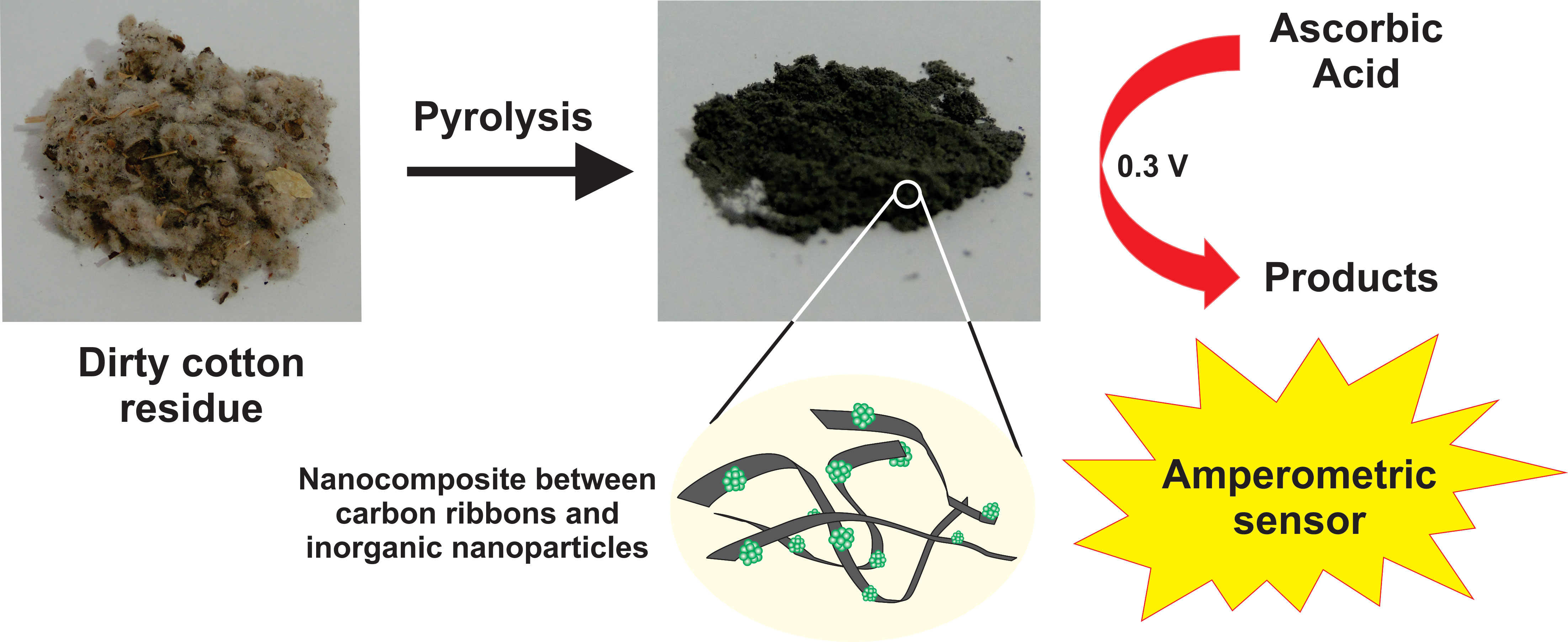
Here, we report a comprehensive study on the characterization of cotton biomass residue, its conversion into carbon-based materials via pyrolysis, and its application as an electrochemical sensor for ascorbic acid (AA). The compositions, morphologies, and structures of the resulting materials were investigated using XRD, FTIR, TGA, SEM, and EDS. Pyrolysis was carried out in an air atmosphere at different temperatures (300°C and 400°C) and durations (1, 60, and 240 min), leading to the transformation of lignocellulosic cotton residue into carbon-based materials embedded with inorganic nanoparticles, including carbonates, sulfates, chlorates, and phosphates of potassium, calcium, and magnesium. These inorganic nanoparticles exhibited irregular shapes with sizes ranging from 50 to 150 nm. The pyrolysis conditions significantly influenced both the mass ratio and the crystallinity of the inorganic phases, with treatment at 400°C for 60 min resulting in enhanced crystallinity and an inorganic content of 54.4%. The cotton biomass-based nanomaterials were used in the construction of carbon paste electrodes (CPEs) and evaluated in PBS for AA oxidation. The electrocatalytic performance increased with the inorganic nanoparticle content. Among all, the sample pyrolyzed at 400°C for 60 min demonstrated the highest sensitivity (3.31 ± 0.16 μA (mmol·L−1)−1), along with low limits of detection (2.90 ± 1.87 μmol·L−1) and quantification (9.66 ± 6.23 μmol·L−1). These promising sensor characteristics highlight the potential of cotton biomass residue as a renewable source of electroactive nanomaterials, considering the simplicity of the carbon material preparation process and the ease of electrode fabrication.Graphic Abstract
Keywords
Supplementary Material
Supplementary Material FileCite This Article
 Copyright © 2025 The Author(s). Published by Tech Science Press.
This work is licensed under a Creative Commons Attribution 4.0 International License , which permits unrestricted use, distribution, and reproduction in any medium, provided the original work is properly cited.
 Downloads
 Citation Tools
