
 Login
Login Register
 Submit a Paper
 Propose a Special lssue
 Open Access
REVIEW

Sustainable Biocomposites from Renewable Resources in West Africa: A Review
1 UPR BioWooEB, CIRAD, Montpellier, F-34398, France
2 BioWooEB, CIRAD, University of Montpellier, Montpellier, F-34398, France
* Corresponding Authors: Souha Mansour. Email: ; Marie-France Thevenon. Email:
Journal of Renewable Materials 2025, 13(8), 1547-1586. https://doi.org/10.32604/jrm.2025.02024-0078
Received 27 December 2024; Accepted 28 March 2025; Issue published 22 August 2025
 View Full Text
 Download PDF
Abstract
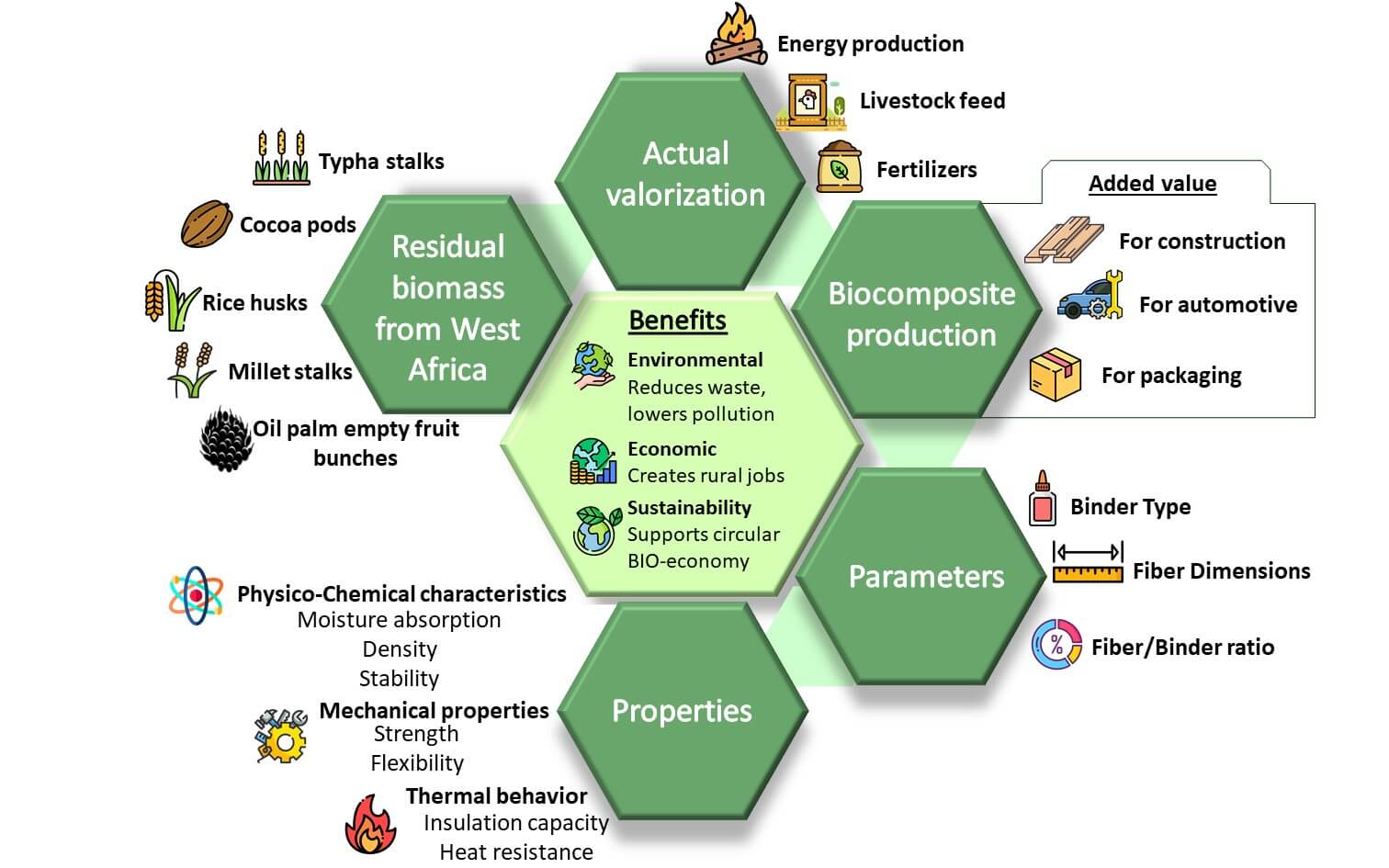
The use of agricultural residues in biocomposite production has gained increasing attention, driven by several benefits. Converting agricultural by-products into bio-based materials within a circular economy represents a sustainable strategy to mitigate lignocellulosic waste, reduce reliance on fossil resources, and lower environmental pollution. This approach also creates economic opportunities for rural African communities by generating diverse income sources for workers in collection, processing, and manufacturing. As a result, the integration of agricultural residues into biocomposites production not only addresses environmental concerns but also fosters economic growth and supports rural development. In this review, five biomasses from West Africa are examined, focusing on their production, chemical composition, physical and mechanical properties, and potential applications in biocomposites. The five biomasses listed are cocoa pod husks, oil palm empty fruit bunches, rice husks, millet stalks, and typha stalks. Key parameters, such as the type of binder, fiber dimensions, fiber-to-binder ratio, and the strength of fiber-binder adhesion, are systematically studied to assess their influence on the overall performance of the resulting composites. Special attention is given to understanding how these factors affect mechanical properties (e.g., strength and flexibility), thermal behavior (e.g., insulation capacity and heat resistance), and physico-chemical characteristics (e.g., moisture absorption, density, and chemical stability). This comprehensive analysis provides insights into optimizing composite formulations for enhanced functionality and sustainability. This study is essential to optimize the use of agricultural residues in West Africa for biocomposites, tackling waste issues, promoting sustainability, and filling research gaps on their properties.Graphic Abstract
Keywords
Biocomposites; natural fibers; agricultural residues; West African biomasses; sustainable materials; eco-friendly composites
Cite This Article
APA Style
Mansour, S., Viretto, A., Thevenon, M., Brancheriau, L. (2025). Sustainable Biocomposites from Renewable Resources in West Africa: A Review. Journal of Renewable Materials, 13(8), 1547–1586. https://doi.org/10.32604/jrm.2025.02024-0078
Vancouver Style
Mansour S, Viretto A, Thevenon M, Brancheriau L. Sustainable Biocomposites from Renewable Resources in West Africa: A Review. J Renew Mater. 2025;13(8):1547–1586. https://doi.org/10.32604/jrm.2025.02024-0078
IEEE Style
S. Mansour, A. Viretto, M. Thevenon, and L. Brancheriau, “Sustainable Biocomposites from Renewable Resources in West Africa: A Review,” J. Renew. Mater., vol. 13, no. 8, pp. 1547–1586, 2025. https://doi.org/10.32604/jrm.2025.02024-0078
 Copyright © 2025 The Author(s). Published by Tech Science Press.
This work is licensed under a Creative Commons Attribution 4.0 International License , which permits unrestricted use, distribution, and reproduction in any medium, provided the original work is properly cited.
 Downloads
 Citation Tools
