
 Login
Login Register
 Submit a Paper
 Propose a Special lssue
 Open Access
REVIEW

Sustainable Biocomposites from Renewable Resources in West Africa: A Review
1 UPR BioWooEB, CIRAD, Montpellier, F-34398, France
2 BioWooEB, CIRAD, University of Montpellier, Montpellier, F-34398, France
* Corresponding Authors: Souha Mansour. Email: ; Marie-France Thevenon. Email:
Journal of Renewable Materials 2025, 13(8), 1547-1586. https://doi.org/10.32604/jrm.2025.02024-0078
Received 27 December 2024; Accepted 28 March 2025; Issue published 22 August 2025
 View Full Text
 Download PDF
Abstract
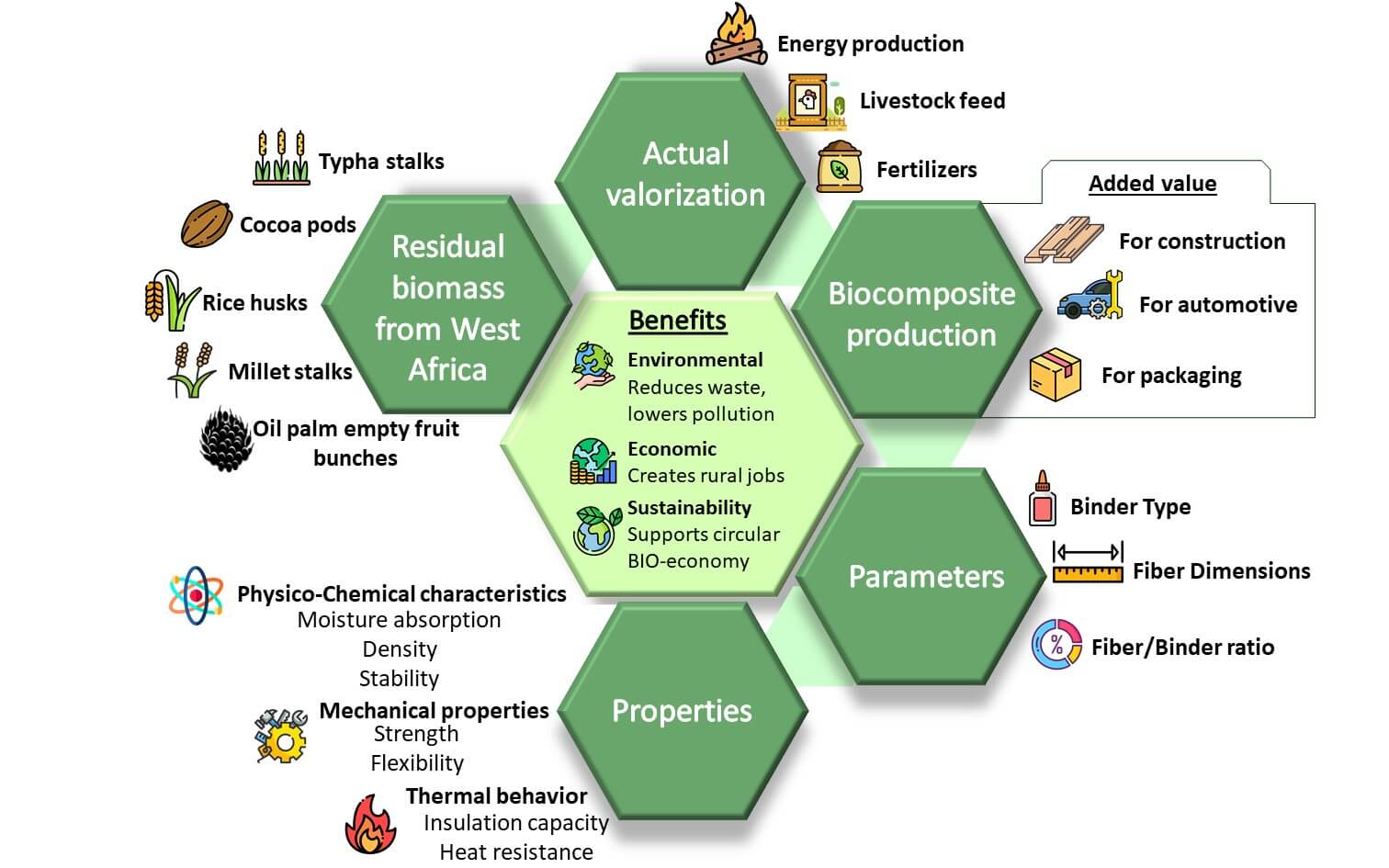
The use of agricultural residues in biocomposite production has gained increasing attention, driven by several benefits. Converting agricultural by-products into bio-based materials within a circular economy represents a sustainable strategy to mitigate lignocellulosic waste, reduce reliance on fossil resources, and lower environmental pollution. This approach also creates economic opportunities for rural African communities by generating diverse income sources for workers in collection, processing, and manufacturing. As a result, the integration of agricultural residues into biocomposites production not only addresses environmental concerns but also fosters economic growth and supports rural development. In this review, five biomasses from West Africa are examined, focusing on their production, chemical composition, physical and mechanical properties, and potential applications in biocomposites. The five biomasses listed are cocoa pod husks, oil palm empty fruit bunches, rice husks, millet stalks, and typha stalks. Key parameters, such as the type of binder, fiber dimensions, fiber-to-binder ratio, and the strength of fiber-binder adhesion, are systematically studied to assess their influence on the overall performance of the resulting composites. Special attention is given to understanding how these factors affect mechanical properties (e.g., strength and flexibility), thermal behavior (e.g., insulation capacity and heat resistance), and physico-chemical characteristics (e.g., moisture absorption, density, and chemical stability). This comprehensive analysis provides insights into optimizing composite formulations for enhanced functionality and sustainability. This study is essential to optimize the use of agricultural residues in West Africa for biocomposites, tackling waste issues, promoting sustainability, and filling research gaps on their properties.Graphic Abstract
Keywords
The search for alternatives to petroleum-based composites has gained significant attention due to their inherent drawbacks. These materials exhibit a high carbon footprint, contributing to greenhouse gas emissions, and are non-biodegradable, leading to long-term environmental persistence. For example, it is estimated that a single plastic bag could take as much as 500 years to break down [1]. Driven by growing environmental and sustainability concerns, biocomposites have emerged as a promising solution to mitigate these issues [2]. A biocomposite is a material in which at least one component, either the polymer matrix or the reinforcing fibers, originates from renewable biological sources. These materials provide notable environmental benefits and mark progress toward a more sustainable approach to material design compared to petroleum-based alternatives [3]. The use of natural fibers in composite materials has gained scientific interest due to their environmental and functional advantages.
Natural fibers, particularly those sourced from agricultural residues, offer a sustainable alternative to synthetic fibers. These fibers are biodegradable, reducing the environmental impact associated with plastic waste. Agro-waste fibers also support the principles of a circular economy by providing a renewable source of materials, thereby reducing dependence on petrochemical-based materials. The use of agro-waste not only addresses waste disposal issues but also contributes to the development of sustainable, high-performance materials with a lower carbon footprint [4]. The carbon footprint difference between glass fibers and lignocellulosic fibers is well-established; glass fibers have a carbon footprint of 1.8 t CO2-equivalent, whereas hemp fibers range bundles promoting the dispersion between 364 and 406 kg CO2-equivalent per tonne of hemp, and flax fibers had an average of 349 kg CO2-equivalent per tonne of flax [5]. Hemp fiber composites reduce greenhouse gas emissions by 10%–50% compared to their functionally equivalent fossil-based counterparts. Accounting for carbon uptake, these reductions increase further to 30%–70% [5]. The use of cellulose fibers in composites for automotive applications reduced greenhouse gas emissions by around 16% while also causing energy savings between 6.5% and 7.4% [6]. They pose lower health risks to workers compared to synthetic fibers, particularly concerning inhalation hazards. A report emphasized that natural fibers offer friendly processing, resulting in no tool wear and no skin irritation, which implies a safer working environment compared to synthetic fibers [7]. Moreover, it was reported that natural fibers can be incinerated efficiently with minimal residue. While glass fiber composites can leave behind up to 30% ash, natural fiber composites typically result in only 1%–2% ash. This reduction in residue reduces the environmental burden of incineration and simplifies disposal, making natural fibers a more eco-friendly option [8]. Finally, their lower cost and reduced specific weight compared to synthetic fibers contribute to lighter composite materials, leading to decreased transportation costs and energy consumption during production. Lotfi et al. [9] showed that the unit price of most natural fibers is also by far lower than that of glass and carbon fibers (natural fibers values are between 0.5 and 2.5 $/kg-while carbon fibers prices between 8 and 11 $/kg and glass fibers between 2 and 3.5 $/kg). For example, Joshi et al. [10] stated that natural fibers presented up to 30% weight reduction compared to glass fiber composites.
Functionally, natural fibers provide excellent thermal and acoustic insulation, making them highly suitable for use in applications such as construction and automotive manufacturing. A study has shown that jute and pineapple fibers offer thermal conductivity values between 0.038 and 0.055 W/m · K, and 0.035 to 0.041 W/m · K, respectively, making their thermal insulation performance comparable to that of synthetic materials [11]. Despite their advantages, natural fiber-based composites exhibit certain limitations that restrict their range of applications. A key limitation is that, with few exceptions, most natural fibers do not match the mechanical performance of synthetic fibers like glass fibers. For instance, glass fibers exhibit tensile strength values ranging from 2000 to 3000 MPa, whereas most natural fibers (flax, hemp, jute, sisal, etc.) fall within the range of 50 to 1000 MPa [12]. Additionally, they are susceptible to degradation, although this can be mitigated through appropriate treatments. Another challenge is their tendency to absorb water, leading to swelling and potential dimensional instability [12]. Le Bourhis et al. [13] reported tensile strength values of 0.7 GPa for hemp fibers and 3 GPa for glass fibers, also noting that hemp fibers are hydrophilic, unlike glass fibers.
There are three classes of natural fibers: i) plant-based, which are the most abundant, like ramie, cotton, and flax, ii) animal-based like wool and silk, and iii) mineral-based fibers like asbestos. Various classification systems exist for plant-based fibers. Depending on their primary use, fiber-producing plants are categorized into two types: i) primary plants that are cultivated for their fiber content (e.g., jute, hemp, flax, and sisal), and ii) secondary plants where the fibers are a by-product (e.g., pineapple, oil palm, and coir). Classified by the plant part from which they originate, plant-based fibers fall into six categories: bast fibers (e.g., jute, flax, hemp, ramie, and kenaf), leaf fibers (e.g., abaca, sisal, and pineapple), seed fibers (e.g., coir, cotton, and kapok), core fibers (e.g., kenaf, hemp, and jute), grass and reed fibers (e.g., wheat, rice, and corn), and other fibers derived from wood [14].
The chemical composition of natural fibers varies depending on the plant part from which the fibers are derived, the specific plant species, and external factors such as soil characteristics, climatic conditions, and the developmental stage of the plant cells [15]. The lignocellulosic composition is well-documented and widely studied in the literature [14,16,17]. The main components of lignocellulosic fibers are carbohydrates (cellulose, hemicelluloses, and pectins) in combination with lignin and lower amounts of extractives and mineral elements. The interactions between hemicelluloses, cellulose, and lignin in plant cell walls contribute to the cell wall structure’s overall stability and integrity, creating a supramolecular network that affects the material’s mechanical strength and water interaction behavior.
Cellulose (Fig. 1) is the most ubiquitous and abundant polymer on the planet, consisting of a linear hydrophilic glucan polymer with D-glucopyranose units (C6H11O5) which are linked by β-(1-4)-glycosidic bonds [17–20]. The degree of polymerization (DP) depends on the origin and the treatment of the raw material, which consists of 100 to 30,000 units per chain [19]. A large number of hydroxyl groups along the chain (3 hydroxyl groups per unit) confers hydrophilic properties and also induces the formation of intra- and inter-molecular hydrogen bonds which are crucial in guiding the crystalline packing that determines the material’s physical properties [18] with areas of high order (crystalline) and low order (amorphous) [19]. The hydrogen bonds and Van der Waals interactions give cellulose a supramolecular structure, primarily composed of nanofibrils.

Figure 1: Cellobiose structure, monomer of cellulose
Hemicelluloses are complex and abundant polysaccharides found in plant cell walls, consisting of branched, heteropolymer chains made up of various sugar units, including xylose, mannose, galactose, arabinose, and glucuronic acid, linked by β-(1-4)-glycosidic bonds and additional linkages, as illustrated in Fig. 2. Hemicelluloses accounts for 15%–35% of the dry mass in both annual and perennial plants [21]. The degree of polymerization (DP) of hemicelluloses is much lower than that of cellulose, typically ranging from 50 to 300 sugar units per chain, depending on the plant source and the processing conditions. The hemicelluloses’ structure is highly branched, distinguishing it from the more linear cellulose structure. This branching contributes to its lower crystallinity and higher amorphous structure than cellulose [18]. Hemicelluloses are very hydrophilic, soluble in alkaline solutions, and easily hydrolyzed in acid [17].

Figure 2: The monomers of hemicelluloses
Lignin is a complex, three-dimensional, highly cross-linked, and amorphous macromolecule. It consists of both aromatic and aliphatic components and is hydrophobic, insoluble in most solvents, and resistant to acid hydrolysis. Lignin’s primary role in plants is to provide rigidity and structural support by binding cellulose and hemicellulose fibers within cell walls. Its synthesis occurs alongside cellulose, filling spaces between the polysaccharides. Lignin is made up of phenylpropane units and has functional groups such as hydroxyl and methoxy, however, its precise structure is not fully understood, and no method currently exists to isolate it in its native state. While lignin is resistant to microbial degradation, it becomes more susceptible to enzymatic breakdown after pretreatment. Its molecular weight varies between 1000 and 20,000 g/mol, but the degree of polymerization is difficult to measure due to its fragmentation during extraction [17]. Lignin’s structure originates from three monolignols: p-coumaryl alcohol, coniferyl alcohol, and sinapyl alcohol, upon polymerization, these alcohols form p-hydroxyphenyl (H unit), guaiacyl (G unit), and syringyl (S unit), respectively (Fig. 3). The structure and bonding of lignin units vary significantly based on plant species, age, type, and growing conditions [22].

Figure 3: Lignin unit molecular structure
In addition to the three main components, minor constituents such as pectins, extractives, and inorganic compounds are also present. Pectins refer to a group of heteropolysaccharides found in the middle lamella, primarily composed of polygalacturonic acid. Pectins contribute to plant flexibility and become water-soluble only after partial neutralization with alkali or ammonium hydroxide [17]. Extractives are classified based on their solubility in specific solvents and are categorized into three groups: water-soluble, toluene-ethanol-soluble, and ether-soluble extractives. Although present in small quantities, the amount of extractives varies significantly depending on plant species, age, storage conditions, and extraction method. Inorganic compounds include silica, metal oxides, phosphates, and other trace elements [23].
The mechanical properties of natural fibers are affected by the cellulose content, the degree of polymerization of cellulose and the microfibrillar angle. For example, high cellulose content and cellulose microfibrils that are more aligned in the fiber direction lead to higher mechanical performances. Table 1 resumes the physical and mechanical properties of some natural fibers [12].

As illustrated in the table above, the mechanical properties exhibit substantial variation among the different types of biomasses. These variations have a significant impact on the overall properties of the composite material. In composite materials, fibers primarily bear the mechanical load, contributing to the composite’s stiffness and strength. The polymer resin holds the fibers in place and facilitates load transfer from fractured or weaker fibers to intact ones, helping maintain the composite’s structural integrity. A third crucial factor affecting the properties and behavior of the composite is the fiber/matrix interface. When working with natural fibers, compatibility with the matrix is often lacking due to the presence of numerous hydroxyl and carboxyl groups in key components such as cellulose, hemicelluloses, and pectins, which render the fibers hydrophilic and polar. These fibers are typically combined with polymer matrix which are mainly non-polar and hydrophobic. This non-compatibility causes poor interfacial bonding that plays an important role in the mechanical properties of the composites [3]. In order to overcome this problem, different treatments have been developed to improve the fiber/matrix interface and they are classified into two categories. The first category includes the pre-treatments that aim to enhance the wetting and the mechanical interlocking between the composite constituents. Pre-treatments modify the roughness and the surface physico-chemistry of the fibers by extracting non-cellulosic compounds from the plant cell walls. This extraction alters inter-cellular cohesion within the fiber bundles, promoting the dispersion of fibers within the matrix. As for the second category, it consists of the functionalization of natural fibers which can be done by chemical or physical treatments. The aim of functionalization is to establish a chemical and/or physico-chemical coupling between the fibers and the matrix [15]. Table 2 shows some of the most important treatments used for natural fibers with the details that characterize each treatment.

This review focuses on the utilization of residual biomasses from major agricultural sectors in West Africa to develop high-value-added products. Five prevalent residual biomasses in West Africa have been identified as, cocoa pod husks, oil palm empty fruit bunches, rice husks, millet stalks and typha fibers. These biomasses are chosen for their significant local abundance and limited current utilization, as they primarily exist as agricultural residues, with the exception of typha which is an invasive plant present in large quantities. The disposal of these materials poses significant challenges, as they are often burned or left to accumulate on agricultural sites. In West Africa, open-field burning remains a common practice for managing crop residues. This practice leads to air quality impairment, smog, haze, and various health issues. The most common health problems affecting locals include coughing, eye irritations, headaches, nausea and skin irritation. The high prevalence of respiratory allergies indicates severe air pollution in the region [25]. From another perspective, in West Africa, the improper management of agricultural residues such as their removal or open-field burning, contributes to soil nutrient depletion and erosion, which in turn adversely affects soil fertility and agricultural productivity. This issue highlights the need for sustainable agricultural practices that not only enhance productivity but also promote environmental conservation. By repurposing these by-products in composite production, this work not only addresses waste management issues but also contributes to sustainable development in the region. This approach supports environmental conservation while creating economic opportunities for farmers and workers, fostering a transition toward circular economy practices in West Africa. Apart from rice husks, these agricultural residues are not well-documented, particularly in the context of biocomposites. Therefore, this study aims to explore their properties and current applications, shedding light on existing gaps in the research and highlighting areas that remain underexplored. By addressing these gaps, this work may pave the way for further studies and innovations in the use of these materials in biocomposite production. Most reviews either focus on a single biomass, exploring its properties and applications in detail, or they examine a specific property across different biomasses, comparing how each material performs with respect to that property. This research focuses on understanding these agricultural residues’ mechanical, thermal, and chemical properties and how they contribute to biocomposite properties, and environmental benefits, emphasizing reducing waste and enhancing eco-friendly production processes in various industries. This review highlights the potential of these agricultural residues as sustainable raw materials for high-value products while addressing the environmental and economic challenges arising from their underutilization. By examining the transformation of these residues into biocomposites, this work supports the development of eco-friendly alternatives to conventional materials, which is crucial for reducing reliance on petrochemicals and minimizing waste. Additionally, the review provides a comprehensive analysis of the processing techniques, mechanical properties, and potential applications of these agro-waste-based materials. It offers valuable insights for future research directions and industrial applications in sectors such as packaging, automotive, and construction, where there is a growing demand for renewable and biodegradable alternatives.
This review is structured into three main sections: i) the first section focuses on outlining the research methodology employed to develop this review, ii) the second section focuses on the biomasses, comprising an overview of the biomass (plant characteristics and production quantities, an analysis on the chemical composition, the physical and mechanical properties of the residual fibers, and a final section covering the current valorization., and iii) the third section examines the use of these biomasses in composites, with the composites categorized based on the binder used. This section concludes with a summary of findings, offering insights into the potential and limitations of biomass-based composites.
This work presents a literature review, following a methodology comprised of four sequential steps: formulation of research questions, study identification, selection and evaluation, and, finally, analysis and synthesis. Each of these steps is examined in detail as follows:
In order to start this work, the following questions are asked:
• What are the most abundant agricultural biomasses in West Africa that cause environmental or management challenges due to their excessive presence, and how can these be valorized in biocomposite production?
• How do the chemical compositions and morphological properties of these biomasses impact their potential applications and the characteristics of the biocomposites they produce?
• What parameters are studied in biocomposite fabrication? And how do these parameters affect the properties of the product?
• What are the gaps in the current research regarding the properties and applications of agricultural residues in biocomposites, and what areas need further investigation to optimize their use?
For this review article, a comprehensive search of relevant studies is conducted to gather information on the use of agricultural residues in biocomposite production, specifically focusing on West African biomasses. The following steps are followed for study identification:
• Databases and Information Sources: A wide range of scholarly sources is searched to ensure comprehensive coverage of the topic. These sources include: Academic databases (Google Scholar, Web of Science, and ScienceDirect). Government reports and technical papers (Reports from relevant agricultural, environmental, and industrial bodies that focus on waste management, and biomass utilization), and finally, conference proceedings.
• Search Strategy: A structured search strategy is applied to locate articles related to the conversion of agricultural residues into biocomposites. The following keywords and phrases are used: “agricultural residues”, “West Africa”, “biocomposites”, “biomass valorization”, “cocoa pod husks biocomposites”, “oil palm empty fruit bunch”, “millet stalks composites”, “typha fibers biocomposites”, “bio-sourced materials”, “sustainable development Africa”, “mechanical properties composites”. Boolean operators (AND, OR) are used to combine search terms, for example, “West Africa AND biocomposites AND agricultural residues” or “biomass valorization AND environmental sustainability”.
• Inclusion and Exclusion Criteria: The following criteria are applied to select the most relevant studies: Inclusion Criteria (Studies published in peer-reviewed journals, conference papers, and technical reports, articles focused on the use of agricultural residues in biocomposites, their properties (chemical, physical, and mechanical), environmental applications, and research articles that investigate the potential for utilizing specific West African biomasses, such as cocoa pod husks, oil palm empty fruit bunches, rice husks, millet stalks, and typha fibers). As for the exclusion criteria (articles not directly related to the use of agricultural residues in biocomposites, studies focusing on biocomposites using non-agricultural fibers or synthetic materials, and publications with limited data on the physical, mechanical, or chemical properties of the materials discussed.
• Title and Abstract Screening: The initial screening involved evaluating titles and abstracts to ensure the study’s relevance to the research questions. Studies that appear to focus on unrelated materials or lacked relevant data are excluded at this stage.
• Full-Text Evaluation: After initial screening, the full texts of the remaining articles are reviewed to assess the quality and relevance of the study. Studies are selected if they provided valuable data on the properties of agricultural residues and their use in biocomposites.
• Data Extraction: Key data points are extracted from each study, including information on the type of biomass, its chemical composition, mechanical and thermal properties, treatment methods, and its applications in biocomposites.
For study identification, a total of 136 articles were selected after a comprehensive database search, while numerous others were excluded due to a lack of relevant information. Studies are included if they i) focus on West African agricultural residues in biocomposites and ii) provide data on chemical composition of biomass and mechanical, or thermal properties of biocomposites. Studies are excluded if they i) focus on synthetic composites or irrelevant biomass types and/or ii) lack key data. The quality of selected articles was assessed based on methodological rigor, reproducibility, and data consistency. As for data extraction, only data on biomass types, properties, and applications and on composites fabricated by these materials and the parameters studied and properties are extracted and compared across studies.
Each study included in the review is analyzed for key findings on the selected biomasses (cocoa pod husks, oil palm empty fruit bunches, rice husks, millet stalks, and typha fibers). The analysis focus on: i) chemical composition by comparing the cellulose, hemicelluloses, lignin and extractives content across biomasses, ii) mechanical properties by assessing tensile strength, impact resistance, and flexibility to determine suitability for various applications, iii) thermal properties by evaluating heat resistance and insulation performance of the composites.
The studies are synthesized by identifying patterns and inconsistencies in the reported data. For example, it is found that oil palm empty fruit bunches tend to result in stronger composites, while rice husks excel in thermal properties. Common factors such as binder types and fiber treatments are also compared to see their impact on composite performance.
Finally, gaps are identified. For example, a synthesis of the studies revealed that while significant progress has been made, there are gaps in understanding the long-term performance and scalability of these biocomposites. The need for further optimization of fiber treatments and binder formulations is identified. Additionally, exploring underutilized agricultural residues could open new opportunities for waste valorization and sustainable material development.
3 Focus on Five Residual Biomasses from West Africa
The cocoa plant, from the Malvaceae family and Theobroma genus, is globally recognized as the key ingredient in chocolate production. Indigenous to the Amazon basin in tropical America, it thrives in the lush rainforests of the region. In the 1800s, it was brought to West Africa, where the tropical climate proved ideal for its cultivation, leading to widespread production in the area. The cocoa tree is classified into two primary groups: Criollo and Forastero, each distinguished by its geographic distribution, as well as unique fruit and seed characteristics. Criollo, typically cultivated on a limited scale due to its low productivity, has large red or green fruits and seeds with white or pale violet interiors, and is highly disease-prone. Forastero, which accounts for the bulk of global cocoa production, has green fruits that turn yellow when ripe and seeds with dark violet or blackish interiors, and it is much more disease-resistant. Additionally, there is a third group, Trinitario, which is a hybrid of Criollo and Forastero, combining the best traits of both [26,27].
The cocoa tree reaches 5 to 8 m in height under cultivation with a diameter of 4 to 6 m of the crown. In some cases, and under forest conditions, it can reach up to 20 m due to competition for light with other species [26]. Cocoa has a dimorphic growth pattern, meaning it develops two distinct types of growth forms. Specifically, it produces vegetative shoots, which support leaf and stem growth, and reproductive shoots, which generate flowers and fruit. This duality allows the plant to allocate resources and energy to growth and reproduction, adapting its growth strategy to environmental conditions and developmental stages. Though cocoa is typically considered shallow-rooted, its roots can reach depths of 1.5–2.0 m, with 80% located in the top 0.2–0.4 m of soil. While roots can extend laterally over considerable distances (more than 5 m), most are found within 0.5 m of the stem. The soil’s nature (structure, texture, and consistency) affects this plant’s root system [27]. The cocoa fruit is protected by the cocoa pod husk (CPH) which consists of three layers, arranged from outermost to innermost as follows: the epicarp, the mesocarp, and the endocarp (Fig. 4). The epicarp is the exterior part of the fruit, it has an oval shape with a rough and thick appearance which protects the fruit against the climate, plagues, and damage done by impact. The mesocarp is a hard-composite structure that holds the beans in place under severe conditions. And finally, the endocarp is the innermost part and it is a soft whitish tissue that protects the beans in a lubricated environment [28].

Figure 4: Cocoa tree and parts of the cocoa pod
In 2022, global cocoa bean production reached 5,875,000 t, with the Côte d’Ivoire contributing nearly 40% of this total, amounting to 2,230,000 t of cocoa beans [29]. The husk of the cocoa pod makes up 70% to 80% of the fruit’s dry weight. As an estimation, every ton of dry cocoa bean generates 10 t of CPH as waste and Côte d’Ivoire presents approximately 6,500,000 t of CPH to valorize [28].
Many researchers have studied the chemical composition of the CPH for possible uses as shown in Table 3.

In addition to cellulose, hemicelluloses, and lignin, other elements are present in smaller amounts. Fidelis et al. [38] reported that nitrogen constitutes 1.6% of the total solids, phosphorus 0.3%, potassium 2.5%, and magnesium 0.3%. Similarly, Vasquez et al. [34] analyzed the minor elements in the chemical composition of CPH, finding 2.77% of potassium, 0.01% of sodium, 0.11% of magnesium, 0.25% of calcium, 0.04% of manganese, 0.04% of zinc, and 0.006% of iron. Additionally, other studies have indicated small percentages of these elements, such as approximately 0.45% phosphorus, 7.2% potassium, 0.7% magnesium, 0.85% calcium, and trace amounts of manganese and iron [39,40].
The cocoa fruit is used in producing chocolate, which utilizes only about 33% of the fruit’s total weight, leaving approximately 70% of the fruit, in the form of CPH, discarded without proper treatment. While some farmers repurpose CPH as natural fertilizer, most of it goes to waste [41]. If left untreated on the soil surface, these CPH can become a source of inoculum for plant diseases, notably black pod rot. This is due to the presence of Phytophthora spp., a pathogen responsible for significant yield losses, accounting for nearly 25% of global cocoa production [42]. Leaving CPH waste on the ground significantly contributes to its carbon footprint due to anaerobic decomposition, generating methane and nitrous oxide, which account for over 85% of emissions [43]. Utilizing CPH in value-added products offers both economic and environmental benefits, enhancing the sustainability of cocoa production.
CPH can be repurposed in various industries, including soap production, papermaking, biofuel generation, and dietary fiber extraction, as detailed below [28,41,42]. CPH’s chemical composition indicates that it contains many minerals, including potassium. West African nations are benefiting from its presence by using it to produce natural soap rather than potentially carcinogenic chemical-based soaps. Every ton of fresh CPH yields six kilograms of potash, which can be concentrated and filtered for use in oil saponification to produce soap. Potash soaps made from CPH are more soluble and have greater cleaning and foaming power than chemical soaps based on potassium hydroxide. Because it gives farmers a new source of income and frees them from the quantities of waste they produce, the use of CPH in producing soap is important [44].
Numerous researchers have explored the potential of substituting wood fibers with plant-based fibers in paper production to reduce deforestation, a major driver of climate change. For biomass to be suitable for this application, it must exhibit specific characteristics. Two key factors determine its suitability: i) chemical composition—ideal biomass should have high cellulose content, contain no more than 30% lignin, and have low ash content ii) Fiber morphology—the diameter and length of the fibers are critical, as they affect paper properties such as tear resistance and strength. Depending on fiber morphology, the paper’s application varies. Shorter and thinner fibers produce pulp suitable for porous tissues, while longer fibers manufacture high-tear resistance paper. CPH meets the criteria by exhibiting both the recommended chemical composition and fiber morphology suitable for paper production. Studies have shown that CPH can be a viable alternative to wood fibers, presenting a promising solution to reduce deforestation and its associated climate impacts [28,31,42].
In light of the expanding global energy demand, efforts are being made to find inexpensive, environmentally friendly, renewable energy sources that can replace fossil fuels. Studies have been conducted to explore the properties and potential applications of CPH in bioenergy production. Amongst these researches, Mancini et al. [45] found that it is possible to use CPH to produce biogas with accumulated methane yields. Bio-oil production is also possible via a rapid pyrolysis process from this residue. Thermogravimetric analysis confirmed that CPH can serve as a viable raw material for pyrolysis [46]. Thompson et al. [47] estimated the production of bioethanol from cocoa pod husk to be around 0.28 L ethanol (kg TS)−1 which was lower than other biomasses and that is due to its high lignin content which demands additional delignification steps.
CPH contain between 52% to 74% of insoluble dietary fibers consisting of cellulose, hemicelluloses, and lignin. The insoluble dietary fibers have the ability to absorb water within its fibrous matrix. There are also the soluble dietary fibers, mainly pectin, β-glucan, and oligosaccharides. Pectin is the predominant soluble dietary fibers present in CPH. The development of soluble dietary fibers-enriched food is beneficial for weight management and dietary fiber intake deficiency since they can retain water, increase satisfaction after eating, and decrease glucose absorption in the intestines. Not many studies have investigated the role of total dietary fibers from CPH as an ingredient in food products even though CPH could contribute to the fight against hunger and malnutrition [42].
3.2 Oil Palm Empty Fruit Bunch
Oil palm, also known as Elaeis guineensis from the family Arecaceae, is a diploid monoecious perennial crop. Elaeis derives from elaion which is Greek meaning oil, as for guineensis it is attributed to the guinea coast [48,49]. The oil palm tree reaches about 7 to 13 m in height and between 45 to 65 cm in diameter at 1.5 m above the ground, with leaves of about five meters long. It takes five years for this tree to bear fruit, with a life expectancy of around 25 years [50]. Oil palms grow in tropical regions around the equator, prospering in the presence of sun and humidity; therefore, cultivated between ten degrees north and south from the equator and spread over 42 countries. During their lifespan, oil palms mainly produce oil, fruits, and large lignocellulosic agricultural wastes. In 2022, the world production of oil palm fruit is estimated to be 425 million tons with 21 million tons originating from West Africa [29]. Given that each tree yields 12 to 14 bunches weighing 120–350 kg, it is estimated that between 1 and 3 billion oil palm trees are cultivated worldwide. On average, a single oil palm tree produces about 231 kg of biomass annually, including approximately 40 kg of oil and 191 kg of lignocellulosic material [51–53]. Consequently, West Africa alone generates between 14 and 40 million tons of oil and lignocellulosic materials. There are two ways to obtain the different wastes from this plant. The first is the plantation routines such as pruning and replantation and the second is from the oil extraction mills [54]. The different fibers obtained from oil palm (Fig. 5) are as follows: oil palm trunks fibers (OPT), oil palm fronds fibers (OPF), oil palm mesocarp fibers (OPM), oil palm kernel shell (OPKS), and oil palm empty fruit bunch (OPEFB) [55]. Oil palm fronds (OPF) accounts for 70% of the total oil palm biomass, while oil palm empty fruit bunches (OPEFB) make up 10%, equivalent to approximately 12.4 million tons, and oil palm trunks (OPT) contribute just 5%.

Figure 5: Different types of fibers obtained from an oil palm tree
With almost 15 million tons produced per year, the OPEFB fibers are gaining more interest due to their abundance, renewability, non-toxicity, and low cost [56].
3.2.2 Chemical Composition of Oil Palm Empty Fruit Bunch
Similar to other lignocellulosic biomasses, oil palm empty fruit bunch (OPEFB) is primarily composed of cellulose, hemicelluloses, lignin, ash, and extractives. Several factors influence the composition of these components in OPEFB. For instance, the geographical region significantly impacts the chemical composition, as soil characteristics and environmental conditions vary. Plus, the plant maturity, the species, and the extraction process are all factors that affect the proportions of the listed components inside the OPEFB fibers [51]. Generally, the proportions in OPEFB fibers are as follows: 40%–50% for cellulose, 20%–30% for hemicelluloses, and 10%–15% for lignin with 10% to 15% moisture content. These quantities are detailed in Table 4 based on different studies. In addition to cellulose, hemicelluloses, and lignin, there are other components in minor percentages like arabinose, xylose, mannose, galactose, silica, copper, calcium, manganese, iron, and sodium [57].

3.2.3 Physical and Mechanical Properties of Oil Palm Empty Fruit Bunch
Just like the chemical composition, physical and mechanical properties of the fibers are also affected by the same factors since this composition impairs in mechanical properties. Other factors are also important, such as microfibril angle, cell dimensions and defects, cellulose and crystalline organization, and fiber cell structure’s crystal/amorphous nature [51,57]. Table 5 lists the different values obtained for the different physical and mechanical properties of OPEFB.
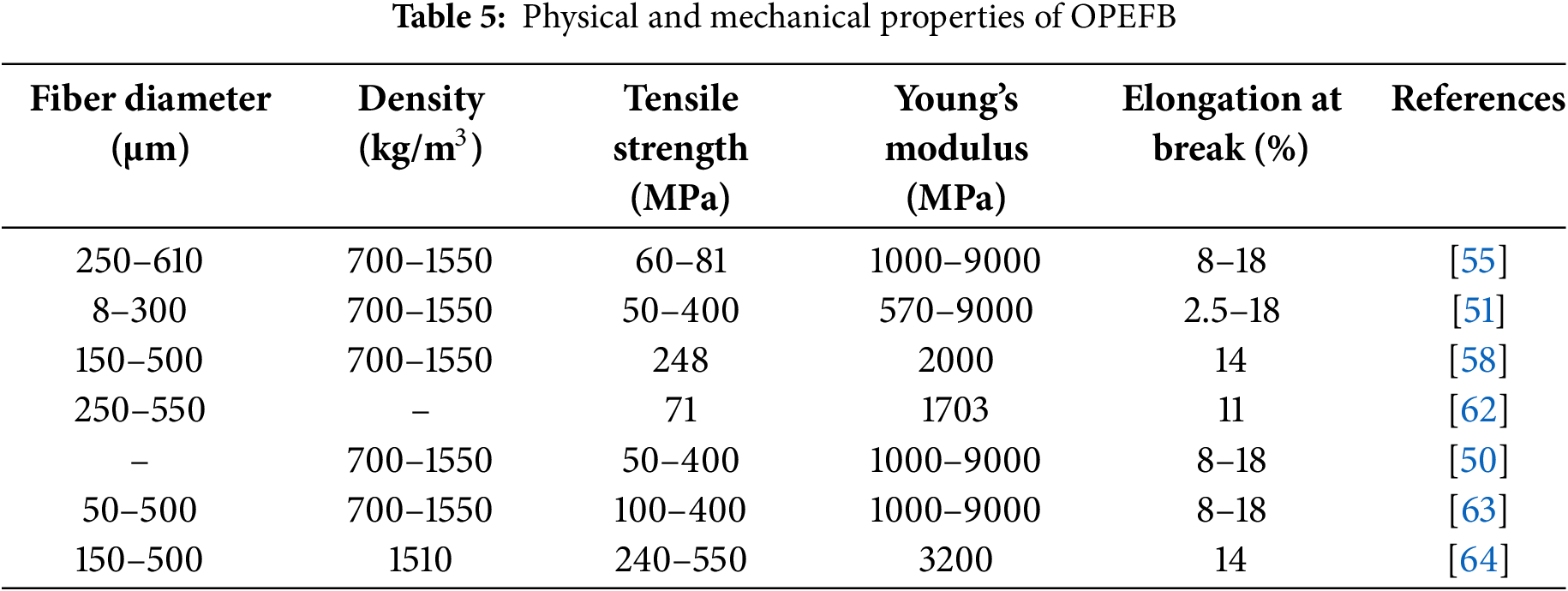
OPEFB fibers vary in length from 0.9 to 280 mm, comprising a mix of both short and long fibers [65]. Danso et al. [66] reported a fiber length of 38 mm. Ramlee et al. [67] mentioned that the value is somewhere between 10 and 20 mm. On the other hand, Abdul Khalil et al. [51] stated that OPEFB fibers can stand between short and long fibers with values going from 0.89 to 142 mm. OPEFB fibers have an average diameter of approximately 300 µm, with density values remaining consistent across studies. Regarding mechanical properties, reported values for Young’s modulus range from 1000 to 9000 MPa. Studies show significant variability in the physical and mechanical properties of OPEFB fibers. These discrepancies can be attributed to variations in fiber extraction methods, testing techniques, and environmental conditions. While some properties, such as density, remain relatively consistent, others, like tensile strength and Young’s modulus, show significant variation, emphasizing the need for standardized characterization methods.
The vast amount of waste generated by the oil palm industry poses significant disposal challenges. Generally, oil palm biomass is used as fuel, mulch, and fertilizer by burning it into ash. Traditionally, OPEFB was primarily disposed of through incineration at palm oil mills, with the resulting ash recycled as fertilizer for plantations. However, this method has largely been abandoned due to its detrimental environmental effects, especially air pollution [68]. In recent years, alternative methods such as using OPEFB as a soil improver and for co-composting have gained traction in Indonesia. Despite these developments, fully converting OPEFB remains essential to protect the environment and ensure the sustainability of the palm oil industry.
The structural composition of OPEFB fibers comprises a complex matrix of cellulose, hemicelluloses, and lignin, collectively forming lignocellulosic material. This material is an excellent source of fermentable sugars, making it highly suitable for conversion into valuable products. Cellulose and hemicelluloses can be broken down through acid or enzymatic hydrolysis, producing glucose along with various pentose and hexose sugars. These sugars can then undergo fermentation to produce bioethanol [69]. Bioethanol produced from OPEFB had higher values (0.41 L ethanol (kg TS)−1) than that of CPH (0.28 L ethanol (kg TS)−1) [47].
Rice originates from the Germineae family and the Oryzae genus. Among nearly twenty species, only two are widely cultivated: Oryza sativa L. the Asian rice, and Oryza glaberrima Steud., which is African rice [70]. O. sativa is now cultivated globally, as for O. glaberrima, it is limited to the West African region. To benefit from the best qualities of these two species, breeding of the two was realized which gave birth to new varieties entitled NERICA rice (new rice for Africa) that are well spreading in many regions in Africa. Given the widespread distribution of Oryza species, geographic origin alone is not a reliable criterion for species identification. Consequently, the distinction between Oryza sativa and Oryza glaberrima is characterized by the latter’s more strictly annual growth habit, in contrast to the former, which exhibits greater flexibility in its life cycle. Additionally, O. glaberrima lacks secondary branching on the primary branches of the panicle, a feature present in O. sativa. Furthermore, the ligule length differs between the species, with O. sativa typically having a longer ligule, whereas O. glaberrima has a shorter, more rounded ligule [71]. These differences in species also influence rice husk characteristics. For example, species with higher silica content makes them more suitable for industrial applications such as silica extraction, cement additives, and insulation materials [71]. In contrast, other species may contain slightly higher levels of lignin and cellulose, which can make them more useful for biofuel production, biodegradable packaging, or animal feed. The structure and density of rice husks can impact their combustion efficiency and thermal insulation properties, which are important factors in energy applications. Optimizing rice husk utilization across industries requires understanding variations in panicle length, grain length, and width, as these factors influence the physical and chemical properties that determine their potential applications. Rice varieties with longer and wider grains tend to have thicker husks, which can contribute to higher silica content, making them more suitable for industrial uses such as silica extraction and cement additives. Rice varieties with smaller grains often produce thinner husks with greater surface area, enhancing their efficiency in biofuel combustion and insulation. Husk thickness and density also impact mechanical properties, determining their suitability for applications such as biodegradable materials, animal bedding, and agricultural mulching. Grain morphology influences husk composition and is a crucial factor for optimizing its utilization across various industries.
A typical rice plant averages around 1.2 m in height, although notable exceptions exist. Dwarf mutants, for instance, reach only 0.3 to 0.4 m, while certain floating varieties can attain heights exceeding 7 m. The plant consists of round and hollow stems, flat leaves, roots, and panicles made up of spikelets (Fig. 6). The roots are fibrous and relatively shallow helping the plant to absorb water and nutrients. The stem, or culm, comprises a series of nodes and internodes. The node bears a leaf and a bud that might give rise to a tiller. The internodes are hollow with a smooth surface, their length varies along the culm typically increasing the length from the base of the plant upwards. As for the leaves, they grow one on each node, and the last leaf wrapping the panicle is called the flag leaf. Eventually, the panicle is carried on the previous internode and it carries the spikelets, and based on its length, shape, and angle the variety can be identified [70].

Figure 6: Rice plant
Rice has historically been the primary food source for nearly half of the global population, playing a crucial role in the sustenance of billions of people. Covering approximately 1% of the Earth’s surface, rice cultivation is a significant agricultural activity worldwide. In terms of production volume, rice ranks as the third most produced agricultural commodity globally, after sugarcane and maize. In 2022, global rice production reached nearly 780 million tons, underscoring its importance not only as a staple food but also as a vital component of global food security and agricultural economies. Asia is the dominant contributor to global rice production, accounting for 90% of the total, while Africa contributes 5.1%. Within Africa, West Africa is the most productive region, generating approximately 22 million tons of rice in 2022. The principal rice-producing countries in this region include Nigeria, Mali, Guinea, Senegal, and Côte d’Ivoire [29]. The rice kernel is composed of endosperm, husk, bran, and germ. The endosperm makes up 70% of the whole seed weight, rice husk accounts for 20%, rice bran for 6% to 8%, and rice germ for 1% [72]. This means for every 1000 kg of rice paddy there are 200 kg of husk. So, for a global estimation of the quantity produced in 2021, there are almost 158 million tons of rice husk. Rice husk, also known as rice hull, is the tough, protective outer layer of the rice grain, which is removed during the milling process. This by-product is generated in large quantities annually, in rice-producing countries. While rice husk is often considered agricultural waste, its improper disposal, particularly through burning, poses significant environmental concerns. Disposing of rice husk results in the release of harmful gases, such as carbon dioxide while burning, and methane if landfilling was applied, which contribute to air pollution and exacerbate global warming. Additionally, the combustion process generates ash, which can contain silica and other particulate matter that further contaminates the air and contributes to respiratory problems in humans and animals [73]. Given these environmental risks, it is crucial to explore sustainable alternatives for rice husk management.
3.3.2 Chemical and Physical Properties
Rice husk (RH) is tough, has abrasive resistance behavior, and silica-cellulose structure. The length of RH typically ranges from 8 to 10 mm and the bulk density was found to be between 100 to 160 kg/m3. The chemical composition of RH varies depending on factors such as paddy variety, crop year, climate, geographical conditions, soil chemistry, and fertilizer use during cultivation. RH is made of 80% organic matter and 20% ash. The inorganic part is composed mainly of amorphous silica and contains traces of some alkali oxides, earth metals, aluminum, and iron. RH is generally composed of 25% to 35% of cellulose, 18% to 21% hemicelluloses, 26% to 31% lignin, and 15%–17% of ash [74–76]. RH ash is a porous, lightweight material with a high external surface area, making it valuable for diverse industrial applications. Its significance lies in its high silica content, which constitutes 87%–97% of the ash. The remaining composition includes minor amounts of other oxides, such as potassium oxide (K2O), aluminum oxide (Al2O3), calcium oxide (CaO), magnesium oxide (MgO), sodium oxide (Na2O), and iron oxide (Fe2O3). This combination of properties and composition enables RH ash to be used effectively in fields like construction, ceramics, and environmental management [77].
RH has gained significant attention due to its unique properties, including high silica content, lightweight structure, and porous nature making it valuable for a range of industrial applications. RH and its derivatives, such as RH ash are now utilized in energy production, construction, environmental remediation, and materials science fields. Its sustainable potential in creating eco-friendly alternatives has made rice husk a valuable resource for reducing waste and contributing to green technologies [78].
In wastewater treatment, RH has proven to be an effective, low-cost adsorbent for removing contaminants such as azo dyes and heave metals. A study on citric acid-treated RH shows that the acid significantly improved dye adsorption capacity, making it an effective solution for environmental cleanup [79]. For example, this research on the removal of Direct Red-23 dye has demonstrated that adsorption onto treated RH follows the Langmuir isotherm model, indicating monolayer adsorption. Kinetic analysis further showed alignments with Lagergren’s first-order model, with film diffusion as the primary rate-controlling step. The findings highlight the potential of RH as an abundant and inexpensive biomaterial for sustainable wastewater treatment [79]. In another case study in wastewater treatment, rice husk has been effectively utilized as a low-cost adsorbent for the removal of hexavalent chromium (Cr(VI)) from aqueous solutions [80]. The study shows that both boiled RH and formaldehyde-treated RH exhibit strong adsorption capacities, with maximum Cr(VI) removal occurring at pH 2.0. The authors also demonstrated that boiled RH and formaldehyde-treated RH achieve removal efficiencies of 71.0% and 76.5%, respectively, at an adsorbent dose of 20 g/L. Given its abundance and cost-effectiveness, untreated boiled RH offers a practical and sustainable solution for small-scale industries in rural areas where conventional materials like activated carbon may not be readily available.
The high cellulose and lignin content, coupled with the naturally porous structure of RH, makes it an excellent material for producing activated carbon. These characteristics enhance its adsorption capacity, making it suitable for diverse applications, including filtration, purification, and environmental remediation [81]. The lignin content in RH makes it an excellent candidate for fertilizer applications, as its slow decomposition rate allows for a gradual release of nutrients into the soil. This extended breakdown process improves soil structure and contributes to long-term soil fertility, making RH a valuable organic amendment in agricultural practices [82].
Its porous nature plays a key role in enhancing the thermal insulation properties of the manufactured bricks. Beyond bricks manufacturing, RH is applied in other materials production, such as cement, and particleboards. Its combination of a lightweight, fibrous structure and high silica content makes it particularly suitable for improving construction materials’ durability, insulation, and sustainability [83]. Additionally, RH-based materials offer thermal and acoustic insulation, contributing to energy efficiency and reducing the environmental impact of construction projects. The higher the porosity of the RH, the more effective the bricks are at reducing heat transfer, making them ideal for energy-efficient construction. This enhances insulation performance, promoting stable indoor temperatures and lowering energy consumption in buildings. Zeolites are also produced from rice husk due to their content of silica (20%) [84]. In India, RH ash has been effectively utilized as a pozzolanic material in concrete, enhancing its durability and strength. The study has demonstrated that incorporating RH ash into cement mixtures improves compressive strength and resistance to sulfate attacks. Taiwo et al. [85], examined the effects of partially substituting ordinary Portland cement with RH ash on concrete durability against sulfate attack. The results indicated that RH ash concrete significantly reduced deterioration when subjected to sulfate attack, highlighting its effectiveness in enhancing concrete durability.
The millet plant encompasses a diversity of species, including, most notably, Pearl millet (Pennisetum glaucum (L.) R. Br.), Finger millet (Eleusine coracana (L.) Gaertn), Foxtail millet (Setaria italica (L.) Beauv), and Proso millet (Panicum miliaceum (L.)). Pearl millet is the most widely cultivated millet species [86], it belongs to the family Poaceae, the genus Pennisetum, and the species glaucum. It originated in West Africa and later spread to Eastern Africa and India [87]. In 2021, global millet production was estimated at 29.5 million tons, cultivated across approximately 30 million hectares. Africa emerged as a major contributor, producing nearly 40% of the total global millet yield. Within this total, pearl millet is the predominant species, accounting for more than half of the global millet production. Pearl millet’s significance lies in its adaptability to arid and semi-arid climates. Its exceptional drought and heat tolerance distinguish it from other cereals, making it a staple in regions like Africa and India, where growing conditions are particularly challenging [88]. Other millet species, including finger millet, foxtail millet, and proso millet, make up the remaining share of millet production, contributing to the crop’s global diversity [29]. Pearl millet ranks as the sixth most important cereal crop globally, following maize, rice, wheat, barley, and sorghum. It is an annual, warm-season crop cultivated primarily between late May and September. Pearl millet (Fig. 7) can grow to heights ranging from 1.5 to 4 m, characterized by a leafy structure. Its leaf blades measure between 20 to 100 cm in length and 1 to 7 cm in width. The plant’s inflorescence presents a spike that is typically 0.1 to 0.5 m long. The cylindrical fruit comes in various colors, including white, pearl, yellow, brown, and occasionally purple [89].

Figure 7: Pearl millet plant parts
Pearl millet grains are primarily harvested for food consumption, while the residual biomass, including the cob, stalk, and husk, is typically utilized as fodder for livestock. In cases where it is not used as animal feed, these residues are often burned on site, with minimal utilization for other valuable applications. According to Bhuyan et al. [90], the Residue-to-Product Ratio (RPR), a metric used to quantify the amount of crop residue remaining after harvest, is 0.33 for the cob, 0.3 for the husk, and 2 for the stalk of pearl millet. This means that for every kilogram of grain harvested, 2 kg of stalk are produced. Using these ratios, estimates suggest that in 2022, global pearl millet stalk production reached approximately 60 million tons, with West Africa contributing 20 million tons of husk—one-third of the world’s total. This substantial quantity of biomass, often regarded as waste, holds significant potential for alternative, beneficial applications [90]. Pearl millet grains can be processed into various food products. Known as “nutri-cereals,” they are valued for their rich nutritional profile, which includes high levels of protein, dietary fiber, essential minerals, and fatty acids, as well as notable antioxidant properties. Additionally, pearl millet is a suitable option for individuals with celiac disease or gluten sensitivity, as it is naturally gluten-free [91].
3.4.2 Chemical and Physical Properties
The chemical composition of pearl millet stalks has been relatively understudied, as research has largely concentrated on major crops such as maize and wheat.
Consequently, pearl millet stalks have received less scientific attention. However, Yadav et al. [88] highlighted that the chemical composition varies significantly between different parts of the stalk, which include the core, sheath, and outer dry leaves. They stated that the cellulose content in the sheath and the leaves are 39.7% and 44.2%, respectively. Hemicelluloses levels were found to be 19.1% in the sheath, and 26.02% in the leaves. Lignin was of 29.5% in the sheath and 9.87% in the leaves and finally for the ash content it was found to be 11.42% and 13.26% for the sheath and leaves, respectively [88]. The core values by Yadav et al. are presented in Table 6 alongside the values obtained by other researchers.

The same goes for the physical properties, where not many studies are found on this subject. Babé et al. [94] found that the bulk density of millet waste fibers is 0.38 g/cm3, with fiber lengths between 2 and 5 mm and a natural water content of 8.8%. As for the rest, it consists mainly of the millet cobs or husk and not the stalk. Saeed et al. [92] worked with millet fibers with a length of 0.41 mm, a diameter of 27.1 mm, a lumen diameter of 13.31 mm, and a cell wall thickness of 7.4 mm.
In regions like Africa and India, the whole plant can be fed directly to livestock, particularly in regions where high-quality forage is scarce. Ground pearl millet biomass serves as suitable poultry feed, whereas milling the grain is typically necessary for cattle and swine to enhance digestion and nutrient absorption [95]. In addition to its role in livestock nutrition, pearl millet residues—such as stalks and husks—are commonly used as fodder, especially in dryland areas where fresh forage is limited. These residues are a vital resource, helping to sustain livestock during dry seasons [96].
In many rural communities, these by-products are repurposed for building materials, including thatching roofs and fencing, owing to their availability and insulating properties. They also serve as a source of fuel for cooking, commonly burned in traditional stoves. This production capacity makes pearl millet a viable feedstock for bioethanol, with efficiency comparable to other widely used cereal grains. With its high starch content, pearl millet is well-suited for ethanol production, supporting renewable energy initiatives, particularly in regions where it is widely cultivated and can serve as an alternative to traditional biofuel crops like corn [93].
Unlike the plants described in previous sections of this review, typha is not an agricultural residue. Typha is a perennial aquatic plant that goes by many names such as reedmace, bulrush, cattail, or corn dog grass [97]. The Typha genus in the Typhaceae family consists of almost 30 species of monocotyledonous flowering plants. Among these species, three are most common: Typha latifolia (broadleaf cattail), Typha angustifolia (narrow-leaf cattail), and Typha domingensis (tall cattail) [98]. This work will be focused on Typha australis, a variety of Typha domingensis also referred to as Typha domingensis Pers. Var. ß. Australis [99]. This genus was selected because of its high distribution volume in West Africa, where it thrives in the warm climates and wetland ecosystems characteristic of subtropical and tropical regions [100]. This plant can reach 1.5 to 2.7 m in height, and it differs from narrow-leaf cattail by having a greater number of broader, more flattened leaves. All typha species are monoecious unisexual plants with wind-pollinated flowers, which develop in dense spikes (female and male spikes). The female spike is dark or pale brown with gray dots. This spike is 16 cm long and 3 cm wide. As for the male spike, it’s narrower, longer, and situated above the female spike [98,100,101]. Up to 80% of the plant’s weight is occupied by the ribbon-like leaves which are formed by a spongy tissue that gives the plant its insulating ability [102]. Typha australis (Fig. 8) has a fibrous root system with rhizomes nearly 3.5 m long, capable of producing oxygen to sustain the plant for up to six days [103]. Typha australis reproduces through two mechanisms: (i) sexual reproduction via seed dispersal, where thousands of seeds are released from the spikes and carried by the wind, enabling long-distance propagation, and (ii) vegetative reproduction through rhizome multiplication, which facilitates rapid and extensive colonization [99].

Figure 8: The different parts of the typha plant
Typha australis is a species with a worldwide distribution, found in diverse regions and countries including Greece, Hawaii, Egypt, South Sudan, West Africa, Southern Africa, Syria, Lebanon, Palestine, Japan, and Northern India [100]. In Senegal, 150,000 T are collected per year. Cluet et al. [104] mentioned that between 300,000 to 500,000 t can be extracted per year from the Senegal river. Typha australis grows on the banks of the Senegal river and its tributaries, also in cultivated plots, and irrigation channels [102]. It grows on the banks of gently agitating streams and stagnant water up to almost one meter deep and in brackish water. In Senegal, Typha australis tolerates a high degree of soil salinity despite generally having low tolerance for saline soils. The rapid spread of Typha australis disrupts irrigation and drainage by slowing water flow and raising water levels, heightening the risk of flooding during the rainy season. Its growth obstructs canoe navigation and fishing, reducing the open water surface area. Additionally, typha has health impacts, as it promotes Bilharzia (Schistosomiasis) by creating year-round stagnant water that fosters parasite growth. It also affects livestock health, as aquatic plants like typha harbor liver fluke parasites, increasing infection risks for animals.
Given the large quantities of typha produced and its associated drawbacks, identifying beneficial applications for this biomass is crucial. There are many applications for different parts of the plant in different fields. As with many plants, various parts of typha serve as a food source, each yielding distinct products. The tender inner part of the plant can be eaten raw or boiled. In Africa, it can also be used to produce salt obtained from the ashes of burned typha. Flour and starch are made from the rhizomes of cattail, and edible oil is extracted from the seeds [99].
In France, an experiment explored converting typha leaves into ethanol, with the remaining residue repurposed for cellulose fiber and fertilizer production [99,100].
Moreover, in medicine, typha’s pollen was used as an absorbent instead of cotton, for surgeries and childbirths and also as an astringent and diuretic substance. A decoction made from typha leaves is traditionally used to treat uterine hemorrhages and bloody diarrhea. Cattail flowers are used in treating burns, wounds, and ulcers [100].
In textile applications, compared to cotton, there are almost 9 to 16 times more quantities produced per hectare per year. With these quantities, its use in textiles is more beneficial than cotton to produce clothing like jackets, hats, gloves, and in ropes, sandals, baskets, rugs, and other materials [99].
In Europe, they are used to stuff chairs and make plant coverings. In Guatemala, typha leaves are crafted into fans used for stoking charcoal fires. In New Zealand, they are manufactured into the interior walls of houses for thermal insulation purposes. In Bermuda, bedding for domestic animals is obtained from the leaves [32].
4 Biomaterials Issued from These Residual Biomasses
Agricultural residues, such as crop stalks, husks, and other plant-based by-products, are increasingly recognized for their potential as sustainable reinforcements in biocomposite materials. Often regarded as waste, these by-products present a viable alternative to synthetic fibers, promoting more sustainable manufacturing practices. Research has delved into the mechanical, thermal, and chemical properties of these agricultural residues, seeking to understand how their unique characteristics enhance the performance of biocomposites. These residues enhance composite strength and functionality while also providing environmental benefits, such as waste reduction and support for circular economy practices. As industries increasingly prioritize sustainability, incorporating agricultural residues into composite materials represents a significant step forward. This section will explore the application of the previously discussed agricultural residues, highlighting their roles as fiber reinforcements in biocomposites and their potential to support more eco-conscious production methods.
CPH is mainly used in bio-based composites for packaging [105], furnishing [106], building [107], and automotive applications [108]. The different biocomposite materials developed from CPH are presented in this section according to the used matrix.
Sanyang et al. [109] studied CPH used in a poly(lactic acid) (PLA) matrix to develop biocomposite films by solvent casting method. CPH was ground in fine particles of 250 µm, and varying fiber contents up to 15% were incorporated into the PLA matrix. The study exclusively examined the mechanical properties of biocomposite films, conducting tensile tests to assess performance. The results showed that the tensile strengths ranged from 8.9 to 10 MPa. The authors noted that “CPH/PLA films with 10% CPH loading exhibited the highest tensile strength, increasing by 12.55% compared to 0% CPH film” however no standard deviations are reported. A more balanced interpretation is warranted, as the recorded tensile strength values remained relatively stable at 8.9, 9.3, 10, and 9.6 MPa for 0%, 5%, 10%, and 15% fiber content, respectively. The stabilization of tensile strength around 9–10 MPa could be attributed to a good dispersion of the fibers in the PLA matrix helping the effective transfer of applied stress from the polymer to the fiber. The corresponding Young’s modulus values were 1.5, 3.2, 7.8, and 10.4 MPa for 0%, 5%, 10%, and 15% fiber content, respectively. These significant increases indicate that CPH provided a genuine reinforcement effect in the PLA matrix, with fiber dispersion remaining effective even at 15% content.
4.1.2 Poly (Vinyl) Alcohol (PVA)
Pua et al. [105] also studied the utilization of CPH in a new green composite film with poly (vinyl) alcohol (PVA) for packaging applications. In this study, the authors have evaluated the effect of chemical modification of CPH (through alkalization treatment), the fiber loading of CPH (up to 15%) with neat CPH and modified CPH, and the presence or absence of a plasticizer (glycerol) in PVA-based biocomposites obtained by solvent casting method. CPH fibers were crushed to approximately 250 µm in size to facilitate their incorporation in PVA-based films. The different obtained PVA-based biocomposite films were mainly characterized in terms of mechanical properties and biodegradability in soil. Regarding the tensile properties, the addition of CPH in PVA-based biocomposite decreases the tensile strength and the elongation at break, with an increase in fiber content of up to 15%. These values were better for modified CPH fibers but a similar decrease is observed with an increase in fiber content. The addition of plasticizer significantly reduced the tensile strength of the biocomposite. The authors interpreted this as the “inability of fiber and the irregularity shape of fiber to support stress which moved from the polymer to fiber”. Concerning the biodegradability of CPH/PVA composite films, it was assessed using a soil burial test, showing a 53.8% reduction in film mass after 15 days. The composite films significantly diminished in size and became fragile and brittle after 7–15 days in soil. A higher fiber content led to greater weight loss, suggesting an accelerated degradation rate. However, weight changes may be underestimated due to soil debris adhering to the film. Additionally, modified CPH fibers improved the degradation rate compared to unmodified fibers.
Imoisili et al. [110] evaluated the use of CPH in polymer composite production within an epoxy matrix, incorporating different fiber contents of 5%, 10%, 20%, and 30%. To prepare epoxy-based biocomposites, the CPH was ground to a particle size of 38 µm, and the epoxy resin was mixed with an amine-class hardener in a 2:1 weight ratio. The authors focused on the mechanical properties of the composites (tensile strength, Young’s modulus, elongation at break, and flexural strength), the micro-hardness, and the morphology. They demonstrated that tensile strength significantly decreased from 55 to 13 MPa as the CPH content increased from 0% to 30%. In terms of Young’s modulus, a slight decrease was observed between 0% and 5% CPH content, where it declined from 615 to 610 MPa. However, beyond 5%, Young’s modulus increased, reaching 639 MPa at 30% fiber content. For elongation at break, a substantial decrease was reported, from 12.5% to 4.7%. Regarding flexural properties, flexural strength declined significantly from 51 to 25 MPa as the CPH content increased, whereas the flexural modulus increased from 1460 to 1740 MPa. The micro-hardness showed an increase from near 15 to 18 HV when the filler content went from 0% to 30%. Finally, the dispersion of CPH in the matrix was shown using scanning electronic microscopy (SEM) micrographs where it was observed that a 5% filler loading exhibited the best dispersion, while higher filler contents led to poorer dispersion.
4.1.4 Thermoplastic Polyurethane (TPU)
El-Shekeil et al. [111] investigated the effect of three CPH filler contents (20%, 30%, and 40%) in a thermoplastic polyurethane (TPU) matrix to understand their effect on the mechanical and morphological properties of the composite. The different CPH/TPU formulations were blended using an internal mixer at 190°C and the biocomposites plates were shaped using a hot press technique. Results showed that for increasing fiber content from 20% to 40%, tensile strength increased (from 18.5 to 21 MPa), Young’s Modulus increased (from 212.5 to 327.9 MPa), tensile strain decreased (from 31% to 14%), flexural strength increased (from 13 to 18 MPa), flexural modulus increased (from 565 to 867 MPa), and finally impact strength decreased (from 12.6 to 6.1 kJ/m2). SEM analysis confirmed strong interfacial bonding, as indicated by the absence of fiber pullouts and gaps between the fibers and the matrix.
Chun et al. [112] studied the use of CPH in polypropylene-based biocomposites as a solution to replace wooden fittings, fixtures and furniture, reducing the forest consumption in cutting trees. They investigated the effect of maleated polypropylene (MAPP) addition in polypropylene (PP) matrix, where MAPP acts as a coupling agent to enhance biocomposite properties. They focused on mechanical, thermal, and morphological properties of polypropylene-based composites obtained by melt blending process. CPH was ground in powder with an average particle size of 22 µm prior to their use in PP matrix by melt blend process. The authors fabricated composites with varying filler contents of 10, 20, 30, and 40 phr (parts per hundred resin), both with and without MAPP. As expected, they found that the increase in CPH content decreased tensile strength (from 20 to 15 MPa) and the elongation at break (from 30% to 12%) while increasing the tensile modulus (from 800 to 1100 MPa). For composites with 10 phr of CPH, they found that the addition of MAPP improved significantly tensile strength (24.5 vs. 20 MPa without MAPP) and modulus (950 vs. 800 MPa without MAPP) values than the composites without MAPP. Concerning the thermal stability, CPH induced an early onset of thermal decomposition (Tonset5%, temperature at 5% weight loss) whatever the CPH content, but demonstrated increased thermal stability at higher temperatures and that was proven by the higher residue % at 700°C (2.69% for 20 phr of CPH without MAPP vs. 1.22% for neat PP). Additionally, they found that the incorporation of MAPP enhanced the thermal stability of the composites, for example for PP/20CPH as indicated by higher Tonset5% (Tonset5% = 283°C with MAPP vs. Tonset5% = 272°C without MAPP), Tdegmax (decomposition temperature at maximum rate) for the same composite (Tdmax = 443°C vs. Tdmax = 422 without MAPP), and increased residue content at 700°C (3.7% vs. 2.69% without MAPP). SEM micrographs revealed poor dispersion and agglomeration of CPH particles in the PP matrix, indicating the incompatibility between hydrophilic CPH and hydrophobic PP, whereas PP/CPH biocomposites with MAPP displayed CPH particles embedded and coated by the PP matrix. This improvement was attributed to the incorporation of MAPP, which enhanced interfacial interaction between the CPH particles and the PP matrix.
The same authors presented another study [113] for PP/CPH composites without MAPP, and instead used fiber treatment: mercaptopropyltrimethoxysilane (MPS) and sodium dodecyl sulfate (SDS). Therefore, the purpose of the study was to compare the effect of the two different filler treatments on torque development, tensile properties, water absorption, thermal properties, and morphological properties of the composites. Similar composites with varying filler contents of 10, 20, 30, and 40 phr (parts per hundred resin), both treated and untreated CPH fibers. As in the previous study, the tensile strength and elongation at break of PP/CPH composites decreased with increasing CPH content, while processing torque, tensile modulus, water absorption, and crystallinity increased. Thermal decomposition was also influenced by CPH content. MPS or SDS presence improved the processing torque, tensile strength, tensile modulus, water resistance, crystallinity, and thermal stability of the PP/CPH composites, due to enhanced filler–matrix adhesion achieved through filler treatment. SEM analysis confirmed that CPH treated with MPS or SDS exhibited improved filler dispersion and interfacial adhesion with the PP matrix. Notably, SDS treatment showed superior performance in tensile properties and water absorption compared to MPS, though both treatments resulted in similar improvements in thermal properties.
Veloso et al. [108] aimed to investigate the effects of incorporating varying levels of CPH particles into composites with a recycled low-density polyethylene (LDPE) matrix. The study analyzes the physical and mechanical properties of these composites to evaluate their suitability for construction applications. The fibers were ground using a hammer mill, and the fibers used were 0.841 mm. Five compositions were prepared, replacing LDPE with cocoa waste at 0%, 10%, 20%, 30%, and 40% by weight. The materials were mixed using a twin-screw extruder, and samples were molded in a thermal press. Density decreased from 0.81 to 0.61 g/cm³ with increased CPH content (from 0% to 40%), resulting in lighter materials, which are well-suited for construction applications. Moisture content increased but remained at low levels (0.03% for 0% CPH to 0.60% for 40%). Water absorption rose (0.17% at 0% CPH to 2.68% at 40% CPH) but was still lower compared to wood-based materials. As for the mechanical properties, the modulus of elasticity (MOE) values slightly increased with added CPH. Tensile strength dropped from 13 MPa (neat LDPE) to 3.5 MPa (40% CPH), indicating increased stiffness. Specific elongation and tenacity decreased as a result of CPH incorporation. SEM analysis revealed a non-uniform particle distribution and the formation of agglomerates, which contributed to the decline in mechanical properties. The inclusion of CPH in recycled LDPE composites results in lighter, more rigid materials with some loss of tensile strength and flexibility. These changes are attributed to the chemical properties of CPH, including its extractive and lignin content, as well as the inconsistent interaction between the matrix and reinforcement.
4.2 Oil Palm Empty Fruit Bunch
OPEFB is the interest of many researchers whether alone or mixed with other fibers to develop composite materials [55,114,115] due to its low price and its large availability. OPEFB fibers are also recognized for their excellent mechanical properties. Researchers have explored their compatibility with various types of binders, including natural, and synthetic matrices. Additionally, efforts have been made to combine OPEFB fibers with other natural or synthetic fibers, creating hybrid composites. This approach leverages the complementary properties of different fibers to achieve improved mechanical, thermal, or functional characteristics, tailoring the material for specific applications such as construction [55], automotive [116], and packaging [117] industries.
4.2.1 High-Density Polyethylene (HDPE)
Rozman et al. [118] investigated the effect of different filler loadings and the particle size of OPEFB fibers with high-density polyethylene (HDPE) composites on their mechanical properties. The OPEFB fibers were ground in three sizes (270–500 µm, 180–270 µm, and 75–180 µm), and then incorporated into the HDPE matrix using a single-screw extruder before being shaped into composite plates via compression molding. The results showed that MOE (modulus of elasticity) increased with higher filler loading, indicating improved stiffness, especially for smaller particle sizes. However, MOR (modulus of rupture) and tensile strength decreased with increasing filler content, attributed to weak interfacial adhesion between the fibers and the polymer matrix. Similarly, impact strength and elongation at break diminished as filler levels rose, due to poor wetting and fiber agglomeration. SEM micrographs revealed extensive fiber pullout and debonding, underscoring the challenges of achieving strong filler-matrix bonding. The authors concluded that smaller particle sizes are preferable for enhancing certain mechanical properties, particularly stiffness and stress resistance. Filler loading had a negative effect on properties such as tensile strength, impact strength, MOR, and elongation at break, while positively influencing stiffness and MOE. Still, further work is needed to improve interfacial adhesion, potentially through chemical treatments or compatibilizers. The findings highlight OPEFB’s potential as a low-cost reinforcement material, though optimization is required for broader applications.
Ewulonu et al. [56] investigated the use of OPEFB fiber as filler in HDPE-based composites. The study aimed to comprehensively analyze the properties of HDPE composites with OPEFB fiber, evaluate the influence of filler particle size using loadings from 0 to 1.5 wt.%, explore the impact of maleic anhydride-grafted polyethylene (MAPE) as a compatibilizer, and identify the optimal MAPE dosage for the OPEFB-HDPE composite system. The composites were prepared using three particle sizes (0.150, 0.212, and 0.300 mm) and filler loadings ranging from 0 to 1.5 wt.%. The study revealed that tensile strength and elongation at break decreased with increasing OPEFB content, attributed to poor filler-matrix interaction and particle size irregularity. Regarding particle size, smaller filler particles corresponded to higher tensile strength values. The addition of small amounts of MAPE (0.125 wt.%) significantly enhanced tensile strength, attributed to the reaction between maleic anhydride in MAPE and the hydroxyl groups of cellulose or hemicelluloses in OPEFB. Additionally, MAPE’s long polymer chains improved compatibility with the matrix through physical entanglement, strengthening fiber-matrix bonding. The elongation at break of OPEFB/HDPE composites significantly improved with the addition of MAPE compatibilizer. However, a decrease in elongation at break was observed at higher MAPE content (0.62 to 0.75 wt.%). The use of MAPE as a compatibilizer reduced the water absorption of OPEFB/HDPE composites, regardless of the OPEFB particle size. The incorporation of OPEFB fiber did not effectively reduce the flame propagation rate of HDPE. However, adding MAPE to the composite system reduced the burning rate of the composites.
Zuhri et al. [119] investigated the tensile and flexural properties of OPEFB/Epoxy composites which contained four different fiber contents (5%, 10%, 15% and 20%). The fibers were ground into 10 to 20 mm of fiber length. Epoxy and hardener were mixed with a ratio of 4:1 to form the epoxy matrix. The fibers were incorporated into the epoxy matrix, and the resulting mixtures were molded into open molds to produce tensile test specimens measuring 200 mm in length. The tensile properties obtained were best for 5% fiber loading with the highest value of 29.9 MPa. The Young’s modulus of the composite material was higher at 5% fiber content compared to pure epoxy. However, as the fiber content exceeded 5%, Young’s modulus decreased, indicating that 5% was the optimal fiber volume fraction. The composites exhibited lower flexural strength than the binder, and fiber content had minimal influence. The highest flexural strength was recorded at 10 vol% (51 MPa), compared to 40.9 MPa at 5 vol%. The same behavior was seen for the flexural modulus where it decreased with the increasing fiber loading. The authors identified void formation, fiber length, fiber dispersion, and fiber-matrix interfacial adhesion as key factors influencing the mechanical properties of the composites.
Several studies [55,114,115] have focused on investigating hybrid composites, exploring configurations that incorporate fully biodegradable fibers as reinforcements, either exclusively or in combination with synthetic industrial fibers. These hybrid composites aim to leverage the environmental benefits of biodegradable materials while maintaining or enhancing mechanical and thermal properties by including industrial fibers. By combining these two types of fibers, researchers seek to optimize the balance between sustainability and performance, addressing challenges related to mechanical strength, durability, and degradation rates. The dual-fiber approach may also offer insights into material synergies that enhance the lifecycle and application potential of the resulting composites across various industries. Table 7 presents the different parameters and findings of authors working on cited materials. The fiber percentage shows the proportion of each of the fibers in the hybrid mix.

Ramlee et al. [55] concluded that hybrid composites (7OPEFB/3SCB) outperform other composites, OPEFB fibers enhance mechanical strength due to their high cellulose content, whereas SCB fibers reduce water absorption and void formation. Karina et al. [114] discovered that the physical and mechanical properties of fiberglass-reinforced polyester composites are influenced by OPEFB fiber length and loading. Shorter OPEFB fibers absorb more water and alter composite dimensions more than longer fibers. Adding OPEFB fibers reduces flexural strength and density but increases water absorption and dimensional changes. Using up to 40% OPEFB fibers results in composites with comparable flexural strength to glass fiber composites but lower density, making them a lightweight and cost-effective alternative. It should be noted that 100% GF composites had higher values of flexural strength (165.4 MPa) where on the other hand the 100% OPEFB composites had much lower values (36.8 MPa). Jawaid et al. [115] demonstrated that incorporating woven jute fibers into pure OPEFB composites significantly enhanced their tensile and flexural properties. The arrangement of layers (OPEFB/Jute/OPEFB and Jute/OPEFB/Jute) significantly influenced performance, with the Jute/OPEFB/Jute configuration yielding the best results. Among all the tested composites, pure woven jute composites achieved the highest tensile and flexural properties. Pure jute-based composites exhibited higher flexural strength (75.5 MPa) compared to pure OPEFB composites (41.7 MPa). However, the opposite trend was observed for impact strength, with OPEFB composites showing higher values (92.7 J/m) than jute composites (32 J/m).
RH widely studied in composite fabrication with mainly polypropylene and polylactic acid (PLA). Among the five biomasses selected for this study, RH is the most extensively researched. Researchers focused on fiber treatment, percentage, and size to determine physical, mechanical, and thermal properties, water absorption, and acoustic isolation. RH-reinforced composites are utilized in panels, particleboards, and concrete reinforcement, and play a crucial role in enhancing fire resistance and insulation in construction boards. RH naturally exhibits toughness, water insolubility, and a woody texture, coupled with notable abrasive resistance, largely due to its unique silica-cellulose structure. The outer surface of the husk is predominantly coated with a thick layer of silica, forming a protective cuticle with surface hairs. In contrast, only a small amount of silica is found in the mid-region and the inner epidermis. This structural arrangement not only contributes to its mechanical durability but also provides enhanced resistance to wear and environmental degradation [74].
Tran et al. [120] incorporated fine granulometry RH fibers (100–125 µm) in a polypropylene matrix while studying NaOH fiber treatment’s effect and the presence of maleic anhydride grafted PP (PP-g-MA) on physical, mechanical, and thermal properties. Analyzing mechanical properties was based on fiber content and PP-g-MA content. Fig. 9 shows the effect of each of the previously listed parameters on the mechanical properties.

Figure 9: Mechanical properties and the content of PP-g-MA and RH fibers—Extracted from Tran et al. [120]
The authors found that the overall mechanical performance was improved with the increase of PP-g-MA from 0 to 4 wt.% then it decreased at 6 and 8 wt% remaining better than the properties for composites without compatibilizer. For 4 wt% compatibilizer, the fiber content was changed from 0 to 120 phr (parts per hundred rubber). With that increase, the composite stiffness was improved. Stress increased with rising filler content till it was 100 phr and then decreased. The thermal conductivity showed a similar trend, which was better with compatibilizer content. It was noticed that the mass loss of PP/RH/PP-g-MA initiates at a higher temperature than that of PP/RH, with a higher mass loss rate for PP/RH and that means the composites with PP-g-MA are more thermally stable than the ones without it. To resume the findings of this study, adding PP-g-MA to composites with NaOH-treated RH (100–125 µm) and a PP matrix enhances tensile strength, flexural strength, toughness, and thermal stability. PP-g-MA effectively improves interfacial adhesion between PP and RH. With RH being abundant in Vietnam, the findings highlight its potential as a renewable resource for polymer composites [120]. Additionally, RH is widely available globally, particularly in West Africa, where similar applications could be effectively implemented.
Hidalgo-Salazar et al. [76] and Yang et al. [121] also tested the filler content on polypropylene composites and their thermal and mechanical properties. Results obtained from the two mentioned studies showed similar tendencies. Hidalgo-Salazar et al. [76] examined the morphology, mechanical, thermal, and viscoelastic properties of biocomposites to evaluate the influence of RH fractions on PP matrix properties. This research highlights the potential of utilizing RH as a reinforcement for polymer matrix composites in practical applications like the fabrication of spoons. RH particle size was found to be 0.42 mm. Three RH ratios were applied (10%, 20%, and 30%). The materials were processed using a co-rotating twin-screw extruder with volumetric feeders to blend PP and RH at calibrated ratios, forming biocomposites. The extruded strands were cooled, pelletized, and dried before being shaped into standardized specimens through injection molding. This process ensured uniform material preparation for mechanical and dynamic testing. The authors indicated that incorporating RH enhances the PP matrix’s tensile, flexural, viscoelastic properties, and thermal stability without affecting its melting process. The RH particles improve dimensional stability and reduce processing defects in PP specimens. This study highlights the potential of PP-RH biocomposites as a promising alternative material for manufacturing thermoplastic products through injection molding.
In the study of Yang et al. [121], RH was dried, blended with PP using a twin-screw extruder. The resulted compounds with filler loadings of 10–40 wt.%, were shaped into test specimens using injection molding at 200°C. The process ensured uniform composite material preparation for tensile and impact testing. They discovered that the tensile strength of the composites decreased slightly, while the tensile modulus improved with increasing filler loading and crosshead speed. Composites maintained acceptable strength up to 40 wt.% filler loading. RH serves as a biodegradable filler, reducing environmental pollution rather than acting as a strong reinforcing filler. Higher filler loading and crosshead speed made the composites more brittle, with decreased tensile and impact strength due to poor interfacial bonding. This issue could be addressed using compatibilizing agents, warranting further research. Morphological analysis showed increased filler particles and voids from particle pull-out with higher filler content.
Guna et al. [122] studied mechanical, thermal, acoustic properties, and water absorption of non-hybrid and hybrid composites mixing RH and groundnut shell with a polypropylene matrix. The composites are destined for low-cost insulating building materials. Sandwich-type prepregs of polypropylene, graphene nanosheets, and RH were compression molded, cooled, and cut into standardized test samples for analysis. The lowest thermal conductivity was that of RH/PP (0.156 W/mK) with 80% fiber content, which is explained by the lower thermal conductivity of RH than GNS (groundnut shell) and PP. Therefore, the addition of more RH caused a decrease in thermal conductivity. The better flame resistance of RH composites compared to GNS composites is likely due to RH’s higher ash content, which is flame-resistant and helps prevent the propagation of flames. Additionally, the composites absorbed 85% less water than gypsum boards, addressing a key issue with current ceiling tiles. Finally, the sound absorption properties (α: 0.11–0.48) at higher frequencies were on par with to gypsum ceiling tiles. The small particle size, higher surface area, and ash content are all reasons behind the results obtained for these hybrid composites.
PLA is one of the key polymers combined with RH to fabricate composite materials. Hua et al. [123] investigated the incorporation of RH powder into polylactic acid (PLA) to analyze the impact of fiber content and a coupling agent, maleic anhydride grafted polypropylene (MAPP), on the composite’s properties. Their study revealed that water absorption increased with higher RH content, while the inclusion of MAPP enhanced water resistance. Initially, water absorption was gradual but intensified after prolonged soaking, leading to significant alterations in the material’s properties. Additionally, the tensile strength (went from 1 to 3 MPa) and hardness of the composite improved with the addition of RH, and MAPP further enhanced mechanical properties, increasing tensile strength from 1 to 4 MPa, by promoting smoother surface interactions and better compatibility between the RH and PLA matrix. Therefore, the use of a coupling agent, such as MAPP, proves to be an effective approach to strengthening the performance of composite materials.
Wu et al. [124] developed two composite types: one with RH and PLA, and another with treated RH (tRH) and a coupling agent (PLA-g-AA) while the fiber content was changed (0, 10, 20, 30, 40 wt.%). Morphological analysis revealed strong adhesion between the tRH phase and the PLA-g-AA matrix. The better adhesion in the presence of fiber treatment and the coupling agent enhanced the thermal properties (higher Tg for PLA-g-AA/tRH than PLA/RH). Tensile tests indicated better adhesion between tRH and PLA-g-AA than between RH and PLA, resulting in enhanced tensile properties, particularly tensile strength. PLA-g-AA/tRH also exhibited better water resistance than PLA/RH. Notably, increasing RH content accelerated biodegradation, though it proceeded more slowly in treated fibers. In conclusion, PLA-g-AA/tRH composites, due to their low cost and favorable properties, are promising candidates for biodegradable filaments in 3D printing.
Research on millet stalks in biocomposites is still emerging, with limited studies available on their application. More research has focused on utilizing this waste for bioenergy rather than biocomposites [93,125,126]. Conversely, millet husk has been more extensively studied than millet stalks in composite materials [127–129].
The only identified study, to our knowledge, on the utilization of millet stalks for biocomposite application investigated the mechanical and thermal properties. In this study, Ndiaye et al. [130] manufactured composites using millet stalk fibers and Arabic gum as a binder aiming at producing insulation materials suitable for the building sector. The study analyzed the impact of millet stalk fiber size and Arabic gum content on the composites’ mechanical and thermal properties. The compressive and flexural strengths of the composites were relatively low for structural or load-bearing applications, highlighting the impact of porosity on mechanical performance. Thermal analysis confirmed the material’s efficiency in insulation panel fabrication, as indicated by its low thermal conductivity. As binder content increased, porosity decreased, leading to a notable improvement in compressive strength. In composites with 0.3 mm fibers, porosity varied between 66.3% and 81.6% with decreasing binder content, while compressive strength increased from 0.61 to 1.49 MPa as binder content rose. Additionally, thermal conductivity dropped from 0.132 to 0.098 W/m · K, and thermal effusivity declined from 228 to 183 W · K−1 · m−2 · s1/2. A similar pattern was observed in composites with a 0.7 mm fiber size, where porosity ranged from 82% to 93.4% and compressive strength increased from 0.45 to 1.37 MPa. Corresponding reductions in thermal conductivity (from 0.119 to 0.092 W/m · K) and thermal effusivity (from 200 to 168 W · K−1 · m−2 · s1/2) were also noted. Overall, increasing binder content reduced porosity, improved the mechanical properties, and caused lower thermal behavior of the composites, making them better suited for applications where higher compressive strength is necessary, although still limited for heavy structural use. The increase in fiber size increased the porosity, causing lower compressive strength values. Conversely, increasing fiber size led to higher porosity, which improved the composites’ thermal properties.
Researchers have shown increasing interest in typha fibers for their exceptional thermal insulation properties, which play a crucial role in enhancing energy efficiency in the building sector. With their highly porous structure and low thermal conductivity, these fibers present a sustainable alternative to conventional thermal insulation materials. Incorporating typha fibers into biocomposites improves both thermal insulation and mechanical properties, expanding their potential for structural and non-structural applications in construction. This section examines the potential of typha fibers in biocomposites, focusing on their thermal insulation and mechanical performance, as well as their suitability for sustainable construction practices.
Diatta et al. [131] investigated the thermo-physical and mechanical properties of Typha australis, a plant found in aquatic environments, to assess its potential use in building materials. The study examined the thermal conductivity of Typha australis alone and when mixed with other materials like cement, sand, and water. Uniaxial compression tests were conducted to assess its mechanical strength. The findings showed that incorporating up to 3% Typha australis into concrete lowered thermal conductivity but also reduced mechanical strength, resulting in a 28-day compressive strength of 0.89 MPa. The study underscored a trade-off between enhanced thermal insulation and diminished mechanical performance. The authors concluded that Typha australis is suitable for thermal insulation, especially when agglomerated for use in panels. The authors proposed investigating the thermal performance of a wall insulated with typha by analyzing its temperature evolution in comparison to a conventional wall. They also aimed to evaluate how typha insulation in social housing influences overall energy consumption.
Ba et al. [132] focused on combining clay with Typha australis fibers to develop construction materials, aiming to assess how the length and percentage of the fibers affect the thermal and mechanical properties of the composite. The study utilized fiber percentages ranging from 0% to 55%, with 15% increments, for two fiber lengths (1 and 3 cm). The porosity of Typha australis fibers was measured to be 87%, indicating a highly porous structure. Upon water exposure, surface absorption persisted for approximately 15 min. However, beyond this period, a marked increase in the water absorption coefficient was observed, reaching 350% at saturation. Additionally, the water absorption rate for Typha australis was found to be 166.7% per minute. The high porosity of the fibers influences not only water absorption but also thermal insulation properties. With a thermal conductivity of 0.06 W/m · K, Typha australis fibers are classified as excellent insulators. This low thermal conductivity suggests that Typha australis fibers are highly effective in reducing heat transfer, which was observed with their incorporation in clay material. In this study, the higher the fiber percentage was, the lower the thermal conductivity. The same goes for the length of the fibers. For fibers of 1 cm, the thermal conductivity decreased from 1.03 to 0.15 W/m · K for percentages going from 0% to 55%. For 3 cm fibers, the thermal conductivity dropped from 1.03 W/m · K at 0% fiber content to 0.11 W/m · K at 55% fiber content. Both fiber percentage and length significantly influenced the composite’s mechanical properties. At 0% fiber content, the compressive strength was 4.6 MPa. With increasing fiber content (15%–55%) and a fiber length of 1 cm, the compressive strength decreased from 4.5 to 3.9 MPa, while for a fiber length of 3 cm, it declined from 4.3 to 3.6 MPa. Similarly, the flexural strength at 0% fiber content was 1.5 MPa, reducing to 1.3–0.5 MPa with increasing fiber content for 1 cm fiber length and from 1.4 to 1 MPa for 3 cm fiber length. Although Typha australis fibers enhance thermal insulation, they slightly reduce compressive strength. However, longer fibers contribute to improved flexural strength. However, longer fibers improve flexural strength. Based on these results, the clay and typha mixture emerges as a promising composite material, particularly for thermal insulation in buildings.
Another study on typha-clay mixtures was done in order to explore how the morphology and quantity of typha affect the hygrothermal properties of typha-clay composites used in building materials. Niang et al. [133] opted for two types of cuts: transversal (T) and longitudinal (L), and two typha/clay ratios, so in total they had three formulations: L 80/20, T 80/20, and T 66/33 [133]. The study found that fiber shape had minimal impact on composite density, whereas the typha-to-clay ratio played a more significant role. Regarding thermal conductivity, T 80/20 had the lowest value (0.115 W/m · K) followed by L 80/20 (0.131 W/m · K), and the highest value was that of T66/33 (0.164 W/m · K).
Dieye et al. [134] developed construction materials by incorporating typha fibers into a clay matrix, focusing on the influence of binder content on the material’s mechanical and thermal properties. The research evaluated five different binder proportions (77.13%, 78.11%, 81.48%, 84.22%, and 84.9%). The density increased along with the binder proportion, causing the thermal conductivity to rise from 0.127 W/m · K at 77.1% binder to 0.163 W/m · K at 85%. Additionally, mechanical properties such as compressive strength improved from 0.279 to 0.796 MPa, while tensile strength increased from 0.34 to 0.969 MPa. These results demonstrate that increasing binder content positively correlates with improved mechanical and thermal performance of the typha-clay composite. Mechanically, the low compressive and tensile strengths suggest that these materials are unsuitable for standalone load-bearing applications but can function effectively alongside a structural support. Thermally, the low conductivity values confirm the material’s strong insulation capabilities.
Dieye et al. [135], in another study, focused not only on the binder content but also on the effect of granulometry on the same properties of the study mentioned earlier. For this purpose, two types of typha aggregates were mixed with clay: powdered typha, with particle sizes ranging from 5 to 0.08 mm, and defibrated typha. Under these conditions, thermal conductivity for powdered typha ranged from 0.12 to 0.275 W/m · K, while for defibrated typha, it varied from 0.085 to 0.227 W/m · K. Defibrated typha panels with 66.7% binder content exhibited approximately 40% greater insulation capacity than powder-based panels. Typha fibers are inherently porous, but grinding them diminishes this property, reducing their insulation capability. Defibrated typha composites were proven to be ductile but the powdered ones presented compressive strength values from 0.67 to 2.84 MPa. Powdered typha composites exhibited low flexural strength, whereas defibrated typha panels underwent significant deformation under maximum load without fracturing, highlighting their ductile nature. In summary, finer aggregates reduce flexural strength, while an optimal combination of typha and clay enhances compressive strength. The thermal conductivity and effusivity of typha panels increase almost linearly with binder content, and the type of aggregates significantly affects thermal conductivity. Defibrated typha sheet panels with 66.7% binder content offer 41.2% greater insulation compared to typha powder sheet panels. Thermal effusivity measurements indicate that typha panels are weakly effusive, with higher effusivity observed in panels made from powdered leaves and with increasing binder content. While these panels can reduce energy consumption in buildings, they lack water resistance [135].
The numerous advantages of natural fibers position them as excellent candidates for composite production. These fibers contribute to the creation of composites that are biodegradable, cost-effective, lightweight with low relative density, and possess high specific strength. Being renewable, they serve as a sustainable alternative to synthetic materials, making them ideal for eco-friendly applications. Various treatments can be applied to address the limitations of natural fibers, enhancing their properties and resulting in stronger, more resistant biocomposites. These treatments improve fiber-matrix bonding, reduce moisture absorption, and increase resistance to degradation, thereby significantly boosting the performance and longevity of the resulting composite materials.
In this study, five residual different biomasses issued from West Africa are selected due to their variations in chemical composition and morphological properties, which significantly impacts their applications and the characteristics of the materials produced from them.
To provide an overview, the advantages and disadvantages of each biomass are summarized to offer a comprehensive perspective on the topic:
• Cocoa pod husks (CPH) have high lignin content, which improves thermal stability. However, this also makes them rigid, requiring pretreatment and the variability in fiber size can lead to inconsistent properties.
• Oil palm empty fruit bunches (OPEFB) contain high cellulose content, enhancing strength. Their longer, flexible fibers improve impact resistance. However, their high variability in density can affect composite uniformity.
• Rice husks (RH) are rich in silica, which enhances thermal stability. However, their short, rigid fibers limit their use as reinforcement, making them more suitable as fillers. They are also highly abrasive, which can affect processing equipment.
• Millet stalks have moderate cellulose content, offering a good balance between properties. Their medium fiber length makes processing easier. However, they have lower strength than OPEFB, limiting their use in high-load applications. Additionally, millet stalks are not widely studied, resulting in limited industrial applications.
• Typha fibers are hollow and porous, making them lightweight and well-suited for insulation and sound absorption. However, their lower lignin content reduces their mechanical strength.
In biocomposites, fiber content plays a crucial role in determining mechanical, thermal, and structural properties. Increasing fiber content generally enhances strength, stiffness, and specific strength, as fibers serve as the primary load-bearing components. However, the relationship is not linear: i) At low fiber content, the matrix dominates, leading to a more flexible but weaker composite, ii) As fiber content increases, strength and stiffness improve due to better load transfer between fibers and the matrix as long as the interface properties are optimal, iii) Beyond a certain point, excessive fiber content can cause poor fiber dispersion, weak bonding, and increased brittleness.
The ideal fiber percentage varies based on fiber type, matrix material, and intended application. Higher fiber content can improve thermal stability but may also heighten moisture absorption and degradation risks if untreated.
Similarly, particle size in a composite plays a critical role in determining its mechanical and physical properties: i) Smaller particles improve strength, stiffness, and bonding, leading to better structural integrity and uniformity, ii) However, very fine particles may lead to agglomeration, reducing reinforcement efficiency, iii) Larger particles may enhance toughness but can decrease flexibility and ductility.
Biocomposite production is a complex process that demands precise selection of fiber type, size, quantity, and structure, along with strong fiber-matrix adhesion for optimal performance. Many natural fibers remain underutilized, yet they offer significant environmental benefits. Advancing research on these materials can lead to sustainable, high-performance composites, simultaneously reducing waste and promoting eco-friendly solutions.
In the context of West Africa, the use of residual biomass from this area offers significant potential to transform agricultural waste into valuable materials. Using locally available biomass to develop bio-based housing materials tackles key challenges such as waste valorization, environmental sustainability, and rural development. Designed for tropical climates, these materials prioritize eco-design principles, ensuring efficient resource use and sustainable end-of-life management. This approach creates new opportunities for waste reduction, job creation, and regional sustainability. The development of durable, efficient, and cost-effective bio-based materials paves the way for a bioeconomy in rural Africa. Future studies can further optimize these materials, explore new applications, and expand their adoption, contributing positively to both regional development and global sustainability goals. This review focuses on five types of agricultural waste, recognizing that many other regional materials hold untapped potential for biocomposite applications. Utilizing additional agricultural residues could address waste disposal challenges while facilitating the production of eco-friendly composites. The vast array of agricultural by-products offers immense possibilities for exploration, yet the full scope of their applicability remains underexplored and warrants further investigation to fully understand and optimize their potential.
Acknowledgement: The authors would like to thank “Institut National Polytechnique—Houphouët Boigny (INP-HB)” and “Assane Seck University of Ziguinchor (UASZ)” who are partners in the BIO4Africa Project, involved in biocomposites work package.
Funding Statement: This work is enlisted in the BIO4Africa Project which is funded by the European Union (Horizon 2020-No. 101000762).
Author Contributions: The authors confirm contribution to the paper as follows: study conception and design: Souha Mansour, Amandine Viretto; data collection: Souha Mansour; analysis and interpretation of results: Souha Mansour, Amandine Viretto; draft manuscript preparation: Souha Mansour, Amandine Viretto, Marie-France Thevenon, Loïc Brancheriau. All authors reviewed the results and approved the final version of the manuscript.
Availability of Data and Materials: The detailed data obtained through this study and presented in this article.
Ethics Approval: Not applicable.
Conflicts of Interest: The authors declare no conflicts of interest to report regarding the present study.
References
1. MacLeod M, Arp HPH, Tekman MB, Jahnke A. The global threat from plastic pollution. Science. 2021;373(6550):61–5. doi:10.1126/science.abg5433. [Google Scholar] [PubMed] [CrossRef]
2. Gurunathan T, Mohanty S, Nayak SK. A review of the recent developments in biocomposites based on natural fibres and their application perspectives. Compos Part A Appl Sci Manuf. 2015;77:1–25. doi:10.1016/j.compositesa.2015.06.007. [Google Scholar] [CrossRef]
3. Mitra B. Environment friendly composite materials: biocomposites and green composites. Def Sci J. 2014;64(3):244–61. doi:10.14429/dsj.64.7323. [Google Scholar] [CrossRef]
4. Dejene BK, Geletaw TM. Development of fully green composites utilizing thermoplastic starch and cellulosic fibers from agro-waste: a critical review. Polym Technol Mater. 2024;63(5):540–69. doi:10.1080/25740881.2023.2296649. [Google Scholar] [CrossRef]
5. de Beus N, Carus M, Barth M. Carbon footprint and sustainability of different natural fibres for biocomposites and insulation material. In: Carbon footprint natural fibres; 2019. p. 4–45. [Google Scholar]
6. Boland CS, De Kleine R, Keoleian GA, Lee EC, Kim HC, Wallington TJ. Life cycle impacts of natural fiber composites for automotive applications: effects of renewable energy content and lightweighting. J Ind Ecol. 2016;20(1):179–89. doi:10.1111/jiec.12286. [Google Scholar] [CrossRef]
7. Brouwer WD(Rik). Natural fibre composites in structural components: alternative applications for sisal? [cited 2025 Feb 11]. Available from: https://www.fao.org/4/Y1873E/y1873e0a.htm. [Google Scholar]
8. Latest Advancements in Sustainable Fiber Reinforcement Technologies. [cited 2025 Feb 11]. Available from: https://www.sustainablemanufacturingexpo.com/en/articles/sustainable-fiber-reinforcement.html. [Google Scholar]
9. Lotfi A, Li H, Dao DV, Prusty G. Natural fiber-reinforced composites: a review on material, manufacturing, and machinability. J Thermoplast Compos Mater. 2021;34(2):238–84. doi:10.1177/08927057198445. [Google Scholar] [CrossRef]
10. Joshi S, Drzal L, Mohanty A, Arora S. Are natural fiber composites environmentally superior to glass fiber reinforced composites? Compos Part A Appl Sci Manuf. 2004;35(3):371–6. doi:10.1016/j.compositesa.2003.09.016. [Google Scholar] [CrossRef]
11. Bravo-Moncayo L, Argotti-Gómez M, Jara O, Puyana-Romero V, Ciaburro G, Guerrero VH. Thermo-acoustic properties of four natural fibers, musa textilis, furcraea andina, cocos nucifera, and schoenoplectus californicus, for building applications. Buildings. 2024;14(8):2265. doi:10.3390/buildings14082265. [Google Scholar] [CrossRef]
12. Pickering KL, Efendy MGA, Le TM. A review of recent developments in natural fibre composites and their mechanical performance. Compos Part A Appl Sci Manuf. 2016;83:98–112. doi:10.1016/j.compositesa.2015.08.038. [Google Scholar] [CrossRef]
13. Le Bourhis E, Touchard F. Mechanical properties of natural fiber composites. In: Encyclopedia of materials: composites. Amsterdam, The Netherlands: Elsevier; 2021. p. 135–48. [Google Scholar]
14. Faruk O, Bledzki AK, Fink HP, Sain M. Biocomposites reinforced with natural fibers: 2000–2010. Prog Polym Sci. 2012;37(11):1552–96. doi:10.1016/j.progpolymsci.2012.04.003. [Google Scholar] [CrossRef]
15. Le Moigne N, Angellier-coussy H. Springer briefs inmolecular science surfaces and interfaces in Natural fibre reinforced composites. In: Fundamentals, modifications and characterization. Cham: Springer; 2017. p. 1–149. [Google Scholar]
16. Bledzki A. Composites reinforced with cellulose based fibres. Prog Polym Sci. 1999;24(2):221–74. doi:10.1016/S0079-6700(98)00018-5. [Google Scholar] [CrossRef]
17. Fuqua MA, Huo S, Ulven CA. Natural fiber reinforced composites. Polym Rev. 2012;52(3):259–320. [Google Scholar]
18. John MJ, Thomas S. Biofibres and biocomposites. Carbohydr Polym. 2008;71(3):343–64. doi:10.1016/j.carbpol.2007.05.040. [Google Scholar] [CrossRef]
19. Klemm D, Heublein B, Fink H, Bohn A. Cellulose: fascinating biopolymer and sustainable raw material. Angew Chemie Int Ed. 2005;44(22):3358–93. doi:10.1002/anie.200460587. [Google Scholar] [PubMed] [CrossRef]
20. Hassan SH, Voon LH, Velayutham TS, Zhai L, Kim HC, Kim J. Review of cellulose smart material: biomass conversion process and progress on cellulose-based electroactive paper. J Renew Mater. 2018;6(1):1–25. doi:10.7569/JRM.2017.634173. [Google Scholar] [PubMed] [CrossRef]
21. Rao J, Lv Z, Chen G, Peng F. Hemicellulose: structure, chemical modification, and application. Prog Polym Sci. 2023;140:101675. doi:10.1016/j.progpolymsci.2023.101675. [Google Scholar] [CrossRef]
22. José Borges Gomes F, de Souza RE, Brito EO, Costa Lelis RC. A review on lignin sources and uses. J Appl Biotechnol Bioeng. 2020;7(3):100–5. doi:10.15406/jabb.2020.07.00222. [Google Scholar] [CrossRef]
23. Jones D, Ormondroyd GO, Curling SF, Popescu CM, Popescu MC. Chemical compositions of natural fibres. In: Advanced high strength natural fibre composites in construction. Elsevier; 2017. p. 23–58. [Google Scholar]
24. Bogoeva-Gaceva G, Avella M, Malinconico M, Buzarovska A, Grozdanov A, Gentile G, et al. Natural fiber eco-composites. Polym Compos. 2007;28(1):98–107. doi:10.1002/pc.20270. [Google Scholar] [CrossRef]
25. Raza MH, Abid M, Faisal M, Yan T, Akhtar S, Adnan KMM. Environmental and health impacts of crop residue burning: scope of sustainable crop residue management practices. Int J Environ Res Public Health. 2022;19(8):4753. doi:10.3390/ijerph19084753. [Google Scholar] [PubMed] [CrossRef]
26. de Souza PA, Moreira LF, Sarmento DHA, da Costa FB. Cacao—Theobroma cacao. In: Exotic fruits. Amsterdam, The Netherlands: Elsevier; 2018. p. 69–76. [Google Scholar]
27. Carr MKV, Lockwood G. The water relations and irrigation requirements of cocoa (Theobroma cacao L.a review. Exp Agric. 2011 Oct 27;47(4):653–76. doi:10.1017/S0014479711000421. [Google Scholar] [CrossRef]
28. Ouattara LY, AppiahKouassi EK, Soro D, Soro Y, Yao KB, Adouby K, et al. Cocoa pod husks as potential sources of renewable high-value-added products: a review of current valorizations and future prospects. BioResources. 2021;16(1):1988–2020. [Google Scholar]
29. FAOSTAT. [cited 2022 Nov 18]. Available from: https://www.fao.org/faostat/fr/#data/QCL/visualize. [Google Scholar]
30. Dahunsi SO, Adesulu-Dahunsi AT, Izebere JO. Cleaner energy through liquefaction of Cocoa (Theobroma cacao) pod husk: pretreatment and process optimization. J Clean Prod. 2019;226:578–88. doi:10.1016/j.jclepro.2019.04.112. [Google Scholar] [CrossRef]
31. Daud Z, Kassim ASM, Aripin AM, Awang H, Hatta MZM. Chemical composition and morphological of cocoa pod husks and cassava peels for pulp and paper production. Aust J Basic Appl Sci. 2013;7(9):406–11. [Google Scholar]
32. Mansur D, Tago T, Masuda T, Abimanyu H. Conversion of cacao pod husks by pyrolysis and catalytic reaction to produce useful chemicals. Biomass Bioene. 2014;66:275–85. doi:10.1016/j.biombioe.2014.03.065. [Google Scholar] [CrossRef]
33. Titiloye JO, Abu Bakar MS, Odetoye TE. Thermochemical characterisation of agricultural wastes from West Africa. Ind Crops Prod. 2013;47:199–203. doi:10.1016/j.indcrop.2013.03.011. [Google Scholar] [CrossRef]
34. Vásquez ZS, de Carvalho Neto DP, Pereira GVM, Vandenberghe LPS, de Oliveira PZ, Tiburcio PB, et al. Biotechnological approaches for cocoa waste management: a review. Waste Manag. 2019;90:72–83. doi:10.1016/j.wasman.2019.04.030. [Google Scholar] [PubMed] [CrossRef]
35. Valladares-Diestra KK, Porto de Souza Vandenberghe L, Zevallos Torres LA, Zandoná Filho A, Lorenci Woiciechowski A, Ricardo Soccol C. Citric acid assisted hydrothermal pretreatment for the extraction of pectin and xylooligosaccharides production from cocoa pod husks. Bioresour Technol. 2022;343:126074. doi:10.1016/j.biortech.2021.126074. [Google Scholar] [PubMed] [CrossRef]
36. Campos-Vega R, Nieto-Figueroa KH, Oomah BD. Cocoa (Theobroma cacao L.) pod husk: renewable source of bioactive compounds. Trends Food Sci Technol. 2018;81:172–84. doi:10.1016/j.tifs.2018.09.022. [Google Scholar] [CrossRef]
37. Nazir N, Juita E, Amelia C, Fatli R. Optimization of pre-treatment process of cocoa pod husk using various chemical solvents. Int J Adv Sci Eng Inf Technol. 2016;6(3):403. doi:10.18517/ijaseit.6.3.848. [Google Scholar] [CrossRef]
38. Fidelis C, Rajashekhar Rao BK. Enriched cocoa pod composts and their fertilizing effects on hybrid cocoa seedlings. Int J Recycl Org Waste Agric. 2017;6(2):99–106. doi:10.1007/s40093-017-0156-8. [Google Scholar] [CrossRef]
39. Negesse T, Makkar HPS, Becker K. Nutritive value of some non-conventional feed resources of Ethiopia determined by chemical analyses and an in vitro gas method. Anim Feed Sci Technol. 2009;154(3–4):204–17. doi:10.1016/j.anifeedsci.2009.09.010. [Google Scholar] [CrossRef]
40. Donkoh A, Atuahene CC, Wilson BN, Adomako D. Chemical composition of cocoa pod husk and its effect on growth and food efficiency in broiler chicks. Anim Feed Sci Technol. 1991;35(1–2):161–9. doi:10.1016/0377-8401(91)90107-4. [Google Scholar] [CrossRef]
41. Emmanuel Oddoye OK, Christian Agyente-Badu K, EGA. Chocolate in health and nutrition. In: Watson RR, Preedy VR, Zibadi S, editors. Chocolate in health and nutrition. Totowa, NJ, USA: Humana Press; 2013. p. 1–553. [Google Scholar]
42. Lu F, Rodriguez-Garcia J, Van Damme I, Westwood NJ, Shaw L, Robinson JS, et al. Valorisation strategies for cocoa pod husk and its fractions. Curr Opin Green Sustain Chem. 2018;14(Supplement C):80–8. doi:10.1016/j.cogsc.2018.07.007. [Google Scholar] [CrossRef]
43. Ortiz-Rodríguez OO, Villamizar-Gallardo RA, Naranjo-Merino CA, García-Caceres RG, Castañeda-Galvís MT. Carbon footprint of the colombian cocoa production. Eng Agrícola. 2016;36(2):260–70. doi:10.1590/1809-4430-Eng.Agric.v36n2p260-270/2016. [Google Scholar] [CrossRef]
44. Gyedu-Akoto E, Yabani D, Sefa J, Owusu D. Natural skin-care products: the case of soap made from cocoa pod husk potash. Adv Res. 2015;4(6):365–70. doi:10.9734/AIR/2015/17029. [Google Scholar] [CrossRef]
45. Mancini G, Papirio S, Lens PNL, Esposito G. Effect of N-methylmorpholine-N-oxide pretreatment on biogas production from rice straw, cocoa shell, and hazelnut skin. Environ Eng Sci. 2016;33(11):843–50. doi:10.1089/ees.2016.0138. [Google Scholar] [CrossRef]
46. Villasana Y, Armenise S, Javier A, Hablich K, Bimbela F, Cornejo A, et al. Exploring a low-cost valorization route for amazonian cocoa pod husks through thermochemical and catalytic upgrading of pyrolysis vapors. ACS Omega. 2023;8(40):37610–21. doi:10.1021/acsomega.3c06672. [Google Scholar] [PubMed] [CrossRef]
47. Thomsen ST, Kádár Z, Schmidt JE. Compositional analysis and projected biofuel potentials from common West African agricultural residues. Biomass Bioene. 2014;63:210–7. doi:10.1016/j.biombioe.2014.01.045. [Google Scholar] [CrossRef]
48. Cros D, Denis M, Sánchez L, Cochard B, Flori A, Durand-Gasselin T, et al. Genomic selection prediction accuracy in a perennial crop: case study of oil palm (Elaeis guineensis Jacq.). Theor Appl Genet. 2015;128(3):397–410. doi:10.1007/s00122-014-2439-z. [Google Scholar] [PubMed] [CrossRef]
49. Corley RHV, Tinker PB. The oil palm. Oxford, UK: Wiley; 2015. 592 p. [Google Scholar]
50. Jawaid M, Abdul Khalil HPS, Abu Bakar A. Woven hybrid composites: tensile and flexural properties of oil palm-woven jute fibres based epoxy composites. Mater Sci Eng A. 2011;528(15):5190–5. doi:10.1016/j.msea.2011.03.047. [Google Scholar] [CrossRef]
51. Abdul HPS, Jawaid M, Hassan A, Paridah MT, Zaido A. Oil palm biomass fibres and recent advancement in oil palm biomass fibres based hybrid biocomposites. In: Composites and their applications.London, UK: InTech; 2012. [Google Scholar]
52. Oil Palm | Description, Uses, Cultivation, Environmental Impacts, & Facts | Britannica. [cited 2022 Nov 17]. Available from: https://www.britannica.com/plant/oil-palm. [Google Scholar]
53. Palm Oil Production » European Palm Oil Alliance. [cited 2024 Mar 7]. Available from: https://palmoilalliance.eu/palm-oil-production/. [Google Scholar]
54. Faizi MK, Bakar SA, Majid MSA, Tamrin SBM, Israr HA, Rahman AA, et al. Tensile characterizations of oil palm empty fruit bunch (OPEFB) fibres reinforced composites in various epoxy/fibre fractions. Biointerface Res Appl Chem. 2021;12(5):6148–63. doi:10.33263/BRIAC125.61486163. [Google Scholar] [CrossRef]
55. Ramlee NA, Jawaid M, Zainudin ES, Yamani SAK. Tensile, physical and morphological properties of oil palm empty fruit bunch/sugarcane bagasse fibre reinforced phenolic hybrid composites. J Mater Res Technol. 2019;8(4):3466–74. doi:10.1016/j.jmrt.2019.06.016. [Google Scholar] [CrossRef]
56. Ewulonu CM, Igwe IO. Properties of oil palm empty fruit bunch fibre filled high density polyethylene. Int J Eng Technol. 2011;3(6):458–71. [Google Scholar]
57. Hassan A, Salema AA, Ani FN, Bakar AA. A review on oil palm empty fruit bunch fiber-reinforced polymer composite materials. Polym Compos. 2010;31(12):2079–101. doi:10.1002/pc.21006. [Google Scholar] [CrossRef]
58. Sreekala MS, Kumaran MG, Thomas S. Oil palm fibers: morphology, chemical composition, surface modification, and mechanical properties. J Appl Polym Sci. 1997;66(5):821–35. doi:10.1002/(SICI)1097-4628(19971031)66:5<821::AID-APP2>3.0.CO;2-X. [Google Scholar] [CrossRef]
59. Sudiyani Y, Styarini D, Triwahyuni E, Sudiyarmanto, Sembiring KC, Aristiawan KC, et al. Utilization of biomass waste empty fruit bunch fiber of palm oil for bioethanol production using pilot-scale unit. Energy Proc. 2013;32:31–8. doi:10.1016/j.egypro.2013.05.005. [Google Scholar] [CrossRef]
60. Baharuddin AS, Md Yunos NSH, Nik Mahmud NA, Zakaria R, Md Yunos KF. Effect of high-pressure steam treatment on enzymatic saccharification of oil palm empty fruit bunches. BioResources. 2012;7(3):3525–38. doi:10.15376/biores.7.3.3525-3538. [Google Scholar] [CrossRef]
61. Abdullah N, Sulaiman F, Gerhauser H. Characterisation of oil palm empty fruit bunches for fuel application. J Phys Sci. 2011;22(1):1–24. [Google Scholar]
62. Yusoff MZM, Salit MS, Ismail N. Tensile properties of single oil palm empty fruit bunch (OPEFB) fibre. Sains Malays. 2009;38(4):525–9. [Google Scholar]
63. Sreekala MS, George J, Kumaran MG, Thomas S. The mechanical performance of hybrid phenol-formaldehyde-based composites reinforced with glass and oil palm fibres. Compos Sci Technol. 2002;62(3):339–53. doi:10.1016/S0266-3538(01)00219-6. [Google Scholar] [CrossRef]
64. Joseph S, Appukuttan SP, Kenny JM, Puglia D, Thomas S, Joseph K. Dynamic mechanical properties of oil palm microfibril-reinforced natural rubber composites. J Appl Polym Sci. 2010;117(3):1298–308. doi:10.1002/app.30960. [Google Scholar] [CrossRef]
65. Momoh EO, Osofero AI. Recent developments in the application of oil palm fibers in cement composites. Front Struct Civ Eng. 2020;14(1):94–108. doi:10.1007/s11709-019-0576-9. [Google Scholar] [CrossRef]
66. Danso H. Properties of coconut, oil palm and bagasse fibres: as potential building materials. Procedia Eng. 2017;200:1–9. doi:10.1016/j.proeng.2017.07.002. [Google Scholar] [CrossRef]
67. Ramlee NA, Naveen J, Jawaid M. Potential of oil palm empty fruit bunch (OPEFB) and sugarcane bagasse fibers for thermal insulation application—a review. Constr Build Mater. 2021;271(109):121519. doi:10.1016/j.conbuildmat.2020.121519. [Google Scholar] [CrossRef]
68. Mahjoub R, Bin Mohamad Yatim J, Mohd Sam AR. A review of structural performance of oil palm empty fruit bunch fiber in polymer composites. Adv Mater Sci Eng. 2013;2013(4):1–9. doi:10.1155/2013/415359. [Google Scholar] [CrossRef]
69. Rame. Oil palm empty fruit bunches (OPEFBexisting utilization and current trends bio refinery in Indonesia. Vol. 31. In: E3S Web of Conferences; Les Ulis, France; 2018. [Google Scholar]
70. Chang TTBE. The morphology and varietal characteristics of rice plant. Los Baños, Philippines: International Rice Research Institute (IRRI); 1965. [Google Scholar]
71. Vaughan DA, Lu BR, Tomooka N. The evolving story of rice evolution. Plant Sci. 2008;174(4):394–408. doi:10.1016/j.plantsci.2008.01.016. [Google Scholar] [CrossRef]
72. Zou Y, Yang T. Rice husk, rice husk ash and their applications. In: Rice bran and rice bran oil. Elsevier; 2019. p. 207–46. [Google Scholar]
73. Suhot MA, Hassan MZ, Aziz SA, Md Daud MY. Recent progress of rice husk reinforced polymer composites: a review. Polymers. 2021;13(15):2391. doi:10.3390/polym13152391. [Google Scholar] [PubMed] [CrossRef]
74. Bisht N, Gope PC, Rani N. Rice husk as a fibre in composites: a review. J Mech Behav Mater. 2020;29(1):147–62. doi:10.1515/jmbm-2020-0015. [Google Scholar] [CrossRef]
75. Kwon JH, Ayrilmis N, Han TH. Combined effect of thermoplastic and thermosetting adhesives on properties of particleboard with rice husk core. Mater Res. 2014;17(5):1309–15. doi:10.1590/1516-1439.286314. [Google Scholar] [CrossRef]
76. Hidalgo-Salazar MA, Salinas E. Mechanical, thermal, viscoelastic performance and product application of PP-rice husk Colombian biocomposites. Compos Part B Eng. 2019;176:107135. doi:10.1016/j.compositesb.2019.107135. [Google Scholar] [CrossRef]
77. Kumar S, Sangwan P, V DRM, Bidra S. Utilization of rice husk and their ash: a review. J Chem Environ Sci. 2013;1(5):126–9. [Google Scholar]
78. Rozainee M, Ngo S, Salema A, Tan K, Ariffin M, Zainura Z. Effect of fluidising velocity on the combustion of rice husk in a bench-scale fluidised bed combustor for the production of amorphous rice husk ash. Bioresour Technol. 2008;99(4):703–13. doi:10.1016/j.biortech.2007.01.049. [Google Scholar] [PubMed] [CrossRef]
79. Abdelwahab O, El Nemr A, Khaled A. Use of rice husk for adsorption of direct dyes from aqueous solution: a case study of direct F. Scarlet Egyptian J Aquat Res. 2005;31(12005):110. [Google Scholar]
80. Bansal M, Garg U, Singh D, Garg VK. Removal of Cr(VI) from aqueous solutions using pre-consumer processing agricultural waste: a case study of rice husk. J Hazard Mater. 2009;162(1):312–20. doi:10.1016/j.jhazmat.2008.05.037. [Google Scholar] [PubMed] [CrossRef]
81. Alam M, Hossain A, Hossain D, Johir MAH, Karmakar AK, Ahmed MB. The potentiality of rice husk-derived activated carbon: from synthesis to application. Processes. 2020;8(2):203. doi:10.3390/pr8020203. [Google Scholar] [CrossRef]
82. Science AS for H. Growstones ideal alternative to perlite, parboiled rice hulls. Carlsbad, CA, USA: American Society for Horticultural Science; 2011. [Google Scholar]
83. Ugheoke BI, Onche EO, Namessan ON, Asikpo GA. Property optimization of kaolin-rice husk insulating fire-bricks. Leonardo Electron J Pract Technol. 2006;9(9):167–78. [Google Scholar]
84. Mehta PK. Siliceous ashes and hydraulic cements prepared therefrom. [cited 2025 Mar 27]. Available from: https://patents.google.com/patent/US4105459A/en. [Google Scholar]
85. Taiwo PA, Ikumapayi CM, Agboola MA, Kayode O, Ajadi EO. Mitigating sulfate attack in concrete using rice husk ash. J Adv Agron Crop Sci. 2022;1:1–18. [Google Scholar]
86. Jukanti AK, Gowda CLL, Rai KN, Manga VK, Bhatt RK. Crops that feed the world 11. Pearl Millet (Pennisetum glaucum L.an important source of food security, nutrition and health in the arid and semi-arid tropics. Food Secur. 2016;8(2):307–29. doi:10.1007/s12571-016-0557-y. [Google Scholar] [CrossRef]
87. Sanjana Reddy P. Millets and sorghum. In: Patil JV, editor. Millets and sorghum. Hoboken, NJ, USA : Wiley; 2017. p. 49–86. [Google Scholar]
88. Yadav M, Rengasamy RS, Gupta D. Characterization of pearl millet (Pennisetum glaucum) waste. Carbohydr Polym. 2019;212:160–8. doi:10.1016/j.carbpol.2019.02.034. [Google Scholar] [PubMed] [CrossRef]
89. Newman Y, Jennings E, Vendramini J, Blount A. Pearl millet (Pennisetum glaucumoverview and management. EDIS. 2010;2010(7):1–6. [Google Scholar]
90. Bhuyan N, Narzari R, Gogoi L, Bordoloi N, Hiloidhari M, Palsaniya DR, et al. Valorization of agricultural wastes for multidimensional use. In: Current developments in biotechnology and bioengineering. Amsterdam, The Netherlands : Elsevier; 2020. p. 41–78. [Google Scholar]
91. Dias-Martins AM, Pessanha KLF, Pacheco S, Rodrigues JAS, Carvalho CWP. Potential use of pearl millet (Pennisetum glaucum (L.) R. Br.) in Brazil: food security, processing, health benefits and nutritional products. Food Res Int. 2018;109:175–86. doi:10.1016/j.foodres.2018.04.023. [Google Scholar] [PubMed] [CrossRef]
92. Saeed HAM, Liu Y, Chen H. Exploring Sudanese agricultural residues as alternative fibres for pulp and paper manufacturing. IOP Conf Ser Mater Sci Eng. 2018;368(1):012030. doi:10.1088/1757-899X/368/1/012030. [Google Scholar] [CrossRef]
93. Packiam M, Subburamu K, Desikan R, Uthandi S, Subramanian M, Soundarapandian K. Suitability of pearl millet as an alternate lignocellulosic feedstock for biofuel production in India “Suitability of pearl millet as an alternate lignocellulosic feedstock for biofuel production in India. J Appl Environ Microbiol. 2018;6(2):51–8. doi:10.12691/jaem-6-2-4. [Google Scholar] [CrossRef]
94. Babé C, Kidmo DK, Tom A, Mvondo RRN, Boum RBE, Djongyang N. Thermomechanical characterization and durability of adobes reinforced with millet waste fibers (Sorghum bicolor). Case Stud Constr Mater. 2020;13:e00422. doi:10.1016/j.cscm.2020.e00422. [Google Scholar] [CrossRef]
95. Basavaraj G, Rao PP, Bhagavatula S, Ahmed W. Availability and utilization of pearl millet in India; 2010 [cited 2025 Mar 27]. Available from: https://www.researchgate.net/publication/266529722_Availability_and_utilization_of_pearl_millet_in_India. [Google Scholar]
96. Sathya M, Vinodhana NK, Sumathi P. Hierarchial clustering of pearl millet (Pennisetum glaucum (L.) R. Br) inbreds for morpho-physiological traits. Int J Curr Microbiol App Sci. 2013;2(12):647–52. [Google Scholar]
97. Pandey A, Verma RK. Taxonomical and pharmacological status of Typha: a review. Ann Plant Sci. 2018;7(3):2101. doi:10.21746/aps.2018.7.3.2. [Google Scholar] [CrossRef]
98. Apfelbaum SI. Cattail (Typha spp.) management. Nat Areas Journal. 1985;5(3):9–17. [Google Scholar]
99. Calestreme A. Invasion de typha australis dans le bassin du fleuve senegal. Montpellier, France: Montpellier University; 2002. [Google Scholar]
100. Morton JF. Cattails (Typha spp.)—weed problem or potential crop? Econ Bot. 1975;29(1):7–29. doi:10.1007/BF02861252. [Google Scholar] [CrossRef]
101. Akkol EK, Süntar I, Keles H, Yesilada E. The potential role of female flowers inflorescence of Typha domingensis Pers. in wound management. J Ethnopharmacol. 2011;133(3):1027–32. doi:10.1016/j.jep.2010.11.036. [Google Scholar] [PubMed] [CrossRef]
102. Dieye Y. Comparison of two types of binders naturals on the mechanical and thermal properties of typha leaf powder panels. Sigma J Eng Nat Sci. 2020;38(4):2069–81. [Google Scholar]
103. Niang I, Samin E, Maalouf C, Gacoin A, Munoz P, Henry JF, et al. Typha bio-based aggregate mixed with natural clay to form composites: the compressive strength, the hygric performance and the fire reaction of composites are studied. Academic J Civil Eng. 2017;35(2):181–7. doi:10.26168/icbbm2017.27. [Google Scholar] [CrossRef]
104. Cluet B, Pénot R. Valorisation énergétique du typha. Sciences de l’;ingénieur [physics]; 2018. [cited 2025 Mar 27]. Available from: https://hal.univ-lorraine.fr/hal-01881048/document. [Google Scholar]
105. Pua F, Sapuan S, Kumaran A. Study of cocoa pod husk/polyvinyl alcohol (PVA) as a new biodegradable composite film. In: Asian-Australasian Conference on Composite Materials; Seattle, WA, USA; 2013. p. 394–9. [Google Scholar]
106. Chun KS, Husseinsyah S, Osman H. Tensile properties of polypropylene/cocoa pod husk biocomposites: effect of maleated polypropylene. Adv Mater Res. 2013;747:645–8. doi:10.4028/www.scientific.net/AMR.747.645. [Google Scholar] [CrossRef]
107. Nestor Djomou Djonga P, Tom A, Gomdje Valery H, Elambo Nkeng G. Mechanical properties and chemical stability of bathroom wall composites manufactured from recycle polyethylene terephthalate (PET) mixed with cocoa hull powder. In: Fiber-reinforced plastics. London, UK: IntechOpen; 2022. p. 137–44. [Google Scholar]
108. de Araújo Veloso MCR, Scatolino MV, Gonçalves MMBP, Valle MLA, de Paula Protásio T, Mendes LM, et al. Sustainable valorization of recycled low-density polyethylene and cocoa biomass for composite production. Environ Sci Pollut Res. 2021;28(25):32810–22. doi:10.1007/s11356-021-13061-y. [Google Scholar] [PubMed] [CrossRef]
109. Sanyang ML, Sapuan SM, Haron M. Effect of cocoa pod husk filler loading on tensile properties of cocoa pod husk/polylactic acid green biocomposite films. In: AIP Conference Proceedings; 2017. Vol. 1891. [Google Scholar]
110. Imoisili P. Mechanical properties of cocoa-pod/epoxy composite; effect of filler fraction. Am Chem Sci J. 2013;3(4):526–31. [Google Scholar]
111. El-Shekeil YA, Sapuan SM, Algrafi MW. Effect of fiber loading on mechanical and morphological properties of cocoa pod husk fibers reinforced thermoplastic polyurethane composites. Mater Des. 2014;64:330–3. doi:10.1016/j.matdes.2014.07.034. [Google Scholar] [CrossRef]
112. Chun KS, Husseinsyah S, Osman H. Utilization of cocoa pod husk as filler in polypropylene biocomposites. J Thermoplast Compos Mater. 2015;28(11):1507–21. doi:10.1177/0892705713513291. [Google Scholar] [CrossRef]
113. Chun KS, Husseinsyah S. Agrowaste-based composites from cocoa pod husk and polypropylene. J Thermoplast Compos Mater. 2016;29(10):1332–51. doi:10.1177/08927057145631. [Google Scholar] [CrossRef]
114. Karina M, Onggo H, Abdullah AHD, Syampurwadi A. Effect of oil palm empty fruit bunch fiber on the physical and mechanical properties of fiber glass reinforced polyester resin. J Biol Sci. 2007;8(1):101–6. doi:10.3923/jbs.2008.101.106. [Google Scholar] [CrossRef]
115. Jawaid M, Abdul Khalil HPS, Abu Bakar A. Mechanical performance of oil palm empty fruit bunches/jute fibres reinforced epoxy hybrid composites. Mater Sci Eng A. 2010;527(29–30):7944–9. doi:10.1016/j.msea.2010.09.005. [Google Scholar] [CrossRef]
116. Mahardika M, Zakiyah A, Ulfa SM, Ilyas RA, Hassan MZ, Amelia D, et al. Recent developments in oil palm empty fruit bunch (OPEFB) fiber composite. J Nat Fibers. 2024;21(1):1. doi:10.1080/15440478.2024.2309915. [Google Scholar] [CrossRef]
117. Indriati L, Elyani N, Dina SF. Empty fruit bunches, potential fiber source for Indonesian pulp and paper industry. IOP Conf Ser Mater Sci Eng. 2020 Dec 1;980(1):012045. doi:10.1088/1757-899X/980/1/012045. [Google Scholar] [CrossRef]
118. Rozman HD, Ismail H, Jaffri RM, Aminullah A, Mohd ishak ZA. Mechanical properties of polyethylene-oil palm empty fruit bunch composites. Polym Plast Technol Eng. 1998;37(4):495–507. doi:10.1080/03602559808001376. [Google Scholar] [CrossRef]
119. Zuhri M, Yusoff M, Mohd Sapuan S, Ismail N, Wirawan R. Mechanical properties of short random oil palm fibre reinforced epoxy composites. Sains Malays. 2010;39(1):87–92. [Google Scholar]
120. Duy Tran T, Dang Nguyen M, Thuc CNH, Thuc HH, Dang Tan T. Study of mechanical properties of composite material based on polypropylene and Vietnamese rice husk filler. J Chem. 2013;2013(1):15. doi:10.1155/2013/752924. [Google Scholar] [CrossRef]
121. Yang HS, Kim HJ, Son J, Park HJ, Lee BJ, Hwang TS. Rice-husk flour filled polypropylene composites; mechanical and morphological study. Compos Struct. 2004;63(3–4):305–12. doi:10.1016/S0263-8223(03)00179-X. [Google Scholar] [CrossRef]
122. Guna V, Ilangovan M, Rather MH, Giridharan BV, Prajwal B, Vamshi Krishna K, et al. Groundnut shell/rice husk agro-waste reinforced polypropylene hybrid biocomposites. J Build Eng. 2020;27:100991. doi:10.1016/j.jobe.2019.100991. [Google Scholar] [CrossRef]
123. Hua J, Zhao ZM, Yu W, Wei BZ. Hydroscopic and mechanical properties performance analysis of rice husk powder/PLA composites. Adv Mater Res. 2011;230–232:1231–5. doi:10.4028/www.scientific.net/AMR.230-232.1231. [Google Scholar] [CrossRef]
124. Wu CS, Tsou CH. Fabrication, characterization, and application of biocomposites from poly(lactic acid) with renewable rice husk as reinforcement. J Polym Res. 2019;26(2):44. doi:10.1007/s10965-019-1710-z. [Google Scholar] [CrossRef]
125. Tagade A, Sawarkar AN. Valorization of millet agro-residues for bioenergy production through pyrolysis: recent inroads, technological bottlenecks, possible remedies, and future directions. Bioresour Technol. 2023;384(7):129335. doi:10.1016/j.biortech.2023.129335. [Google Scholar] [PubMed] [CrossRef]
126. Hiloidhari M, Das D, Baruah DC. Bioenergy potential from crop residue biomass in India. Renew Sustain Energy Rev. 2014;32:504–12. doi:10.1016/j.rser.2014.01.025. [Google Scholar] [CrossRef]
127. Hammajam AA, Nur IZ, Salit SM, Zulkeffle L. The effect of fiber sizes on mechanical properties of millet husk (Pennisetum glaucum) fiber filled high density polyethylene composites. Arid Zone J Eng Technol Environ. 2020;16(1):37–47. [Google Scholar]
128. Hammajam AA, Ismarrubie ZN. Millet husk fiber filled high density polyethylene composites and its potential properties. Int J Eng Tech Res. 2014;11:248–50. [Google Scholar]
129. Abba HA, Zahari IN, Sapuan SM, Leman Z. Characterization of millet (Pennisetum glaucum) husk fiber (MHF) and its use as filler for high density polyethylene (HDPE) composites. BioResources. 2017;12(4):9287–301. doi:10.15376/biores.12.4.9287-9301. [Google Scholar] [CrossRef]
130. Ndiaye MMD, Touré PMD, Dieye Y, Gueye PM. Thermo-mechanical characterization of building component with crushed millet stalk fiber. Int J Innovat Appl Stud. 2019;26:1230–9. [Google Scholar]
131. Diatta M, Gaye S, Thiam A, Azilinon D. Détermination des propriétés thermo-physique et mécanique du typha australis; 2018 [cited 2025 Mar 27]. Available from: https://www.researchgate.net/publication/325870613_Determination_des_proprietes_thermo-physique_et_mecanique_du_typha_australis. [Google Scholar]
132. Ba L, El Abbassi I, Ngo TT, Pliya P, Kane CSE, Darcherif AM, et al. Experimental investigation of thermal and mechanical properties of clay reinforced with Typha australis: influence of length and percentage of fibers. Waste Biomass Valoriz. 2021;12(5):2723–37. doi:10.1007/s12649-020-01193-0. [Google Scholar] [CrossRef]
133. Niang I, Maalouf C, Moussa T, Bliard C, Samin E, Thomachot-Schneider C, et al. Hygrothermal performance of various Typha-clay composite. J Build Phys. 2018;42(3):316–35. doi:10.1177/1744259118759677. [Google Scholar] [CrossRef]
134. Dieye Y, Sambou V, Faye M, Thiam A, Adj M, Azilinon D. Thermo-mechanical characterization of a building material based on Typha australis. J Build Eng. 2017;9:142–6. doi:10.1016/j.jobe.2016.12.007. [Google Scholar] [CrossRef]
135. Dieye Y. Study of thermal and mechanical properties of typha leaf-clay panels. J Sustain Constr Mater Technol. 2021;6:135–42. doi:10.14744/jscmt.2021.02. [Google Scholar] [PubMed] [CrossRef]
Cite This Article
 Copyright © 2025 The Author(s). Published by Tech Science Press.
This work is licensed under a Creative Commons Attribution 4.0 International License , which permits unrestricted use, distribution, and reproduction in any medium, provided the original work is properly cited.
 Downloads
 Citation Tools
