
 Login
Login Register
 Submit a Paper
 Propose a Special lssue
 Open Access
ARTICLE

Engineering Microporous Bamboo-Derived Carbons via Alkaline Activation for Formaldehyde Adsorption in Building Environments
1 College of Landscape Architecture, Fujian Agriculture and Forestry University, 63 Xiyuangong Road, Fuzhou, China
2 College of Transportation and Civil Engineering, Fujian Agriculture and Forestry University, Fuzhou, China
3 College of Material Engineering, Fujian Agriculture and Forestry University, Fuzhou, China
4 Fujian Yongan Forestry (Group) Co., Ltd., No. 819 Yanjiang East Rd., Yong’an, China
* Corresponding Authors: Jiuping Rao. Email: ; Mizi Fan. Email:
; Weigang Zhao. Email:
# These authors contributed equally to this work
(This article belongs to the Special Issue: Renewable Nanostructured Porous Materials: Synthesis, Processing, and Applications)
Journal of Renewable Materials 2026, 14(4), 6 https://doi.org/10.32604/jrm.2026.02026-0012
Received 27 January 2026; Accepted 26 March 2026; Issue published 24 April 2026
 View Full Text
 Download PDF
Abstract
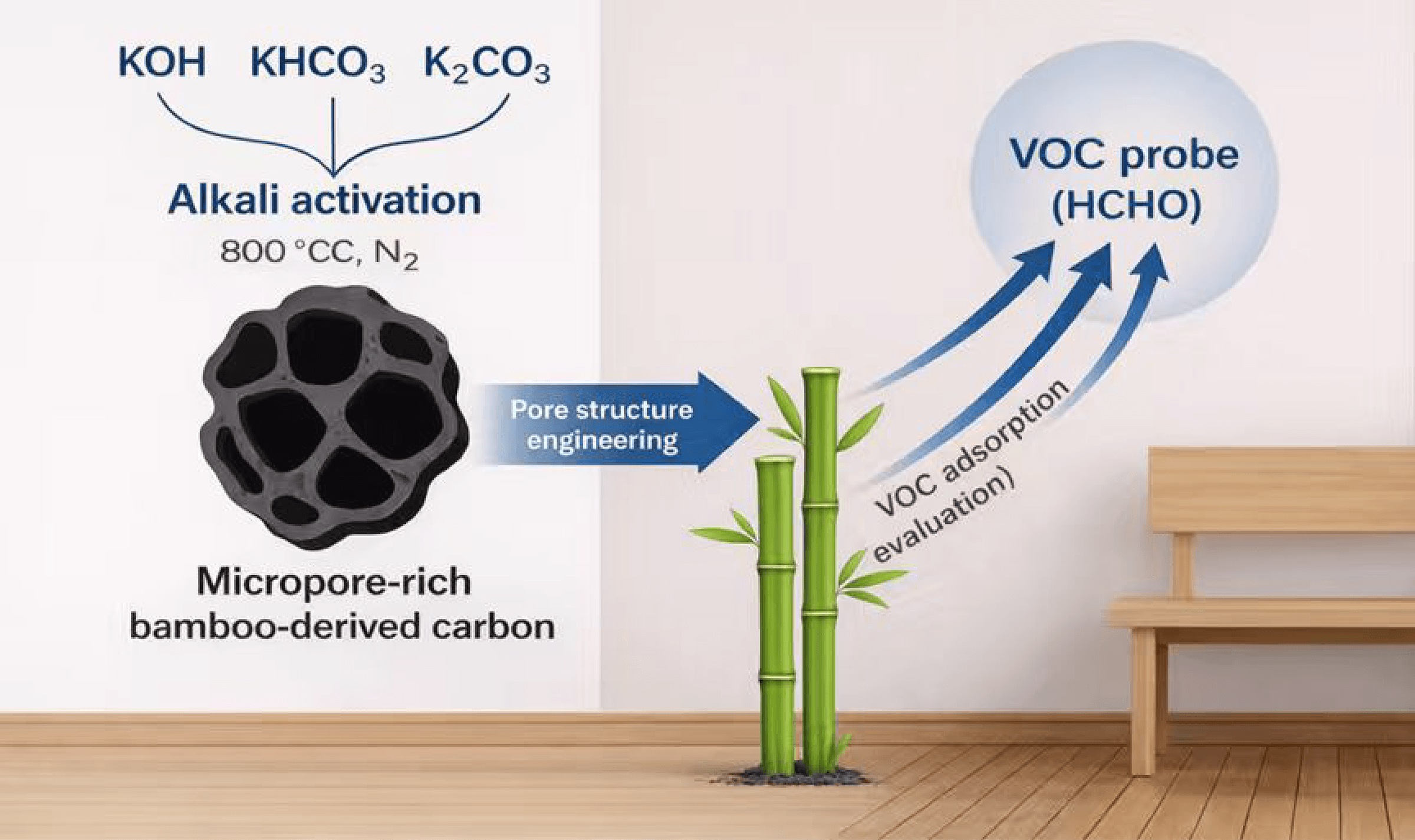
This study presents a systematic evaluation of bamboo-derived activated carbons (ACs) prepared using three alkaline activating agents-KOH, KHCO3, and K2CO3-for efficient formaldehyde adsorption. The pore structures of the resulting ACs were modulated by varying the alkali-to-carbon (A/C) ratio from 1:1 to 4:1, and the effects on microstructure and adsorption performance were thoroughly investigated. Among all samples, AC-MB@KOH(3) demonstrated superior performance, featuring a high specific surface area of 2141.77 m2/g and a removal efficiency of 90%, attributed to its rich microporous texture and well-developed hierarchical porosity. Comparative analysis revealed that the activation strength and decomposition behavior of different alkaline agents critically influenced pore formation dynamics and gas diffusion pathways. Correlation analysis indicated a strong linear relationship between formaldehyde removal efficiency and micropore volume (R2 = 0.87), emphasizing the pivotal role of micropores in gas molecule capture. These findings underscore the advantages of strong alkaline activation and offer a theoretical foundation for designing high-efficiency, biomass-derived porous adsorbents for indoor air purification applications.Graphic Abstract
Keywords
Cite This Article
 Copyright © 2026 The Author(s). Published by Tech Science Press.
This work is licensed under a Creative Commons Attribution 4.0 International License , which permits unrestricted use, distribution, and reproduction in any medium, provided the original work is properly cited.
 Downloads
 Citation Tools
