Home / Journals / JRM / Vol.14, No.4, 2026
Special Issues
Table of Content
cover

On the Cover

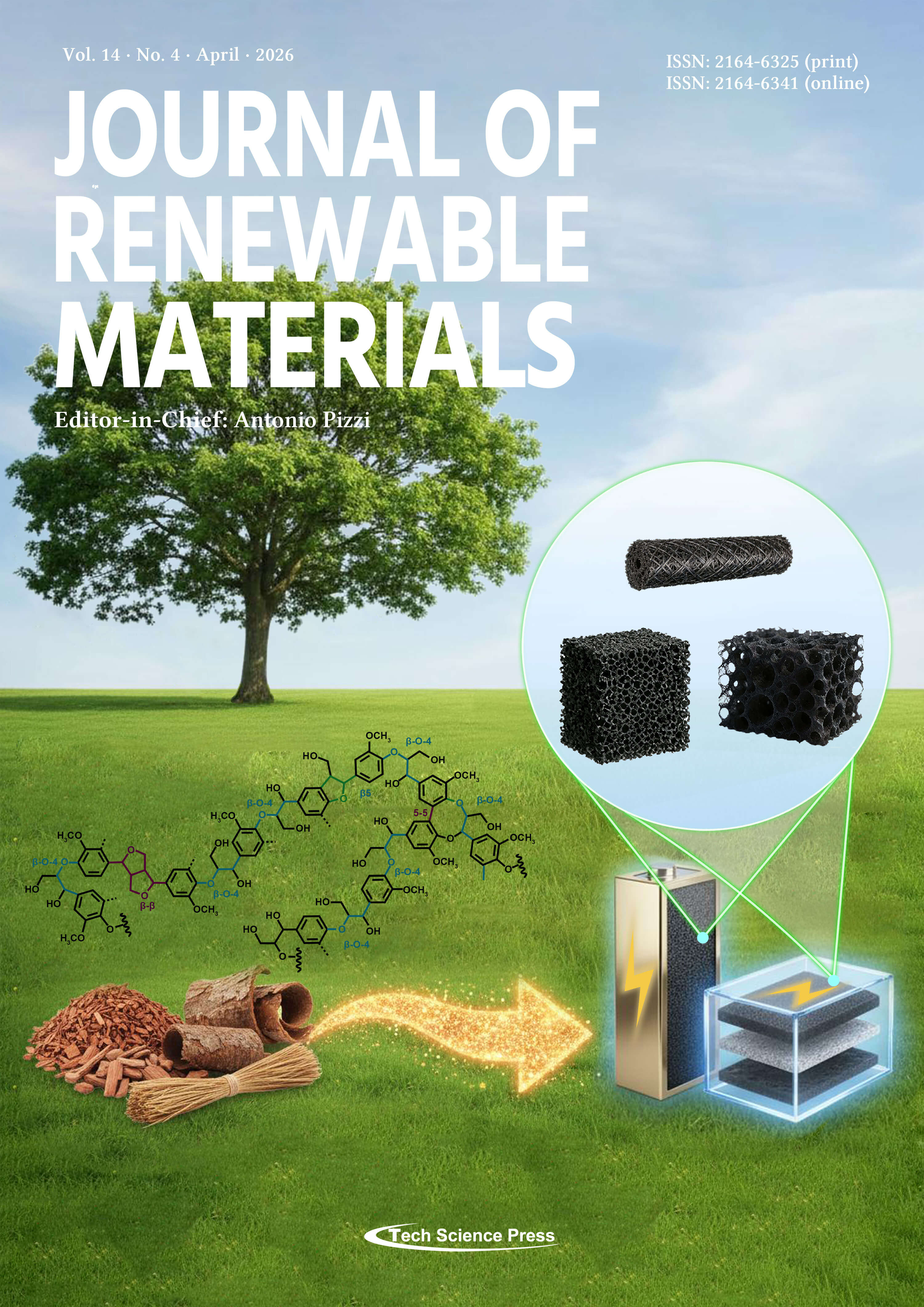
Lignin, a byproduct of the paper industry, is transformed into high-performance carbon materials for energy storage. Through advanced processing, it becomes porous carbon, carbon fiber, and carbon aerogel. These sustainable materials serve as efficient electrodes in supercapacitors and batteries, offering high surface area and stability while turning industrial waste into a valuable resource for green technology.

View this paper

  • Open AccessOpen Access

    ARTICLE

    Maleated Deep Eutectic Solvent (DES) Lignin-Glyoxal-Chitosan Wood Adhesives

    Hamed Younesi-Kordkheili1,*, Antonio Pizzi2,*, Ghorban Niyatzadeh3
    Journal of Renewable Materials, Vol.14, No.4, 2026, DOI:10.32604/jrm.2026.02026-0013 - 24 April 2026
    (This article belongs to the Special Issue: Renewable and Biosourced Adhesives-3rd Edition)
    Abstract In this research, an effective method has been developed to bond wood panel adhesives of good performance using biosourced lignin and chitosan as the two main raw materials. Lignin was thus modified by a deep eutectic solvent (DES) and maleic anhydride (MA), respectively. Then DES/MA modified lignin was reacted with glyoxal to obtain a new environmentally friendly lignin-glyoxal (LG) resin. Next, chitosan was added as a bio-crosslinker to the synthesised LG resin. Finally, the performance of the resulting adhesives was evaluated by bonding plywood panels with them. Fourier Transform Infra Red (FTIR) analysis was used… More >

    Graphic Abstract

    Maleated Deep Eutectic Solvent (DES) Lignin-Glyoxal-Chitosan Wood Adhesives

  • Open AccessOpen Access

    REVIEW

    Research Prospective of Lignin-Based Carbon Electrode Materials for Advanced Electrochemical Energy Storage Applications

    Rui Lou*, Chendan Xie, Haiyuan Yang, Yunyun Liu, Bin Zhang, Long He, Wei Chen
    Journal of Renewable Materials, Vol.14, No.4, 2026, DOI:10.32604/jrm.2026.02025-0193 - 24 April 2026
    Abstract Amidst escalating global energy demands and the depletion of fossil fuel reserves, there is an urgent need to develop energy storage materials derived from low-cost and sustainable biomass. Lignin, an abundant aromatic polymer, has gained increasing recognition as a highly promising precursor for electrode materials due to its low cost, high carbon content, and rich functional groups. For electrochemical energy storage applications, lignin-derived carbon materials, including porous carbon, carbon fibers, and carbon aerogels, demonstrate considerable potential as effective electrodes. This review provides a comprehensive summary and analysis of recent advances in the field. It systematically… More >

    Graphic Abstract

    Research Prospective of Lignin-Based Carbon Electrode Materials for Advanced Electrochemical Energy Storage Applications

  • Open AccessOpen Access

    REVIEW

    Recent Advances in Natural Polysaccharide-Based Materials for Wound Healing: Chitosan, Konjac Glucomannan and Cellulose

    Jin Shang1,#, Weimin Zhang2,#, Landuo Zhang1, Xiangwen Li1, Qi Wang1, Peng Zhao3, Liangliang Duan1,*
    Journal of Renewable Materials, Vol.14, No.4, 2026, DOI:10.32604/jrm.2026.02025-0124 - 24 April 2026
    Abstract Wound healing is a complex and dynamic process essential for restoring the integrity of damaged skin. It requires wound dressings that actively regulate the wound microenvironment by preventing infection, maintaining moisture balance, allowing gas exchange, and managing exudate. Natural polysaccharides, such as konjac glucomannan (KGM), chitosan, and cellulose, are well suited to this role because of their biocompatibility, biodegradability, and intrinsic bioactivity. Extensive research has focused on developing polysaccharide-based wound dressings with enhanced functionality to promote healing. This review examines recent scientific research published mostly in the past five years on the development and application… More >

    Graphic Abstract

    Recent Advances in Natural Polysaccharide-Based Materials for Wound Healing: Chitosan, Konjac Glucomannan and Cellulose

  • Open AccessOpen Access

    REVIEW

    A Review of Natural-Oil Soot-Derived Carbon Nanoparticles: Significance, Synthesis, and Applications

    Naile Karakehya1,2,*
    Journal of Renewable Materials, Vol.14, No.4, 2026, DOI:10.32604/jrm.2025.02025-0131 - 24 April 2026
    Abstract In the early years of the Industrial Revolution, the extensive use of fossil resources and energy-intensive production methods was widely accepted, even celebrated, as signs of progress. However, growing concerns over environmental degradation, resource depletion, and climate change have necessitated a transition toward more sustainable and environmentally responsible production strategies. Within this context, wick-and-oil flame synthesis has emerged as a simple, energy-efficient, and cost-effective method that utilizes natural oils as both fuel and renewable carbon sources for the generation of carbon nanoparticles, particularly carbon nano-onions. This review presents a comprehensive overview of this emerging synthesis… More >

    Graphic Abstract

    A Review of Natural-Oil Soot-Derived Carbon Nanoparticles: Significance, Synthesis, and Applications

  • Open AccessOpen Access

    ARTICLE

    Valorisation of Jicama (Pachyrhizus erosus) Bagasse into Cellulose Microfibers for the Reinforcement of Biocomposite Jicama Starch Films

    Devita Amelia1, R. A. Ilyas1,2,*, Hairul Abral2,3, Mochamad Asrofi4, Muhammad Asyraf Muhammad Rizal2,5, Mohamad Zaki Hassan6, Mohamad Haafiz Mohamad Kassim2,7,8, Nurul Fazita Mohammad Rawi2,7,8, Nasrullah Razali9, Melbi Mahardika2,7,8,10,*
    Journal of Renewable Materials, Vol.14, No.4, 2026, DOI:10.32604/jrm.2025.02025-0147 - 24 April 2026
    (This article belongs to the Special Issue: From Nature to Function: Natural Fiber Cellulose and Starch-Based Materials for a Sustainable Composites)
    Abstract This study characterizes biocomposites derived from jicama starch and reinforced with microfibers obtained from jicama bagasse (JB). The incorporation of jicama bagasse microfibers into the jicama matrix was systematically varied at concentrations of 1, 2, 3, 4, and 5 wt%. The starch film and biocomposite were prepared using solution casting methodologies, employing glycerol as a plasticizing agent. The biocomposites were characterized using Fourier-transform infrared spectroscopy, X-ray diffraction analysis, and scanning electron microscopy. In addition, the moisture absorption and tensile properties were evaluated. The jicama starch contained 44% w/w amylose, whereas the jicama bagasse microfiber contained… More >

  • Open AccessOpen Access

    ARTICLE

    Engineering Microporous Bamboo-Derived Carbons via Alkaline Activation for Formaldehyde Adsorption in Building Environments

    Ju He1,#, Peiwen Zhao2,#, Dongyang Han3, Kexin Lv2, Jiuping Rao3,*, Xinqiang Ye4, Guodong Ruan4, Fei Guo3, Mizi Fan3,*, Weigang Zhao3,*
    Journal of Renewable Materials, Vol.14, No.4, 2026, DOI:10.32604/jrm.2026.02026-0012 - 24 April 2026
    (This article belongs to the Special Issue: Renewable Nanostructured Porous Materials: Synthesis, Processing, and Applications)
    Abstract This study presents a systematic evaluation of bamboo-derived activated carbons (ACs) prepared using three alkaline activating agents-KOH, KHCO3, and K2CO3-for efficient formaldehyde adsorption. The pore structures of the resulting ACs were modulated by varying the alkali-to-carbon (A/C) ratio from 1:1 to 4:1, and the effects on microstructure and adsorption performance were thoroughly investigated. Among all samples, AC-MB@KOH(3) demonstrated superior performance, featuring a high specific surface area of 2141.77 m2/g and a removal efficiency of 90%, attributed to its rich microporous texture and well-developed hierarchical porosity. Comparative analysis revealed that the activation strength and decomposition behavior of different More >

    Graphic Abstract

    Engineering Microporous Bamboo-Derived Carbons via Alkaline Activation for Formaldehyde Adsorption in Building Environments

  • Open AccessOpen Access

    ARTICLE

    Citric Acid as an Alternative Adhesive: Optimisation of Concentrations on Characteristics of Jabon Plywood

    Muhammad Ilham Aulia1, Alifah Syahfitri1, Imam Busyra Abdillah1, Abdus Syukur1, Dede Hermawan1,*, Rita Kartika Sari1, Mahdi Mubarok1, Muhammad Adly Rahandi Lubis2, Sukma Surya Kusumah2, Sarah Augustina2, Jajang Sutiawan2,*
    Journal of Renewable Materials, Vol.14, No.4, 2026, DOI:10.32604/jrm.2025.02025-0160 - 24 April 2026
    (This article belongs to the Special Issue: Advances in Eco-friendly Wood-Based Composites: Design, Manufacturing, Properties and Applications – Ⅱ)
    Abstract Citric acid adhesive is an alternative to formaldehyde-based adhesives that are more environmentally friendly because they are non-toxic and made from natural ingredients. This study aims to determine the effect of variations in citric acid adhesive concentrations on the physical and mechanical properties of jabon plywood. This study used citric acid adhesive with variations in citric acid (CA) concentrations of 59%, 69%, and 79%. Physical property tests include density, moisture content (MC), water absorption (WA), thickness expansion (TS), and delamination, while mechanical tests include modulus of rupture (MOR), modulus of elasticity (MOE), and shear stress… More >

  • Open AccessOpen Access

    ARTICLE

    Preliminary Fabrication and Characterization of Cross-Laminated Panel Made from Nipah Palm Petiole Fibres

    Ros Syazmini Mohd Ghani1,2,3,*, Mohamad Saiful Sulaiman1,2,3, Sofiyah Mohd Razali2,4, Madihan Yusof2, Ellisha Iling1,2,3
    Journal of Renewable Materials, Vol.14, No.4, 2026, DOI:10.32604/jrm.2025.02025-0174 - 24 April 2026
    (This article belongs to the Special Issue: Biomass-based Thermoset and Thermoplastic Polymers for Biomass-based Composites)
    Abstract The increasing demand for sustainable construction materials has driven research into non-wood biomass for engineered composites. This study reports the preliminary fabrication and evaluation of cross-laminated panels (CLPs) made from Nipah palm (Nypa fruticans) petioles bonded with a bio-epoxy resin adhesive. Panels were manufactured at three target densities (400, 600, and 800 kg/m3) and evaluated for their physical, mechanical, and microstructural properties. Physical tests included moisture content, water absorption, and thickness swelling, while mechanical tests measured compressive and flexural strength in accordance with JIS A 5908:2022 and ASTM D1037 standards. The results showed that higher panel density More >

    Graphic Abstract

    Preliminary Fabrication and Characterization of Cross-Laminated Panel Made from Nipah Palm Petiole Fibres

Per Page:

Share Link