Home / Journals / JRM / Vol.13, No.9, 2025
Special Issues
Table of Content
cover

On the Cover

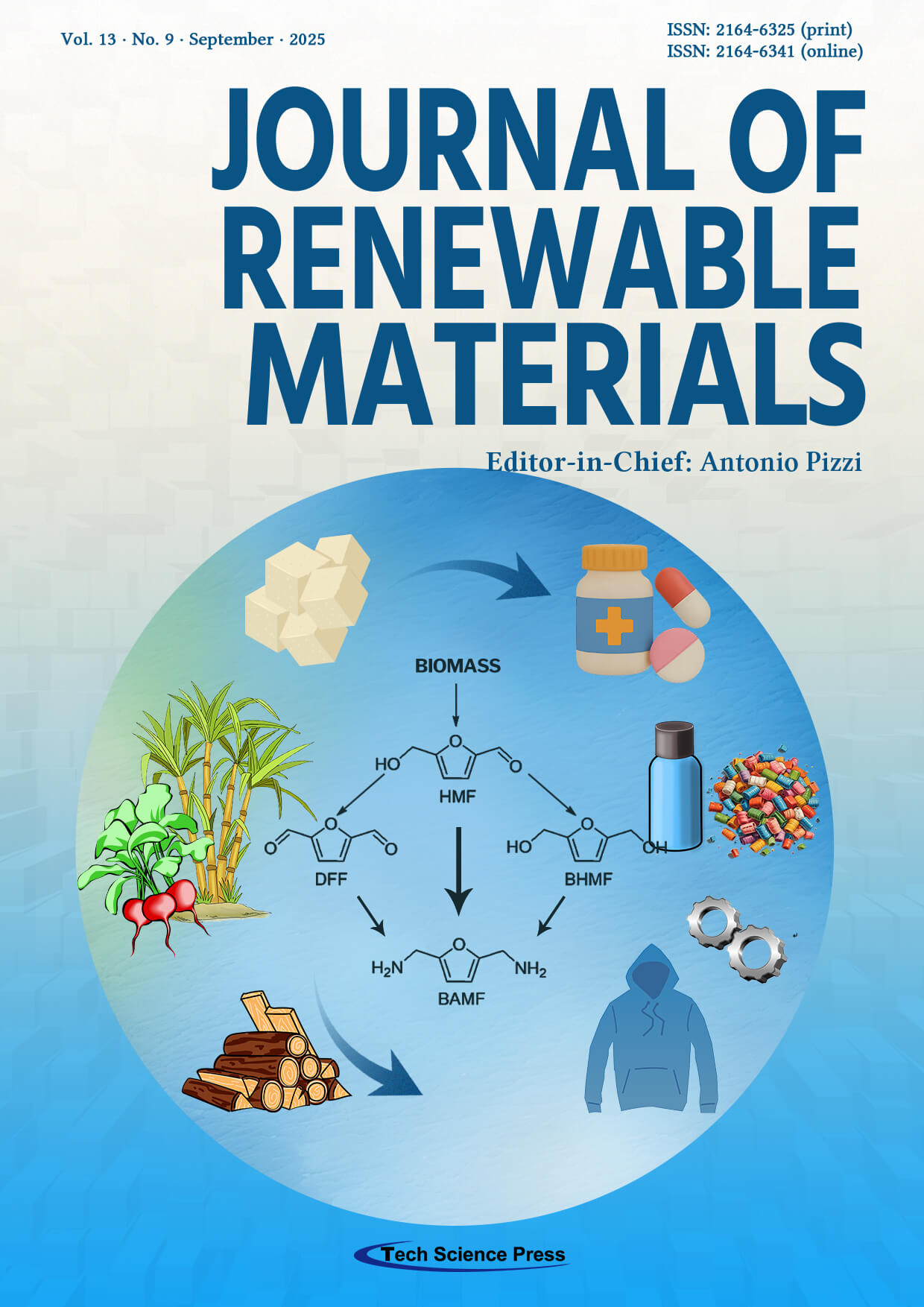
Primary diamines are essential for pharmaceutical and polymer synthesis but are typically produced from petroleum under harsh conditions. Biomass offers a renewable alternative. This review highlights recent advances in synthesizing 2,5-bis(aminomethyl)furan from biomass-derived alcohols and aldehydes. However, side reactions still limit efficiency. Strategies, key advances and remaining hurdles are discussed to guide the development of more sustainable and efficient routes for biomass-based diamine production.

View this paper

  • Open AccessOpen Access

    REVIEW

    The Reductive Amination of Biomass-Based Aldehydes and Alcohols towards 2,5-bis(aminomethyl)furan: Progress, Challenges and Prospects

    Li Ji1,2, Jiawei Mao1,3, Ruixiang Li1,*, Jiaqi Xu1,*
    Journal of Renewable Materials, Vol.13, No.9, pp. 1683-1706, 2025, DOI:10.32604/jrm.2025.02025-0043 - 22 September 2025
    Abstract Primary diamines play an important role in the chemical industry, where they are widely used as raw materials for the manufacture of pharmaceuticals and polymers. Currently, primary diamines are mainly derived from petroleum, while harsh or toxic conditions are often needed. Biomass is abundant and renewable , which serves as a promising alternative raw material to produce primary diamines. This review primarily focuses on the synthesis of 2,5-bis(aminomethyl)furan (BAMF), a bio-based diamine with potential as a biomonomer for polyamides and polyureas. Specifically, this review emphasizes the synthesis of BAMF from three biomass-derived alcohols and aldehydes,… More >

    Graphic Abstract

    The Reductive Amination of Biomass-Based Aldehydes and Alcohols towards 2,5-bis(aminomethyl)furan: Progress, Challenges and Prospects

  • Open AccessOpen Access

    REVIEW

    Extraction, Utilization, Functional Modification, and Application of Cellulose and Its Derivatives

    Wohua He, Fangji Wu, Haoqun Hong*
    Journal of Renewable Materials, Vol.13, No.9, pp. 1707-1763, 2025, DOI:10.32604/jrm.2025.02025-0005 - 22 September 2025
    Abstract Under the background of the current energy crisis and environmental pollution, the development of green and sustainable materials has become particularly urgent. As one of the most abundant natural polymers on earth, cellulose has attracted wide attention due to its green recycling, sustainable development, degradability, and low cost. Therefore, cellulose and its derivatives were used as the starting point for comprehensive analysis. First, the basic structural properties of cellulose were discussed, and then the extraction and utilization methods of cellulose were reviewed, including Sodium Hydroxide based solvent system, N, N-Dimethylacetamide/Lithium Chloride System, N-Methylmorpholine-N-Oxide (NMMO) system, More >

    Graphic Abstract

    Extraction, Utilization, Functional Modification, and Application of Cellulose and Its Derivatives

  • Open AccessOpen Access

    ARTICLE

    Molasses Adhesive Boosts Bio-Pellet Potential: A Study on Oyster Mushroom Baglog Waste

    Sarah Augustina1, Ananda Suci Bazhafah2, Jajang Sutiawan1, Sudarmanto1, Eko Setio Wibowo1, Nissa Nurfajrin Solihat1, Alvin Muhammad Savero1, Ismadi Ismadi1, Jayadi Jayadi3, Agus Sukarto Wismogroho4, Nuniek Ina Ratnaningtyas2, Sukma Surya Kusumah1,*
    Journal of Renewable Materials, Vol.13, No.9, pp. 1765-1781, 2025, DOI:10.32604/jrm.2025.02025-0014 - 22 September 2025
    (This article belongs to the Special Issue: Renewable and Biosourced Adhesives-2023)
    Abstract The increasing demand for renewable energy sources has driven the exploration of innovative materials for biofuel production. This study investigates bio-pellet characteristics derived from several oyster mushroom baglog wastes with varying concentrations of molasses as an adhesive. The process began with sun-drying the baglog waste for three days, followed by oven drying at 80°C for 24 h. Bio-pellets were produced by blending baglog waste with molasses at concentrations of 5% and 10% (w/v), then subsequently fed into a pellet mill. The bio-pellets were left to rest for one hour before analysis. The quality of bio-pellets… More >

    Graphic Abstract

    Molasses Adhesive Boosts Bio-Pellet Potential: A Study on Oyster Mushroom Baglog Waste

  • Open AccessOpen Access

    REVIEW

    Transforming the Leather Industry: A Comprehensive Review on Leather Alternatives

    Alehegn Atalay Birlie*
    Journal of Renewable Materials, Vol.13, No.9, pp. 1783-1802, 2025, DOI:10.32604/jrm.2025.02025-0039 - 22 September 2025
    Abstract This study explores vegan leather, an eco-friendly substitute for conventional animal-derived leather. Using materials like polyurethane, pineapple leaves, cork, and recycled plastics, vegan leather aims to transform the fashion industry and consumer products while addressing environmental concerns. Despite its advantages, challenges related to availability and durability persist. The booming market for vegan leather is expected to reach billions of dollars, reflecting a broader societal shift towards sustainable and cruelty-free alternatives. The review traces the historical development of vegan leather from its origins in Germany to modern innovations like Mylo and Piñatex. By comparing these materials More >

  • Open AccessOpen Access

    ARTICLE

    Enhancing Rice Straw Fibers for Pulp Films Using DES and Streptomyces rochei Synergy

    Cheng Yong1,2,3,4,5, Enhui Sun1,*, Xiaodong Fan1,4, Zhiping Zhang5, Jing Zhang1, Ling Chen1, Ping Qu1, Qiujun Wang1, Hongying Huang1, Hongmei Jin1, Mingjie Guan4,*
    Journal of Renewable Materials, Vol.13, No.9, pp. 1803-1817, 2025, DOI:10.32604/jrm.2025.02025-0059 - 22 September 2025
    Abstract Long-time fermentation has always been one of the reasons restricting the development of straw biological pulping. This study aimed to develop a novel straw pulp film with shortened solid-state fermentation time with less than 20% mass loss rate by bio-pulping synergistic treatment of straw fibers with deep eutectic solvent (DES) and Streptomyces rochei (S. rochei). Results illustrated that at 3% S. rochei concentration with 7-day fermentation, both cellulose and hemicellulose enzyme activities of the treated rice straw fiber reached peak values with a fiber mass loss rate of 17.01%. Microstructural morphology revealed that S. rochei colonization initiated on straw… More >

    Graphic Abstract
    Enhancing Rice Straw Fibers for Pulp Films Using DES and <i>Streptomyces rochei</i> Synergy

  • Open AccessOpen Access

    ARTICLE

    Ultrasonic Modification of Wood Surface: Study of Macro and Micro Properties after Long-Term Storage

    Alena Vjuginova1,*, Leonid Leontyev2
    Journal of Renewable Materials, Vol.13, No.9, pp. 1819-1828, 2025, DOI:10.32604/jrm.2025.02025-0061 - 22 September 2025
    Abstract In this paper, the stability of the results of ultrasonic wood surface modification after long-term storage, including macroscopic properties and microstructure of specimens, was investigated. Specimens of aspen wood (Populus tremula) were processed by the developed ultrasonic method of wood surface modification in three different treatment modes and the surface hardness of the specimens was evaluated after processing and after storing the specimens for more than 5 years since long-term stability is an important factor for the use of ultrasonically modified sawn timber as construction and finishing materials. The obtained results of surface hardness measurements by… More >

    Graphic Abstract

    Ultrasonic Modification of Wood Surface: Study of Macro and Micro Properties after Long-Term Storage

  • Open AccessOpen Access

    ARTICLE

    Improving the Environmental Friendliness of Glued Structures Made of Thermal Wood by Preliminary Low-Temperature Plasma Treatment

    Ksenia Saerova*, Ruslan Safin
    Journal of Renewable Materials, Vol.13, No.9, pp. 1829-1840, 2025, DOI:10.32604/jrm.2025.02025-0076 - 22 September 2025
    (This article belongs to the Special Issue: Advances in Eco-friendly Wood-Based Composites: Design, Manufacturing, Properties and Applications – Ⅱ)
    Abstract This article presents research focused on developing and scientifically substantiating a technology for producing environmentally friendly glued structures from wood treated through a two-stage process. The methodology involves preliminary thermal modification followed by high-frequency low-temperature plasma treatment. Thermal modification enhances performance characteristics such as resistance to rot, lowers hygroscopicity, and increases dimensional stability. However, it can diminish the adhesive properties of wood, complicating the bonding process. To address this challenge, the study introduces high-frequency low-temperature plasma treatment, which activates the wood surface, improving wettability and adhesion while minimizing glue consumption. Experimental results indicate that plasma More >

  • Open AccessOpen Access

    ARTICLE

    Characterization, In Vitro Dissolution, and Drug Release Kinetics in Hard Capsule Shells Made from Hydrolyzed κ-Carrageenan and Xanthan Gum

    Tri Susanti1,2, Syahnur Haqiqoh1, Pratiwi Pudjiastuti2,*, Siti Wafiroh2,*, Esti Hendradi3, Oktavia Eka Puspita4, Nashriq Jailani5
    Journal of Renewable Materials, Vol.13, No.9, pp. 1841-1857, 2025, DOI:10.32604/jrm.2025.02024-0084 - 22 September 2025
    Abstract This study aims to enhance the mechanical properties, disintegration, and dissolution rates of cross-linked carrageenan (CRG) capsule shells by shortening the long chains of CRG through a hydrolysis reaction with citric acid (CA). The hydrolysis of CRG was carried out using varying concentrations of CA, resulting in hydrolyzed CRG (HCRG). This was followed by cross-linking with xanthan gum (XG) and the addition of sorbitol (SOR) as a plasticizer. The results indicated that the optimal swelling capacity of HCRG-XG/SOR hard-shell capsules occurred at a CA concentration of 0.5%, achieving a maximum swelling rate of 445.39% after… More >

Per Page:

Share Link