
 Login
Login Register
 Submit a Paper
 Propose a Special lssue
 Open Access
REVIEW
The Reductive Amination of Biomass-Based Aldehydes and Alcohols towards 2,5-bis(aminomethyl)furan: Progress, Challenges and Prospects
1 Key Laboratory of Green Chemistry and Technology of Ministry of Education, College of Chemistry, Sichuan University, Chengdu, 610064, China
2 Sichuan Research Institute of Chemical Quality and Safety Testing, Chengdu, 610031, China
3 Sichuan Institute of Product Quality Supervision and Inspection, Chengdu, 610100, China
* Corresponding Authors: Ruixiang Li. Email: ; Jiaqi Xu. Email:
Journal of Renewable Materials 2025, 13(9), 1683-1706. https://doi.org/10.32604/jrm.2025.02025-0043
Received 21 February 2025; Accepted 07 May 2025; Issue published 22 September 2025
 View Full Text
 Download PDF
Abstract
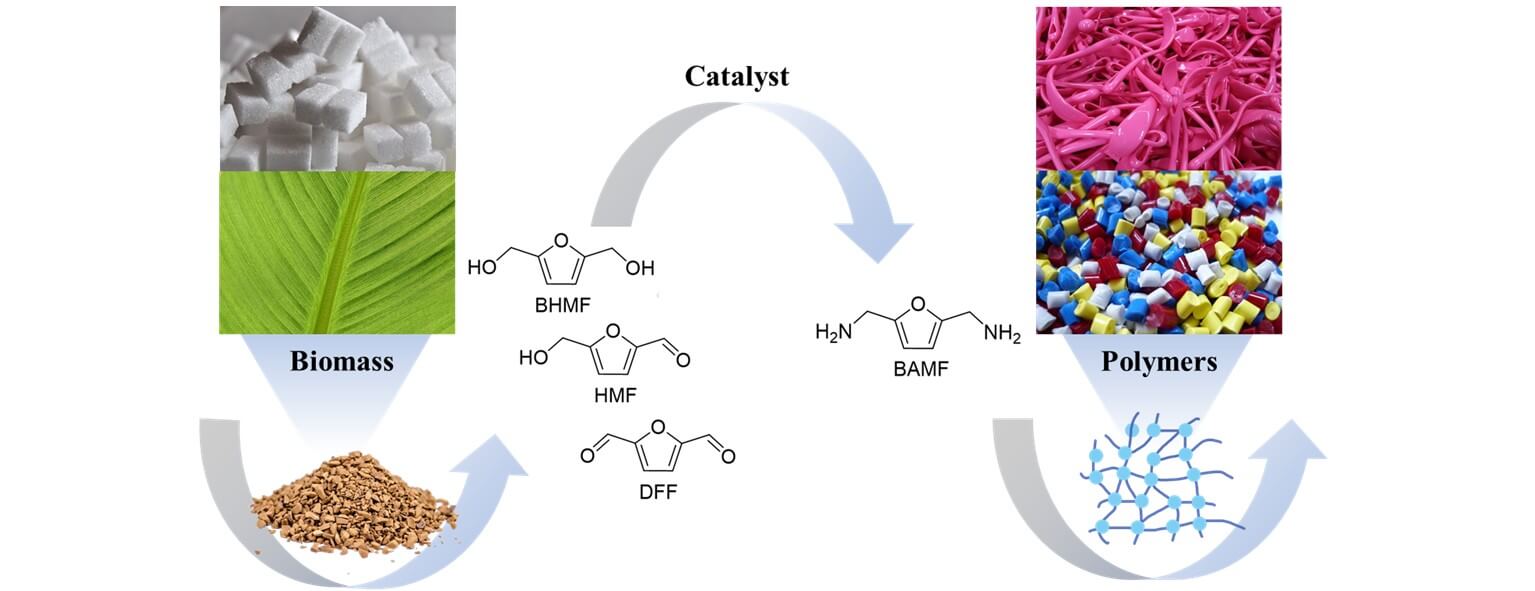
Primary diamines play an important role in the chemical industry, where they are widely used as raw materials for the manufacture of pharmaceuticals and polymers. Currently, primary diamines are mainly derived from petroleum, while harsh or toxic conditions are often needed. Biomass is abundant and renewable , which serves as a promising alternative raw material to produce primary diamines. This review primarily focuses on the synthesis of 2,5-bis(aminomethyl)furan (BAMF), a bio-based diamine with potential as a biomonomer for polyamides and polyureas. Specifically, this review emphasizes the synthesis of BAMF from three biomass-derived alcohols and aldehydes, namely 5-hydroxymethylfurfural (HMF), 2,5-bis(hydroxymethyl)furan (BHMF), and 2,5-diformylfuran (DFF). These are the key substrates to get BAMF and could be readily obtained from carbohydrates. Even though great effort has been put into the synthesis of BAMF, it remains a tough problem to obtain BAMF with a high yield at a low cost due to the inevitable side reactions, such as unwanted hydrogenation reactions and condensation reactions. Many strategies have been proposed to solve this problem, such as the hydrogen-borrowing strategy and stepwise reductive amination strategy. Herein, we will summarize the key advancements in this area, and discuss the challenges that need to be responded in the future, hoping to provide an insight into the design and development of a more efficient system for the production of biomass-derived diamines.Graphic Abstract
Keywords
Cite This Article
 Copyright © 2025 The Author(s). Published by Tech Science Press.
This work is licensed under a Creative Commons Attribution 4.0 International License , which permits unrestricted use, distribution, and reproduction in any medium, provided the original work is properly cited.
 Downloads
 Citation Tools
