
 Login
Login Register
 Submit a Paper
 Propose a Special lssue
 Open Access
ARTICLE
Molasses Adhesive Boosts Bio-Pellet Potential: A Study on Oyster Mushroom Baglog Waste
1 Research Center for Biomass and Bioproducts, National Research and Innovation Agency, Cibinong, 16911, Indonesia
2 Faculty of Biology, Universitas Jenderal Soedirman, Purwokerto, 53122, Indonesia
3 Research Center for Advance Material, National Research and Innovation Agency, Serpong, 15314, Indonesia
4 Research Center for Nanotechnology System, National Research and Innovation Agency, Serpong, 15314, Indonesia
* Corresponding Author: Sukma Surya Kusumah. Email:
(This article belongs to the Special Issue: Renewable and Biosourced Adhesives-2023)
Journal of Renewable Materials 2025, 13(9), 1765-1781. https://doi.org/10.32604/jrm.2025.02025-0014
Received 16 January 2025; Accepted 11 April 2025; Issue published 22 September 2025
 View Full Text
 Download PDF
Abstract
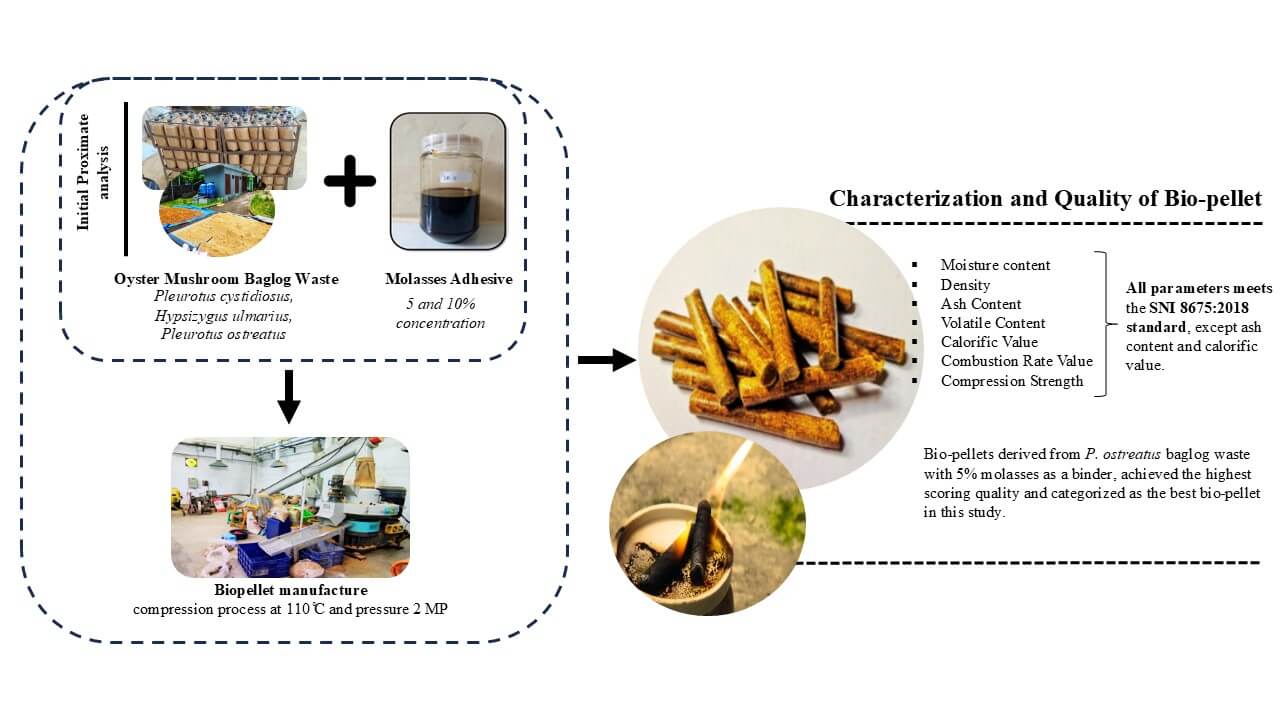
The increasing demand for renewable energy sources has driven the exploration of innovative materials for biofuel production. This study investigates bio-pellet characteristics derived from several oyster mushroom baglog wastes with varying concentrations of molasses as an adhesive. The process began with sun-drying the baglog waste for three days, followed by oven drying at 80°C for 24 h. Bio-pellets were produced by blending baglog waste with molasses at concentrations of 5% and 10% (w/v), then subsequently fed into a pellet mill. The bio-pellets were left to rest for one hour before analysis. The quality of bio-pellets was determined by evaluating moisture content, ash content, volatile matter, calorific value, combustion rate, density, and compressive strength following SNI 8675:2018 standards. Results indicate that adding molasses as a binder significantly affected the bio-pellet quality. The optimal molasses concentration for balanced performance was found at 5%, providing a lower moisture content (6.8%), volatile matter (68.42%), and density (1.55 g·cm−3). In addition, the bio-pellet has a slightly higher calorific value (approximately 3614 cal·g−1), compressive strength (40.68 N·mm−2), and ash content (18.59%). All of the parameters for the bio-pellet containing 5% molasses satisfied the standard except for ash content and calorific value.Graphic Abstract
Keywords
Cite This Article
 Copyright © 2025 The Author(s). Published by Tech Science Press.
This work is licensed under a Creative Commons Attribution 4.0 International License , which permits unrestricted use, distribution, and reproduction in any medium, provided the original work is properly cited.
 Downloads
 Citation Tools
