Home / Journals / JRM / Vol.13, No.12, 2025
Special Issues
Table of Content
cover

On the Cover

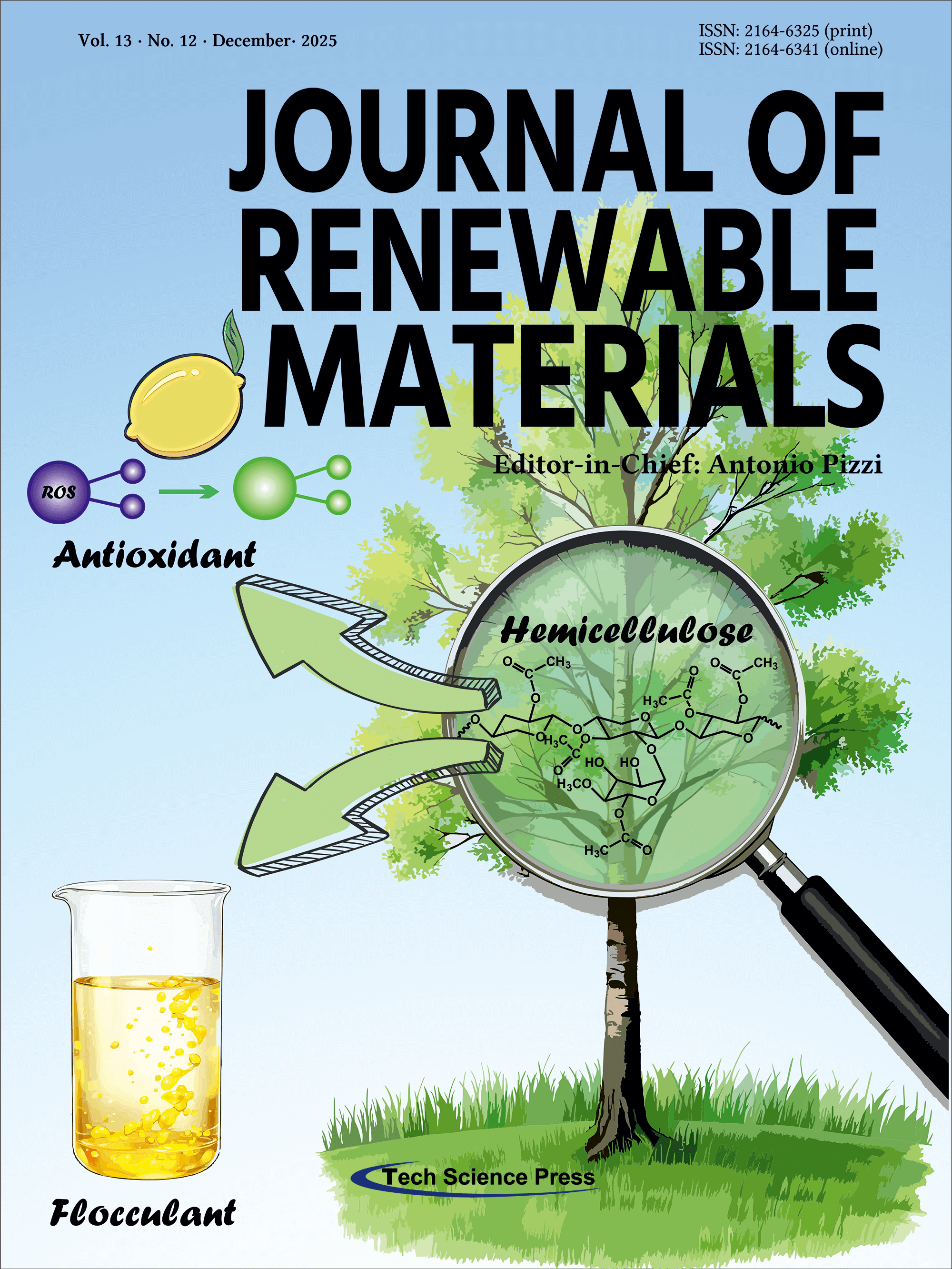
This work presents a new promising method for processing plant materials, which allows for the extraction of cellulose and hemicelluloses. During the catalytic process, highly pure water-soluble hemicellulose - xylan with a yield of 12.5 wt.% was obtained. Such polysaccharides show significant antioxidant and flocculation activity.

View this paper

  • Open AccessOpen Access

    ARTICLE

    Highly Pure Water-Soluble Aspen Wood Hemicelluloses Derived by Catalytic Peracetic Treatment and Their Antioxidant and Flocculation Activity

    Valentina Sergeevna Borovkova1,2,*, Yuriy Nikolaevich Malyar1,2, Vladislav Alexandrovich Ionin1,2, Alexander Sergeevich Kazachenko1,2
    Journal of Renewable Materials, Vol.13, No.12, pp. 2281-2296, 2025, DOI:10.32604/jrm.2025.02025-0067 - 23 December 2025
    Abstract The valorization of plant biomass towards high-value chemicals is a global trend aimed at solving the problem of the huge accumulation of lignocellulosic waste. Plant polysaccharides are natural polymers that make up about 20% by weight of biomass, with a unique variety of structures and properties that depend on the type of raw materials and the method of their extraction. In this study, the effect of variability of the oxidative delignification process conditions in the «acetic acid-hydrogen peroxide-water-(NH4)6Mo7O24» on the extraction and properties of aspen (Populus tremula) wood hemicelluloses was investigated for the first time. The developed… More >

    Graphic Abstract

    Highly Pure Water-Soluble Aspen Wood Hemicelluloses Derived by Catalytic Peracetic Treatment and Their Antioxidant and Flocculation Activity

  • Open AccessOpen Access

    ARTICLE

    Biomass-Derived Hard Carbon Anodes from Setaria Viridis for Na-Ion Batteries

    Jingxiang Meng1, Xin Liu1, Wenping Zeng1, Jianjun Song2, Songyi Liao1, Yonggang Min1,2,*, Jintao Huang1,*
    Journal of Renewable Materials, Vol.13, No.12, pp. 2297-2308, 2025, DOI:10.32604/jrm.2025.02025-0098 - 23 December 2025
    Abstract Biomass-derived hard carbon has gradually become an important component of sodium-ion batteries’ anodes. In this work, Setaria viridis, a widely distributed plant, was employed as a precursor to synthesize hard carbon anodes for sodium-ion batteries. However, the hard carbon derived from raw precursors contains substantial impurities, which limit the performance of the obtained hard carbon. With different chemical etching processes, the content of impurities in the resultants was reduced to varying degrees. The optimized hard carbon anode delivered a reversible capacity of 198 mAh g−1 at a current density of 0.04 A g−1. This work shows the More >

    Graphic Abstract

    Biomass-Derived Hard Carbon Anodes from Setaria Viridis for Na-Ion Batteries

  • Open AccessOpen Access

    REVIEW

    Research Progress on Bio-Based Biodegradable Barrier Materials

    Kezheng Gao1, Shuaifei Li1, Qingyuan Niu2, Xiaojing Zhang2,*
    Journal of Renewable Materials, Vol.13, No.12, pp. 2309-2353, 2025, DOI:10.32604/jrm.2025.02025-0108 - 23 December 2025
    (This article belongs to the Special Issue: Valorization of Lignocellulosic Biomass for Functional Materials)
    Abstract The current global shortage of oil resources and the pollution problems caused by traditional barrier materials urgently require the search for new substitutes. Biodegradable bio-based barrier materials possess the characteristics of being renewable, environmentally friendly, and having excellent barrier properties. They have become an important choice in fields such as food packaging, agricultural film covering, and medical protection. This review systematically analyzes the design and research of this type of material, classifying biobased and biodegradable barrier materials based on the sources of raw materials and synthesis pathways. It also provides a detailed introduction to the More >

  • Open AccessOpen Access

    ARTICLE

    Synthesis and Application of Activated Charcoal from Indonesian Sugar Palm Bunches (Arenga longipes) as a Potential Absorbent for Heavy Metals

    Luthfi Hakim1,*, Yunida Syafriani Lubis2, Apri Heri Iswanto1, Harisyah Manurung1, Jayusman2, Widya Fatriasari3, Petar Antov4, Tomasz Rogoziński5, Lee Seng Hua6, Nur Izyan Wan Azelee7
    Journal of Renewable Materials, Vol.13, No.12, pp. 2355-2373, 2025, DOI:10.32604/jrm.2025.02025-0078 - 23 December 2025
    (This article belongs to the Special Issue: Advances in Eco-friendly Wood-Based Composites: Design, Manufacturing, Properties and Applications)
    Abstract Activated charcoals were synthesized from sugar palm bunches (SPB) of the native tree of Arenga longipes in Indonesia. The synthesized activated charcoal (AC) was characterized, and utilized as an absorbent for heavy metals (lead/Pb and copper/Cu) through thermal activation. The synthesis of AC was accomplished through furnace activation at temperatures of 500°C, 600°C, 700°C, and 800°C. Acid chlorides were blended with the SPB-AC samples at 5% impregnation level and subsequently subjected to washing for activation, resulting in the elimination of volatile substances and ash content, which facilitates the development of a porous structure in the activated… More >

  • Open AccessOpen Access

    REVIEW

    Transforming Sawdust Waste into Renewable Energy Resources: A Comprehensive Review on Sustainable Bio-Oil and Biochar Production via Thermochemical Processes

    Hauwau Kaoje1,2, Adekunle Adeleke2,3,*, Esther Anosike-Francis2,3, Seun Jesuloluwa2,3, Temitayo Ogedengbe2,3, Hauwa Rasheed2, Jude Okolie4
    Journal of Renewable Materials, Vol.13, No.12, pp. 2375-2430, 2025, DOI:10.32604/jrm.2025.02025-0109 - 23 December 2025
    Abstract The increasing need for sustainable energy and the environmental impacts of reliance on fossil fuels have sparked greater interest in biomass as a renewable energy source. This review provides an in-depth assessment of bio-oil and biochar generation through the pyrolysis of sawdust, a significant variety of lignocellulosic biomass. The paper investigates different thermochemical conversion methods, including fast, slow, catalytic, flash, and co-pyrolysis, while emphasizing their operational parameters, reactor designs, and effects on product yields. The influence of temperature, heating rate, and catalysts on enhancing the quality and quantity of bio-oil and biochar is thoroughly analyzed. More >

  • Open AccessOpen Access

    ARTICLE

    Characteristics of Food Packaging Bioplastics with Nanocrystalline Cellulose (NCC) from Oil Palm Empty Fruit Bunches (OPEFB) as Reinforcement

    Maryam1,*, Rahayu Puji2, Luthfi Muhammad Zulfikar2, Ikhsandy Ferry2, Nadiyah Khairun1, Hidayat3, Ilyas Rushdan Ahmad4, Syafri Edi5
    Journal of Renewable Materials, Vol.13, No.12, pp. 2431-2451, 2025, DOI:10.32604/jrm.2025.02024-0063 - 23 December 2025
    (This article belongs to the Special Issue: Special issue from 1st International Conference of Natural Fiber and Biocomposite (1st ICONFIB) 2024 )
    Abstract The development of the bioplastics industry addresses critical issues such as environmental pollution and food safety concerns. However, the industrialization of bioplastics remains underdeveloped due to challenges such as high production costs and suboptimal material characteristics. To enhance these characteristics, this study investigates bioplastics reinforced with Nanocrystalline Cellulose (NCC) derived from Oil Palm Empty Fruit Bunches (OPEFB), incorporating dispersing agents. The research employs a Central Composite Design from the Response Surface Methodology (RSM) with two factors: the type of dispersing agent (KCl and NaCl) and the NCC concentration from OPEFB (1%–5%), along with the dispersing… More >

  • Open AccessOpen Access

    ARTICLE

    Behavior of Sandwich Glued Laminated Bamboo Structures with a Core Formed by Bioplastic Fiber Using 3D Printing Technology

    Nattawat Mahasuwanchai, Thippakorn Udtaranakron, Kasan Chanto, Tawich Pulngern*
    Journal of Renewable Materials, Vol.13, No.12, pp. 2453-2478, 2025, DOI:10.32604/jrm.2025.02025-0137 - 23 December 2025
    (This article belongs to the Special Issue: Advances in Eco-friendly Wood-Based Composites: Design, Manufacturing, Properties and Applications)
    Abstract This research investigates the behavior of sandwich glued laminated bamboo (Glubam) structures with a core formed by biodegradable plastic fibers, specifically polylactic acid (PLA), fabricated using 3D printing technology. The influence of various fiber printing orientations (0° and 45/135°) on tensile and compressive properties was investigated. The experimental results indicated that polylactic acid with calcium carbonate (PLA+) printed unidirectionally and aligned with the loading direction (0°) exhibits superior tensile and compressive strengths compared to specimens printed bidirectionally at 45/135°. Furthermore, the effect of additives on bioplastics of carbon fiber (PLA-CF) and glass fiber (PLA-GF) additives… More >

    Graphic Abstract

    Behavior of Sandwich Glued Laminated Bamboo Structures with a Core Formed by Bioplastic Fiber Using 3D Printing Technology

  • Open AccessOpen Access

    REVIEW

    Finger-Joint Lumber: A Systematic Literature Review and a Global Industry Survey on this Ecofriendly Structural Building Material

    Victor De Araujo1,2,3,*, Pedro Jardim3,4, Poliana Pessôa3, Juliano Vasconcelos2,5, Matheus Souza6, José Garcia7, Jozef Švajlenka8, André Christoforo3,1
    Journal of Renewable Materials, Vol.13, No.12, pp. 2479-2524, 2025, DOI:10.32604/jrm.2025.02025-0127 - 23 December 2025
    (This article belongs to the Special Issue: Advances in Eco-friendly Wood-Based Composites: Design, Manufacturing, Properties and Applications)
    Abstract Finger-joint lumber is a sustainable building product commercialized as a structural solution for beams, pillars and other thin flat load-bearing elements. This study aims to study finger-joint lumber and its industry to promote this engineered wood product. The first research stage assessed the collection of publications on finger-joint lumber available globally, in which a structured protocol was developed to prospect studies based on two complementary methodologies: PRISMA 2020 using Scopus and Web of Science databases, and Snowball using both forward and backward models to complete with additional literature. The second research stage assessed finger-joint lumber… More >

Per Page:

Share Link