
 Login
Login Register
 Submit a Paper
 Propose a Special lssue
 Open Access
REVIEW
Transforming Sawdust Waste into Renewable Energy Resources: A Comprehensive Review on Sustainable Bio-Oil and Biochar Production via Thermochemical Processes
1 Department of Chemistry, Nile University of Nigeria, FCT, Abuja, 9000001, Nigeria
2 Waste to Wealth Research Group, Nile University of Nigeria, FCT, Abuja, 9000001, Nigeria
3 Department of Mechanical Engineering, Nile University of Nigeria, FCT, Abuja, 9000001, Nigeria
4 Department of Chemical Engineering, Bucknell University, Lewisburg, PA 17837, USA
* Corresponding Author: Adekunle Adeleke. Email:
Journal of Renewable Materials 2025, 13(12), 2375-2430. https://doi.org/10.32604/jrm.2025.02025-0109
Received 02 June 2025; Accepted 01 September 2025; Issue published 23 December 2025
 View Full Text
 Download PDF
Abstract
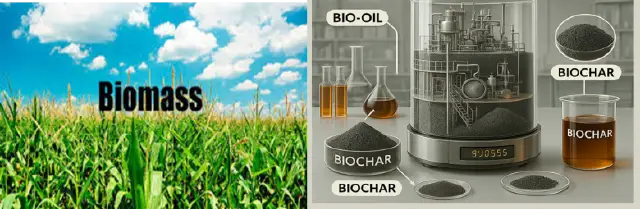
The increasing need for sustainable energy and the environmental impacts of reliance on fossil fuels have sparked greater interest in biomass as a renewable energy source. This review provides an in-depth assessment of bio-oil and biochar generation through the pyrolysis of sawdust, a significant variety of lignocellulosic biomass. The paper investigates different thermochemical conversion methods, including fast, slow, catalytic, flash, and co-pyrolysis, while emphasizing their operational parameters, reactor designs, and effects on product yields. The influence of temperature, heating rate, and catalysts on enhancing the quality and quantity of bio-oil and biochar is thoroughly analyzed. Additionally, the review examines advanced reactor technologies such as fluidized beds, fixed beds, auger reactors, and plasma pyrolysis systems. It also discusses recent progress in catalyst innovation and product enhancement techniques to overcome the challenges posed by bio-oil, including its high oxygen content and low stability. By synthesizing experimental results and conducting comparative analyses, the paper identifies existing research gaps and provides insights into future paths for effective biomass utilization, thereby aiding in the creation of economically viable and environmentally responsible bioenergy systems.Graphic Abstract
Keywords
Cite This Article
 Copyright © 2025 The Author(s). Published by Tech Science Press.
This work is licensed under a Creative Commons Attribution 4.0 International License , which permits unrestricted use, distribution, and reproduction in any medium, provided the original work is properly cited.
 Downloads
 Citation Tools
