
 Login
Login Register
 Submit a Paper
 Propose a Special lssue
 Open Access
ARTICLE

Maleated Deep Eutectic Solvent (DES) Lignin-Glyoxal-Chitosan Wood Adhesives
1 Department of Wood and Paper Sciences, Faculty of Natural Resources, Semnan University, Semnan, Iran
2 Laboratoire d’Etude et de Recherche sur le Materiau Bois (LERMAB), University of Lorraine, Blvd des Aiguiellettes, Nancy, France
3 Department of Chemistry, Science and Research Branch, Islamic Azad University, Tehran, Iran
* Corresponding Authors: Hamed Younesi-Kordkheili. Email: ; Antonio Pizzi. Email:
(This article belongs to the Special Issue: Renewable and Biosourced Adhesives-3rd Edition)
Journal of Renewable Materials 2026, 14(4), 1 https://doi.org/10.32604/jrm.2026.02026-0013
Received 28 January 2026; Accepted 27 March 2026; Issue published 24 April 2026
 View Full Text
 Download PDF
Abstract
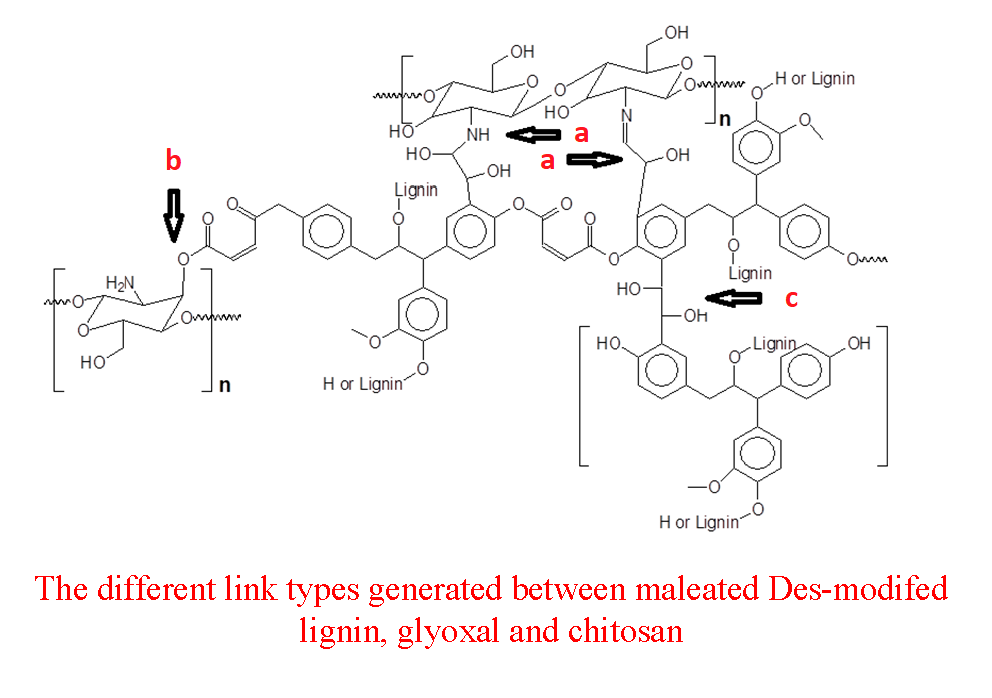
In this research, an effective method has been developed to bond wood panel adhesives of good performance using biosourced lignin and chitosan as the two main raw materials. Lignin was thus modified by a deep eutectic solvent (DES) and maleic anhydride (MA), respectively. Then DES/MA modified lignin was reacted with glyoxal to obtain a new environmentally friendly lignin-glyoxal (LG) resin. Next, chitosan was added as a bio-crosslinker to the synthesised LG resin. Finally, the performance of the resulting adhesives was evaluated by bonding plywood panels with them. Fourier Transform Infra Red (FTIR) analysis was used to confirm the chemical modification of lignin as well as the cross-links between lignin and chitosan. 13C Nuclear Magnetic Resonance (13C NMR) and Matrix Assisted Laser Desorption Ionization Time of Flight (MALDI TOF) mass spectrometry analysis show that both DES lignin and chitosan readily react and link with glyoxal and indicate the type of structures that are formed. Differential Scanning Calorimetry (DSC) showed that the glass transition temperature (Tg) in pristine lignin decreased after DES treatment but it increases by functionalizing it with maleic anhydride. The DES/MA-modified lignin resin has higher solid content, viscosity and density compared to those prepared with either DES-modified lignin or pristine lignin. The results also indicated that the addition of chitosan to the LG resin prepared had consequent effects on improving the bond strength of the plywood panels as their dry shear strength can meet the required adhesion level of the EN-314 standard. Meanwhile, the dimensional stability of the plywood panels bonded with lignin-glyoxal resin was decreased by the addition of chitosan. Finally, the results suggest that the crosslinking of DES/MA-treated lignin with glyoxal in the presence of chitosan as a bio-crosslinker is a promising approach for developing lignin-based bioadhesives for wood bonding.Graphic Abstract
Keywords
Cite This Article
 Copyright © 2026 The Author(s). Published by Tech Science Press.
This work is licensed under a Creative Commons Attribution 4.0 International License , which permits unrestricted use, distribution, and reproduction in any medium, provided the original work is properly cited.
 Downloads
 Citation Tools
