
 Login
Login Register
 Submit a Paper
 Propose a Special lssue
 Open Access
ARTICLE

Developing a Tannin-Furanic Foam with Excellent Thermal Insulation and Robust Flame Retardancy via the Synergistic Effect of Phytic Acid
1 Yunnan Provincial Key Laboratory of Wood and Bamboo Biomass Materials, Southwest Forestry University, Kunming, China
2 Yunnan Xinze Xing Wood-Based Panel Co., Ltd., Kunming, China
3 Department of Polymers and Pigments, National Research Centre, Cairo, Egypt
4 CNRS/Univ Pau & Pays Adour, Institut des Sciences Analytiques et de Physico-Chimie pour l’Environnement et les Matériaux-Xylomat, UMR5254, Mont-de-Marsan, France
5 LERMAB, University of Lorraine, 27 rue Philippe Seguin, Epinal, France
6 National Research Center of Engineering and Technology for Utilization of Botanical Functional Ingredients, Key Laboratory of Tea Science of Ministry of Education, College of Horticulture, Hunan Agricultural University, Changsha, China
* Corresponding Authors: Xinyi Chen. Email: ; Mingzhi Zhu. Email:
; Xiaojian Zhou. Email:
Journal of Renewable Materials 2026, 14(6), 2 https://doi.org/10.32604/jrm.2026.02026-0062
Received 28 April 2026; Accepted 08 June 2026; Issue published 29 June 2026
 View Full Text
 Download PDF
Abstract
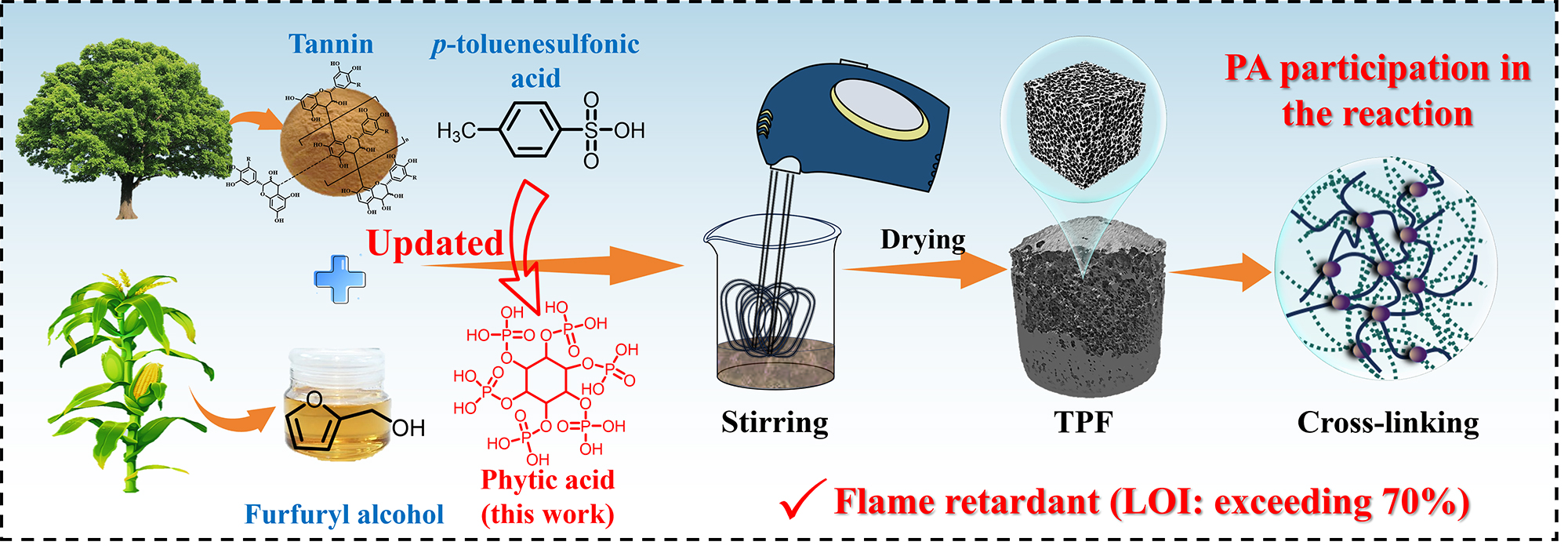
It is p-toluenesulfonic acid (p-TSA) that is commonly used as a catalyst in conventional tannin-furanic foams. However, it does not participate in the crosslinking network and tends to leach out from the foam during use, resulting in a strongly acidic material that may corrode contacting substrates and accelerate material aging. To address this issue, herein, tannin and furfuryl alcohol were used as raw materials, and bio-derived phytic acid (PA) was employed to completely replace p-TSA for the preparation of tannin-furanic foams. The multi-phosphate groups of PA form a stable crosslinked network with tannin, thereby anchoring the catalyst in the foam matrix. Inductively coupled plasma (ICP) and energy-dispersive X-ray spectroscopy (EDS) analyses revealed that the leaching ratio of p-TSA from the foam was as high as approximately 92%, whereas the leaching ratio of PA reached about 78%, demonstrating the superior loading stability of PA. The as-prepared tannin-furanic foam exhibited a compressive strength of 0.137 MPa, which is approximately 49% higher than that of the foam catalyzed by p-TSA. Ignition tests confirmed that the prepared tannin-furanic foam possessed excellent flame retardancy, with a limiting oxygen index (LOI) exceeding 70%, much higher than that of conventional foam (ca. 38%). This study provides an effective route for the development of an eco-friendly tannin-furanic foam material with excellent flame retardancy.Graphic Abstract
Keywords
Cite This Article
 Copyright © 2026 The Author(s). Published by Tech Science Press.
This work is licensed under a Creative Commons Attribution 4.0 International License , which permits unrestricted use, distribution, and reproduction in any medium, provided the original work is properly cited.
 Downloads
 Citation Tools
