Home / Journals / JRM / Vol.14, No.6, 2026
Special Issues
Table of Content
cover

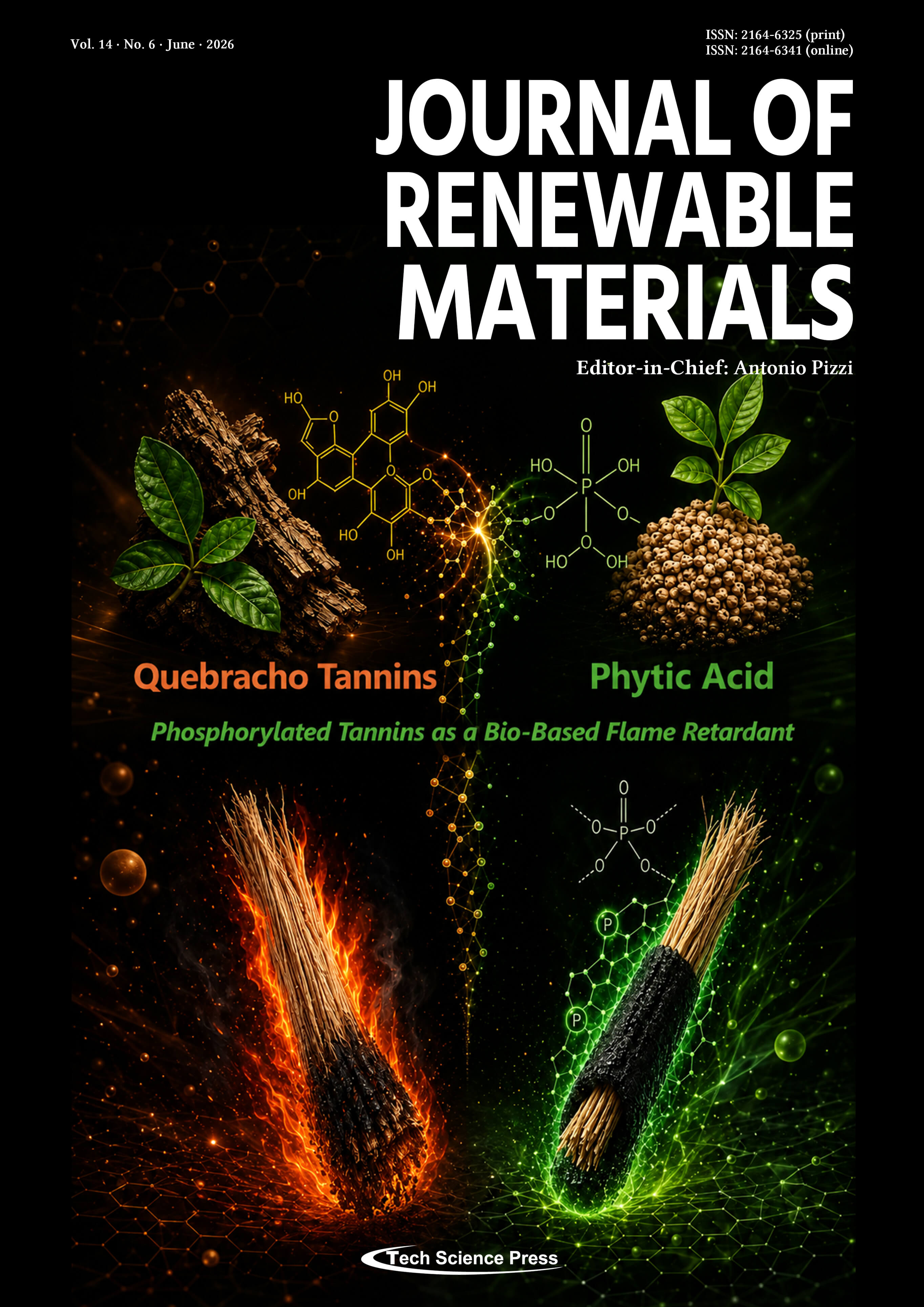
On the Cover

A sustainable strategy for enhancing flame retardancy of flax fibres using phosphorylated quebracho tannins. Chemical modification and impregnation improve phosphorus retention and promote char formation, leading to enhanced thermal stability and fire resistance. This bio-based approach highlights the potential of tannin-derived systems for advanced flame-retardant composite applications.

View this paper

  • Open AccessOpen Access

    ARTICLE

    Towards the Development of Innovative Bio-Based Flame-Retardant Systems Derived from Phosphorylated Condensed Tannins

    K. Tilouche-Guerdelli, C. Lacoste*, D. Perrin, A. Bergeret*
    Journal of Renewable Materials, Vol.14, No.6, 2026, DOI:10.32604/jrm.2026.02025-0229 - 29 June 2026
    Abstract In this study, tannins were investigated as sustainable flame retardants. The thermal and structural properties of tannic acid, chestnut, oak, and quebracho extracts were first characterized by Fourier Transform Infrared Spectroscopy (FTIR), Thermogravimetric Analysis (TGA), and Pyrolysis Combustion Flow Calorimetry (PCFC). Quebracho exhibited the most promising thermal performance, showing the lowest heat release and the highest char yield (≈38 wt.%). To further improve their efficiency, quebracho tannins were phosphorylated using phytic acid (QPHYA) or phosphoric acid (QPHOA). Phosphorus contents reached 13% and 15%, respectively, as confirmed by ICP and SEM–EDX analyses, while FTIR and NMR… More >

    Graphic Abstract

    Towards the Development of Innovative Bio-Based Flame-Retardant Systems Derived from Phosphorylated Condensed Tannins

  • Open AccessOpen Access

    ARTICLE

    Developing a Tannin-Furanic Foam with Excellent Thermal Insulation and Robust Flame Retardancy via the Synergistic Effect of Phytic Acid

    Wenhe Bi1, Yang Yang1, Jiamin Wu1, Jianji Chu2, Jun Zhang1, Guanben Du1, Hisham Essawy3, Bertrand Charrier4, Antonio Pizzi5, Xinyi Chen1,*, Mingzhi Zhu6,*, Xiaojian Zhou1,*
    Journal of Renewable Materials, Vol.14, No.6, 2026, DOI:10.32604/jrm.2026.02026-0062 - 29 June 2026
    Abstract It is p-toluenesulfonic acid (p-TSA) that is commonly used as a catalyst in conventional tannin-furanic foams. However, it does not participate in the crosslinking network and tends to leach out from the foam during use, resulting in a strongly acidic material that may corrode contacting substrates and accelerate material aging. To address this issue, herein, tannin and furfuryl alcohol were used as raw materials, and bio-derived phytic acid (PA) was employed to completely replace p-TSA for the preparation of tannin-furanic foams. The multi-phosphate groups of PA form a stable crosslinked network with tannin, thereby anchoring the catalyst… More >

    Graphic Abstract
    Developing a Tannin-Furanic Foam with Excellent Thermal Insulation and Robust Flame Retardancy via the Synergistic Effect of Phytic Acid

  • Open AccessOpen Access

    ARTICLE

    Advancing Sustainable Materials: Nano-Palm Kernel Shell Biochar (n-PKSB) and Nano-Activated Biochar (n-APKS) as Renewable Fillers in Natural Rubber (NR) Biocomposites

    Nur ‘Aisyah Ar-Raudhoh Mohammad Tahar1, Muhammad Haziq Mohd Fadzli1, Siti Nur Liyana Mamauod1,2,*, Nahrul Hayawin Zainal3
    Journal of Renewable Materials, Vol.14, No.6, 2026, DOI:10.32604/jrm.2025.02025-0177 - 29 June 2026
    (This article belongs to the Special Issue: Biomass-based Thermoset and Thermoplastic Polymers for Biomass-based Composites)
    Abstract The palm oil industry is a major contributor to Malaysia’s economy, but its huge production has generated large amounts of oil palm biomass, particularly palm kernel shell (PKS), which poses environmental challenges if not properly managed. Converting PKS into biochar (PKSB) and activated carbon (APKS) offers a sustainable way to valorise this waste as potential bio-fillers in rubber composites. This study investigates the influence of nano-sized PKSB (n-PKSB) and activated PKS (n-APKS) as bio-fillers on the mechanical performance of natural rubber (NR) vulcanizates, with filler loadings ranging from 0 to 10 parts per hundred rubber… More >

    Graphic Abstract

    Advancing Sustainable Materials: Nano-Palm Kernel Shell Biochar (n-PKSB) and Nano-Activated Biochar (n-APKS) as Renewable Fillers in Natural Rubber (NR) Biocomposites

  • Open AccessOpen Access

    REVIEW

    Advances in Cellulose-Based Materials: A Comprehensive Review of Functionalization and Processing for Water Remediation

    Wafaa Abou-Elseoud, Mohammad Hassan*
    Journal of Renewable Materials, Vol.14, No.6, 2026, DOI:10.32604/jrm.2026.02025-0190 - 29 June 2026
    (This article belongs to the Special Issue: Process and Engineering of Lignocellulose Utilization)
    Abstract Cellulose-based materials have emerged as promising biomaterials for advanced water remediation technologies due to their bioavailability, non-toxicity, biocompatibility, hydrophilicity, and ease of chemical modification. Cellulose can be prepared in multiple forms, including nanomaterials such as cellulose nanofibrils (CNFs), cellulose nanocrystals (CNCs), and electrospun nanofibers. The abundant surface functional groups, such as hydroxyl and carboxyl groups, enable chemical tailoring, grafting, and composite formation with organic and inorganic additives, including metal–organic frameworks (MOFs), carbon-based materials, and metal oxide nanoparticles. These modifications enhance pollutant removal through adsorption, catalysis, and antimicrobial activity, enabling the treatment of heavy metals, dyes, More >

  • Open AccessOpen Access

    ARTICLE

    Characteristics of Cellulose from Oil Palm Trunks at Different Ages for Renewable Materials Applications

    Elina Hishamuddin*, Fatiha Ismail, Stasha Eleanor Rosland Abel, Humaira Alias Aisyah, Abdul Wahab Noorshamsiana
    Journal of Renewable Materials, Vol.14, No.6, 2026, DOI:10.32604/jrm.2026.02025-0187 - 29 June 2026
    (This article belongs to the Special Issue: Biomass-based Thermoset and Thermoplastic Polymers for Biomass-based Composites)
    Abstract Oil palm trunks (OPT), abundantly available during plantation replanting, represent a renewable lignocellulosic resource for sustainable material applications. Although OPT-derived cellulose has been extensively explored, the influence of oil palm age on cellulose properties remains insufficiently understood. In this study, cellulose was isolated from OPT aged 21, 25, and 32 years and characterized by scanning electron microscopy (SEM), Fourier-transform infrared spectroscopy (FTIR), X-ray diffraction (XRD), and thermogravimetric analysis (TGA). SEM observations indicated more uniform and better-separated fibril structures in cellulose from older OPT, suggesting more effective removal of non-cellulosic components. FTIR confirmed successful cellulose isolation More >

    Graphic Abstract

    Characteristics of Cellulose from Oil Palm Trunks at Different Ages for Renewable Materials Applications

  • Open AccessOpen Access

    REVIEW

    Smart Nano-Cellulosic-Based Materials as Antiviral Agents: A Brief Insight into Scientific Advances and Functionalization Strategies

    Tamer Y. A. Fahmy1, Samir Kamel1, Ahmed M. Khalil2,*
    Journal of Renewable Materials, Vol.14, No.6, 2026, DOI:10.32604/jrm.2025.02025-0180 - 29 June 2026
    (This article belongs to the Special Issue: Recent Advances on Renewable Materials)
    Abstract The growing threat of viral pandemics necessitates innovative antiviral strategies that are effective, sustainable, and scalable. This review highlights nanocellulose as a renewable, biocompatible nanomaterial and a promising multifunctional antiviral platform. We examine cellulose nanocrystals, nanofibrils, and bacterial nanocellulose, emphasizing their synergistic antiviral mechanisms, including nanoscale viral entrapment and surface-mediated inactivation via sulfation, cationic groups, and metal nanoparticles. Key advances include photothermally active nanocellulose-graphene composites for on-demand viral deactivation, sulfated nanocellulose mimicking heparin’s virus-trapping properties, and engineered biopolymer hybrids for targeted drug delivery and mucosal immunity. Translational applications span antiviral coatings, self-sterilizing filters, and regenerative More >

    Graphic Abstract

    Smart Nano-Cellulosic-Based Materials as Antiviral Agents: A Brief Insight into Scientific Advances and Functionalization Strategies

Per Page:

Share Link