Home / Journals / JRM / Vol.14, No.7, 2026
Special Issues
Table of Content
cover

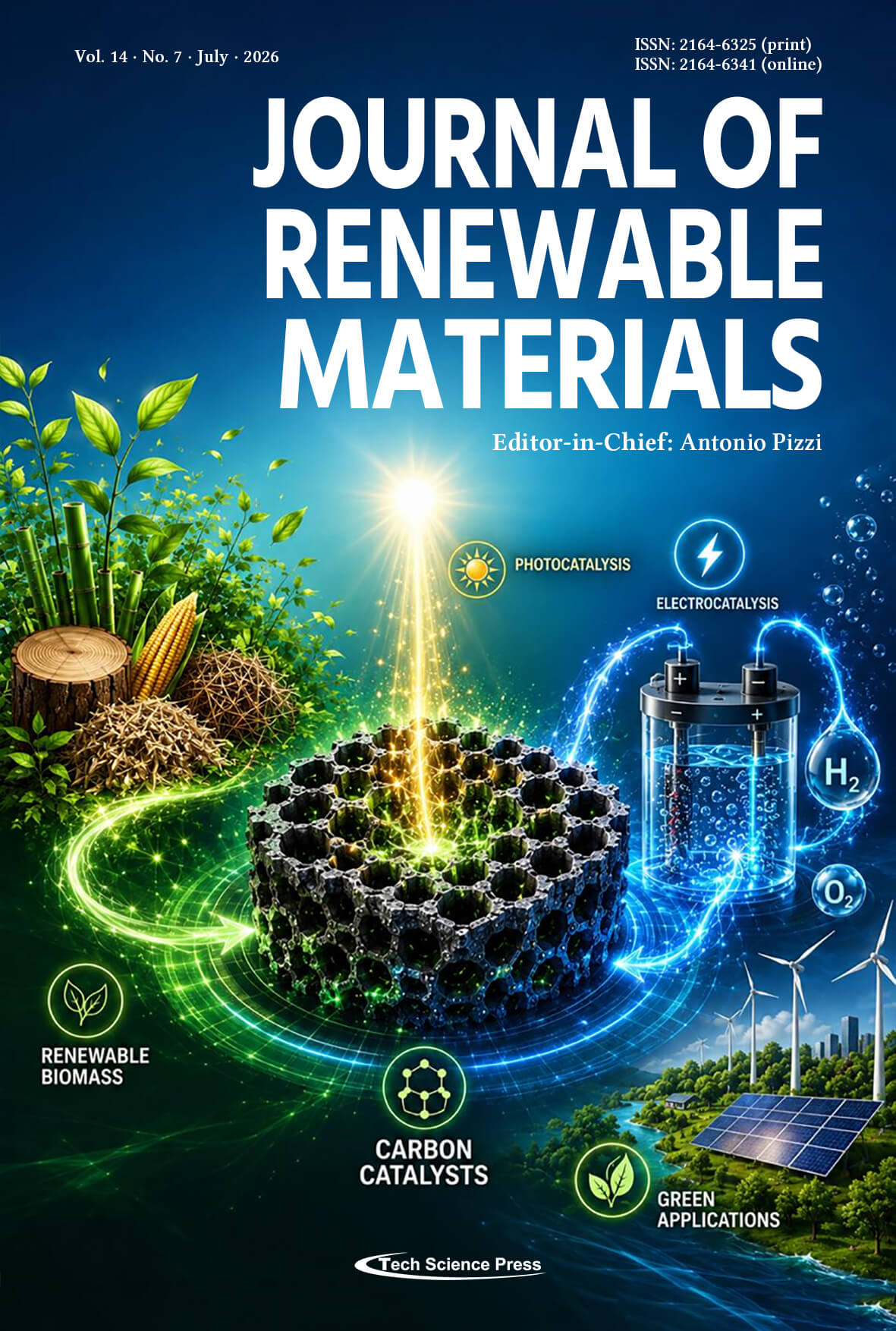
On the Cover

Renewable biomass-derived carbon catalysts are highlighted as multifunctional platforms integrating catalysis, photocatalysis, and electrocatalysis for sustainable chemical and energy applications. Their tunable porous structures and efficient charge-transfer properties enable green hydrogen production, environmentally friendly transformations, and clean energy conversion. The illustration emphasizes biomass valorization and the role of advanced carbon materials in a sustainable circular economy.

View this paper

  • Open AccessOpen Access

    ARTICLE

    Biobenzoxazines Generated in Hardened Tannin-Hexamine Wood Adhesives

    Antonio Pizzi*
    Journal of Renewable Materials, Vol.14, No.7, 2026, DOI:10.32604/jrm.2026.02026-0056 - 28 July 2026
    Abstract Cross Polarization Magic Angle Spinning Carbon 13 Nuclear Magnetic Resonance (CP-MAS 13C NMR) analysis of commercial procyanidin (pine bark) and delphinidin (pecan nut membranes) condensed flavonoid tannin extracts reacted with hexamethylenetetramine (hexamine) have shown that due to the highly reactive imino-amino methylene species formed before its degradation reaches the generation of formaldehyde, benzylamine bridges between the flavonoid units are formed. This study shows that tannin-based biobenzoxazines are also generated at the same time, with both benzylamines and benzoxazines bridges being in more marked proportions, the more reactive the tannin reacted with hexamethylenetetramine is. This is not More >

    Graphic Abstract

    Biobenzoxazines Generated in Hardened Tannin-Hexamine Wood Adhesives

  • Open AccessOpen Access

    REVIEW

    Spotlight on Sustainable Biobased Carbon Catalysts: Recent Progress and Cross-Cutting Opportunities in Catalysis, Photochemistry and Electrochemistry

    Kelly Leite dos Santos Castro Assis1, Druval Santos de Sá1, Bruno da Silva Marques1, Carolina Carvalho de Mello1, João Lucas Marques Barros2, Henrique Carvalhais Milanezi2, João Batista Oliveira dos Santos2, Carlos Alberto Franchini1, Bráulio Soares Archanjo1, Carlos Alberto Achete1, Adriana Maria da Silva1,*
    Journal of Renewable Materials, Vol.14, No.7, 2026, DOI:10.32604/jrm.2026.02025-0233 - 28 July 2026
    (This article belongs to the Special Issue: Renewable Nanostructured Porous Materials: Synthesis, Processing, and Applications)
    Abstract The transition toward a circular economy and zero-waste strategies has driven increasing interest in biomass-derived carbon materials as sustainable alternatives to conventional catalyst supports. Agricultural and industrial residues can be converted into porous carbons with high surface area, tunable porosity, and rich surface chemistry, enabling waste valorization and stabilization of metal species ranging from nanoparticles to single atoms. These properties support their application across heterogeneous catalysis, photocatalysis, and electrochemical systems, revealing cross-cutting opportunities among these fields. Despite these advantages, challenges remain, including feedstock heterogeneity, energy-intensive processing, scalability limitations, and the lack of standardized methodologies. This More >

    Graphic Abstract

    Spotlight on Sustainable Biobased Carbon Catalysts: Recent Progress and Cross-Cutting Opportunities in Catalysis, Photochemistry and Electrochemistry

  • Open AccessOpen Access

    ARTICLE

    Mussel Shell Waste as a Bio-Filler in PLLA: Effects on Crystallization, Thermal and Mechanical Performance

    Nathan Jourdainne1,2, Mathilda Ekholm1, Nawel Belkessa1, Antonin Vignon1, Nicolas Sbirrazzuoli1, Christelle Combeaud2, Jean-Luc Bouvard2, Nathanael Guigo1,2,*
    Journal of Renewable Materials, Vol.14, No.7, 2026, DOI:10.32604/jrm.2026.02026-0040 - 28 July 2026
    Abstract This study investigates the valorization of mussel shell waste as a bio-derived filler in poly(L-lactic acid) (PLLA) to promote sustainable materials aligned with circular economy principles. Mussel shells, a seafood industry byproduct rich in biogenic calcium carbonate, were ground into powder and incorporated into PLLA at 10–50 wt%. The resulting composites were thoroughly characterized using scanning electron microscopy and energy dispersive X-ray spectroscopy (SEM-EDX), Fourier transform infrared spectroscopy (FTIR), thermogravimetric analysis (TGA), differential scanning calorimetry (DSC), dynamic mechanical thermal analysis (DMTA), and uniaxial tensile testing to assess morphological, chemical, thermal, and mechanical properties. Incorporation of… More >

    Graphic Abstract

    Mussel Shell Waste as a Bio-Filler in PLLA: Effects on Crystallization, Thermal and Mechanical Performance

  • Open AccessOpen Access

    SHORT COMMUNICATION

    Comparative Study of PLA/Kenaf Core and PLA/Kenaf Bast Flexural Properties

    Siti Norasmah Surip1, Wan Nor Raihan Wan Jaafar1,*, Jaka Fajar Fatriansyah2, Ing Kong3
    Journal of Renewable Materials, Vol.14, No.7, 2026, DOI:10.32604/jrm.2025.02025-0182 - 28 July 2026
    (This article belongs to the Special Issue: Biomass-based Thermoset and Thermoplastic Polymers for Biomass-based Composites)
    Abstract Most studies on kenaf fibre composites focus on the bast due to its higher fibre yield and strength, while the core is often neglected. In this work, Polylactic Acid (PLA) matrix was reinforced with both kenaf bast and core fibres at a 49:1 wt% ratio. The fibres were chemically treated and cryo-crushed to improve bonding and dispersion. Mechanical testing revealed that treated Kenaf Core Composites (KCC) exhibited comparable flexural and impact properties to Kenaf Bast Composites (KBC), with flexural strengths of 46.19 and 46.52 MPa, respectively, and impact strengths of 5.8 and 4.4 J/m. Meanwhile, More >

  • Open AccessOpen Access

    REVIEW

    Recent Advances, Challenges, and Analytical Perspectives in Starch-Based Bioplastics

    Nuhu Lawal1,2, Adekunle Adeleke2,3, Petrus Nzerem2,4, Chizoma Adewumi2,5, Frank Ogundolie2,6, Esther Anosike-Francis2,3, Waliyi Adeleke2,3, Seun Jesuloluwa2,3,*
    Journal of Renewable Materials, Vol.14, No.7, 2026, DOI:10.32604/jrm.2026.02025-0203 - 28 July 2026
    Abstract The environmental concerns of petroleum-based plastics, including their non-biodegradability, contribution to pollution, and reliance on finite fossil resources, have motivated growing global interest in biodegradable alternatives, with starch-based bioplastics emerging as a promising solution due to their renewability, biodegradability, cost-effectiveness, and compatibility with existing processing technologies. This review synthesizes recent developments, challenges, and analytical techniques related to starch-based bioplastics. It examines the physicochemical properties of starch, modification methods such as plasticization, blending, and chemical treatments, and key production techniques including extrusion, injection molding, and 3D printing. Mechanical, thermal, and barrier properties are evaluated through standardized More >

  • Open AccessOpen Access

    ARTICLE

    Oil Palm Empty Fruit Bunch–Derived Cellulose as a Sustainable Reinforcement for Enhanced Starch-Based Bioplastic Films

    Harmiansyah1,2, Maisy Pitaloka Sinaga1, Sheilla Ika Amalia1, Salma Hanan Arwinda1, Al Aqib Anugerah Ramadhan1, Hervianna Indira Kusuma Riandara1, Mohamad Haafiz Mohamad Kassim3,4,5, Mohd Shahrieel Mohd Aras6, Melbi Mahardika3,7,*
    Journal of Renewable Materials, Vol.14, No.7, 2026, DOI:10.32604/jrm.2026.02026-0007 - 28 July 2026
    (This article belongs to the Special Issue: Advances in Eco-friendly Wood-Based Composites: Design, Manufacturing, Properties and Applications – Ⅱ)
    Abstract The limited mechanical performance of starch-based bioplastic films, particularly their low strength and stiffness, remains a major challenge for their broader application as sustainable packaging materials. This study aims to address this issue by utilizing cellulose fibers extracted from oil palm empty fruit bunch (OPEFB) waste as a reinforcing agent in corn starch–based bioplastic films. The bioplastic films were fabricated using a solution casting method with varying cellulose contents and subsequently characterized to evaluate their mechanical properties, crystalline structure, and thermal stability. The results demonstrate that the incorporation of cellulose fibers significantly enhances the tensile… More >

Per Page:

Share Link