
 Login
Login Register
 Submit a Paper
 Propose a Special lssue
 Open Access
ARTICLE

Mussel Shell Waste as a Bio-Filler in PLLA: Effects on Crystallization, Thermal and Mechanical Performance
1 Nice Institute of Chemistry (CNRS UMR 7272), University Côte d’Azur, Valrose Avenue, 28, Nice, France
2 Mines Paris, PSL University, CEMEF (CNRS UMR 7635), Sophia Antipolis, France
* Corresponding Author: Nathanael Guigo. Email:
Journal of Renewable Materials 2026, 14(7), 3 https://doi.org/10.32604/jrm.2026.02026-0040
Received 18 March 2026; Accepted 06 May 2026; Issue published 28 July 2026
 View Full Text
 Download PDF
Abstract
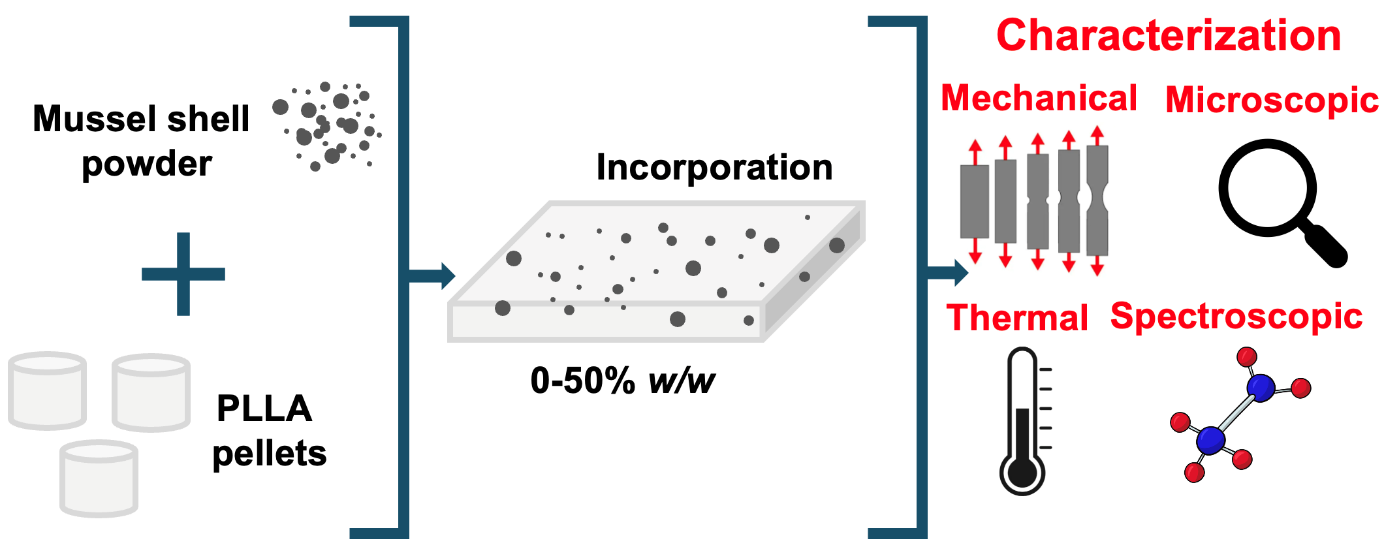
This study investigates the valorization of mussel shell waste as a bio-derived filler in poly(L-lactic acid) (PLLA) to promote sustainable materials aligned with circular economy principles. Mussel shells, a seafood industry byproduct rich in biogenic calcium carbonate, were ground into powder and incorporated into PLLA at 10–50 wt%. The resulting composites were thoroughly characterized using scanning electron microscopy and energy dispersive X-ray spectroscopy (SEM-EDX), Fourier transform infrared spectroscopy (FTIR), thermogravimetric analysis (TGA), differential scanning calorimetry (DSC), dynamic mechanical thermal analysis (DMTA), and uniaxial tensile testing to assess morphological, chemical, thermal, and mechanical properties. Incorporation of mussel shell powder significantly increased stiffness, with the storage modulus improving by more than 70% at the highest filler content. DSC results suggest that mussel shell powder promotes a heterogeneous nucleation effect in PLLA, enhancing crystallization and modifying crystallization behavior. DMTA measurements further demonstrated a substantial increase in thermomechanical stiffness while only slightly affecting the glass transition temperature, indicating restricted chain mobility due to the presence of the rigid mineral filler. TGA revealed a second degradation step from calcium carbonate decomposition, without compromising processability. Conversely, tensile strength, ductility, and toughness decreased progressively, reflecting the typical stiffness-toughness trade-off of mineral-filled composites. Overall, this work highlights the potential of mussel shell powder not only as a sustainable bio-derived filler but also as a functional reinforcing phase that can influence crystallization behavior and thermomechanical performance of PLLA.Graphic Abstract
Keywords
Biogenic; biodegradable polymers; composite materials; mechanical properties; thermal properties; scanning electron microscopy
Cite This Article
APA Style
Jourdainne, N., Ekholm, M., Belkessa, N., Vignon, A., Sbirrazzuoli, N. et al. (2026). Mussel Shell Waste as a Bio-Filler in PLLA: Effects on Crystallization, Thermal and Mechanical Performance. Journal of Renewable Materials, 14(7), 3. https://doi.org/10.32604/jrm.2026.02026-0040
Vancouver Style
Jourdainne N, Ekholm M, Belkessa N, Vignon A, Sbirrazzuoli N, Combeaud C, et al. Mussel Shell Waste as a Bio-Filler in PLLA: Effects on Crystallization, Thermal and Mechanical Performance. J Renew Mater. 2026;14(7):3. https://doi.org/10.32604/jrm.2026.02026-0040
IEEE Style
N. Jourdainne et al., “Mussel Shell Waste as a Bio-Filler in PLLA: Effects on Crystallization, Thermal and Mechanical Performance,” J. Renew. Mater., vol. 14, no. 7, pp. 3, 2026. https://doi.org/10.32604/jrm.2026.02026-0040
 Copyright © 2026 The Author(s). Published by Tech Science Press.
This work is licensed under a Creative Commons Attribution 4.0 International License , which permits unrestricted use, distribution, and reproduction in any medium, provided the original work is properly cited.
 Downloads
 Citation Tools
