Home / Journals / JRM / Vol.14, No.8, 2026
Special Issues
Table of Content
cover

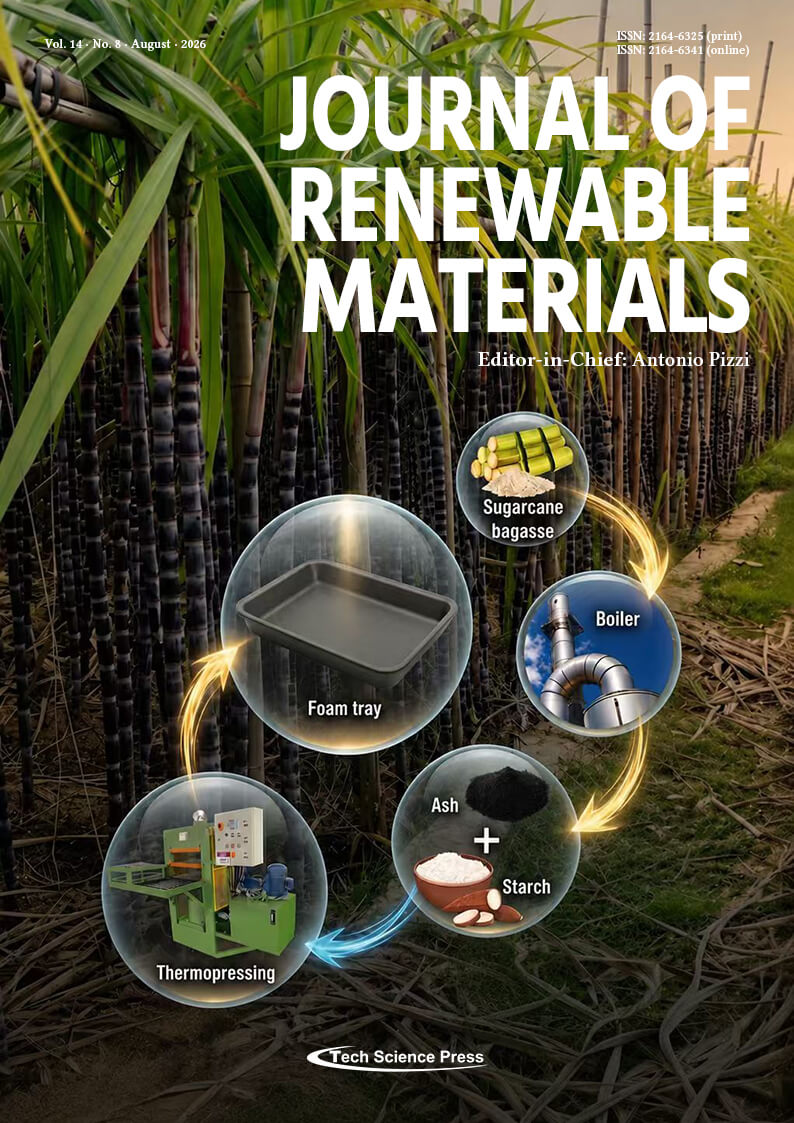
On the Cover

This study demonstrates the valorization of sugarcane bagasse ash as a bio-based filler in cassava starch foam trays produced via thermopressing. Bagasse ash significantly enhances the trays' water resistance, surface hydrophobicity, and thermal stability, presenting a promising sustainable circular-economy alternative to single-use expanded polystyrene packaging.

View this paper

  • Open AccessOpen Access

    ARTICLE

    Valorization of Sugarcane Bagasse Ash for the Production of Sustainable Biobased Trays

    Guilherme José Aguilar, Larissa Rodrigues Beitum, Ana Laura Garcia, Delia Rita Tapia-Blácido*
    Journal of Renewable Materials, Vol.14, No.8, 2026, DOI:10.32604/jrm.2026.02026-0029 - 26 August 2026
    Abstract The search for sustainable alternatives to expanded polystyrene (EPS) has led to the development of starch-based foams reinforced with agro-industrial by-product. This study aimed to evaluate the effect of sugarcane bagasse ash (SBA) content on the physical, mechanical, and water-interaction properties of cassava starch foam trays, and to determine the maximum feasible ash content that could be incorporated. Sugarcane bagasse ash was collected from the boiler air preheater. Foam trays were prepared by thermopressing using cassava starch, guar gum, magnesium stearate, glycerol, and SBA at 0%, 2%, 5%, 8%, and 11%. The trays were characterized… More >

    Graphic Abstract

    Valorization of Sugarcane Bagasse Ash for the Production of Sustainable Biobased Trays

  • Open AccessOpen Access

    REVIEW

    Formation of Binder-Free Composites Based on Natural Materials: Structure, Mechanisms, and Prospects for Chemical Modification

    Alexey E. Shkuro1,*, Artyom V. Artyomov2, Victor G. Buryndin2, Anna S. Ershova2, Tatyana V. Yakubova3
    Journal of Renewable Materials, Vol.14, No.8, 2026, DOI:10.32604/jrm.2026.02025-0194 - 26 August 2026
    (This article belongs to the Special Issue: Process and Engineering of Lignocellulose Utilization)
    Abstract Binder-free lignocellulosic boards and molded composites are gaining momentum as low-emission alternatives to conventional wood-based panels because they exploit intrinsic self-bonding of biomass under hot pressing. This review critically analyzes structure-formation pathways in binder-free composites, focusing on (i) thermo-mechanical softening and flow of lignin as a natural adhesive phase, (ii) auto-hydrolysis of hemicelluloses generating organic acids and reactive furanic intermediates, and (iii) subsequent condensation and crosslinking reactions that consolidate the network. We compare process routes historically associated with Masonite-type fiber processing and Lignoplast-type direct compaction, highlighting how moisture, temperature, pressure, sealing degree, and particle morphology More >

  • Open AccessOpen Access

    REVIEW

    Renewable Polymeric Tissue Scaffolding: Trends in Structural Development

    Huan Long1, Emmanuel Abu-Danso1,2,*, Mônica Rufino Senra1,3, Leonid Ionov4, Jussi V. K. Kukkonen2, Holger Ruckdäschel1,5,*
    Journal of Renewable Materials, Vol.14, No.8, 2026, DOI:10.32604/jrm.2026.02025-0198 - 26 August 2026
    Abstract Polymeric scaffolds are now widely used in biomedical engineering to reconstruct tissues as well as other corrective medical applications. They are designed to promote the proliferation of the host cell and provide load-bearing capabilities. Through tailored fabrication methods and material compatibility, polymeric scaffolds can be applied either temporarily or permanently, and successful applications have resulted in commercialized products. Currently, there is a high interest in tissue scaffolds that combine both effective mechanical performance with efficient surface response functionalities. In this work, we performed an in-depth comparative analysis of tissue scaffolds made from renewable parent materials,… More >

    Graphic Abstract

    Renewable Polymeric Tissue Scaffolding: Trends in Structural Development

  • Open AccessOpen Access

    ARTICLE

    Synergistic Effect of Low-Concentration ZnCl2-Activated Bio-Carbon from Red Suren Leaves with Hierarchical Pore Structure and Self-Doping for High-Performance Supercapacitor Applications

    Erman Taer1,*, Novi Yanti1, Asmarwati1, Apriwandi1, Abrar Ismardi2, Indra Wahyudhin Fathona2, Memoria Rosi2, Bidayatul Armynah3, Dahlang Tahir3, Ninis Hadi Haryanti4, Suryajaya4, Isnasyauqiah5, Ida Usman6, Julnaidi7, Rika Taslim8,*
    Journal of Renewable Materials, Vol.14, No.8, 2026, DOI:10.32604/jrm.2026.02026-0022 - 26 August 2026
    (This article belongs to the Special Issue: Renewable Nanostructured Porous Materials: Synthesis, Processing, and Applications)
    Abstract The promotion of bio-carbon for developing superior electrodes has become a trending topic in realising the practical application of supercapacitor devices. This study aimed to prepare porous carbon (PC) with a taproot fiber-like nanostructure that was decorated with self-doped oxygen. The waste of red suren leaves (RSL) was further treated using a direct heating method with the catalyst effect of ZnCl2 (0.3, 0.5, and 0.7 M) in an N2/CO2 environment at 850°C, being examined. The results showed that RSL@PC-0.5 exhibited the best amorphous carbon structure (FWHM = 0.105° and 0.182°). The specific surface area (SSA =… More >

    Graphic Abstract
    Synergistic Effect of Low-Concentration ZnCl<sub><b>2</b></sub>-Activated Bio-Carbon from Red Suren Leaves with Hierarchical Pore Structure and Self-Doping for High-Performance Supercapacitor Applications

  • Open AccessOpen Access

    ARTICLE

    In Situ Peracetic Acid-Driven Oxidative Delignification for Enhancing the Properties of Densified Randu Wood (Ceiba pentandra L. Gaertn.)

    Nurhasnah1, Naresworo Nugroho1,*, Sarah Augustina2,*, Silvia Uthari Nuzaverra Mayang Mangurai3, Deazy Rachmi Trisatya1,2
    Journal of Renewable Materials, Vol.14, No.8, 2026, DOI:10.32604/jrm.2026.02026-0027 - 26 August 2026
    (This article belongs to the Special Issue: Densification of Wood and Biomass)
    Abstract Randu wood is a fast-growing wood species with a low density, ranging from 0.21 to 0.28 g/cm3. This limits the utilization of this species, particularly for structural purposes. Improving the quality and strength of wood can be done by applying a densification process. The effectiveness of this process may be improved by applying in-situ delignification using peracetic acid as a pretreatment. Therefore, this study aimed to analyze the physical (moisture content and density), dimensional stability (TR-ratios, water absorption, and thickness swelling), spring-back (compression set, and compression-set recovery) and mechanical properties (Modulus of Rupture/MOR and Modulus of… More >

    Graphic Abstract

    <i>In Situ</i> Peracetic Acid-Driven Oxidative Delignification for Enhancing the Properties of Densified Randu Wood (<i>Ceiba pentandra</i> L. Gaertn.)

  • Open AccessOpen Access

    ARTICLE

    Thermodynamic Approach to Migration Stability of Biosourced Plasticizers via Hysteresis Analysis

    Irina N. Vikhareva*
    Journal of Renewable Materials, Vol.14, No.8, 2026, DOI:10.32604/jrm.2026.02026-0042 - 26 August 2026
    Abstract The development of efficient and migration-resistant plasticizers from renewable resources is an important challenge for the modern polymer industry. This work presents a thermodynamic approach for the rapid screening of novel bio-based plasticizers-esters of dicarboxylic acids. Using differential scanning calorimetry (DSC), the temperatures and enthalpies of melting and crystallization of the individual esters were determined, and the hysteresis of phase transition parameters was calculated as a predictive indicator. It is shown that bio-based butoxyethyl esters are characterized by low temperature hysteresis ΔT ~ 20°C and enthalpy hysteresis close to zero, indicating weak intermolecular interactions and… More >

    Graphic Abstract

    Thermodynamic Approach to Migration Stability of Biosourced Plasticizers via Hysteresis Analysis

Per Page:

Share Link