
 Login
Login Register
 Submit a Paper
 Propose a Special lssue
 Open Access
ARTICLE
In Situ Peracetic Acid-Driven Oxidative Delignification for Enhancing the Properties of Densified Randu Wood (Ceiba pentandra L. Gaertn.)
1 Forest Products Department, Faculty of Forestry and Environment, IPB University, Bogor, Indonesia
2 Research Center for Biomass and Bioproducts, National Research and Innovation Agency, Serpong, Indonesia
3 Faculty of Forestry, Universitas Tanjungpura, Pontianak, Indonesia
* Corresponding Authors: Naresworo Nugroho. Email: ; Sarah Augustina. Email:
(This article belongs to the Special Issue: Densification of Wood and Biomass)
Journal of Renewable Materials 2026, 14(8), 5 https://doi.org/10.32604/jrm.2026.02026-0027
Received 22 February 2026; Accepted 01 July 2026; Issue published 26 August 2026
 View Full Text
 Download PDF
Abstract
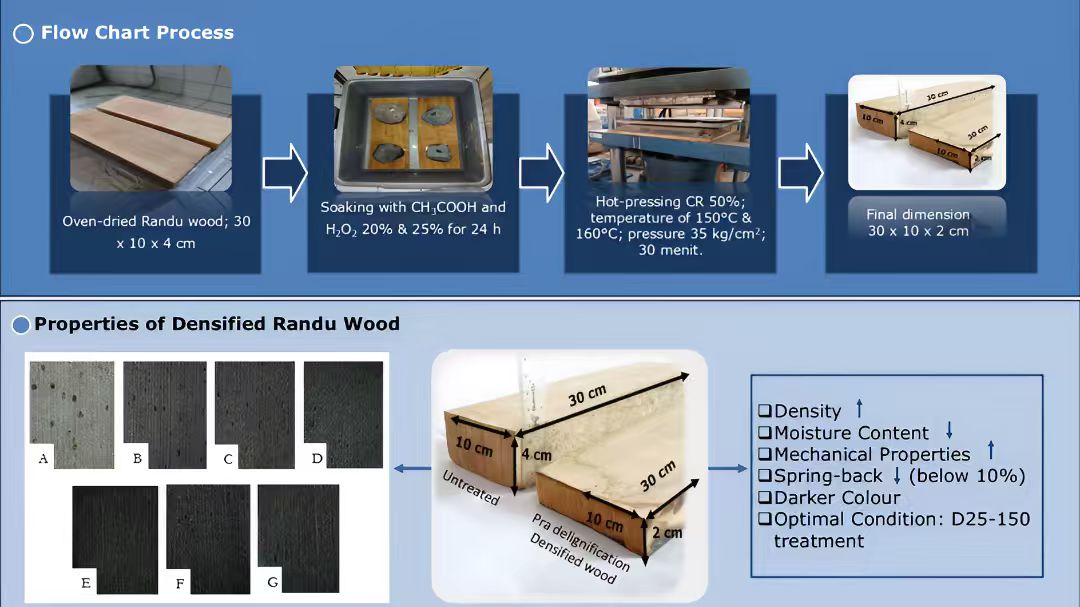
Randu wood is a fast-growing wood species with a low density, ranging from 0.21 to 0.28 g/cm3. This limits the utilization of this species, particularly for structural purposes. Improving the quality and strength of wood can be done by applying a densification process. The effectiveness of this process may be improved by applying in-situ delignification using peracetic acid as a pretreatment. Therefore, this study aimed to analyze the physical (moisture content and density), dimensional stability (TR-ratios, water absorption, and thickness swelling), spring-back (compression set, and compression-set recovery) and mechanical properties (Modulus of Rupture/MOR and Modulus of Elasticity/MOE) of densified randu wood (Ceiba pentandra L. Gaertn.) with an in-situ peracetic acid assisted delignification process as a pretreatment, as well as determining the optimum densification parameters for this species. The process begins with the application of the delignification process using a mixture of CH3COOH and H2O2 (1:1) at concentrations of 20% and 25%, as well as distilled water (0%), followed by densification at 150°C and 160°C for 30 min with a pressure of 3.43 MPa. The results showed that the application of an in-situ peracetic acid assisted delignification process as pretreatment following the densification process was able to improve the physical and mechanical properties, as well as the dimensional stability of randu densified wood with minimum spring-back (below 10%). The pressing temperature at 150°C combined with a 25% delignification solution concentration (D25-150 treatment) proved to be the most effective treatment for enhancing the properties of densified randu wood.Graphic Abstract
Keywords
Cite This Article
 Copyright © 2026 The Author(s). Published by Tech Science Press.
This work is licensed under a Creative Commons Attribution 4.0 International License , which permits unrestricted use, distribution, and reproduction in any medium, provided the original work is properly cited.
 Downloads
 Citation Tools
