
 Login
Login Register
 Submit a Paper
 Propose a Special lssue
 Open Access
ARTICLE
In Situ Peracetic Acid-Driven Oxidative Delignification for Enhancing the Properties of Densified Randu Wood (Ceiba pentandra L. Gaertn.)
1 Forest Products Department, Faculty of Forestry and Environment, IPB University, Bogor, Indonesia
2 Research Center for Biomass and Bioproducts, National Research and Innovation Agency, Serpong, Indonesia
3 Faculty of Forestry, Universitas Tanjungpura, Pontianak, Indonesia
* Corresponding Authors: Naresworo Nugroho. Email: ; Sarah Augustina. Email:
(This article belongs to the Special Issue: Densification of Wood and Biomass)
Journal of Renewable Materials 2026, 14(8), 5 https://doi.org/10.32604/jrm.2026.02026-0027
Received 22 February 2026; Accepted 01 July 2026; Issue published 26 August 2026
 View Full Text
 Download PDF
Abstract
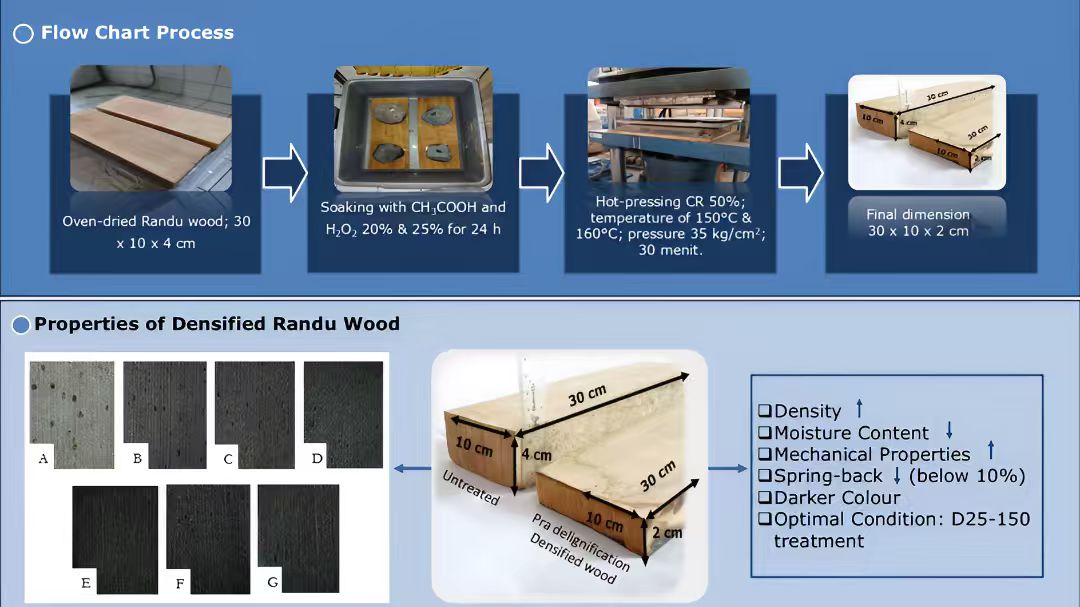
Randu wood is a fast-growing wood species with a low density, ranging from 0.21 to 0.28 g/cm3. This limits the utilization of this species, particularly for structural purposes. Improving the quality and strength of wood can be done by applying a densification process. The effectiveness of this process may be improved by applying in-situ delignification using peracetic acid as a pretreatment. Therefore, this study aimed to analyze the physical (moisture content and density), dimensional stability (TR-ratios, water absorption, and thickness swelling), spring-back (compression set, and compression-set recovery) and mechanical properties (Modulus of Rupture/MOR and Modulus of Elasticity/MOE) of densified randu wood (Ceiba pentandra L. Gaertn.) with an in-situ peracetic acid assisted delignification process as a pretreatment, as well as determining the optimum densification parameters for this species. The process begins with the application of the delignification process using a mixture of CH3COOH and H2O2 (1:1) at concentrations of 20% and 25%, as well as distilled water (0%), followed by densification at 150°C and 160°C for 30 min with a pressure of 3.43 MPa. The results showed that the application of an in-situ peracetic acid assisted delignification process as pretreatment following the densification process was able to improve the physical and mechanical properties, as well as the dimensional stability of randu densified wood with minimum spring-back (below 10%). The pressing temperature at 150°C combined with a 25% delignification solution concentration (D25-150 treatment) proved to be the most effective treatment for enhancing the properties of densified randu wood.Graphic Abstract
Keywords
The increasing need for sustainable architecture and high-performance materials has intensified interest in wood-based resources as renewable alternatives due to their minimal environmental impact, high carbon-sequestering capacity, low embodied energy [1], low emissions, and enhanced energy efficiency during service life [2]. These attributes position wood as a viable substitute for conventional construction and engineering materials, such as cement, concrete, steel, etc. [3]. Wood is categorized as a complex three-dimensional biopolymer with a porous structure, composed mainly of cellulose (40%–45%), hemicellulose (19%–26%), lignin (23%–34%), along with a few amount of extractives and inorganic compounds [4]. Its inherent properties, such as lightweight, favourable strength-to-weight ratio, excellent insulating capability, and ease of processing, constitute key advantages of wood-based materials [5]. However, the utilization of wood is often constrained by its low density, limited mechanical strength, and dimensional instability, particularly in fast-growing tropical species. Randu, also known as Kapok (Ceiba pentandra L. Gaertn.), is a fast-growing wood species categorized by a low density ranging from 0.21–0.26 g/cm3 [6–8], high porosity around 77% [9] with a surface area of 2.57 m2/g [10], and weak intercellular bonding [11]. These characteristics are reflected in its low strength and stiffness, as well as its high brittleness [9]. Such limitations have driven the development of wood modification technologies aimed at enhancing performance while maintaining environmental compatibility.
Among wood modification technologies, the densification process is a promising technique that exploits the viscoelastic properties of wood to transform low-density wood species into high-performance materials through mechanical, chemical, or combined treatments [12]. This process is carried out by pressing wood under transverse compression (radial or tangential direction) at a certain temperature and pressure for a predetermined period of time. The densification process can be divided into four stages: softening or plasticizing of the cell wall, followed by compression perpendicular to the grain in the softened state, setting by cooling and drying in the deformed state and fixing the deformed state [13]. The important things on densification process are the softening or plasticizing stage before compression, which is usually performed at temperatures exceeding the glass transition temperature (Tg) of the cell wall components. Several studies have suggested that the glass transition temperature for lignin is 60°C [14], 73°C–95°C [15], or even ranges from 55°C to 100°C [16,17]. When the temperature of wood reaches Tg, the stiffness decreases rapidly, and the characteristic of the material becomes more rubbery. This condition promotes polymer mobility and permits re-arrangement of the molecules, therefore large deformation can occur without elastic fractures [18]. However, according to Scharf et al. [19], wood densification remains unstable due to thickness recovery (springback), which often occurs when densified wood is exposed to varying environmental temperature and humidity. Research by Handono [20] explained that densification of randu wood can improve several properties, such as density (0.23–0.28 g/cm3) and mechanical properties, however, the wood does not achieve perfect fixation (unstable/spring back). Therefore, this study incorporates a pretreatment step prior to densification to produce densified randu wood with enhanced properties through a delignification process.
In-situ delignification as pre-treatment for the wood densification process facilitates homogeneous deformation and minor damage by partially removing lignin, which reduces cell wall stiffness and enhances the viscoelastic behavior of the wood. The primary chemicals used include NaOH-only [21] or a combination between NaOH/Na2SO3 [22,23], Na2CO3 [24], NaCl2 and H2O2/NaCl2 [25], organic solvents, and any other common solvents [26]. This process can be applied in the alkaline-, oxidative-, organosolv-, and solvent-based delignification [26]. Despite their effectiveness, those chemicals present several limitations, alkali-based treatments often lead to excessive carbohydrate degradation or severe cell wall damage [26], while NaOH/Na2SO3 and systems may introduce sulfur-containing residues and environmental concerns [22,23], as well as Na2CO3 exhibits relatively weak delignification capability, requiring harsher processing conditions to achieve comparable lignin removal [24]. Among them, in situ delignification using peracetic acid is a promising option, as it is a strong oxidizing agent that can be prepared by mixing hydrogen peroxide with acetic acid, with or without a catalyst [27]. According to Liu et al. [26], oxidative delignification proceeds through radical-driven reactions that oxidize and preferentially break down the aromatic backbone of lignin, thus enabling more rapid reaction kinetics at relatively lower temperatures (60°C–100°C), or even room temperature, with lignin removal levels of up to 95%. According to Yunianti et al. [28], the application of pretreatment by soaking in a mixture of acetic acid (CH3COOH) and hydrogen peroxide (H2O2) at a 20% concentration at 80°C for 24 h followed by densification at 150°C increases the flexural strength of pine and gmelina wood. Moreover, peracetic acid/PAA treatment is an environmentally friendly oxidizing agent, as hydrogen peroxide decomposes into water (H2O) and oxygen (O2), while the hydronium ion (HO+) functions as the active reactive agents in the oxidation process [29]. Delignified wood cells show fewer cracks when delignified compared to untreated cells. Frey et al. [30] observed that after delignification and densification, initially thin wood cells tend to fold homogeneously, signaling significant structural changes. However, the temperature and duration of treatment must be carefully considered, as densification phenomena vary among different wood species.
The use of in situ PAA allows better control over the reaction process and improves the effectiveness of delignification. Li et al. [31] reported that in situ chemical treatment can effectively remove lignin and significantly modify the wood structure, particularly when combined with densification. The removal of lignin enhances the effectiveness of the densification process, resulting in improved wood performance. Previous studies on PAA delignification have primarily focused on temperate wood species such as Larix kaempferi and Quercus mongolica, native to Korea [32], as well as eucalyptus wood [33]. However, the application of in situ PAA delignification in low-density tropical wood has not been widely explored, particularly in the context of improving wood performance through the combined approach of in situ PAA pretreatment and densification. In addition, only limited studies have specifically investigated its application in low-density tropical species, such as randu wood, with respect to improving densification stability and reducing spring-back behavior. Furthermore, the mechanistic role of mild oxidative delignification in modifying the hierarchical structure, cell wall integrity, and subsequent densification behavior of low-density tropical wood remains insufficiently understood.
Therefore, this research focuses on analyzing the effect of the in situ delignification process using peracetic acid solution (CH3COOH and H2O2) for enhancing physical (moisture content and density), dimensional stability (TR-ratios, water absorption, and thickness swelling), spring-back (compression set, and compression-set recovery) and mechanical properties (Modulus of Rupture/MOR and Modulus of Elasticity/MOE) of densified randu wood (Ceiba pentandra L. Gaertn.), as well as determining the optimum densification parameters for this species.
Randu wood (Ceiba pentandra L. Gaertn.) with an approximate diameter of 50 cm and length of 100 m was obtained from the community forest in Bogor, West Java, Indonesia. The wood was processed into samples with dimensions of 30 cm × 10 cm × 4 cm (L × T × R). The samples were oven-dried at 103 ± 2°C for 24 h to obtain their oven-dry mass. Chemicals used in this study, including acetic acid (CH3COOH) and hydrogen peroxide (H2O2), were procured from Sigma-Aldrich, while distilled water was purchased from local suppliers.
2.2.1 Preparation of Raw Materials
After oven-drying to a constant weight, the randu wood was conditioned at room temperature and subsequently cut into samples of various dimensions according to the requirements of each test standard. The samples were carefully prepared to ensure uniformity in grain orientation and to minimize defects such as knots and cracks. The allocation and distribution of the test samples for each experimental characterization are illustrated in Fig. 1.

Figure 1: Distribution of test samples. (A) log pieces with a diameter of ±50 cm (B) samples for delignification, densification samples, and compression set testing; (C) samples for mechanical properties (MOE and MOR) and density testing; (D) samples for physical properties testing, including moisture content and dimensional stability (T/R-ratio, thickness swelling, and water absorption); and (E) samples for hardness and compression set recovery testing.
The delignification process was conducted by modifying the method reported by Yunianti et al. [28]. The oven-dried samples were then immersed for 24 h in a reaction container containing either destilled water (0%, control) or a peracetic-acid-forming solution prepared from a 1:1 (v/v) mixture of acetic acid (CH3COOH) and hydrogen peroxide (H2O2) at concentrations of 20% and 25%. During soaking, the solution was allowed to react in situ with the wood structure to promote oxidative delignification. After treatment, the samples were removed and thoroughly rinsed with running water three times until the wash water reached neutral pH (≈7), ensuring the removal of residual chemicals and reaction by-products.
After measuring the dimensions and weight, the samples were immediately pressed in the radial direction. A compression ratio (CR) of 50% was applied to reach a final size of 30 × 10 × 2 cm3 (L × T × R). The densification process was carried out at a pressure of 3.43 MPa. The pressure was applied gradually and maintained for 30 min at pressing temperatures of 150°C and 160°C to soften the cell wall components and facilitate plastic deformation of the wood structure. After the heating stage, the samples were kept under pressure overnight to allow slow cooling to room temperature (cold pressing), thereby minimizing spring-back and stabilizing the compressed structure. The densified samples were then re-measured for their dimensions and mass, followed by oven drying at 103 ± 2°C for 24 h to obtain the oven-dry condition prior to the final measurements [34]. All sample treatment conditions are summarized in Table 1.

2.2.4 Physical Properties Testing
The physical properties evaluated included moisture content and wood density, which were determined in accordance with British Standard 373-1999 [35]. Test samples were weighed and measured in their air-dry condition. Afterwards, the samples were oven-dried at 103 ± 2°C for 24 h. Moisture content and wood density were calculated using the following equations:
where, BA is the initial air-dry weight (g); BKT is the oven-dry condition (g); and VA is the air-dry volume of the sample (cm3).
2.2.5 Dimensional Stability Testing
Wood samples that had undergone delignification and densification were converted into samples with a size of 20 × 20 × 20 mm3, then weighed and measured. The samples were submerged in water at room temperature for 24 h, followed by oven-drying at 103 ± 2°C for another 24 h. Their weight and thickness in the oven-dry condition after water immersion, were recorded. The parameters examined included T/R ratio, water absorption (WA), and thickness swelling (TS) which were calculated using the following equations, according to Augustina et al. [36], as well as Kilumets et al. [37]:
where, ST is the tangential shrinkage (%); SR is the radial shrinkage (%); Bsb is the oven-dry weight of the sample before immersion (g); Bss is the weight of the sample after immersion (g); Tsb is the oven-dry thickness before immersion (mm); and Tss is the oven-dry thickness after immersion (mm).
The compression set (C-set) was measured using the initial sample dimensions to observe thickness changes after the delignification and densification processes. Meanwhile, the compression set recovery (CSR) was determined using 100 × 20 × 20 mm3 samples to observe the thickness recovery of densified wood after being submerged in water for 24 h. C-set and CSR were calculated using the following equations, according to Kilumets et al. [37] and Ma et al. [38]:
where, To is the sample thickness before delignification and densification (mm); Ta is the oven-dry thickness after delignification and densification (mm); Tsb is the oven-dry thickness before water immersion (mm); and Tss is the oven-dry thickness after water immersion (mm).
2.2.7 Mechanical Properties Testing
Wood samples that had undergone delignification and densification were processed into samples with dimensions of 300 × 20 × 20 mm3 and 100 × 20 × 20 mm3, then weighed and measured. Modulus of Rupture (MOR) and Modulus of Elasticity (MOE) tests were conducted using a Universal Testing Machine (UTM) in accordance with British Standard 373-1999 [35]. Wood hardness was tested in accordance with the American Society for Testing and Materials D143-2002 [39]. These properties were calculated using the following equations:
where, L is the span between supports (mm); ∆P is the load change below the proportional limit (N); ∆y is the deflection corresponding to ∆P (mm); b is the specimen width (mm); h is the specimen thickness (mm), Pmax is the maximum applied load, and A is the indented area within the specimen (mm2), determined based on the indenter geometry according to ASTM D143-2002.
The functional groups of randu wood in each treatment applied were determined using Fourier Transform Infrared Spectroscopy (FTIR) with a Universal Attenuated Total Reflectance (UATR) accessory equipped with a diamond plate (PerkinElmer Inc., Waltham, MA, USA). For this analysis, 2 mg of powder sample (30–40 mesh) was subjected to scanning from 400 to 4000 cm−1 with a resolution of 4 cm−1 at room temperature.
Quantitative data were analyzed for mean and standard deviation using Microsoft Excel 2019 software. The resulting data are presented in the form of tables and graphs. The study employed a completely randomized design (CRD), incorporating two factors: the treatment type (water immersion pre-treatment; and delignification pre-treatment using peracetic acid at concentration of 20% and 25%) and the densification temperature (150°C and 160°C). Data analysis was performed using SPSS software. Duncan’s Multiple Range Test (DMRT) was conducted for further analysis in cases where significant differences were detected for any factor or their interactions. Each treatment was performed in three replicates.
Moisture Content and Density
The physical properties observed in this study including moisture content (MC) and density values. According to Mori et al. [40], moisture content refers to the equilibrium state of water within wood relative to its surrounding environment, whereas density is defined as mass per unit volume. The average MC and density values are presented in Fig. 2A,B, respectively, while the ANOVA results are shown in Table 2.

Figure 2: Average physical properties values of randu wood in each treatment: (A) moisture content; and (B) density. Different letters above the bars indicate significant differences at the 5% level based on Duncan’s multiple range test.

The average MC values fluctuated across the applied treatments, ranging from 2.02% to 5.40%. In general, the MC values would be decreased after the densification process due to the reduction in void volume (cell lumens), which drives-out the free water from the wood structure and left out the bound water within the cell wall [41]. As shown in Fig. 2A, the MC of randu wood without treatment (control) was approximately 3.37%. The average MC of the water-immersion densified sample (AQ treatments) was slightly higher, at about 3.43%, and increased to 5.16% after pre-treatment with a 20% delignification solution (D20 treatments). This increase can be explained by the higher initial MC induced by water immersion (AQ treatment) and delignification prior to densification, which subsequently led to a slight increase in the final MC of densified randu wood. Moreover, the partial delignification using peracetic acid solution could remove lignin and hemicellulose, which exposes additional hydrophilic hydroxyl groups in the cellulose-rich cell wall, thereby enhancing surface area, water affinity through inter or intramolecular hydrogen bonds and moisture uptake prior to densification [42]. In contrast, the average MC decreased significantly to approximately 2.56% following pre-treatment with a 25% delignification solution (D25 treatments). At a high delignification level, a higher portion of lignin and partly of hemicellulose are removed, which increases cell wall flexibility during densification process. This enhanced deformability promotes severe collapsing of the lumen and buckling of the ray cells, as well as flattening pore, resulting in a highly compacted structure with limited accessible voids for water molecules [43]. Moreover, among the applied densification temperatures, samples pressed at 150°C exhibited a slightly lower MC than those pressed at 160°C. A higher pressing temperature could induce macro- and microscopic cracks in the cell wall structure and thermal degradation of hemicellulose, thereby slightly increasing the moisture re-absorption during conditioning. These phenomena are also supported by the ANOVA results (Table 2), which indicate that both treatment and pressing temperature applied had a significant effect on the MC values.
Apart of the MC results, the density value tended to increase for all of the treatments compared with the control sample (Fig. 2B). As shown in Fig. 2B, the density of randu wood without treatment (control) was approximately 0.29 g/cm3. The application of pre-treatment combined with the densification process increased the average density of the water-immersion densified samples (AQ treatment) to approximately 0.44 g/cm3, and further increased it to about 0.47 and 0.50 g/cm3 after pre-delignification using 20% and 25% solutions, respectively (D20 and D25 treatments). These phenomena are also supported by the ANOVA results (Table 2), which indicate that the interaction between treatment and pressing temperature applied had a significant effect on the density values. The highest increase of density (31%) was achieved at a 25% concentration and pressing temperature of 150°C (D25-150), rising from 0.29 to 0.60 g/cm3. This value is higher compared to the findings of Handono [20], where the densified randu wood at compression ratios of 45% and 60% ranged from 0.45–0.50 g/cm3. According to Wahyuni et al. [44], the density of densified randu wood is comparable to that of palapi wood (0.62 g/cm3) which is commonly used for interior construction, roof trusses and floors.
It can be seen in Fig. 2B, higher concentration of delignification solution resulted in slightly higher average density of densified wood. This may be attributed to the partial removal of lignin and a portion of hemicellulose, which reduces the plasticization of the wood cell wall and enhances cellulose–cellulose interactions during hot pressing, thereby increasing the effectiveness of the densification process. A Similar phenomenon was also reported by Wang et al. [43], who stated that increasing delignification solution concentration could increase the compression depth and deformation level under the same conditions. During the densification process, the wood experience structural deformation, particularly in compression areas, causing cell cavities to become flattened and dense as illustrated in Fig. 3 [12]. As shown in Fig. 3, the macroscopic changes occurred within control and densified samples in both pretreatment processes. The control wood showed the normal vessel structure (Fig. 3A), whereas the pre-treatment using water immersion (AQ treatments) prior to densification resulted in partial closure of vessel cells. The AQ treatments-150°C (Fig. 3B) resulted in larger vessel sizes than AQ treatments-160°C (Fig. 3E). Furthermore, the delignification samples (D20 and D25 treatments) showed more pronounced vessel closure. The largest vessel closure was observed in D25-160°C (Fig. 3G), followed by D25-150°C (Fig. 3D), D20-160°C (Fig. 3F), and D20-150°C (Fig. 3C). The compression of void cells during the densification process could effectively displace moisture from or within the wood’s cellular structure, thus significantly increasing the wood density [7,45,46]. This is consistent with the MC and density values obtained in this work (Fig. 2A,B). According to Wang et al. [47], this phenomenon is driven by the degradation of lignin and hemicellulose in the primary cell wall and middle lamella, which facilitates structural changes and increases mechanical strength. The increase in wood density is also dependent on the direction/plane of compression. Applying radial pressures ensures a more uniform and consistent deformation, resulting in a more homogeneous quality in the densified wood [45,48].

Figure 3: Cross-section of randu wood in each treatment: (A) control; (B) AQ-150; (C) D20-150; (D) D25-150; (E) AQ-160; (F) D20-160; and (G) D25-160.
However, the application of a higher temperature (160°C) resulted in different structural or experimental outcomes. At 160°C, the densified randu wood showed relatively inferior density than those treated at 150°C. This phenomenon is consistent with the findings of Cabral et al. [12], who stated that increasing the temperature during hot pressing does not always correlate with improved mechanical properties and may instead induce a reverse trend. This trend may be attributed to anatomical changes, including macro- and microstructural cracks, and degradation of chemical components triggered by thermal stress [13,49]. Accordingly, this suggests that the optimum balance for the delignification and densification process is achieved at 150°C. This finding is in line with Yunianti et al. [28], who highlighted that 150°C is the ideal temperature for enhancing density and flexural strength in pine and gmelina wood.
T/R-Ratio, Water Absorption, and Thickness Swelling
The dimensional stability observed in this study including the T/R-ratio, water absorption (WA), and thickness swelling (TS) values. T/R-ratio represents the difference between tangential and radial shrinkage, which describes wood performance during drying. WA and TS are critical factors for determining dimensional stability. The average values of T/R-ratio, WA and TS are presented in Fig. 4A–C.

Figure 4: Average dimensional stability values of randu wood in each treatment: (A) T/R ratio; (B) water absorption; and (C) thickness swelling. Different letters above the bars indicate significant differences at the 5% level based on Duncan’s multiple range test.
The average T/R ratio across all treatments increased by approximately 10.71% compared to the control wood, which was around 1.0 (Fig. 4A). The largest increase in T/R-ratio occurred at 20% concentration at 150°C (D20-150) and 25% concentration at 160°C (D25-160), rising by 14%, from 1 to 1.14. Among the applied treatments and temperatures, the T/R values were nearly similar and showed no significant differences. This phenomenon is also supported by the ANOVA results (Table 2), which indicate that the T/R ratio values did not differ significantly among the treatments or pressing temperatures applied. According to Bowyer et al. [50], wood achieved structural stability when its T/R-ratio is close to one (≈1). Bossu et al. [51] highlighted that the T/R ratio illustrates the susceptibility of wood to drying defects. In this study, the observed increase in the T/R ratio was driven by more pronounced shrinkage in the tangential direction compared to the radial direction; however, this difference was not statistically significant. This indicates that the structural integrity and dimensional stability of randu wood were well maintained throughout the densification process. Moreover, the results suggest that partial delignification combined with radial compression did not adversely affect the shrinkage anisotropy of randu wood. From a structural standpoint, this outcome is particularly favorable, as the densified wood is unlikely to exhibit a higher risk of wrapping and cupping than natural wood when exposed to varying humidity levels.
In addition, WA and TS values declined compared to the control, except for the TS value in the AQ-150 treatment. As shown in Fig. 4B,C, the WA and TS values of randu wood without treatment (control) were approximately 187.79% and 3.49%, respectively. The application of pre-treatment combined with the densification process decreased those average values of the water-immersion densified samples (AQ treatment) to approximately 97.05% and 5.85%, and further decreased to about 81.54% and 2.88% after pre-delignification using 20%, as well as around 80.31% and 2.62% after pre-delignification using 25% solutions, respectively (D20 and D25 treatments). These phenomena are also supported by the ANOVA results (Table 2). The most significant reduction in WA value was achieved at 25% concentration and 150°C (D25-150), decreasing from 187.79% to 75.34%. Meanwhile, the largest decrease in TS occurred d at a 25% concentration and 160°C (D25-160), reducing from 3.49% to 2.44%.
According to Wang et al. [52], partial delignification enables more effective wood deformation/flattened, resulting in higher density and reduced water absorption. This result is further supported by the negative correlation observed between these parameters (Fig. 5). Although the correlation is moderate, it clearly demonstrates the influence of structural modification through combined chemical and heat-pressing treatment on the dimensional stability of the densified wood. The ability of wood to absorb water is directly related to the degree of thickness swelling, since the internal forces attempting to restore the cell structure to its original shape [46]. The AQ-150 treatment resulted in higher TS and WA compared to other treatments. Pretreatment with water immersion lacks the necessary chemical changes to ensure permanent fixation, leaving the wood susceptible to shape recovery. This is due to reversible and irreversible swelling within the cell wall. As defined by Fang et al. [53], reversible swelling (thickness swelling) is attributed to wood’s hygroscopic properties, while irreversible swelling is fundamentally linked to compression set recovery (CSR). Furthermore, irreversible swelling may also be triggered by the mechanical failure of hemicellulose-lignin covalent bonds if the internal stress exceeds their bonding capacity [54].

Figure 5: Correlation between density and water absorption values of randu wood in each treatment applied.
Compression Set and Compression Set Recovery
The springback analysis in this study including the compression-set (C-set) and compression-set recovery (CSR). As shown in Fig. 6A, the C-set values were similar among the treatments applied, which reflected the target compression ratio (CR) applied within this study. Higher C-set values resulted from the extensive flattening of cell cavities (Fig. 3), which could directly increase the wood density after densification process [46].

Figure 6: Average springback value of randu wood in each treatment: (A) compression set; and (B) compression set recovery. Different letters above the bars indicate significant differences at the 5% level based on Duncan’s multiple range test.
The CSR values were evaluated to assess the effectiveness of the compression process and the extent of thickness swelling after 24 h of water immersion [55]. The highest average of C-set (49.47%) was found in the AQ-150 treatment, while the lowest average of CSR (6.19%) was observed in the D25-160 treatment (Fig. 6A,B). In the water immersion treatment (AQ-150), higher CSR values indicated that the use of water alone to reduce wood viscoelasticity is inadequate for providing sufficient fixation for the compressed cell structure of randu wood, leading to poor dimensional stability. Without chemical pretreatment to partially remove lignin and hemicellulose, the rigid lignin matrix acts as a reinforcing agent that stores internal stresses, which subsequently lead to springback upon wetting. Han et al. [56] reported that during densification, lignin and hemicellulose become plastic under heat, moisture, and pressure, enabling wood deformation and densification. Meanwhile, cellulose undergoes elastic deformation and stores internal stress. When the wood is re-exposed to moisture, the lignin and hemicellulose soften, hydrogen bonds break, and the wood tends to return to its original shape. Moreover, the delignification treatment using peracetic acid resulted in the reduction of wood plastisization due to partial removal of lignin and hemicellulose. Chemical treatments can remove lignin and hemicellulose thereby enabling maximum densification [13].
Among the temperature applied, treatment with 160°C shown a significantly decreased of CSR values. Inoue et al. [57] explained that the CSR of pretreated wood decreases with higher compression temperatures. This suggests that at 160°C, the fixation of the compression is not achieved through structural integrity, but rather through the permanent loss of elasticity of the cell wall. This phenomenon is in accordance with Lin et al. [58], who stated that high-temperature treatment can eliminate the ‘shape memory’ of wood by pyrolyzing hemicellulose. Consequently, the minimal CSR observed in randu wood at 160°C is likely attributable to advanced polymer degradation, the cells are no longer able to return to their original form, even though the presence of micro-cracks increases the wood’s susceptibility to higher water absorption. In addition, high temperature treatment may induce cross-linking reactions within cell wall polymers, thereby increasing deformation resistance. This phenomenon, coupled with the release of internal stresses stored in the microfibrils through the degradation of cell wall polymers [59], explains the significant reduction in springback observed at higher temperature.
Modulus of Elasticity, Modulus of Ruptures, and Hardness
The mechanical properties observed in this study include MOE, MOR and hardness. According to Maloney [60], MOE is the flexural resistance up to the proportion limit, while MOR is the maximum load capacity until fracture. Wood hardness is a measure of the ability of wood to resist pressure on the wood surface [61]. The average values of MOE, MOR, and hardness can be seen in Fig. 7A–C.

Figure 7: Average mechanical properties values of randu wood in each treatment: (A) MOE; (B) MOR; and (C) hardness. Different letters above the bars indicate significant differences at the 5% level based on Duncan’s multiple range test.
The bending properties of densified randu wood, including MOE and MOR values, tended to increase after the applied pretreatments compared with the control samples. This result is supported by the positive correlation observed between density and bending properties of randu wood (Fig. 8). The increases in MOE and MOR values, by 61.95% and 44.85%, respectively, occurred at the 25% concentration and 150°C condition (D25-150), where the MOE increased from 2232.88 to 5868.58 MPa and the MOR increased from 25.44 to 46.13 MPa, compared with control samples. The MOE value obtained was higher than that of densified randu wood with alkali treatment at 120°C, which is 5473.97 MPa, but the MOR value tended to be decreased [62]. This is also in accordance with Shi et al. [22], who stated that densification process with pre-delignification using NaOH/Na2SO3 could increase both MOE and MOR values up to 346% and 97%, respectively, due to partial degradation of chemical composition within wood structure with combined with the rearrangement of wood cells during the hot-pressing process. The ANOVA results indicated that both the treatment type and the interaction between treatment and temperature significantly affected the MOE and MOR values. Duncan’s further test showed that the MOE and MOR values of randu wood were significantly different at each level (Table 2).

Figure 8: Correlation between density and mechanical properties of randu wood in each treatment: (A) density vs. MOE; and (B) density vs. MOR.
Higher delignification solution concentrations result in a significant increase in the MOE and MOR values. According to Dwianto et al. [63], the increase of these values occurred due to the crystallization of cellulose molecules in the amorphous region of the microfibrils resulting in the wood becoming more compact and dimensionally stable. However, increasing the pressing temperature caused the reduction of those values, except for the AQ treatments. The decrease can be caused by the degradation of wood chemical components by acidic substances resulting in the damage of wood anatomical structure [64]. This also supported by Luan et al. [13], who stated that increasing the compression degree enhanced MOE, MOR, and CS, whereas excessive pressing temperature negatively affected these mechanical properties. The MOE and MOR values were related to the compression-set recovery (CSR) and density, where lower CSR values indicating higher dimensional stability, where higher density indicating a more compact structure, thus resulting in increased MOE and MOR values, and vice versa. These results are further supported by the positive correlation between density and MOE values, as well as density and MOR values, as shown in Fig. 9. These relationships indicate a moderate correlation for MOE and a weaker, yet observable, correlation for MOR. This suggests that increasing density through densification significantly contributes to improved stiffness (MOE), while the enhancement in bending strength (MOR) is influenced not only by density but also by other structural factors, such as cell wall integrity, microfibril orientation, and the extent of lignin removal. The mechanical properties of densified randu wood demonstrated an improvement in strength class from IV–V to III–IV. This strength class is comparable to that of sengon and jabon wood, which are commonly used as lightweight construction materials for interior applications [7].

Figure 9: Damage shape after MOE and MOR testing in each treatment: (A) control; (B) AQ-150; (C) D20-150; (D) D25-150; (E) AQ-160; (F) D20-160; and (G) D25-60.
During MOE testing, the specimen typically exhibited elastic bending (arching), followed by further loading in the MOR test until failure occurred. The observed failure modes were dominated by splinter tension failure, characterized by flake-shaped cracking that caused the wood to split. Brash tension failure was also observed, indicated by brittle cracking behavior. According to Mardikanto et al. [65], this type of failure occurs suddenly and produces a relatively flat fracture surface. Moreover, compression failure was also identified by cracks forming in the outer fibers of the compression zone as shown in Fig. 9.
In addition, the largest increase in hardness was at 25% concentration at 160°C (D25-160), from 18.14 to 29.03 MPa. Higher concentrations and temperatures applied shown an increase in hardness values. According to Luan et al. [13], hardness values of densified wood could increase one and twofolds compare with untreated wood due to a more compact and dense of wood structure. This may also be attributed to the preservation of bonding forces between fibers during densification, even at elevated temperatures. In addition, the low CSR value indicates improved dimensional stability and a more compact structure. According to Green et al. [66], hardness shows a positive correlation with density, as cell walls flatten with increasing density, resulting in a more compact material. Augustina et al. [67] and Wang et al. [43] also reported that densified wood produces a smoother surface when subjected to loading by steel balls. These findings are consistent with the results obtained in this study (Fig. 10).

Figure 10: Damage shape after hardness testing in each treatment: (A) control; (B) AQ-150; (C) D20-150; (D) D25-150; (E) AQ-160; (F) D20-160; and (G) D25-60.
FTIR analysis was used to examine the chemical components degradation in each treatment applied, including control wood, densified of randu wood with water immersion pre-treatment (AQ treatments) and densified of randu wood with pre-treatment delignification process at pressing temperature of 150°C and 160°C (D20 and D25 treatments), respectively. It can be seen in Fig. 11, distinct fingerprint bands were observed in the densified randu wood in water immersion and delignification pre-treatments compared with control sample, particularly at wavenumbers of 1030, 1232, 1589, 1734, 2910, and 3345 cm−1.

Figure 11: FTIR spectra comparison of the sample in each treatment applied: (A) full-spectra analysis ranges from 700–4000 cm−1; and (B) enlargement spectra analysis ranges from 700–1800 cm−1.
The absorband band at 1030 cm−1 was attributed to C-O-H stretching of alcohol, which is usually found in raw hardwood species [26]. The increased sharpness and relative intensity within this band within the treatment samples showed enhanced exposure of cellulose and a relative enrichment of carbohydrate structures after lignin removal. According to Bao et al. [68], the absorption band within this range indicated C=O and C–O stretching vibration of CH3CO in hemicelluloses. Fig. 11B also shown a stretching band at 1232 cm−1 in the treatment applied, however, the stretching became more pronounced in the pre-delignification samples, indicating that the delignification process affected the lignin and partly the hemicellulose structure, while the cellulose component remained largely unchanged. This is similar with Wang et al. [47] in densified poplar wood after alkaline delignification that stated at 1232 cm−1 indicated the presence of the loss unconjugated ester bond in the lignin-carbohydrate complex (LCC). In Aspen densified-wood, peak 1233 cm−1 showed lignin could be degraded, especially syringyl lignin [69]. Shi et al. [22] stated that the peak at 1261 cm−1 is attributed to C–H of guaiacyl ring in lignin, therefore, the stretching within this band indicated the changes of lignin unit structure. At 1589 cm−1, the absorband band showed shoulder absorption peak, however, the peak became more pronounced after densification following the pre-treatment process. A similar phenomenon was reported by Shi et al. [22], who assigned the peak at 1589 cm−1 to C=C stretching vibrations of the aromatic benzene ring in lignin. Changes in this band indicate modifications of polar functional groups conjugated with the aromatic structure in densified wood subjected to the pre-delignification process. Moreover, the peak at 1734 cm−1 is attributed to the hemicellulose fingerprint band, which indicates the presence of hemicellulose within the wood structure even after the pre-delignification process. However, the change in its intensity suggests partial degradation and deacetylation of hemicellulose rather than complete removal during treatment [26]. The absorption peaks observed at 3378 and 2900 cm−1 were assigned to O–H and C–H stretching vibrations originating from cellulose, hemicellulose, and lignin components [21].
The partial delignification pretreatment significantly enhanced the physical and mechanical properties of densified randu wood at a 50% compression ratio. The improvement tended to increase with higher concentrations of the delignification solution, indicating a strong dependence of densification efficiency on the extent of lignin removal. The treatment increased wood density while simultaneously reducing moisture content (MC), reflecting a more compact cell structure and reduced hygroscopicity. In addition, all evaluated mechanical properties, including modulus of elasticity (MOE), modulus of rupture (MOR), and hardness, as well as dimensional stability parameters, particularly water absorption (WA) and thickness swelling (TS), showed clear improvement compared with the control, except for the T/R ratios. The effectiveness of densification was confirmed by compression set (C-set) values that closely reached the targeted compression ratio and by low compression set recovery (CSR) values, indicating minimal springback after treatment. Based on the overall performance, densification at 150°C combined with a 25% delignification solution concentration (D25-150) was identified as the optimal condition. These findings demonstrate that in-situ peracetic acid delignification as a pretreatment is an effective strategy for enhancing densification efficiency and reducing springback in densified randu wood.
Acknowledgement: The authors would like to thank IPB University, especially Department of Forest Products Technology for their invaluable guidance and support. Special appreciation goes to the National Research and Innovation Agency of Indonesia (BRIN) for its financial and facilities support.
Funding Statement: This work was supported by the RIIM LPDP Grant and BRIN (Grant number: 48/II.7/HK/2025), and partly by the Research Organization for Nanotechnology and Materials—National Research and Innovation Agency (BRIN) research grant 2026.
Author Contributions: Nurhasnah: Conceptualization; Investigation; Methodology; Visualization; Writing—original draft. Naresworo Nugroho: Writing—Review & Editing. Sarah Augustina: Resources; Investigation; Methodology; Visualization; Writing—Review & Editing. Silvia Uthari Nuzaverra Mayang Mangurai: Writing—Review & Editing. Deazy Rachmi Trisatya: Writing—Review & Editing. All authors reviewed and approved the final version of the manuscript.
Availability of Data and Materials: The authors confirm that the data supporting the findings of this study are available within the article.
Ethics Approval: Not applicable.
Conflicts of Interest: The authors declare no conflicts of interest.
References
1. Luis Christoforo A, De Araujo V. Towards sustainable and high-performance engineered wood products for the construction sector. Nat Rev Mater. 2025;3:1–2. doi:10.1038/s41578-025-00865-4. [Google Scholar] [CrossRef]
2. Firoozi AA, Firoozi AA, Oyejobi DO, Avudaiappan S, Flores ES. Emerging trends in sustainable building materials: technological innovations, enhanced performance, and future directions. Results Eng. 2024;24:103521. doi:10.1016/j.rineng.2024.103521. [Google Scholar] [CrossRef]
3. Himes A, Busby G. Wood buildings as a climate solution. Dev Built Environ. 2020;4:100030. doi:10.1016/j.dibe.2020.100030. [Google Scholar] [CrossRef]
4. Akpan EI, Wetzel B, Friedrich K. Eco-friendly and sustainable processing of wood-based materials. Green Chem. 2021;23(6):2198–232. doi:10.1039/d0gc04430j. [Google Scholar] [CrossRef]
5. Augustina S, Dwianto W, Narto, Bahanawan A, Sejati PS, Amin Y, et al. In-situ modification of wood polymer via impregnation with ultra-low molar ratio urea-formaldehyde resins. Eur J Wood Wood Prod. 2025;83(1):39. doi:10.1007/s00107-024-02160-5. [Google Scholar] [CrossRef]
6. Handono M, Maulana MI, Febrianto F, Wistara NJ, Nikmatin S, Masruchin N, et al. Characteristics of nanocellulose crystals from Balsa and kapok fibers at different ammonium persulfate concentrations. Wood Sci Technol. 2021;55(5):1319–35. doi:10.1007/s00226-021-01319-0. [Google Scholar] [CrossRef]
7. Purnawati R, Febrianto F, Wistara J, Nikmatin IN, Hidayat S, Lee W, et al. Physical and chemical properties of kapok (Ceiba pentandra) and Balsa (Ochroma pyramidale) fibers. J Korean Wood Sci Technol. 2018;46(4):393–401. doi:10.5658/wood.2018.46.4.393. [Google Scholar] [CrossRef]
8. Nawawi DS, Maria A, Firdaus RD, Rahayu IS, Fatrawana A, Pramatana F, et al. Improvement of dimensional stability of tropical light-wood Ceiba pentandra (L.) by combined alkali treatment and densification. J Korean Wood Sci Technol. 2023;51(2):133–44. doi:10.5658/wood.2023.51.2.133. [Google Scholar] [CrossRef]
9. Sangalang RH. Kapok fiber-structure, characteristics and applications: a review. Orient J Chem. 2021;37(3):513–23. doi:10.13005/ojc/370301. [Google Scholar] [CrossRef]
10. Yang Z, Wu X, Han J, Xu S, Li F, Guan F, et al. Superhydrophobically modified kapok fiber and powder: surface characteristic, oil sorption and pore structure. Ind Crops Prod. 2024;209:117960. doi:10.1016/j.indcrop.2023.117960. [Google Scholar] [CrossRef]
11. Baraniak J, Kania-Dobrowolska M. Multi-purpose utilization of kapok fiber and properties of Ceiba pentandra tree in various branches of industry. J Nat Fibres. 2023;20(1):2192542. doi:10.1080/15440478.2023.2192542. [Google Scholar] [CrossRef]
12. Cabral JP, Kafle B, Subhani M, Reiner J, Ashraf M. Densification of timber: a review on the process, material properties, and application. J Wood Sci. 2022;68(1):20. doi:10.1186/s10086-022-02028-3. [Google Scholar] [CrossRef]
13. Luan Y, Fang CH, Ma YF, Fei BH. Wood mechanical densification: a review on processing. Mater Manuf Process. 2022;37(4):359–71. doi:10.1080/10426914.2021.2016816. [Google Scholar] [CrossRef]
14. Makri SP, Xanthopoulou E, Klonos PA, Grigoropoulos A, Kyritsis A, Deligkiozi I, et al. Lignin particle size affects the properties of PLA composites prepared by in situ ring-opening polymerization. Polymers. 2024;16(24):3542. doi:10.3390/polym16243542. [Google Scholar] [CrossRef]
15. Jakes JE, Hunt CG, Zelinka SL, Ciesielski PN, Plaza NZ. Effects of moisture on diffusion in unmodified wood cell walls: a phenomenological polymer science approach. Forests. 2019;10(12):1084. doi:10.3390/f10121084. [Google Scholar] [CrossRef]
16. Mihalcica M, Stanciu MD, Teodorescu HD, Iftimie N. Evaluation of viscous-elastic properties of resonance maple wood. Int J Mod Manuf Technol. 2022;14(2):145–50. doi:10.54684/ijmmt.2022.14.2.145. [Google Scholar] [CrossRef]
17. Ramachandran RP, Cenkowski S, Paliwal J. Thermo-physical characterization of kraft lignin mixed with bio-plasticizers: a valorization approach. Trans ASABE. 2020;63(5):1193–206. doi:10.13031/trans.13720. [Google Scholar] [CrossRef]
18. Kutnar A, Sernek M. Densification of wood. Zb Gozdarstva Lesar. 2007;82:53–62. [Google Scholar]
19. Scharf A, Lemoine A, Neyses B, Sandberg D. The effect of the growth ring orientation on spring-back and set-recovery in surface-densified wood. Holzforschung. 2023;77(6):394–406. doi:10.1515/hf-2023-0004. [Google Scholar] [CrossRef]
20. Handono D. Densification of randu wood (Ceiba pentandara L. Gaertn.) using pressing process and polymer surface coating and UV-radiation method. Jakarta, Indonesia: State Islamic University Syarif Hidayatullah Jakarta; 2011. (In Bahasa Indonesia). [Google Scholar]
21. Andze L, Nefjodovs V, Zoldners J, Milbreta U, Skute M, Vecbiskena L, et al. NaOH-only pretreated wood densification: a simplified sulfite-free route across wood species. Polymers. 2026;18(3):312. doi:10.3390/polym18030312. [Google Scholar] [PubMed] [CrossRef]
22. Shi J, Peng J, Huang Q, Cai L, Shi SQ. Fabrication of densified wood via synergy of chemical pretreatment, hot-pressing and post mechanical fixation. J Wood Sci. 2020;66(1):5. doi:10.1186/s10086-020-1853-x. [Google Scholar] [CrossRef]
23. Song J, Chen C, Zhu S, Zhu M, Dai J, Ray U, et al. Processing bulk natural wood into a high-performance structural material. Nature. 2018;554(7691):224–8. doi:10.1038/nature25476. [Google Scholar] [PubMed] [CrossRef]
24. Wang J, Simson R, Gleisner R, Fishwild SJ, Begel M, Zhu JY. Carbonate pre-treatment of wood for transformative structural applications through densification. Ind Crops Prod. 2022;188:115645. doi:10.1016/j.indcrop.2022.115645. [Google Scholar] [CrossRef]
25. Kumar A, Jyske T, Petrič M. Delignified wood from understanding the hierarchically aligned cellulosic structures to creating novel functional materials: a review. Adv Sustain Syst. 2021;5(5):2000251. doi:10.1002/adsu.202000251. [Google Scholar] [CrossRef]
26. Liu Q, Samad YA, Zhang H, Keplinger T, Rojas OJ, Beaumont M, et al. Delignification pathways for the engineering of nanostructured wood. Small Struct. 2026;7(1):e202500575. doi:10.1002/sstr.202500575. [Google Scholar] [CrossRef]
27. Kundu C, Samudrala SP, Kibria MA, Bhattacharya S. One-step peracetic acid pretreatment of hardwood and softwood biomass for platform chemicals production. Sci Rep. 2021;11:11183. doi:10.1038/s41598-021-90667-9. [Google Scholar] [PubMed] [CrossRef]
28. Yunianti AD, Tirtayasa PK, Suhasman T, Agussalim I, Muin M. Modified densification process for increasing strength properties of pine and gmelina wood from community forests. J Korean Wood Sci Technol. 2019;47(4):418–24. doi:10.5658/wood.2019.47.4.418. [Google Scholar] [CrossRef]
29. Terzopoulou P, Vouvoudi EC, Achilias DS. Delignification as a key strategy for advanced wood-based materials: chemistry, delignification parameters, and emerging applications. Forests. 2025;16(6):993. doi:10.3390/f16060993. [Google Scholar] [CrossRef]
30. Frey M, Zirkelbach M, Dransfeld C, Faude E, Trachsel E, Hannus M, et al. Fabrication and design of wood-based high-performance composites. J Vis Exp. 2019;153:60327. doi:10.3791/60327. [Google Scholar] [PubMed] [CrossRef]
31. Li J, Chen C, Zhu JY, Ragauskas AJ, Hu L. In situ wood delignification toward sustainable applications. Acc Mater Res. 2021;2(8):606–20. doi:10.1021/accountsmr.1c00075. [Google Scholar] [CrossRef]
32. Park KC, Kim B, Park H, Park SY. Peracetic acid treatment as an effective method to protect wood discoloration by UV light. J Korean Wood Sci Technol. 2022;50(4):283–98. doi:10.5658/wood.2022.50.4.283. [Google Scholar] [CrossRef]
33. Zhuo J, Bobokalonov J, Usmanova S, Xiang Z. Effects of peracetic acid delignification on hemicellulose extraction by dimethyl sulfoxide. Ind Crops Prod. 2024;222:119731. doi:10.1016/j.indcrop.2024.119731. [Google Scholar] [CrossRef]
34. Augustina S, Wahyudi I, Darmawan IW, Malik J, Basri E, Kojima Y. Specific gravity and dimensional stability of boron-densified wood on three lesser-used species from Indonesia. J Korean Wood Sci Technol. 2020;48(4):458–71. doi:10.5658/wood.2020.48.4.458. [Google Scholar] [CrossRef]
35. BS-373. Methods of Testing Small Clear Specimens of Timber. London, UK: British Standards Institution; 1999. [Google Scholar]
36. Augustina S, Darmawan T, Sudarmanto, Narto N, Bahanawan A, Adi DS, et al. Effects of succinic acid impregnation on physical properties of sapwood and heartwood from plantation-grown short-rotation teak. South For A J For Sci. 2023;85(3–4):201–11. doi:10.2989/20702620.2023.2220893. [Google Scholar] [CrossRef]
37. Kilumets C, Kallakas H, Ralph S, Zhu JY, Hunt CG, Rohumaa A, et al. Effect of lignin on veneer densification and set-recovery. Constr Build Mater. 2024;451:138795. doi:10.1016/j.conbuildmat.2024.138795. [Google Scholar] [CrossRef]
38. Ma P, An X, Wang F, Huang H, Chen Z, Wang S, et al. Effects of pre-heating treatment parameters on dimensional stability and mechanical properties of densified Chinese fir. Constr Build Mater. 2023;407:133484. doi:10.1016/j.conbuildmat.2023.133484. [Google Scholar] [CrossRef]
39. ASTM D143. Test Standard. West Conshohocken, PA, USA: American Society for Testing and Materials; 2002. [Google Scholar]
40. Mori T, Ariki A, Enatsu Y, Sadakane Y, Tanaka K. Study on measurement methods for moisture content inside wood. Buildings. 2025;15(15):2719. doi:10.3390/buildings15152719. [Google Scholar] [CrossRef]
41. Cabral JP, Subhani M, Ashraf M, Kafle B, Reiner J. A critical multi-parameter analysis of the densification process on the dimensional stability and bending performance of densified timber. J Wood Sci. 2024;70(1):58. doi:10.1186/s10086-024-02161-1. [Google Scholar] [CrossRef]
42. Alqrinawi H, Ahmed B, Wu Q, Lin H, Kameshwar S, Shayan M. Effect of partial delignification and densification on chemical, morphological, and mechanical properties of wood: structural property evolution. Ind Crops Prod. 2024;213:118430. doi:10.1016/j.indcrop.2024.118430. [Google Scholar] [CrossRef]
43. Wang J, Fishwild SJ, Begel M, Zhu JY. Properties of densified poplar wood through partial delignification with alkali and acid pretreatment. J Mater Sci. 2020;55(29):14664–76. doi:10.1007/s10853-020-05034-2. [Google Scholar] [CrossRef]
44. Wahyuni IZ, Muin M, Suhasman. Changes in physical properties and dimensional stability of wood due to preservation using carbon dioxide impregnation. J Perennial. 2007;3(1):1–5. doi:10.24259/perennial.v3i1.162. [Google Scholar] [CrossRef]
45. Wang X, Tu D, Chen C, Zhou Q, Huang H, Zheng Z, et al. A thermal modification technique combining bulk densification and heat treatment for poplar wood with low moisture content. Constr Build Mater. 2021;291:123395. doi:10.1016/j.conbuildmat.2021.123395. [Google Scholar] [CrossRef]
46. Pertuzzatti A, Missio AL, Cademartori PHG, Santini EJ, Haselein CR, Berger C, et al. Effect of process parameters in the thermomechanical densification of Pinus elliottii and Eucalyptus grandis fast-growing wood. BioResources. 2017;13(1):1576–90. doi:10.15376/biores.13.1.1576-1590. [Google Scholar] [CrossRef]
47. Wang J, Minami E, Asmadi M, Kawamoto H. Effect of delignification on thermal degradation reactivities of hemicellulose and cellulose in wood cell walls. J Wood Sci. 2021;67(1):19. doi:10.1186/s10086-021-01952-0. [Google Scholar] [CrossRef]
48. Maturana JC, Guindos P, Lagos J, Arroyave C, Echeverría F, Correa E. Two-step hot isostatic pressing densification achieved non-porous fully-densified wood with enhanced physical and mechanical properties. Sci Rep. 2023;13:14324. doi:10.1038/s41598-023-41342-8. [Google Scholar] [PubMed] [CrossRef]
49. Wang J, Liu J, Li J, Zhu JY. Characterization of microstructure, chemical, and physical properties of delignified and densified poplar wood. Materials. 2021;14(19):5709. doi:10.3390/ma14195709. [Google Scholar] [PubMed] [CrossRef]
50. Bowyer JL, Shmulsky R, Haygreen JG. Forest products and wood science: an introduction, translation. 4nd ed. Hoboken, NJ, USA: John Wiley & Sons, Inc.; 2003. [Google Scholar]
51. Bossu J, Beauchêne J, Estevez Y, Duplais C, Clair B. New insights on wood dimensional stability influenced by secondary metabolites: the case of a fast-growing tropical species Bagassa guianensis Aubl. PLoS One. 2016;11(3):e0150777. doi:10.1371/journal.pone.0150777. [Google Scholar] [PubMed] [CrossRef]
52. Wang J, Chai Y, Liu J, Zhu JY. The viscoelastic and hygroscopicity behavior of delignified and densified poplar wood. Forests. 2023;14(9):1721. doi:10.3390/f14091721. [Google Scholar] [CrossRef]
53. Fang CH, Mariotti N, Cloutier A, Koubaa A, Blanchet P. Densification of wood veneers by compression combined with heat and steam. Eur J Wood Wood Prod. 2012;70(1):155–63. doi:10.1007/s00107-011-0524-4. [Google Scholar] [CrossRef]
54. Ohlmeyer M, Paul W. Optimization of the properties of wood materials by means of thermal modification methods. Hamburg, Germany: University of Hamburg; 2010. [Google Scholar]
55. Esteves B, Ribeiro F, Lopes L, Ferreira J, Domingos I, Duarte M, et al. Densification and heat treatment of maritime pine wood. Bratislava, Slovak: Slovak Forest Products Research Institute; 2017. [Google Scholar]
56. Han L, Kutnar A, Couceiro J, Sandberg D. Creep properties of densified wood in bending. Forests. 2022;13(5):757. doi:10.3390/f13050757. [Google Scholar] [CrossRef]
57. Inoue M, Sekino N, Morooka T, Rowell RM, Norimoto M. Fixation of compressive deformation in wood by presteaming. J Trop For Sci. 2008;20(4):273–81. [Google Scholar]
58. Lin F, Zhong H, Bao Y, Li N, Zheng Y, Gong Y, et al. An efficient high-temperature saturated-steam process for bamboo flattening: crack generation and improvement mechanisms. Constr Build Mater. 2025;473:141074. doi:10.1016/j.conbuildmat.2025.141074. [Google Scholar] [CrossRef]
59. Darwis A, Wahyudi I, Dwianto W, Cahyono TD. Densified wood anatomical structure and the effect of heat treatment on the recovery of set. J Indian Acad Wood Sci. 2017;14(1):24–31. doi:10.1007/s13196-017-0184-z. [Google Scholar] [CrossRef]
60. Maloney TM. Modern particleboard & dry-process fiberboard manufacturing. San Fransisco, CA, USA: Miller Freeman Inc.; 1993. [Google Scholar]
61. Tsoumis GT. Science and technology of wood: structure, properties, utilization. New York, NY, USA: Van Nostrand Reinhold; 1991. [Google Scholar]
62. Nawawi DS, Rahayu IS. Effect of alkali treatment on physi-mechanical properties of densified randu (Ceiba pentandara L. Gaertn.) wood. Bogor, Indonesia: IPB University; 2019. (In Bahasa Indonesia). [Google Scholar]
63. Dwianto W, Tanaka F, Inoue M, Norimoto M. Crystallinity changes of wood by heat or steam treatment. Wood Res. 1996;83:47–9. [Google Scholar]
64. Hill CAS. Wood modification: chemical, thermal and other processes. Hoboken, NJ, USA: John Wiley & Sons, Inc.; 2006. 10.1002/0470021748. [Google Scholar] [CrossRef]
65. Mardikanto TR, Karlinasari L, Bahtiar ET. Mechanical properties of wood. Bogor, Indonesia: IPB Press; 2011. (In Bahasa Indonesia). [Google Scholar]
66. Green DW, Begel M, Nelson W. Janka hardness using nonstandard specimens. Madison, WI, USA: U.S. Department of Agriculture; 2006. [Google Scholar]
67. Augustina S, Wahyudi I, Darmawan IW, Malik J, Kojima Y, Okada T, et al. Effect of chemical charateristics on mechanical and natural durability properties of three lesser-used wood species. J Sylva Lestari. 2021;9(1):161–78. (In Bahasa Indonesia). doi:10.23960/jsl19161-178. [Google Scholar] [CrossRef]
68. Bao X, Yang M, Zhu J, Xu H, Dang H, Guo K, et al. Efficient delignification of poplar and Chinese fir wood using a peroxyacetic acid/hydrogen peroxide system. J Wood Sci. 2025;71(1):44. doi:10.1186/s10086-025-02214-z. [Google Scholar] [CrossRef]
69. Mania P, Kupfernagel C, Curling S. Densification of delignified wood: influence of chemical composition on wood density, compressive strength, and hardness of Eurasian aspen and Scots pine. Forests. 2024;15(6):892. doi:10.3390/f15060892. [Google Scholar] [CrossRef]
Cite This Article
 Copyright © 2026 The Author(s). Published by Tech Science Press.
This work is licensed under a Creative Commons Attribution 4.0 International License , which permits unrestricted use, distribution, and reproduction in any medium, provided the original work is properly cited.
 Downloads
 Citation Tools
