
 Login
Login Register
 Submit a Paper
 Propose a Special lssue
 Open Access
ARTICLE
Valorization of Sugarcane Bagasse Ash for the Production of Sustainable Biobased Trays
Department of Chemistry, Faculty of Philosophy, Sciences and Letters of Ribeirão Preto, Ribeirão Preto, São Paulo, Brasil
* Corresponding Author: Delia Rita Tapia-Blácido. Email:
Journal of Renewable Materials 2026, 14(8), 1 https://doi.org/10.32604/jrm.2026.02026-0029
Received 25 February 2026; Accepted 28 May 2026; Issue published 26 August 2026
 View Full Text
 Download PDF
Abstract
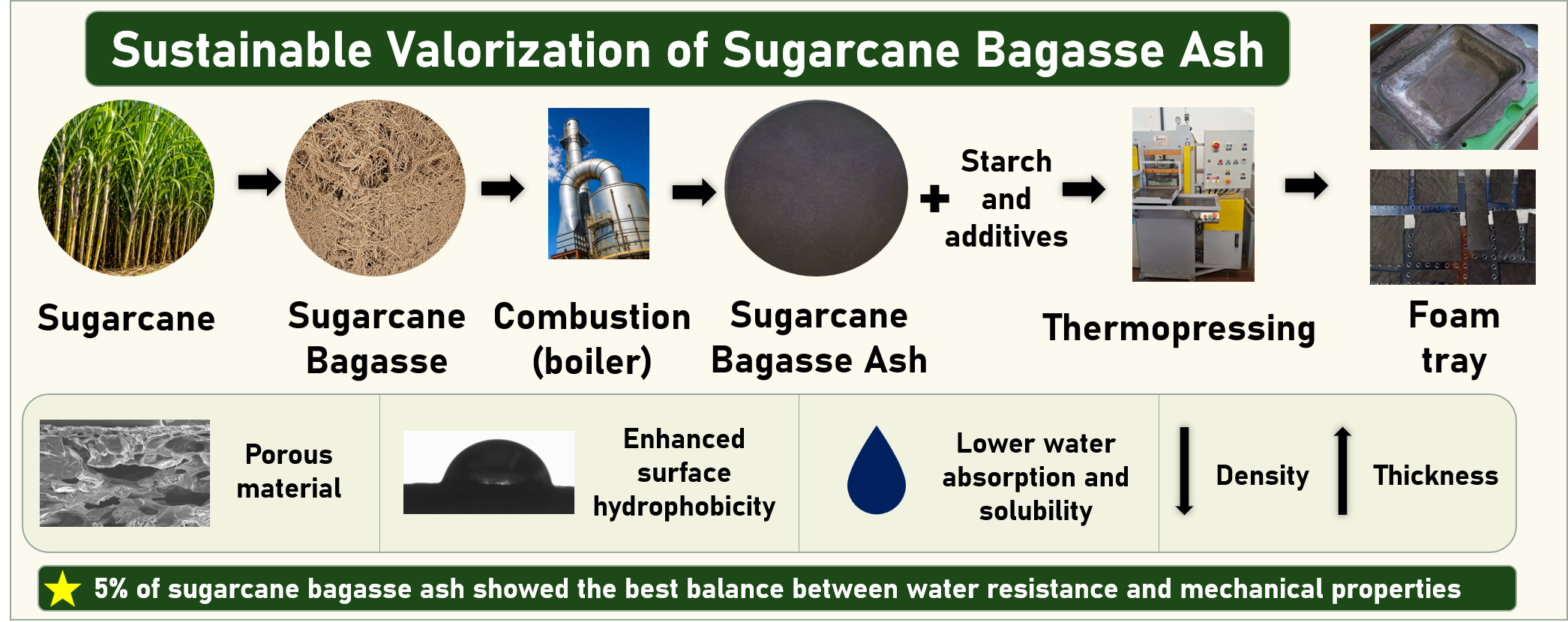
The search for sustainable alternatives to expanded polystyrene (EPS) has led to the development of starch-based foams reinforced with agro-industrial by-product. This study aimed to evaluate the effect of sugarcane bagasse ash (SBA) content on the physical, mechanical, and water-interaction properties of cassava starch foam trays, and to determine the maximum feasible ash content that could be incorporated. Sugarcane bagasse ash was collected from the boiler air preheater. Foam trays were prepared by thermopressing using cassava starch, guar gum, magnesium stearate, glycerol, and SBA at 0%, 2%, 5%, 8%, and 11%. The trays were characterized in terms of their thickness, apparent density, moisture content, water solubility, water absorption, surface wettability, mechanical properties, color, chemical structure, morphology, and thermal stability. The results show that increasing the SBA content from 0% to 11% reduced both water solubility (from 11.39% to 8.81%) and water absorption after 240 min (from 1199.38% to 799.45%). Adding 11% SBA significantly increased the contact angle (from 45.80° with 2% SBA to 70.20°), indicating enhanced surface hydrophobicity of the foam tray. However, the mechanical properties decreased with higher ash content: the tensile strength dropped from 2.06 MPa (2% SBA) to 0.62 MPa (11% SBA) and the Young’s modulus decreased from 354.32 to 112.90 MPa. The trays became progressively darker (L* decreased from 70.06 to 22.79) as the ash content increased. SBA proved to be a promising agro-industrial residue for producing sustainable starch composite foam trays, as it effectively improved water resistance and thermal stability. While the mechanical strength decreased with higher ash loadings, the 5% formulation offered the optimal balance of hydrophobicity and processability, demonstrating its potential as a bio-based alternative to EPS trays.Graphic Abstract
Keywords
Packaging; ash; starch; sugarcane; tray; biobased; container
Cite This Article
APA Style
Aguilar, G.J., Beitum, L.R., Garcia, A.L., Tapia-Blácido, D.R. (2026). Valorization of Sugarcane Bagasse Ash for the Production of Sustainable Biobased Trays. Journal of Renewable Materials, 14(8), 1. https://doi.org/10.32604/jrm.2026.02026-0029
Vancouver Style
Aguilar GJ, Beitum LR, Garcia AL, Tapia-Blácido DR. Valorization of Sugarcane Bagasse Ash for the Production of Sustainable Biobased Trays. J Renew Mater. 2026;14(8):1. https://doi.org/10.32604/jrm.2026.02026-0029
IEEE Style
G. J. Aguilar, L. R. Beitum, A. L. Garcia, and D. R. Tapia-Blácido, “Valorization of Sugarcane Bagasse Ash for the Production of Sustainable Biobased Trays,” J. Renew. Mater., vol. 14, no. 8, pp. 1, 2026. https://doi.org/10.32604/jrm.2026.02026-0029
 Copyright © 2026 The Author(s). Published by Tech Science Press.
This work is licensed under a Creative Commons Attribution 4.0 International License , which permits unrestricted use, distribution, and reproduction in any medium, provided the original work is properly cited.
 Downloads
 Citation Tools
