
 Login
Login Register
 Submit a Paper
 Propose a Special lssue
 Open Access
ARTICLE
Synergistic Effect of Low-Concentration ZnCl2-Activated Bio-Carbon from Red Suren Leaves with Hierarchical Pore Structure and Self-Doping for High-Performance Supercapacitor Applications
1 Department of Physics, University of Riau, Simpang Baru, Indonesia
2 Department of Engineering Physics, School of Electrical Engineering, Telkom University, Bandung, Indonesia
3 Department of Physics, Hasanuddin University, Makassar, Indonesia
4 Department of Physics, University of Lambung Mangkurat, Banjarmasin, Indonesia
5 Department of Chemical Engineering, University of Lambung Mangkurat, Banjarmasin, Indonesia
6 Department of Physics, Haluoleo University, Kendari, Indonesia
7 Department of Mechanical Engineering, Sekolah Tinggi Teknologi Pekanbaru, Pekanbaru, Indonesia
8 Department of Industrial Engineering, Universitas Islam Negeri Sultan Syarif Kasim Riau, Simpang Baru, Indonesia
* Corresponding Authors: Erman Taer. Email: ; Rika Taslim. Email:
(This article belongs to the Special Issue: Renewable Nanostructured Porous Materials: Synthesis, Processing, and Applications)
Journal of Renewable Materials 2026, 14(8), 4 https://doi.org/10.32604/jrm.2026.02026-0022
Received 11 February 2026; Accepted 08 June 2026; Issue published 26 August 2026
 View Full Text
 Download PDF
Abstract
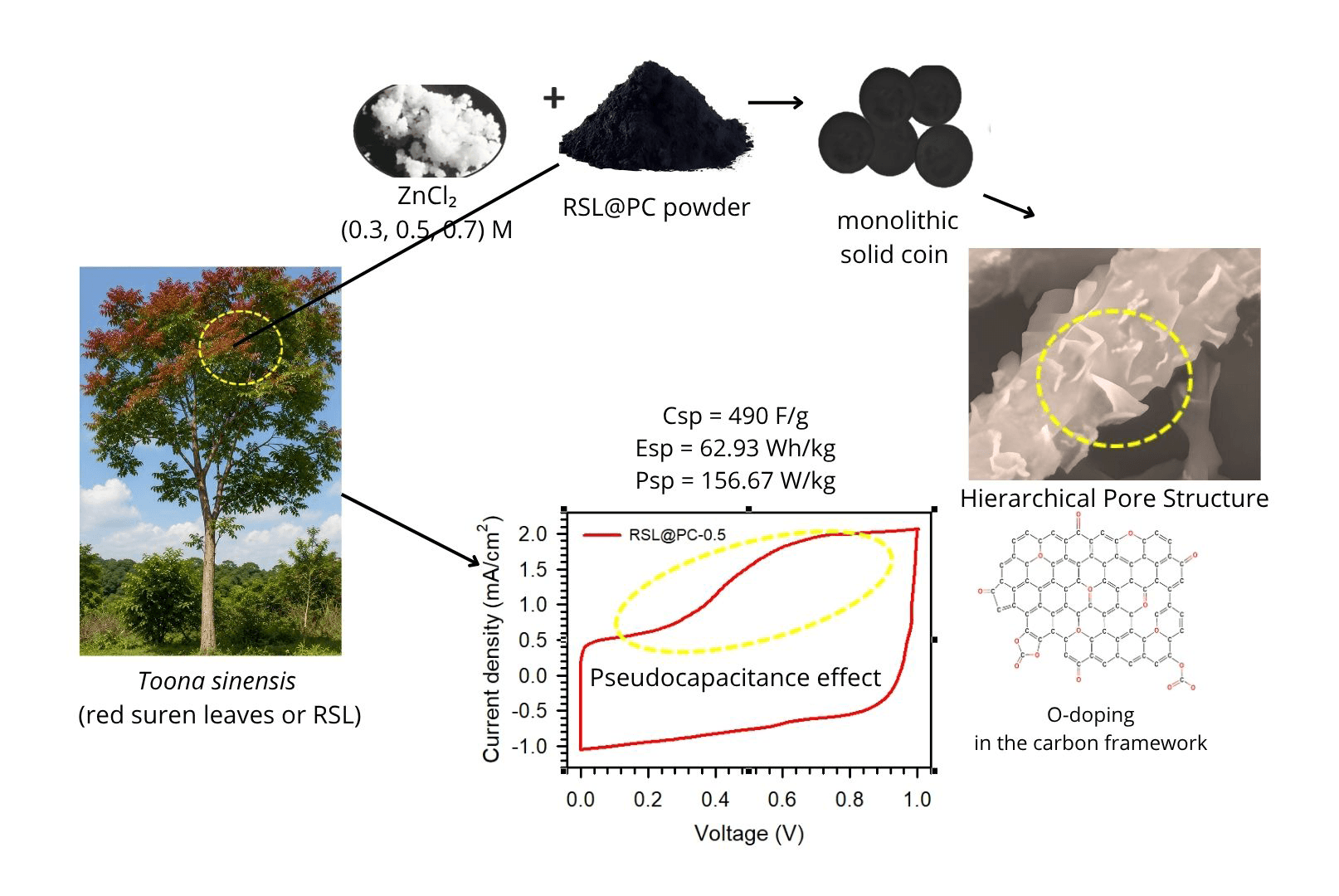
The promotion of bio-carbon for developing superior electrodes has become a trending topic in realising the practical application of supercapacitor devices. This study aimed to prepare porous carbon (PC) with a taproot fiber-like nanostructure that was decorated with self-doped oxygen. The waste of red suren leaves (RSL) was further treated using a direct heating method with the catalyst effect of ZnCl2 (0.3, 0.5, and 0.7 M) in an N2/CO2 environment at 850°C, being examined. The results showed that RSL@PC-0.5 exhibited the best amorphous carbon structure (FWHM = 0.105° and 0.182°). The specific surface area (SSA = 495.31 m2/g) and the combination of hierarchical nanostructure with abundant multi-level pores (micro-mesopores) were supported by the appropriate presence of O (4.26%) heteroatoms. Oxygen within the carbon matrix enhanced the electrode-electrolyte interaction by adding active sites, thereby contributing additional pseudocapacitance. Furthermore, the electrochemical performance showed a high specific capacitance of 490 F/g at a current density of 1 A/g. The energy density and power density reached 62.93 Wh/kg and 156.67 W/kg, indicating the excellent electrochemical performance of the RSL@PC-0.5 material. This study presented a supercapacitor material derived from biomass, showing a new PC with O self-doped fiber nanostructures that could serve as a rational reference for the practical application of environmentally friendly energy storage.Graphic Abstract
Keywords
Cite This Article
 Copyright © 2026 The Author(s). Published by Tech Science Press.
This work is licensed under a Creative Commons Attribution 4.0 International License , which permits unrestricted use, distribution, and reproduction in any medium, provided the original work is properly cited.
 Downloads
 Citation Tools
