
 Login
Login Register
 Submit a Paper
 Propose a Special lssue
 Open Access
ARTICLE
Optimizing Activation Temperature of Sustainable Porous Materials Derived from Forestry Residues: Applications in Radar-Absorbing Technologies
1 National Institute for Space Research, São José dos Campos, 12227-010, Brazil
2Departamento de Engenharias e Computação (DEC), Universidade Estadual de Santa Cruz (UESC), Ilhéus, 45662-900, Brazil
3 Department of Metallurgical and Materials Engineering, University of São Paulo, São Paulo, 05508-030, Brazil
4 Institut de recherche sur les forêts (IRF), Université du Québec en Abitibi-Témiscamingue (UQAT), Rouyn-Noranda, QC J9X 5E4, Canada
* Corresponding Author: Flavia Lega Braghiroli. Email:
(This article belongs to the Special Issue: Renewable Nanostructured Porous Materials: Synthesis, Processing, and Applications)
Journal of Renewable Materials 2025, 13(6), 1021-1042. https://doi.org/10.32604/jrm.2025.02025-0017
Received 22 January 2025; Accepted 27 March 2025; Issue published 23 June 2025
 View Full Text
 Download PDF
Abstract
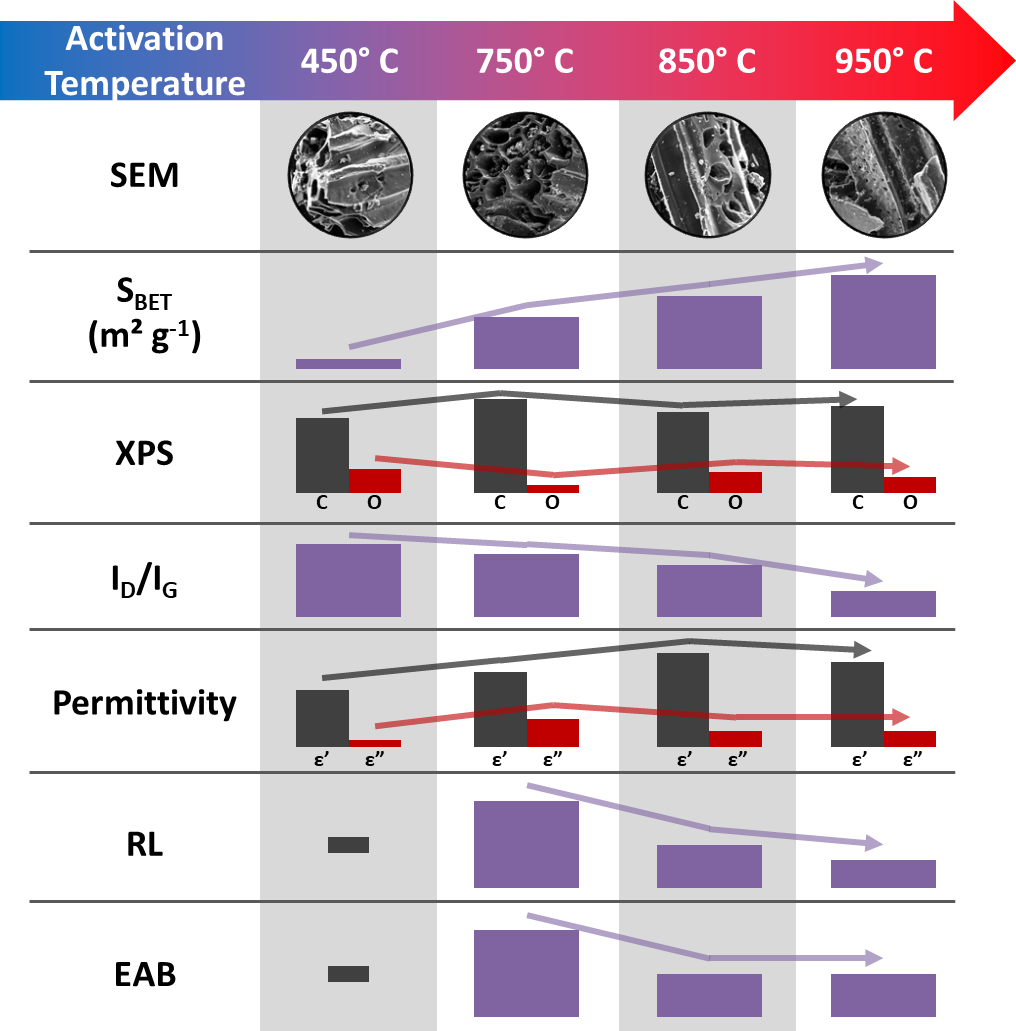
Biochar, a carbon-rich material derived from the thermochemical conversion of biomass under oxygen-free conditions, has emerged as a sustainable resource for radar-absorbing technologies. This study explores the production of activated biochars from end-of-life wood panels using a scalable and sustainable physical activation method with CO2 at different temperatures, avoiding the extensive use of corrosive chemicals and complex procedures associated with chemical or vacuum activation. Compared to conventional chemically or vacuum-activated biochars, the physically activated biochar demonstrated competitive performance while minimizing environmental impact, operational complexity, and energy consumption. Furthermore, activation at 750°C reduces energy consumption by 14% and 28% compared to activations at 850°C and 950°C, respectively, emphasizing the cost-effectiveness of this method for large-scale applications. The composite with 15% of biochar embedded in silicon rubber presented good electromagnetic performance, achieving a measured reflection loss (RL) of −37.2 dB at 11.3 GHz with an 8.4 mm thickness and an effective absorption bandwidth (EAB) of 1.25 GHz. These results highlight the potential of biochar-silicone rubber composites as flexible radar-absorbing materials (RAMs) for applications in electromagnetic shielding, anechoic chambers, and Internet of Things (IoT) devices. This study also shows the importance of forestry residues as sustainable precursors for producing low-cost porous carbon materials, aligning with circular economy principles and the United Nations’ 2030 Agenda for Sustainable Development. This work establishes a framework for scalable, cost-effective, and sustainable biochar production, addressing critical challenges in electromagnetic interference (EMI) mitigation and advancing the global adoption of green technologies.Graphic Abstract
Keywords
Cite This Article
 Copyright © 2025 The Author(s). Published by Tech Science Press.
This work is licensed under a Creative Commons Attribution 4.0 International License , which permits unrestricted use, distribution, and reproduction in any medium, provided the original work is properly cited.
 Downloads
 Citation Tools
