Home / Journals / JRM / Vol.14, No.5, 2026
Special Issues
Table of Content
cover

On the Cover

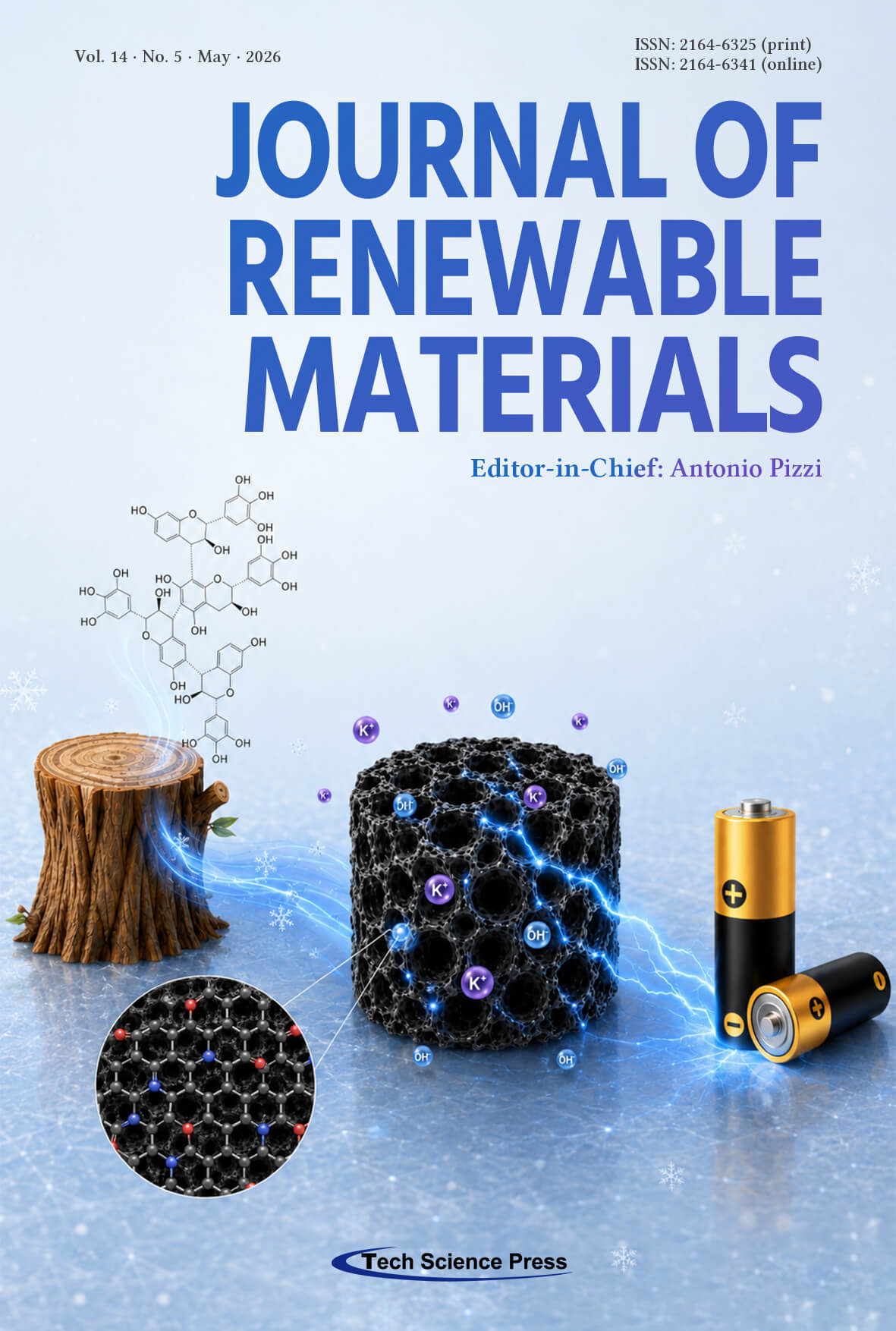
This cover illustrates the transformation of bio-derived tannin from quebracho wood into porous carbon cryogels for sustainable supercapacitors. Freeze-drying preserves the hierarchical pore network, enabling efficient K+/OH- transport and stable charge storage. The artwork highlights green biomass conversion, structural engineering, and renewable energy storage applications.

View this paper

  • Open AccessOpen Access

    ARTICLE

    Bio-Derived Tannin-Modified Phenolic Carbon Cryogels with Optimized Microstructure for Supercapacitors Application

    Zhiying Lin1, Boju Deng1, Qianqian Zhang1, Jingming Chen2, Xinqiang Ye3, Yuling Lan1, Jiuping Rao1,*, Mizi Fan4, Weigang Zhao1,*
    Journal of Renewable Materials, Vol.14, No.5, 2026, DOI:10.32604/jrm.2025.02025-0096 - 28 May 2026
    (This article belongs to the Special Issue: Renewable Nanostructured Porous Materials: Synthesis, Processing, and Applications)
    Abstract Bio-derived carbon cryogels have garnered significant interest as promising electrode materials for supercapacitors due to their high specific surface area (SSA), hierarchical porosity, and eco-friendly synthesis methods. In this study, a tannin-modified phenolic hydrogel was synthesized using a sustainable tannin–phenol precursor system and subsequently subjected to three distinct drying methods-freeze-drying (FD), supercritical drying (SCD), and ambient pressure drying (APD)-to systematically evaluate their influence on structural integrity, porosity, and electrochemical behavior. Among these, the sample obtained via freeze-drying (TPUF-FD) maintained the most intact porous network, minimizing structural collapse during sublimation of ice under vacuum. This preservation… More >

    Graphic Abstract
    Bio-Derived Tannin-Modified Phenolic Carbon Cryogels with Optimized Microstructure for Supercapacitors Application

  • Open AccessOpen Access

    ARTICLE

    Sustainable Particleboards Using Lignosulfonate-Modified MUF Adhesives for Enhanced Bond Strength and Reduced Formaldehyde Emissions

    Pavlo Bekhta1,2,*, Iryna Lytvyn1
    Journal of Renewable Materials, Vol.14, No.5, 2026, DOI:10.32604/jrm.2026.02026-0035 - 28 May 2026
    (This article belongs to the Special Issue: Advances in Eco-friendly Wood-Based Composites: Design, Manufacturing, Properties and Applications – Ⅱ)
    Abstract The modification of melamine–urea–formaldehyde (MUF) adhesives with lignosulfonates (LS) represents a promising strategy for developing more sustainable wood-based panels. However, the influence of the counterion type remains poorly understood. In this study, the effect of lignosulfonate counterions on adhesives performance and properties of MUF-bonded particleboards was investigated, with a focus on sodium (NaLS) and magnesium (MgLS) lignosulfonates incorporated at 2.5%, 5.0%, and 7.5%. Adhesives performance was characterized by measuring dry solids content, dynamic viscosity, gelation time, and pH. The produced particleboards were evaluated in terms of density, bending strength, modulus of elasticity, internal bond strength… More >

    Graphic Abstract

    Sustainable Particleboards Using Lignosulfonate-Modified MUF Adhesives for Enhanced Bond Strength and Reduced Formaldehyde Emissions

  • Open AccessOpen Access

    REVIEW

    Sustainable Plant-Based Starch as Binder in Biocomposites: Extraction, Modification, and Their Calorific Behaviour

    Adib Hafiizhullah Mohamad Prim Nasir1,2, Mohd Nurazzi Norizan1,2,3,*, Nur Izzaati Saharudin1,2, Sumarni Mansur1,2
    Journal of Renewable Materials, Vol.14, No.5, 2026, DOI:10.32604/jrm.2025.02025-0156 - 28 May 2026
    (This article belongs to the Special Issue: Biomass-based Thermoset and Thermoplastic Polymers for Biomass-based Composites)
    Abstract Plant-based starch has emerged as a promising natural binder in biocomposites owing to its biodegradability, renewability, and functional adaptability. This study critically reviews the extraction, modification, and performance of starches derived from sources such as corn, potato, and cassava, with particular attention to their calorific behaviour as measured through bomb calorimetry. Calorimetric analysis provides insight into the energy density and combustion efficiency of starch binders, parameters that influence both processing and End-of-life valorisation of biocomposites. Through physical, chemical, enzymatic, and genetic modifications, the inherent limitations of native starch such as moisture sensitivity and low mechanical More >

    Graphic Abstract

    Sustainable Plant-Based Starch as Binder in Biocomposites: Extraction, Modification, and Their Calorific Behaviour

  • Open AccessOpen Access

    REVIEW

    Grape Waste as Leather-Like Material Alternative: A Comprehensive Review of Ancient Practices, Current Technologies, and Future Trends

    Megabi Adane Yizengaw1,*, Alehegn Atalay Birlie1, Tamerat Tesfaye2, Rajan Katrikan1, Eldana Bizuneh Cheklie1, Zelalem Girma1
    Journal of Renewable Materials, Vol.14, No.5, 2026, DOI:10.32604/jrm.2025.02025-0175 - 28 May 2026
    Abstract Grape by-product of the wine industry, rich in polyphenols, tannins, lignin, and natural waxes, the chemical constituents grape skins 45%–55%, seeds 25%–35%, and stems or stalks 25%–35% weight of grape provide intrinsic cross-linking, mechanical reinforcement, antioxidant activity, and water resistance, closely replicating the effects of conventional vegetable tanning without using toxic chemicals. This review comprehensively examines current eco-friendly extraction methods to isolate bioactive compounds, as well as fiber modification techniques to improve polymer compatibility. Composite fabrication involves blending processed grape waste fibers with bio-based polymers and renewable plasticizers to produce materials exhibiting competitive tensile strength,… More >

  • Open AccessOpen Access

    ARTICLE

    Enhancing the Performance and Durability of Oil Palm Trunk Particleboards through Chemical Pre-Treatment and Bio-Based Antifungal Modification

    I. Nur Azreena*, H. A. Aisyah, A. W. Noorshamsiana
    Journal of Renewable Materials, Vol.14, No.5, 2026, DOI:10.32604/jrm.2025.02025-0178 - 28 May 2026
    (This article belongs to the Special Issue: Harnessing the Potential of Natural Fiber Composites: A Paradigm Shift Towards Sustainable Materials )
    Abstract This study examined the impact of various pre-treatment techniques on the physical and mechanical characteristics of particleboards derived from oil palm trunks (OPT). Thermal and chemical pre-treatments of the fibers, including hot water, sodium hydroxide (NaOH), and acetic acid, were applied prior to board production. In addition, antifungal agents were incorporated as supplementary additives during the manufacturing process at varying percentages to evaluate their effect on panel performance. Morphology of the treated OPT fibers was examined, and panel properties such as thermal behavior, bending strength, bonding strength, and dimensional stability were evaluated. Statistically significant improvements (pMore >

  • Open AccessOpen Access

    ARTICLE

    Comparative Characterization of Carrageenan Extracted KOH Treatment and Commercially Available Counterparts

    Manda Vais Jatul Fitri1, Melbi Mahardika2,3,4,*, Yuni Kusumastuti1,*, Mochamad Asrofi5
    Journal of Renewable Materials, Vol.14, No.5, 2026, DOI:10.32604/jrm.2026.02025-0197 - 28 May 2026
    Abstract The development of seaweed-derived products, particularly carrageenan, is increasingly prioritized in Indonesia to support sustainability and strengthen the local economy. Despite extensive studies on carrageenan extraction, systematic comparisons between locally extracted carrageenan and specific local commercial products remain limited. This study addresses this gap by directly comparing carrageenan extracted from Eucheuma cottonii harvested in Lombok, Indonesia, with a locally produced commercial carrageenan as a quality benchmark. Carrageenan extraction was performed using alkaline KOH treatment followed by ethanol precipitation. The extracted carrageenan exhibited a relatively high viscosity (61.16 cP) and a low sulfate content (11.58%). FTIR analysis More >

  • Open AccessOpen Access

    REVIEW

    Industrial Lignocellulosic Waste Biomasses: Enormous Substrates for Harnessing Enzymes and Bioethanol Productions

    Blessing C. Ahamefule1, Chidimma Osilo2,3, Jennifer O. Unachukwu2, Stella N. Madueke2, Chukwuemeka Samson Ahamefule2,*
    Journal of Renewable Materials, Vol.14, No.5, 2026, DOI:10.32604/jrm.2026.02025-0202 - 28 May 2026
    (This article belongs to the Special Issue: Process and Engineering of Lignocellulose Utilization)
    Abstract Lignocellulosic waste, consisting mainly of cellulose, hemicellulose and lignin, is the most abundant global biomass. Industries generate millions of tonnes of this waste biomass every year. This includes: sugarcane bagasse, corncob, rice straw and husk, oil palm fibres and empty fruit bunches, wheat straw, brewer’s spent grains, among others. These wastes could be valorized to produce high-value industrial lignocellulase enzymes, such as cellulases, hemicellulases and ligninases, by several microorganisms, including bacteria and fungi. Furthermore, the crude or purified lignocellulase enzymes or the microbes producing these enzymes could be used to hydrolyze the lignocellulosic wastes into… More >

  • Open AccessOpen Access

    ARTICLE

    Effect of Modified Gum Arabic and Euphorbia Trigona Mill Master Batch on the Crystallization and Thermal Stability of Poly (Lactic Acid)

    Kasahun Tsegaye Mekonnen1,*, Melaku Tesfaye Alemea2, Dessie Ezez1, Abenezer Zenebe1, Negussie Darota Daka1
    Journal of Renewable Materials, Vol.14, No.5, 2026, DOI:10.32604/jrm.2026.02026-0221 - 28 May 2026
    Abstract This study examined the effects of modified Gum Arabic (OLLA-g-GA), modified Euphorbia trigona Mill (OLLA-g-ETML), and their master batch (OLLA-g-GA–OLLA-g-ETML) on the non-isothermal crystallisation and thermal stability of poly (lactic acid) (PLA). The interface interactions of PLA with the modifiers before and after modification were analysed and identified using FTIR spectroscopy, which displayed different peak formations and intensities compared to neat PLA, indicating physical interactions with the modifiers. Differential scanning calorimetry (DSC) was used to study non-isothermal crystallisation at a heating rate of 10°C/min. Tensile strength and elongation at break of PLA improved by the addition More >

    Graphic Abstract

    Effect of Modified Gum Arabic and Euphorbia Trigona Mill Master Batch on the Crystallization and Thermal Stability of Poly (Lactic Acid)

Per Page:

Share Link