
 Login
Login Register
 Submit a Paper
 Propose a Special lssue
 Open Access
REVIEW
Sustainable Plant-Based Starch as Binder in Biocomposites: Extraction, Modification, and Their Calorific Behaviour
1 Bioresource Technology Division, School of Industrial Technology, Universiti Sains Malaysia, Penang, 11800, Malaysia
2 Green Bio-polymer, Coatings & Packaging Cluster, School of Industrial Technology, Universiti Sains Malaysia, Penang, 11800, Malaysia
3 Research Collaboration Center for Nanocellulose, BRIN-Andalas University, Padang, 25163, Indonesia
* Corresponding Author: Mohd Nurazzi Norizan. Email:
(This article belongs to the Special Issue: Biomass-based Thermoset and Thermoplastic Polymers for Biomass-based Composites)
Journal of Renewable Materials 2026, 14(5), 3 https://doi.org/10.32604/jrm.2025.02025-0156
Received 03 September 2025; Accepted 03 December 2025; Issue published 28 May 2026
 View Full Text
 Download PDF
Abstract
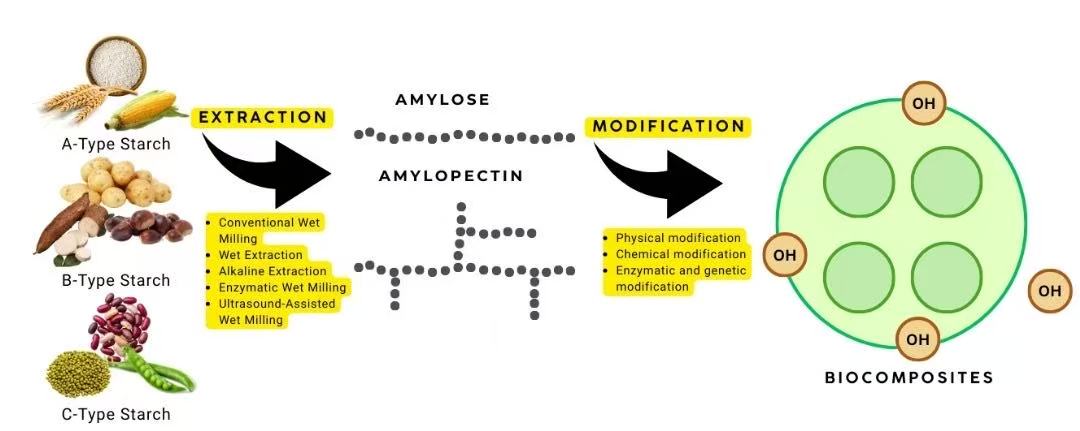
Plant-based starch has emerged as a promising natural binder in biocomposites owing to its biodegradability, renewability, and functional adaptability. This study critically reviews the extraction, modification, and performance of starches derived from sources such as corn, potato, and cassava, with particular attention to their calorific behaviour as measured through bomb calorimetry. Calorimetric analysis provides insight into the energy density and combustion efficiency of starch binders, parameters that influence both processing and End-of-life valorisation of biocomposites. Through physical, chemical, enzymatic, and genetic modifications, the inherent limitations of native starch such as moisture sensitivity and low mechanical strength can be mitigated while simultaneously enhancing thermal stability and heat-release characteristics. Among evaluated starches, cassava starch exhibited a comparatively high calorific value of 3661 cal/g (15.3 MJ/kg), confirming its potential for applications in bio-insulation, biofuel, and thermally resilient composites. The integrated understanding of structural modification and calorific response underscores the dual role of starch as both a functional binder and an energetic component, promoting a pathway toward sustainable, energy efficient biocomposite development.Graphic Abstract
Keywords
Cite This Article
 Copyright © 2026 The Author(s). Published by Tech Science Press.
This work is licensed under a Creative Commons Attribution 4.0 International License , which permits unrestricted use, distribution, and reproduction in any medium, provided the original work is properly cited.
 Downloads
 Citation Tools
