
 Login
Login Register
 Submit a Paper
 Propose a Special lssue
 Open Access
ARTICLE

Towards the Development of Innovative Bio-Based Flame-Retardant Systems Derived from Phosphorylated Condensed Tannins
Polymers Composites and Hybrids (PCH), IMT Mines Ales, Ales, France
* Corresponding Authors: C. Lacoste. Email: ; A. Bergeret. Email:
Journal of Renewable Materials 2026, 14(6), 1 https://doi.org/10.32604/jrm.2026.02025-0229
Received 20 January 2026; Accepted 17 April 2026; Issue published 29 June 2026
 View Full Text
 Download PDF
Abstract
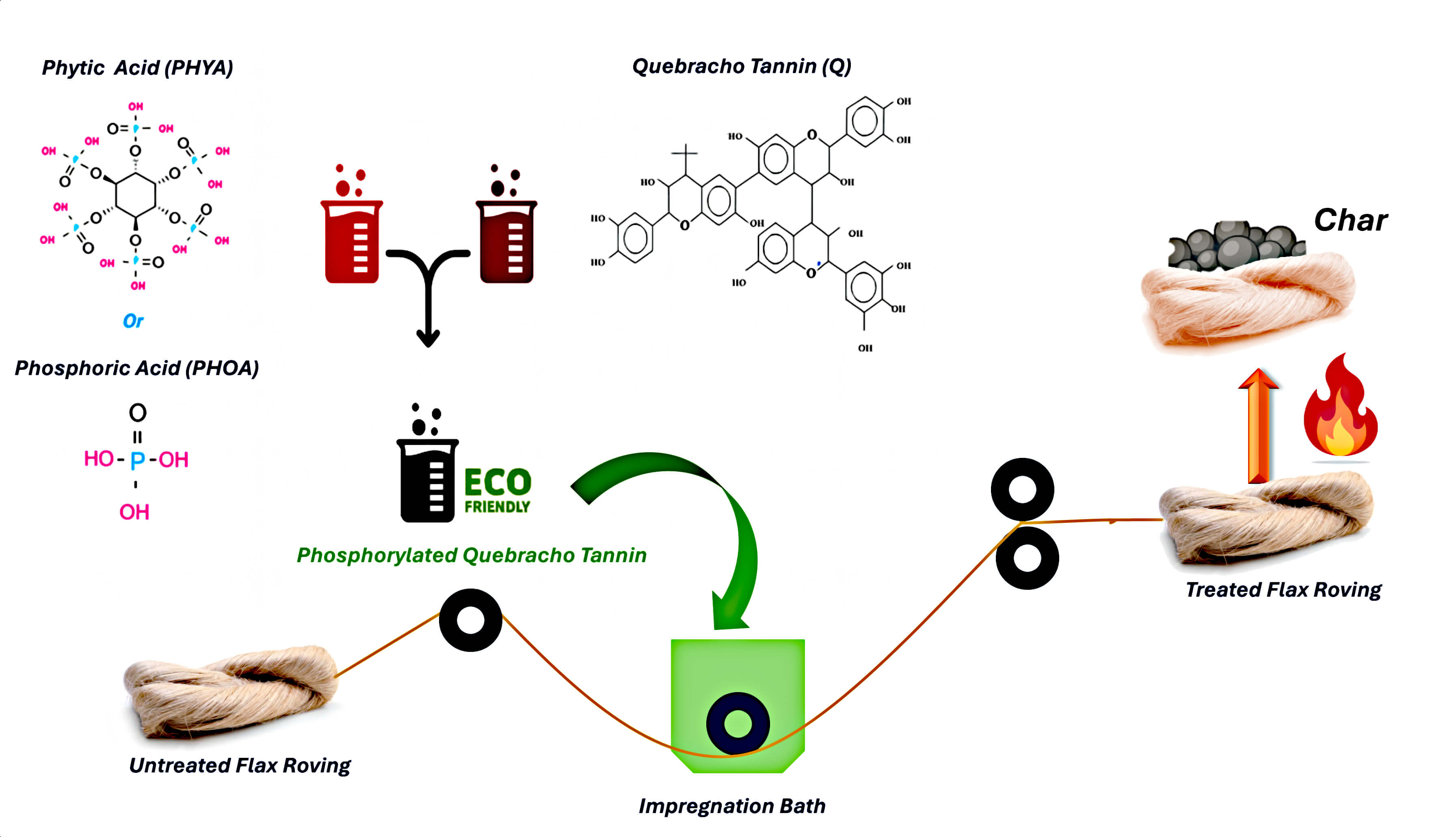
In this study, tannins were investigated as sustainable flame retardants. The thermal and structural properties of tannic acid, chestnut, oak, and quebracho extracts were first characterized by Fourier Transform Infrared Spectroscopy (FTIR), Thermogravimetric Analysis (TGA), and Pyrolysis Combustion Flow Calorimetry (PCFC). Quebracho exhibited the most promising thermal performance, showing the lowest heat release and the highest char yield (≈38 wt.%). To further improve their efficiency, quebracho tannins were phosphorylated using phytic acid (QPHYA) or phosphoric acid (QPHOA). Phosphorus contents reached 13% and 15%, respectively, as confirmed by ICP and SEM–EDX analyses, while FTIR and NMR evidence the formation of new P–O bonds. Phosphorylation enhanced thermal stability, increasing char yield up to 52%. Flax rovings (TR, 500 tex) were treated with tannin formulations using an impregnation line. The treated rovings exhibited higher impregnation efficiency (Δ% ≈ 18) and phosphorus uptake (up to 3.7 wt.%). SEM–EDX analysis confirmed deeper penetration of the tannin-based agents within the rovings, while FTIR spectra revealed the appearance of phosphorus-related P–O and P=O absorption bands, suggesting phosphorus incorporation and treatment-induced interactions. TGA results demonstrated that phosphorylated rovings produced significantly higher char residues (33%–38%) compared to untreated flax (16%) and non-phosphorylated counterparts (≈21%). Overall, these findings highlight phosphorylated quebracho tannins as efficient and eco-friendly flame retardants, where the impregnation efficiency and phosphorus retention are strongly influenced by the fiber architecture.Graphic Abstract
Keywords
Tannins; phytic acid; phosphorylation; flax roving functionalization; thermal stability and char yield
Cite This Article
APA Style
Tilouche-Guerdelli, K., Lacoste, C., Perrin, D., Bergeret, A. (2026). Towards the Development of Innovative Bio-Based Flame-Retardant Systems Derived from Phosphorylated Condensed Tannins. Journal of Renewable Materials, 14(6), 1. https://doi.org/10.32604/jrm.2026.02025-0229
Vancouver Style
Tilouche-Guerdelli K, Lacoste C, Perrin D, Bergeret A. Towards the Development of Innovative Bio-Based Flame-Retardant Systems Derived from Phosphorylated Condensed Tannins. J Renew Mater. 2026;14(6):1. https://doi.org/10.32604/jrm.2026.02025-0229
IEEE Style
K. Tilouche-Guerdelli, C. Lacoste, D. Perrin, and A. Bergeret, “Towards the Development of Innovative Bio-Based Flame-Retardant Systems Derived from Phosphorylated Condensed Tannins,” J. Renew. Mater., vol. 14, no. 6, pp. 1, 2026. https://doi.org/10.32604/jrm.2026.02025-0229
 Copyright © 2026 The Author(s). Published by Tech Science Press.
This work is licensed under a Creative Commons Attribution 4.0 International License , which permits unrestricted use, distribution, and reproduction in any medium, provided the original work is properly cited.
 Downloads
 Citation Tools
