
 Login
Login Register
 Submit a Paper
 Propose a Special lssue
 Open Access
ARTICLE

Advancing Sustainable Materials: Nano-Palm Kernel Shell Biochar (n-PKSB) and Nano-Activated Biochar (n-APKS) as Renewable Fillers in Natural Rubber (NR) Biocomposites
1 Faculty of Applied Sciences, Universiti Teknologi MARA, Shah Alam, 40450, Malaysia
2 Centre for Chemical Synthesis and Polymer Technology, Institute of Science, Universiti Teknologi MARA, Shah Alam, 40450, Malaysia
3 Biomass Technology Unit, Engineering and Processing Division, Malaysian Palm Oil Board, No. 6, Persiaran Institusi, Bandar Baru Bangi, Kajang, 43000, Malaysia
* Corresponding Author: Siti Nur Liyana Mamauod. Email:
(This article belongs to the Special Issue: Biomass-based Thermoset and Thermoplastic Polymers for Biomass-based Composites)
Journal of Renewable Materials 2026, 14(6), 3 https://doi.org/10.32604/jrm.2025.02025-0177
Received 11 September 2025; Accepted 25 November 2025; Issue published 29 June 2026
 View Full Text
 Download PDF
Abstract
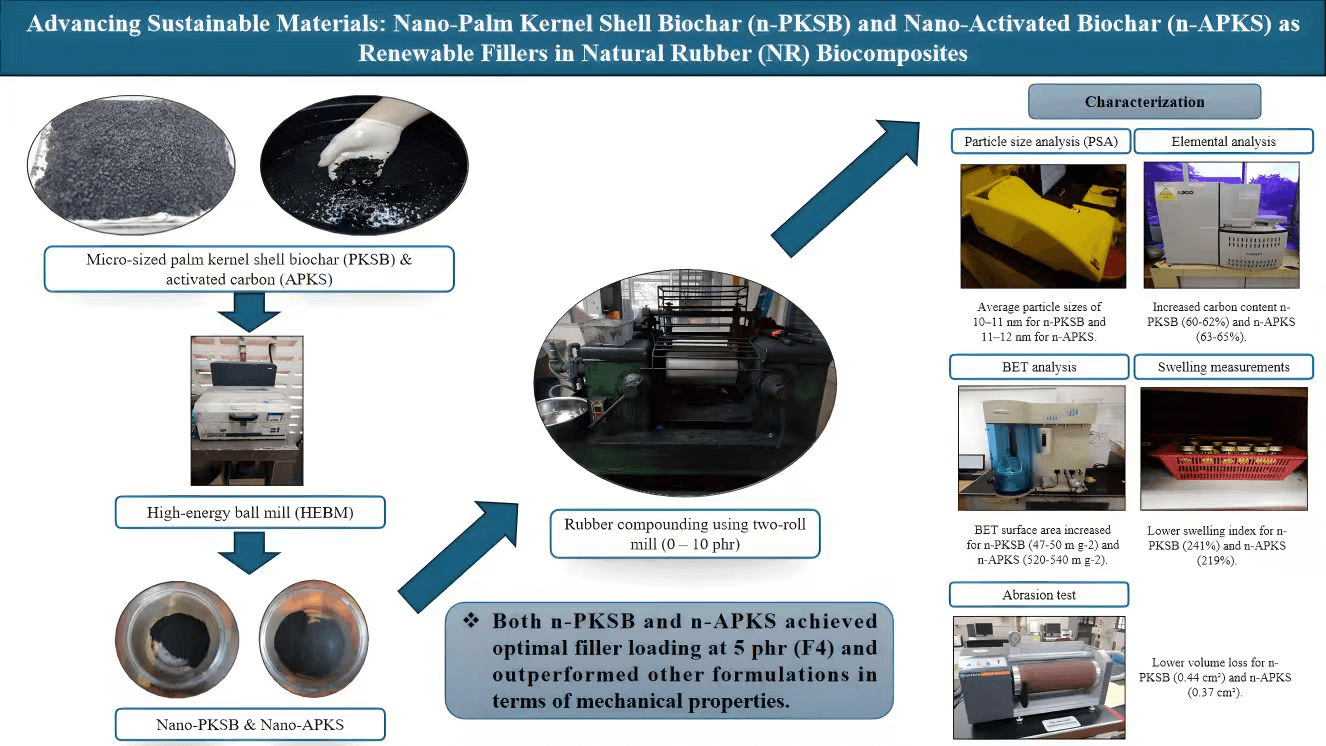
The palm oil industry is a major contributor to Malaysia’s economy, but its huge production has generated large amounts of oil palm biomass, particularly palm kernel shell (PKS), which poses environmental challenges if not properly managed. Converting PKS into biochar (PKSB) and activated carbon (APKS) offers a sustainable way to valorise this waste as potential bio-fillers in rubber composites. This study investigates the influence of nano-sized PKSB (n-PKSB) and activated PKS (n-APKS) as bio-fillers on the mechanical performance of natural rubber (NR) vulcanizates, with filler loadings ranging from 0 to 10 parts per hundred rubber (phr). The fillers were characterized using particle size analyzer (PSA), elemental analyzer, and Brunauer–Emmett–Teller (BET) analysis, while the filled NR vulcanizates were evaluated through swelling and abrasion tests. The PSA results showed average particle sizes of 10–11 nm for n-PKSB and 11–12 nm for n-APKS. The carbonization-activation process increased the carbon content (63%–65%) and BET surface area (520–540 m g−2) of n-APKS compared to n-PKSB (60%–62% and 47–50 m g−2, respectively). These enhancements promote stronger filler–rubber interfacial bonding and improved stress transfer within the matrix. Consequently, n-APKS-filled NR exhibited lower swelling index (219%) and volume loss (0.37 cm3) than n-PKSB filled NR vulcanizates (241% and 0.44 cm3), indicating better resistance to solvent penetration and abrasive forces. Both fillers achieved their optimal results at 5 phr loading. Thus, n-APKS and n-PKSB have potential as bio-fillers that will enhance rubber properties while reducing palm oil waste and contributing to long-term mitigation of environmental impact.Graphic Abstract
Keywords
Cite This Article
 Copyright © 2026 The Author(s). Published by Tech Science Press.
This work is licensed under a Creative Commons Attribution 4.0 International License , which permits unrestricted use, distribution, and reproduction in any medium, provided the original work is properly cited.
 Downloads
 Citation Tools
