
 Login
Login Register
 Submit a Paper
 Propose a Special lssue
 Open Access
REVIEW

Smart Nano-Cellulosic-Based Materials as Antiviral Agents: A Brief Insight into Scientific Advances and Functionalization Strategies
1 Cellulose and Paper Department, National Research Centre, Dokki, Giza, 12622, Egypt
2 Photochemistry Department, National Research Centre, Dokki, Giza, 12622, Egypt
* Corresponding Author: Ahmed M. Khalil. Email:
(This article belongs to the Special Issue: Recent Advances on Renewable Materials)
Journal of Renewable Materials 2026, 14(6), 6 https://doi.org/10.32604/jrm.2025.02025-0180
Received 13 September 2025; Accepted 11 November 2025; Issue published 29 June 2026
 View Full Text
 Download PDF
Abstract
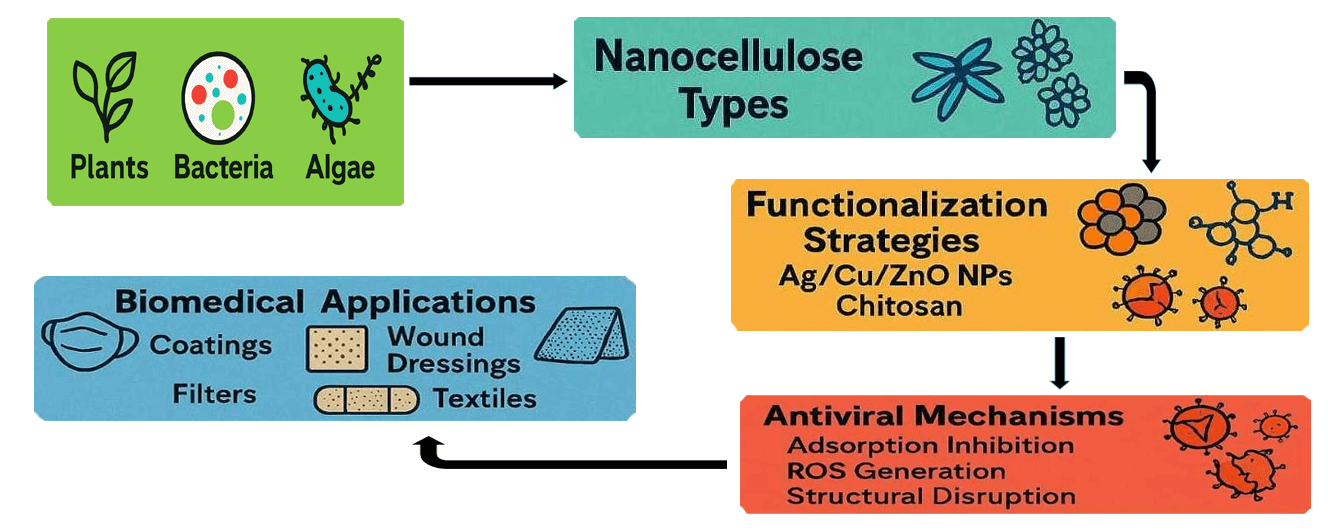
The growing threat of viral pandemics necessitates innovative antiviral strategies that are effective, sustainable, and scalable. This review highlights nanocellulose as a renewable, biocompatible nanomaterial and a promising multifunctional antiviral platform. We examine cellulose nanocrystals, nanofibrils, and bacterial nanocellulose, emphasizing their synergistic antiviral mechanisms, including nanoscale viral entrapment and surface-mediated inactivation via sulfation, cationic groups, and metal nanoparticles. Key advances include photothermally active nanocellulose-graphene composites for on-demand viral deactivation, sulfated nanocellulose mimicking heparin’s virus-trapping properties, and engineered biopolymer hybrids for targeted drug delivery and mucosal immunity. Translational applications span antiviral coatings, self-sterilizing filters, and regenerative wound dressings. The review also addresses scalability and regulatory challenges, integrating computational modeling and structure-activity relationships to guide real-world implementation. Nanocellulose-based technologies offer a transformative approach to antiviral defense, merging adaptability, sustainability, and multifunctionality to meet the demands of pandemic preparedness and redefine the future of biomedical materials.Graphic Abstract
Keywords
Cite This Article
 Copyright © 2026 The Author(s). Published by Tech Science Press.
This work is licensed under a Creative Commons Attribution 4.0 International License , which permits unrestricted use, distribution, and reproduction in any medium, provided the original work is properly cited.
 Downloads
 Citation Tools
