
 Login
Login Register
 Submit a Paper
 Propose a Special lssue
 Open Access
REVIEW
Combining Chemotherapeutic Agents, Targeted Therapies, Vaccines and Natural Bioactive Compounds for Mesothelioma: Advances and Perspectives
1 Department of Clinical Sciences and Translational Medicine, University of Rome “Tor Vergata”, Rome, 00133, Italy
2 Medical School, University of Rome “Tor Vergata”, Rome, 00133, Italy
3 Department of Life, Health and Health Profession Sciences, Link Campus University, Rome, 00165, Italy
4 Department of Experimental Medicine, University of Rome “Sapienza”, Rome, 00161, Italy
5 Department of Applied Sciences and Biotechnology, Università dell’Aquila, L’Aquila, 67100, Italy
* Corresponding Author: Roberto Bei. Email:
# These authors contributed equally to this work
(This article belongs to the Special Issue: Immunotherapy and Chemotherapy: Synergies and Challenges in the Evolving Landscape of Cancer Treatment)
Oncology Research 2025, 33(9), 2181-2204. https://doi.org/10.32604/or.2025.066708
Received 15 April 2025; Accepted 03 July 2025; Issue published 28 August 2025
 View Full Text
 Download PDF
Abstract
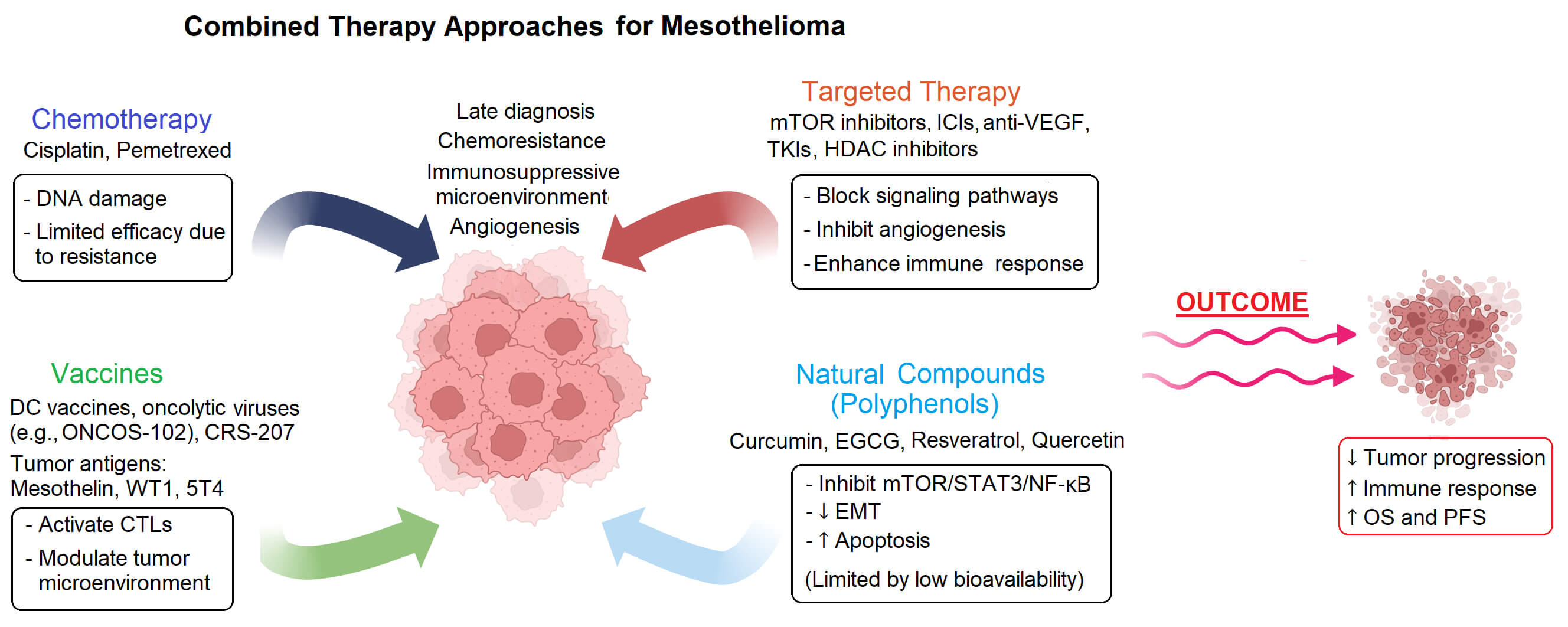
Mesothelioma is a rare and aggressive cancer with a poor prognosis and limited therapeutic options. Despite recent advances, conventional treatment approaches remain largely ineffective due to late diagnosis, chemoresistance and immunosuppressive tumor microenvironment. This review reports the latest studies on combination therapies for mesothelioma, focusing on the potential of integrating chemotherapeutic agents, molecularly targeted agents, vaccines and natural bioactive compounds such as polyphenols. Clinical and preclinical studies demonstrate that integrating immune-modulating drugs or molecular inhibitors with chemotherapy can improve survival and reduce tumor progression in mesothelioma models and patients. Vaccine-based strategies show potential for inducing host-persistent immune responses when combined with conventional treatments. Moreover, natural compounds such as polyphenols show synergistic effects with chemotherapeutics and targeted agents by modulating several signaling pathways involved in cancer cell growth and progression and by overcoming drug resistance. While several combination strategies are under clinical investigation, further studies are needed to develop more effective and personalized therapeutic approaches that could be translated into standardized treatment protocols.Graphic Abstract
Keywords
Cite This Article
 Copyright © 2025 The Author(s). Published by Tech Science Press.
This work is licensed under a Creative Commons Attribution 4.0 International License , which permits unrestricted use, distribution, and reproduction in any medium, provided the original work is properly cited.
 Downloads
 Citation Tools
