
 Login
Login Register
 Submit a Paper
 Propose a Special lssue
 Open Access
REVIEW
Next-Generation Hydrogel Platforms for Effective Localized Cancer Therapy: Advances in Biologics, Immunotherapeutics, and Gene Delivery
1 Clinical Biochemistry, Drug Delivery and Therapy Group (CB-DDT), Vall d’Hebron Institut of Research (VHIR), Vall d’Hebron University Hospital, Vall d’Hebron Barcelona Hospital Campus, Passeig de la Vall d’Hebron, 119-129, Barcelona, 08035, Spain
2 Bio & Nano Materials Lab, Drug Delivery and Controlled Release, Departamento de Microbiología, Facultad de Ciencias de la Salud, Universidad de Talca, Talca, 3460000, Chile
3 Center for Nanomedicine, Diagnostic & Drug Development (ND3), Universidad de Talca, Talca, 3460000, Chile
4 Clinical Biochemistry Service, Vall d’Hebron University Hospital, Vall d’Hebron Barcelona Hospital, Barcelona, 08035, Spain
5 Department of Pharmacy and Pharmaceutical Technology and Physicochemistry, Faculty of Pharmacy and Food Sciences, School of Pharmacy, Universitat de Barcelona (UB), Av. de Joan XXIII, 27-31, Barcelona, 08028, Spain
6 Functional Validation & Preclinical Research (FVPR)/U20 ICTS Nanbiosis, Vall d’Hebron Institut de Recerca (VHIR), Barcelona, 08035, Spain
* Corresponding Authors: Fernanda Andrade. Email: ; Diana Rafael. Email: diana.fernandes_de
Oncology Research 2026, 34(4), 9 https://doi.org/10.32604/or.2026.074061
Received 30 September 2025; Accepted 31 December 2025; Issue published 23 March 2026
 View Full Text
 Download PDF
Abstract
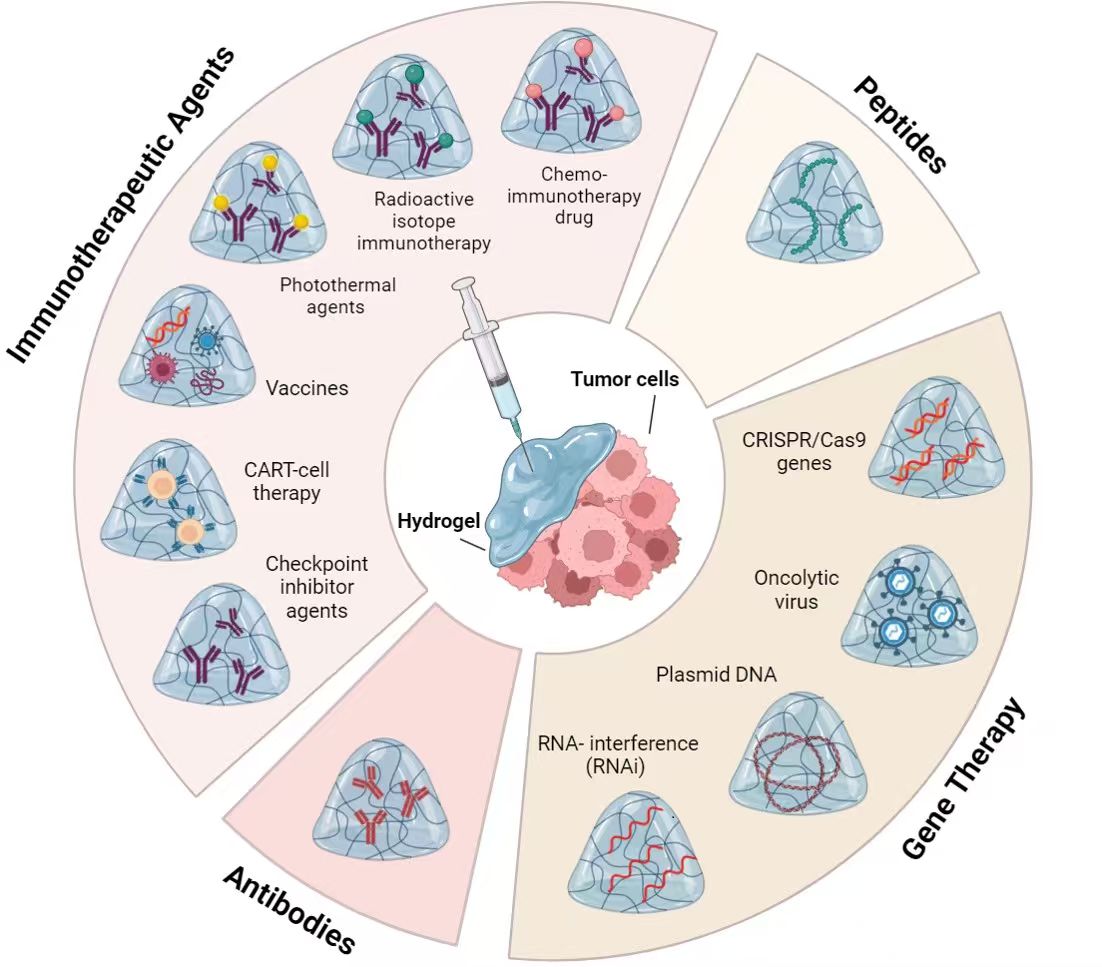
Despite remarkable advances in nanomedicine, localized delivery of advanced cancer therapeutics remains underexploited. Advanced therapies based on biopharmaceuticals, immunotherapy, or gene therapy have revolutionized oncology. Yet, their systemic administration is often associated with limitations such as poor site-specific accumulation, instability, and systemic toxicity. Hydrogels/macrogels offer the ability to encapsulate, protect, and release biomolecules in situ with sustained and stimulus-responsive profiles, addressing key translational gaps. This review provides a focused synthesis of the last five years of hydrogel-based research for cancer therapy, with emphasis on peptides, antibodies, immunotherapeutic agents, and gene delivery systems. We discuss design principles, release mechanisms, and clinical translation challenges, highlighting structure–function relationships and comparative performance across therapeutic classes. By integrating mechanistic insights with recent breakthroughs, we outline how next-generation hydrogels can synergize with personalized medicine and combination therapies to redefine localized cancer treatment. This work explores the fundamental aspects and provides examples of hydrogel-based delivery for the advanced treatment of cancer. The review summarizes the dynamic landscape of hydrogel research of the last 5 years, showcasing their potential systems for the precise delivery of biomolecules. Specifically, we explore the multidimensional role of hydrogels in the sustained and localized release of antibodies, immunotherapeutic agents, and genes as next-generation platforms for localized cancer treatment. This review aims to critically evaluate the mechanisms and applications of these systems in order to assess their potential to transform medical interventions and advance patient care.Graphic Abstract
Keywords
Cite This Article
 Copyright © 2026 The Author(s). Published by Tech Science Press.
This work is licensed under a Creative Commons Attribution 4.0 International License , which permits unrestricted use, distribution, and reproduction in any medium, provided the original work is properly cited.
 Downloads
 Citation Tools
