
 Login
Login Register
 Submit a Paper
 Propose a Special lssue
 Open Access
REVIEW
EZH2 in Acral Lentiginous Melanoma: Molecular, Epigenetic, and Therapeutic Perspectives
1 Melanoma and Skin Tumors Sector, Plastic Surgery Discipline, Escola Paulista de Medicina, Universidade Federal de São Paulo EPM/UNIFESP, Rua Botucatu, 740, São Paulo, SP, Brazil
2 Dermatology Discipline, FMABC University Center, Príncipe de Gales Street, 821, Santo André, SP, Brazil
3 Department of Experimental Research, Hospital Israelita Albert Einstein, Rua Comendador Elias Jafet, 755, Morumbi, São Paulo, SP, Brazil
4 Department of Pharmacology, Escola Paulista de Medicina, Universidade Federal de São Paulo EPM/UNIFESP, Rua Botucatu, 740, São Paulo, SP, Brazil
* Corresponding Author: Renato Santos de Oliveira Filho. Email:
(This article belongs to the Special Issue: Advances in Skin Cancer Management: From Molecular Targets to Innovative Treatments)
Oncology Research 2026, 34(6), 9 https://doi.org/10.32604/or.2026.077913
Received 19 December 2025; Accepted 17 March 2026; Issue published 21 May 2026
 View Full Text
 Download PDF
Abstract
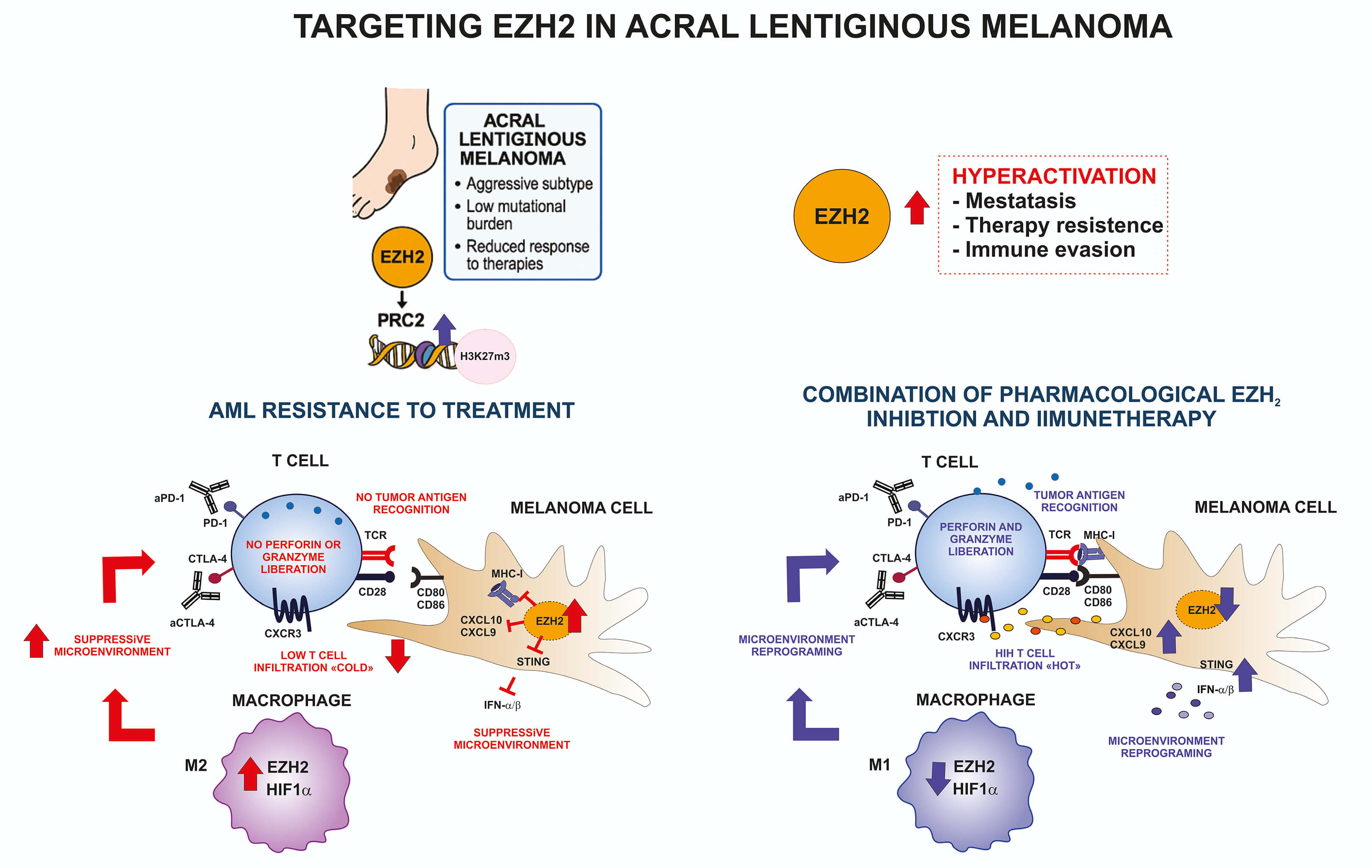
Acral lentiginous melanoma (ALM) is characterized by a low mutational burden, frequent chromosomal rearrangements, and profound epigenetic dysregulation, distinguishing it from ultraviolet (UV)-induced melanoma. Among the epigenetic regulators, Enhancer of Zeste Homolog 2 (EZH2), the catalytic component of the Polycomb Repressive Complex 2 (PRC2), plays a central role in chromatin compaction and transcriptional repression through trimethylation of histone H3 on lysine 27 (H3K27me3). EZH2 overexpression or hyperactivation contributes to tumor progression, immune evasion, and therapeutic resistance. Recent multi-omic studies have highlighted the importance of EZH2 in regulating melanoma plasticity, immune modulation, and metabolic reprogramming. In ALM, where canonical oncogenic mutations such as BRAF V600E and NRAS Q61 are less frequent, EZH2-driven epigenetic mechanisms may play an even more dominant role in tumor initiation and progression. Pharmacological inhibitors of EZH2, including tazemetostat, have shown promise in preclinical melanoma models by restoring antigen presentation, enhancing CD8+ T-cell infiltration, and reversing transcriptional programs associated with immune resistance. This review aims to summarize the role of EZH2 in the molecular pathogenesis of ALM, emphasizing its contributions to epigenetic regulation, tumor plasticity, and immune escape, and discusses emerging therapeutic strategies targeting EZH2-mediated pathways to improve outcomes for this aggressive melanoma subtype.Graphic Abstract
Keywords
Cite This Article
 Copyright © 2026 The Author(s). Published by Tech Science Press.
This work is licensed under a Creative Commons Attribution 4.0 International License , which permits unrestricted use, distribution, and reproduction in any medium, provided the original work is properly cited.
 Downloads
 Citation Tools
