
 Login
Login Register
 Submit a Paper
 Propose a Special lssue
 Open Access
REVIEW
A New Paradigm of Bispecific Antibodies in Clinical Management of Gastrointestinal Cancers
1 Digestive Diseases Center, Research Center, The Seventh Affiliated Hospital of Sun Yat-Sen University, Shenzhen, China
2 College of Laboratory Animal Science, Shandong First Medical University, Jinan, China
3 Division of Oncology, Department of Clinical Sciences, Lund University, Lund, Sweden
4 Breeding and Biotechnology Research Laboratory, Beijing Academy of Agriculture and Forestry Sciences, Beijing, China
* Corresponding Authors: Changhua Zhang. Email: ; Chunhui Sun. Email:
# These authors contributed equally to this work
(This article belongs to the Special Issue: Targeting the Tumor Microenvironment: Emerging Insights into Cancer Progression and Therapeutics)
Oncology Research 2026, 34(7), 7 https://doi.org/10.32604/or.2026.078825
Received 08 January 2026; Accepted 25 March 2026; Issue published 16 June 2026
 View Full Text
 Download PDF
Abstract
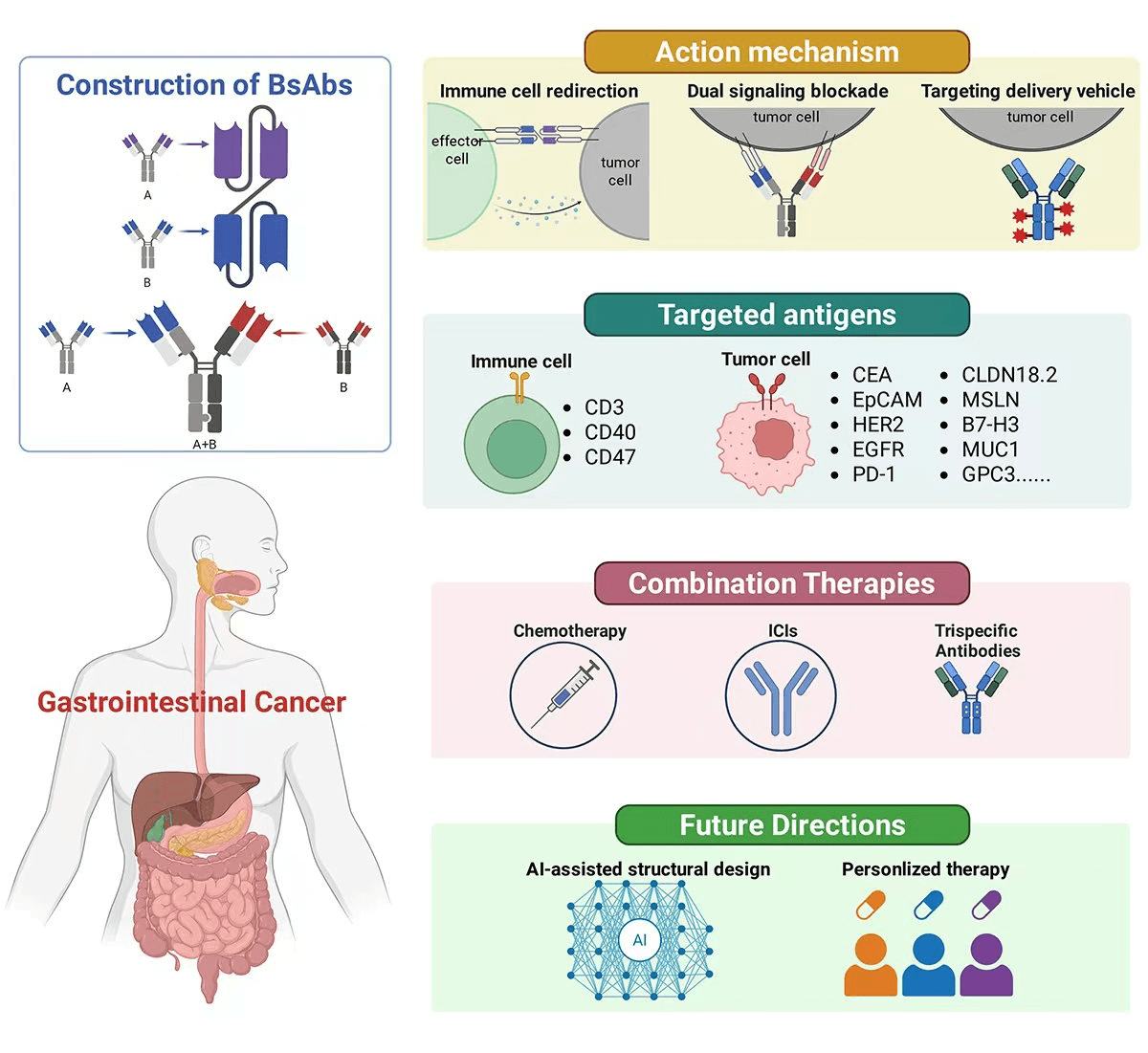
Gastrointestinal (GI) cancers represent a significant global health burden, characterized by high incidence, poor prognosis, and limited response to monotherapies. The advent of bispecific antibodies (BsAbs) has introduced a novel therapeutic paradigm, enabling dual targeting of tumor-associated antigens and immune effectors to enhance antitumor immunity. This review provides a comprehensive overview of recent advances in bsAb-based immunotherapy across major GI malignancies, including colorectal, gastric, pancreatic, biliary tract, esophageal, and liver cancers. We summarize key molecular targets and highlight representative clinical candidates such as CEA-TCB and RG7802. The discussion extends to innovative strategies involving BsAbs in modulating the immunosuppressive tumor microenvironment and overcoming resistance mechanisms. Furthermore, we explore promising combination therapies involving BsAbs with chemotherapy and immune checkpoint inhibitors (ICIs). The role of artificial intelligence in target prediction and structure optimization is also examined, alongside the potential of personalized immune strategies. Despite promising therapeutic potential, BsAbs face challenges including cytokine release syndrome (CRS), on-target/off-tumor toxicity, tumor heterogeneity-driven resistance, and tumor microenvironment (TME). Current strategies to improve therapeutic index encompass affinity-tuned designs, conditional activation mechanisms, biomarker-driven patient stratification, combination therapies, and artificial intelligence (AI)-guided optimization, warranting continued interdisciplinary research efforts. We conclude by outlining future research directions and emphasizing the importance of interdisciplinary, multicenter collaborations to accelerate clinical translation and maximize the therapeutic potential of BsAbs in GI oncology. In summary, the aim of this study is to critically evaluate the current landscape of BsAb-based immunotherapy in gastrointestinal cancers, synthesizing emerging molecular targets, evaluating clinical trial outcomes, identifying key challenges limiting therapeutic efficacy, and proposing evidence-based strategies to optimize future BsAb development.Graphic Abstract
Keywords
Cite This Article
 Copyright © 2026 The Author(s). Published by Tech Science Press.
This work is licensed under a Creative Commons Attribution 4.0 International License , which permits unrestricted use, distribution, and reproduction in any medium, provided the original work is properly cited.
 Downloads
 Citation Tools
