
 Login
Login Register
 Submit a Paper
 Propose a Special lssue
 Open Access
ARTICLE
Transcriptomic Study of Diffuse Large B-Cell Lymphoma Associated with HIV Infection: Identification of Novel Molecular Subtypes
1 Aix Marseille Univ, TAGC/INSERM UMR1090, Parc Scientifique de Luminy, Marseille, France
2 Institut Pierre Louis d’Epidémiologie et de Santé Publique (IPLESP) UMRS1136 INSERM et UPMC, Paris, France
3 Service d’Hématologie Oncologie, Centre Hospitalier de Versailles, Versailles, France
4 Centre de Recherche en Epidémiologie et Santé des Populations (CESP), INSERM U1018, Université Paris-Saclay, Villejuif, France
5 Service d’Anatomopathologie, AP-HP, Le Kremlin-Bicêtre, France
6 Service d’Anatomopathologie, AP-HM, CHU La Timone, Marseille, France
7 Service d’Hématologie et Thérapie Cellulaire, AP-HM, CHU La Conception, Marseille, France
* Corresponding Author: Régis Costello. Email:
Oncology Research 2026, 34(8), 13 https://doi.org/10.32604/or.2026.076241
Received 17 November 2025; Accepted 29 April 2026; Issue published 16 July 2026
 View Full Text
 Download PDF
Abstract
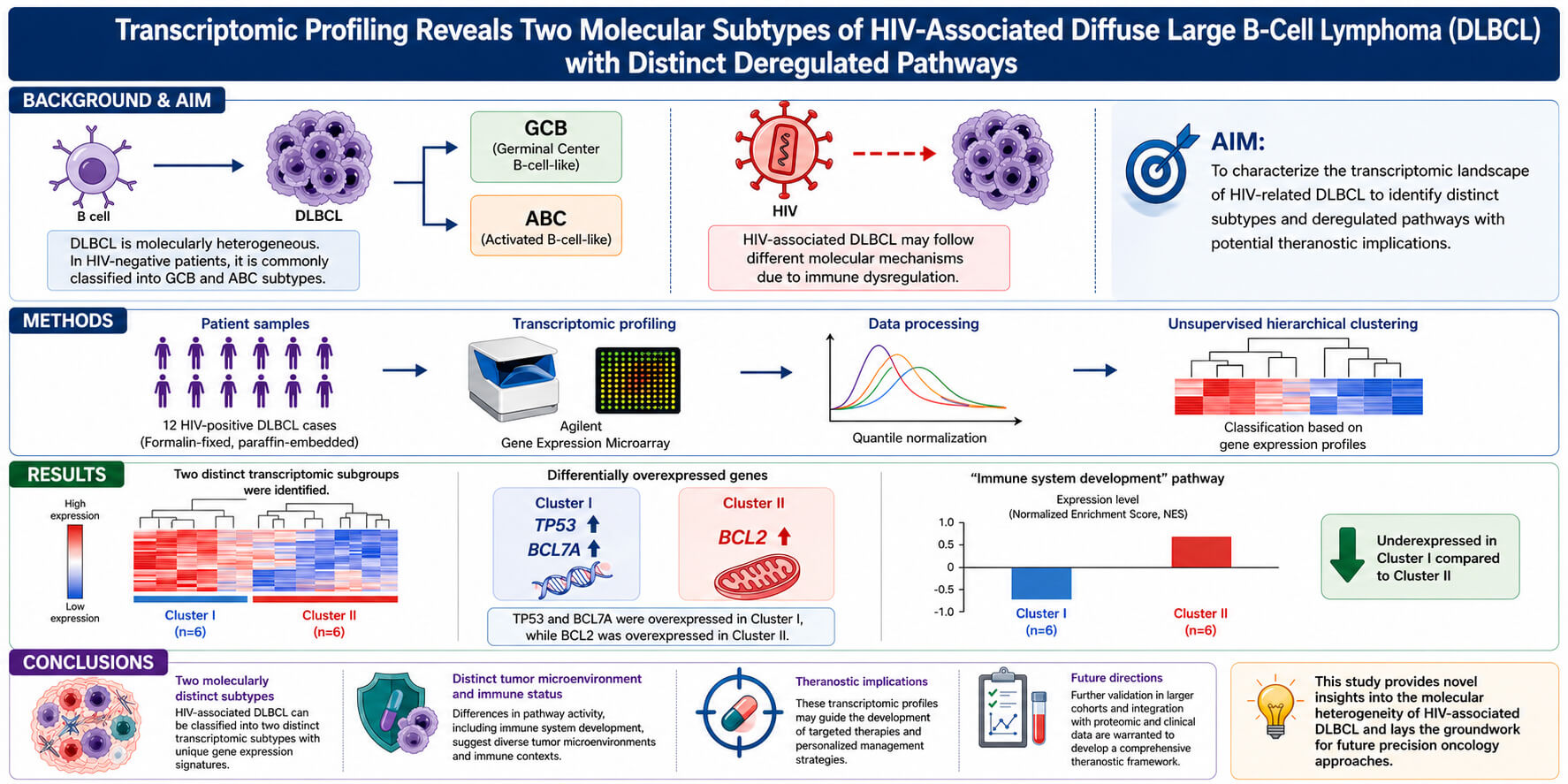
Objectives: Transcriptomic profiling has enabled the classification of Diffuse Large B-Cell Lymphoma (DLBCL) into distinct subtypes, such as Germinal Center B-cell-like (GCB) and Activated B-cell-like (ABC), primarily in HIV-negative patients. However, HIV-associated DLBCL may follow different molecular mechanisms due to immune dysregulation. This study aimed to characterize the transcriptomic landscape of HIV-related DLBCL to identify distinct subtypes and deregulated pathways with potential theranostic implications. Methods: Twelve formalin-fixed, paraffin-embedded DLBCL samples from HIV-positive patients were analyzed using Agilent’s microarray. Quantile normalization and unsupervised hierarchical clustering were performed to classify tumors based on gene expression profiles. Results: Two distinct transcriptomic subgroups were identified. TP53 and BCL7A were overexpressed in cluster I, while BCL2 was overexpressed in cluster II. Notably, the “immune system development” pathway was under expressed in cluster I compared to cluster II. Conclusions: Our findings reveal two molecularly distinct subtypes of HIV-associated DLBCL, likely driven by differences in tumor microenvironment and immune status. These transcriptomic profiles may guide future targeted therapies. Further validation in larger cohorts and integration with proteomic and clinical data are warranted to develop a comprehensive theranostic framework.Graphic Abstract
Keywords
Supplementary Material
Supplementary Material FileCite This Article
 Copyright © 2026 The Author(s). Published by Tech Science Press.
This work is licensed under a Creative Commons Attribution 4.0 International License , which permits unrestricted use, distribution, and reproduction in any medium, provided the original work is properly cited.
 Downloads
 Citation Tools
