
 Login
Login Register
 Submit a Paper
 Propose a Special lssue
 Open Access
REVIEW
Targeting PCNA in Cancer: A Paradigm Shift from Static Inhibition to Dynamic Network Modulation
1 School of Life Science and Technology, North Henan Medical University, Xinxiang, China
2 School of Medical Laboratory, North Henan Medical University, Xinxiang, China
3 Basic Medical College, North Henan Medical University, Xinxiang, China
* Corresponding Author: Hongwei Zhou. Email:
# These authors are co-first authors of the article
Oncology Research 2026, 34(8), 8 https://doi.org/10.32604/or.2026.079988
Received 01 February 2026; Accepted 15 April 2026; Issue published 16 July 2026
 View Full Text
 Download PDF
Abstract
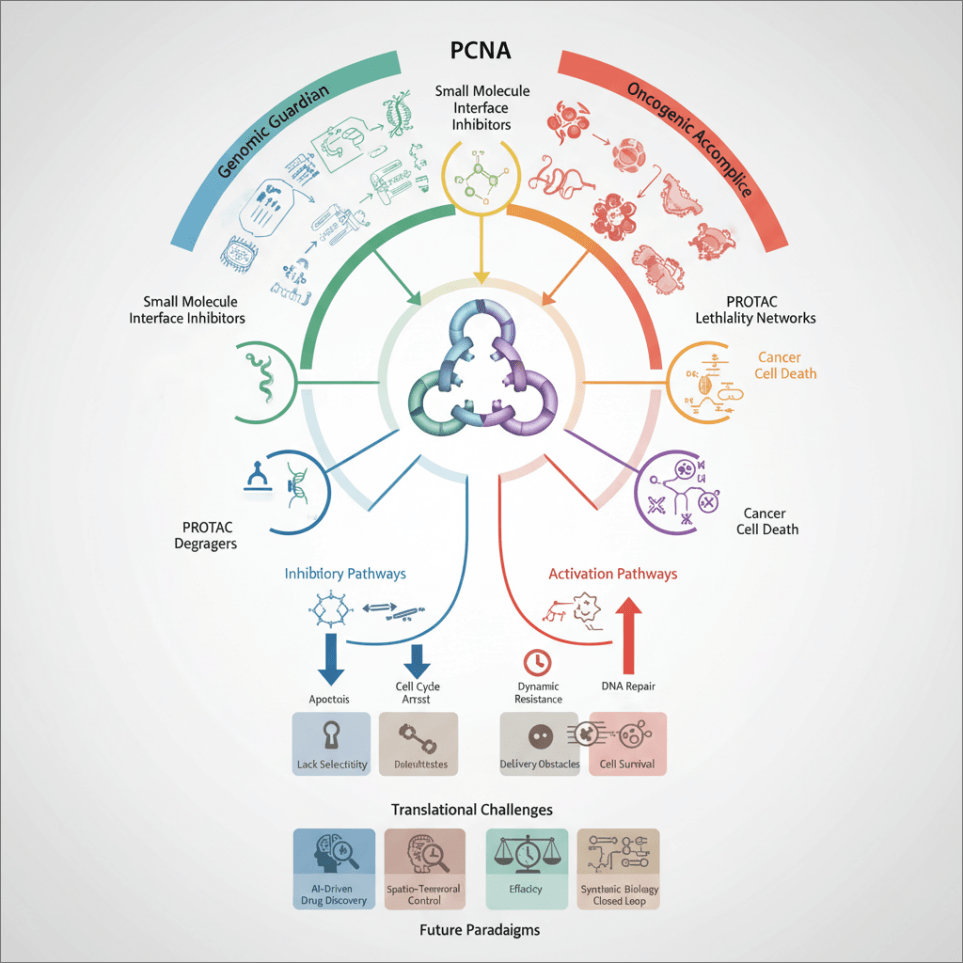
Proliferating Cell Nuclear Antigen (PCNA) is a core protein in DNA replication and repair. Its functional dysregulation drives tumorigenesis and therapeutic resistance, making it a critical anticancer target. However, the fundamental conflict between PCNA’s indispensable “guardian” function in normal cells and its hijacked “accomplice” role in cancer cells constitutes the central challenge for targeted intervention: how to eradicate tumors while avoiding severe toxicity to normal tissues. This review aims to systematically review the latest advances and translational dilemmas in the field of PCNA-targeted therapy. It outlines various intervention strategies, including small-molecule inhibitors, proteolysis-targeting chimeras, post-translational modification interference, and synthetic lethality approaches, analyzing their potential and limitations in preclinical research. The review focuses on dissecting key bottlenecks hindering clinical translation, such as the selectivity dilemma, delivery barriers, and resistance evolution. Concurrently, it critically examines how cross-disciplinary technologies—including artificial intelligence, spatiotemporal regulation, and synthetic biology—offer novel ideas to address these bottlenecks, while clarifying that most remain in early exploratory stages. By synthesizing progress, challenges, and future directions, this article provides a framework to inform the development of highly selective and translatable PCNA-based anticancer strategies.Graphic Abstract
Keywords
Cite This Article
 Copyright © 2026 The Author(s). Published by Tech Science Press.
This work is licensed under a Creative Commons Attribution 4.0 International License , which permits unrestricted use, distribution, and reproduction in any medium, provided the original work is properly cited.
 Downloads
 Citation Tools
