
 Login
Login Register
 Submit a Paper
 Propose a Special lssue
 Open Access
ARTICLE

Humic Acid Biodegradable Film Increased Yam Yield and Total Soluble Sugar Content by Reshaping Soil Microbial Community Structure
1 State Key Laboratory of Vegetable Biobreeding, Institute of Vegetables and Flowers, Chinese Academy of Agricultural Sciences, Beijing, China
2 Wencheng Academy of Agriculture and Forestry Science, Wenzhou Vocational College of Science and Technology, Wenzhou, China
3 Southern Zhejiang Key Laboratory of Crop Breeding, Wenzhou Vocational College of Science and Technology, Wenzhou, China
4 College of Agriculture and Biotechnology, Wenzhou Vocational College of Science and Technology, Wenzhou, China
* Corresponding Authors: Yansu Li. Email: ; Yan Yan. Email:
# These authors contributed equally to this study
Phyton-International Journal of Experimental Botany 2026, 95(2), 4 https://doi.org/10.32604/phyton.2026.074706
Received 16 October 2025; Accepted 08 January 2026; Issue published 28 February 2026
 View Full Text
 Download PDF
Abstract
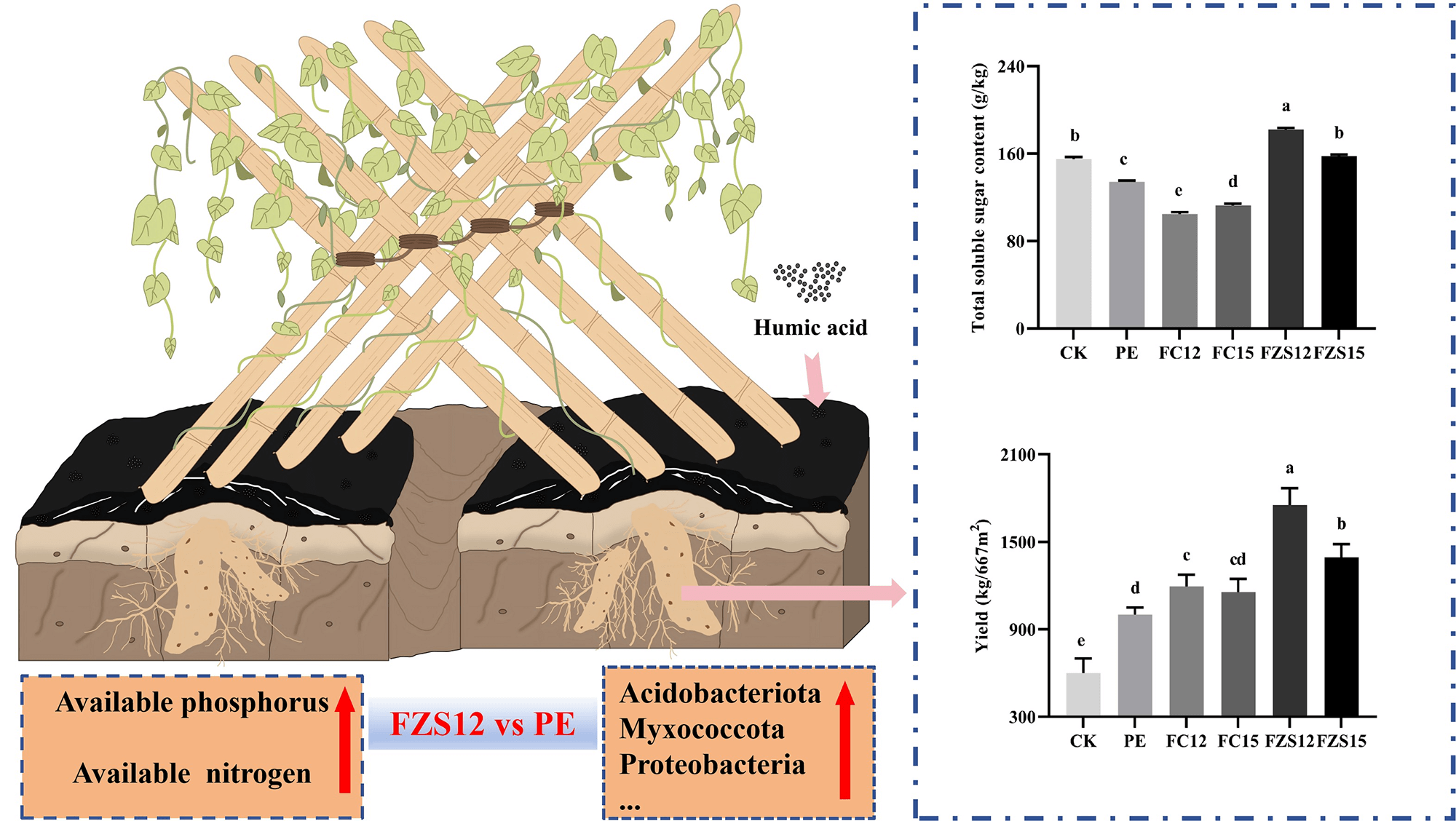
To address the issue of residual pollution caused by polyethylene mulch, this study explored the effects of different mulching methods on the soil environment of the yam field, as well as on yam yield and quality. The experiment comprised six treatments in total: one non-mulched treatment served as the control (CK), along with five different film-mulched treatments, namely PE, FZS12, FZS15, FC12, and FC15. The degradation of these films and their effects on soil physicochemical properties, microbial community, yam yield and quality were compared. The results showed that the FZS12 treatment achieved grade 5 degradation by the end of the planting period. Compared with PE treatment, the total soluble sugar content and yield of yam treated with FZS12 were significantly increased by 35.78% and 74.97%, respectively (p < 0.05). Compared with CK and PE treatments, FZS12 significantly increased soil available nitrogen by 31.62% and 6.20%, respectively (p < 0.05), and significantly increased soil available phosphorus by 8.58% and 4.45%, respectively (p < 0.05). Soil pH, available nitrogen, and available phosphorus were the main environmental factors affecting the soil bacterial community. The FZS12 treatment significantly increased the relative abundances of soil bacteria phylum including Acidobacteriota, Myxococcota, Patescibacteria, and Proteobacteria compared with the CK and PE treatments. Functional prediction using Picrust2 revealed that the FZS12 treatment had significantly higher levels of signal transduction and amino acid metabolism than the CK and PE treatments. In conclusion, covering with 12 μm PBAT/PLA humic acid biodegradable film enhances yam yield and total soluble sugar content by shaping beneficial soil microbial communities, activating soil nutrients.Graphic Abstract
Keywords
Cite This Article
 Copyright © 2026 The Author(s). Published by Tech Science Press.
This work is licensed under a Creative Commons Attribution 4.0 International License , which permits unrestricted use, distribution, and reproduction in any medium, provided the original work is properly cited.
 Downloads
 Citation Tools
