
 Login
Login Register
 Submit a Paper
 Propose a Special lssue
 Open Access
ARTICLE

Anatomical Ventricular Type Determines 30-Year Outcomes in Fontan Patients: Insights from National Korean Registry
1 Department of Pediatrics, Asan Medical Center, University of Ulsan College of Medicine, Seoul, Republic of Korea
2 Department of Pediatrics, Sejong General Hospital, Bucheon, Republic of Korea
3 Department of Pediatrics, College of Medicine, Seoul National University Children’s Hospital, Seoul, Republic of Korea
4 Department of Thoracic and Cardiovascular Surgery, Sejong General Hospital, Bucheon, Republic of Korea
5 Department of Thoracic and Cardiovascular Surgery, Asan Medical Center, University of Ulsan College of Medicine, Seoul, Republic of Korea
6 Department of Pediatrics, Pusan National University Children’s Hospital, Pusan National University School of Medicine, Yangsan, Republic of Korea
7 Department of Pediatrics, Samsung Medical Center, Sungkyunkwan University School of Medicine, Seoul, Republic of Korea
8 Department of Pediatrics, Seoul St. Mary’s Hospital, College of Medicine, The Catholic University of Korea, Seoul, Republic of Korea
9 Department of Pediatrics, College of Medicine, Seoul National University Bundang Hospital, Sungnam, Republic of Korea
10 Department of Pediatric Cardiology, Gachon University Gil Medical Center, Incheon, Republic of Korea
11 Department of Pediatrics, Severance Cardiovascular Hospital, Yonsei University College of Medicine, Seoul, Republic of Korea
12 Department of Pediatrics, Kyungbook National University School of Medicine, Daegu, Republic of Korea
13 Department of Pediatrics, Dong-A University Hospital, Pusan, Republic of Korea
14 Department of Statistics and Actuarial Science, Soongsil University, Seoul, Republic of Korea
* Corresponding Author: Soo-Jin Kim. Email:
(This article belongs to the Special Issue: Registries in Congenital Heart Disease)
Structural and Congenital Heart Disease 2026, 21(2), 2 https://doi.org/10.32604/schd.2026.077034
Received 01 December 2025; Accepted 08 June 2026; Issue published 11 June 2026
 View Full Text
 Download PDF
Abstract
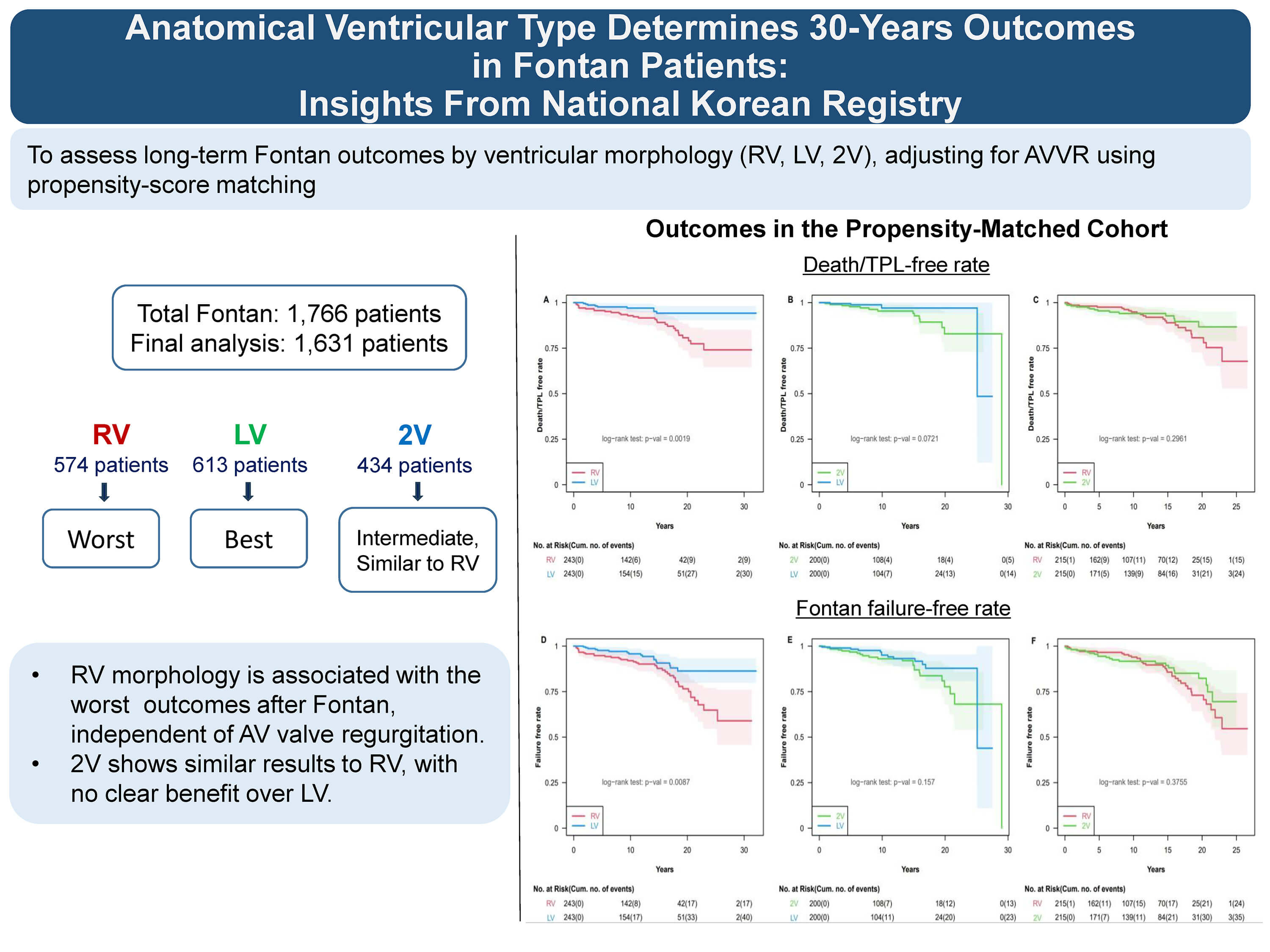
Background: Systemic right ventricular morphology is associated with poor Fontan outcomes, but its independent effect remains uncertain due to confounding by atrioventricular valve regurgitation (AVVR). The prognostic role of two adequately sized ventricles is also unclear. This study aimed to evaluate the independent impact of ventricular morphology on long-term Fontan outcomes after adjustment for AVVR, using a large national registry. Methods: A total of 1631 Fontan survivors were analyzed. Death or heart transplantation and Fontan failure were primarily evaluated using inverse probability of treatment weighting. Fontan failure was defined as death, heart transplantation, Fontan takedown or conversion, protein-losing enteropathy, plastic bronchitis, or New York Heart Association class III/IV. Results: The cohort included 35.8% systemic right ventricular morphology, 38.6% systemic left ventricular morphology, and 25.6% two adequately sized ventricular morphology. Systemic right ventricular morphology was associated with a higher risk of death or heart transplantation compared with systemic left ventricular morphology (HR, 1.699; 95% CI, 1.130–2.554; p = 0.011). A similar pattern was observed for Fontan failure (HR, 1.487; 95% CI, 1.084–2.038; p = 0.014). In comparison, two adequately sized ventricular morphology did not demonstrate a clear advantage over systemic left ventricular morphology for death or heart transplantation (HR, 1.582; 95% CI, 0.977–2.563; p = 0.062) or Fontan failure (HR, 1.207; 95% CI, 0.815–1.788; p = 0.347), and showed no significant difference compared with systemic right ventricular morphology. Conclusion: Systemic right ventricle morphology was associated with the poorest long-term outcomes after adjustment for AVVR. Despite having two adequately sized ventricles, this morphology group showed no advantage over systemic left ventricular morphology and did not differ significantly from systemic right ventricular morphology.Graphic Abstract
Keywords
Cite This Article
 Copyright © 2026 The Author(s). Published by Tech Science Press.
This work is licensed under a Creative Commons Attribution 4.0 International License , which permits unrestricted use, distribution, and reproduction in any medium, provided the original work is properly cited.
 Downloads
 Citation Tools
