
 Login
Login Register
 Submit a Paper
 Propose a Special lssue
 Open Access

Recent Breakthroughs in Leveraging MoS2 to Transcend the Performance Bottlenecks of Perovskite Solar Cells
State Key Laboratory of Smart Power Distribution Equipment and System, School of Materials Science and Engineering, Hebei University of Technology, Tianjin, China
* Corresponding Author: Cong Chen. Email:
Chalcogenide Letters 2026, 23(7), 6 https://doi.org/10.32604/cl.2026.087725
Received 22 June 2026; Accepted 23 July 2026; Issue published 07 August 2026
 View Full Text
 Download PDF
Abstract
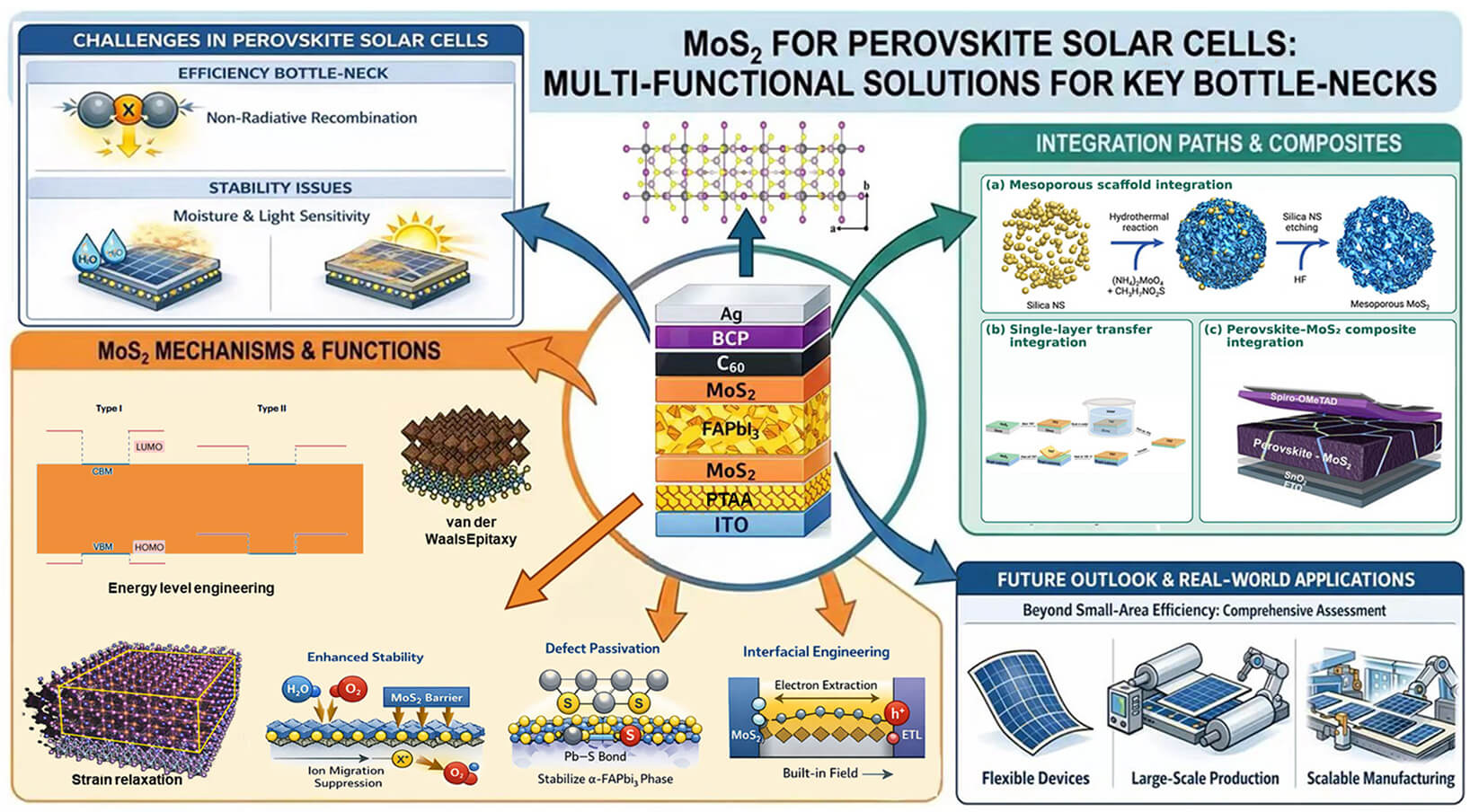
The power conversion efficiency of perovskite solar cells has increased rapidly; however, interfacial-defect-induced non-radiative recombination, ion migration, and sensitivity to moisture, oxygen, and thermal stress continue to cause open-circuit voltage losses and a limited operational lifetime. Owing to its tunable energy levels, high carrier mobility, and compact hydrophobic layered structure, two-dimensional MoS2 can serve as an electron or hole transport layer, an interfacial buffer layer, or an additive, enabling favorable energy-level alignment and optimized interfacial charge-transfer kinetics, thereby promoting carrier extraction and suppressing recombination. The sulfur sites of MoS2 can coordinate with undercoordinated Pb2+ to form Pb–S bonds, thereby passivating defects and stabilizing the α-FAPbI3 phase, while continuous MoS2 layers can suppress ion migration through physical diffusion blocking; meanwhile, van der Waals epitaxy and heterogeneous nucleation induced by MoS2 improve film crystallinity and relieve residual stress, synergistically enhancing both efficiency and durability. This review summarizes the functional mechanisms, preparation methods, and integration routes of MoS2 in PSCs, with particular attention to recent advances in wafer-scale monolayer interfaces, mesoporous electron-transport layers, functionalized nanosheet additives, quantum-dot composite absorbers, and hybrid interfaces. These approaches are compared in terms of their effects on charge transport, defect passivation, crystallization, device efficiency, stability, process compatibility, and scalability. The outlook also considers data-driven optimization, integration with other two-dimensional materials, and applications in flexible, large-area, and tandem devices.Graphic Abstract
Keywords
Perovskite solar cells; MoS2; stability; power conversion efficiency; interfacial engineering
Cite This Article
APA Style
Liu, Q., Chen, C. (2026). Recent Breakthroughs in Leveraging MoS2 to Transcend the Performance Bottlenecks of Perovskite Solar Cells. Chalcogenide Letters, 23(7), 6. https://doi.org/10.32604/cl.2026.087725
Vancouver Style
Liu Q, Chen C. Recent Breakthroughs in Leveraging MoS2 to Transcend the Performance Bottlenecks of Perovskite Solar Cells. Chalcogenide Letters. 2026;23(7):6. https://doi.org/10.32604/cl.2026.087725
IEEE Style
Q. Liu and C. Chen, “Recent Breakthroughs in Leveraging MoS2 to Transcend the Performance Bottlenecks of Perovskite Solar Cells,” Chalcogenide Letters, vol. 23, no. 7, pp. 6, 2026. https://doi.org/10.32604/cl.2026.087725
 Copyright © 2026 The Author(s). Published by Tech Science Press.
This work is licensed under a Creative Commons Attribution 4.0 International License , which permits unrestricted use, distribution, and reproduction in any medium, provided the original work is properly cited.
 Downloads
 Citation Tools
