Home / Journals / CL / Vol.23, No.7, 2026
Special Issues
cover

On the Cover

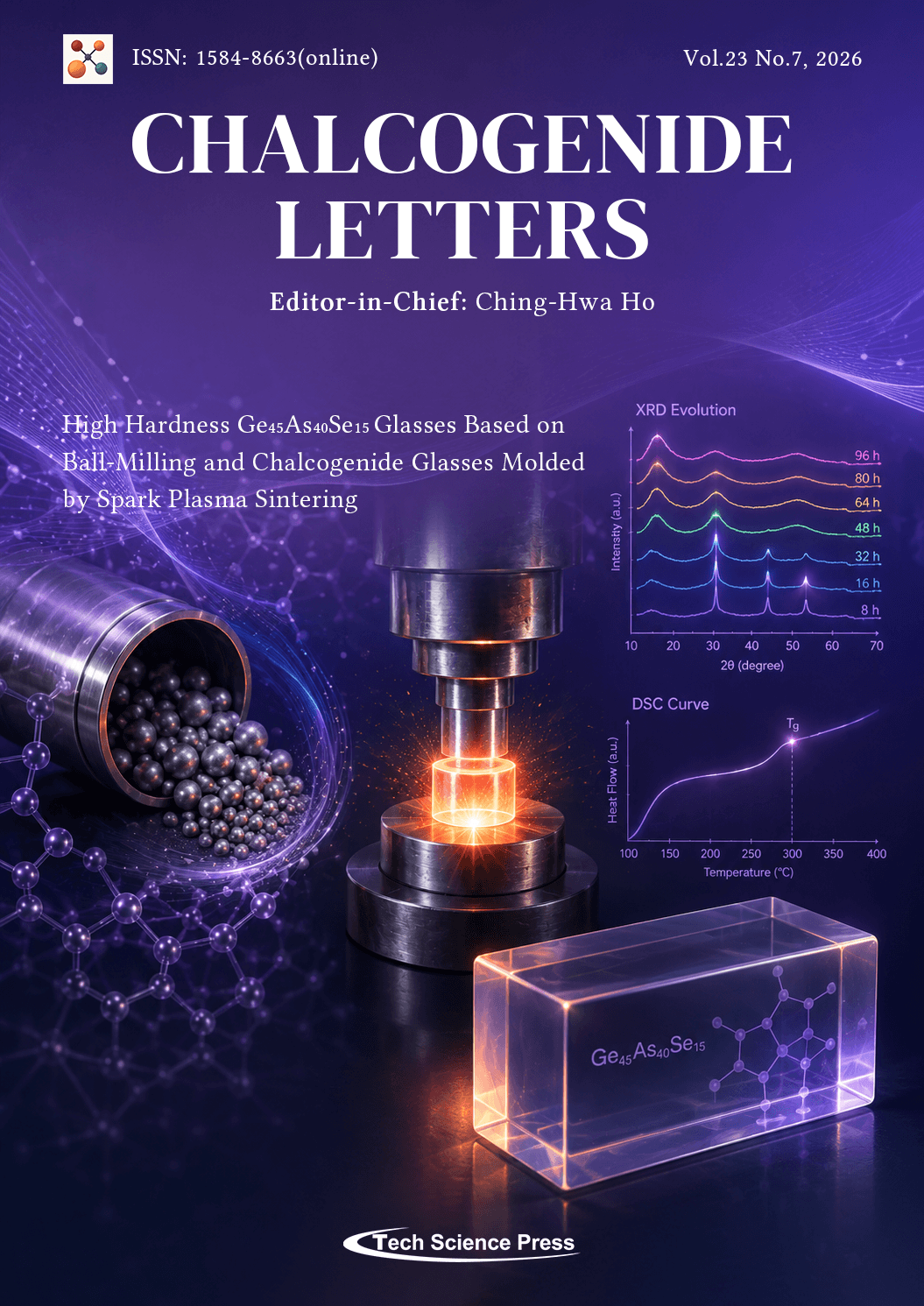
On the Cover This study demonstrates a cost-effective and efficient strategy for fabricating high-hardness Ge₄₅As₄₀Se₁₅ chalcogenide glass by combining ball milling with spark plasma sintering (SPS). The proposed approach enables the consolidation of glass powders into dense bulk components while preserving excellent infrared transparency and optical performance. Structural evolution during ball milling and glass formation after hot pressing were systematically characterized by X-ray diffraction (XRD) and differential scanning calorimetry (DSC), revealing the gradual amorphization process and the presence of a distinct glass transition temperature. This powder-based SPS route extends the preparation of chalcogenide glasses beyond the conventional glass-forming region, offering a simple, economical, and scalable pathway for manufacturing infrared optical components such as lenses and windows for advanced photonic applications. The cover image illustrates the transformation from ball-milled powders to dense infrared glass through spark plasma sintering, highlighting the structural evolution and thermal characteristics that underpin the fabrication process.
The cover image was created by Chatgpt and contains no copyrighted elements or misleading representations.

View this paper

  • Open AccessOpen Access

    ARTICLE

    Influence of Germanium Substitution on the DC Electrical Properties and Energy Density of States in Pb50−xGexTe50 Ternary Chalcogenide Alloys

    Muayed Khaleel Ibrahim1, Shaymaa Hashim Aneed2, Nidhal Saleh Mohammed2, Kareem Ali Jasim2, Mudatheer M. Al-Slivani3,*
    Chalcogenide Letters, Vol.23, No.7, 2026, DOI:10.32604/cl.2026.082607 - 07 August 2026
    (This article belongs to the Special Issue: New Horizons in Structural Design and Experimental Synthesis of Chalcogenide-based Materials for Energy Storage and Conversion)
    Abstract This study investigates the structural evolution and DC electrical properties of Pb50−xGexTe50 ternary chalcogenide alloys with varying germanium concentrations (x = 5, 10, 15, 20). Synthesized via the melt-quenching technique, the alloys were characterized using Scanning Electron Microscopy (SEM) and temperature-dependent electrical resistivity measurements within the range of 290–475 K. Microstructural analysis revealed that increasing Ge substitution significantly promotes matrix densification, reducing porosity and improving inter-granular connectivity. The DC conductivity exhibits a systematic increase with Ge content up to x = 15, attributed to the increased density of defect states. For instance, as Ge content increases… More >

  • Open AccessOpen Access

    ARTICLE

    Bandgap Tunable PbSnSeS Quaternary Quantum Dots for near-Infrared Optoelectronic and Solar Cell Applications

    M. Irshad Ahamed1,*, P. J. Suresh Babu2, R. Lal Raja Singh3, S. Sivamani2, R. Leena Rose4
    Chalcogenide Letters, Vol.23, No.7, 2026, DOI:10.32604/cl.2026.084991 - 07 August 2026
    Abstract Semiconductor quantum dots (QDs) with tunable narrow bandgaps have emerged as promising materials for next-generation near-infrared (NIR) optoelectronic and photovoltaic devices because their optical properties can be tailored through composition and quantum confinement. Among IV–VI chalcogenide nanomaterials, quaternary alloy systems provide greater compositional flexibility than conventional binary and ternary counterparts; however, PbSnSeS quantum dots remain largely unexplored despite their potential for broadband infrared applications. Here, the structural, electronic, and optical properties of PbSnSeS quaternary QDs synthesized by a one-pot colloidal hot-injection method are systematically investigated. The crystalline IV–VI chalcogenide phase and successful quaternary alloy formation… More >

  • Open AccessOpen Access

    ARTICLE

    Synthesis, Crystal Structure, Optical, and Thermal Properties of a Novel Quaternary Selenide EuErAgSe3

    Navruzbek Habibullayev1,*, Ilya Yurev1,2, Maxim Molokeev1,3,4, Aleksandr Aleksandrovsky3,5, Olga Trofimova1, Nikita Shulaev1, Svetlana Volkova1, Oleg Andreev1,6
    Chalcogenide Letters, Vol.23, No.7, 2026, DOI:10.32604/cl.2026.085815 - 07 August 2026
    Abstract A novel quaternary selenide, EuErAgSe3, has been synthesized for the first time. The phase forms upon annealing in the 1120–1800 K range and retains its crystal structure upon cooling to ambient conditions. The phase was prepared by the ampoule method from EuSe and AgErSe2 powders, followed by annealing at 1270 ± 10 K for up to 300 h. Powder X-ray diffraction revealed that EuErAgSe3 crystallizes in the AgBiS2 structure type (space group Fm-3m) with the lattice parameter a = 5.95322(14) Å. The microhardness of the phase is 340 ± 15 HV. The optical band gap for direct transitions More >

  • Open AccessOpen Access

    ARTICLE

    High Hardness Ge45As40Se15 Glasses Based on Ball-Milling and Chalcogenide Glasses Molded by Spark Plasma Sintering

    Jierong Gu1,*, Licheng Hua2, Shuangquan Xie3,4, Xiang Shen3,4, Tiefeng Xu3,4, Zijun Liu3,4
    Chalcogenide Letters, Vol.23, No.7, 2026, DOI:10.32604/cl.2026.086724 - 07 August 2026
    Abstract In this work, Ge45As40Se15 chalcogenide glass was prepared using spark plasma sintering. This method synthesizes glass powder into blocks through a certain temperature and pressure, which is an effective densification and high-precision molding of infrared transparent blocks and lenses. Through X-ray diffraction (XRD) and differential scanning calorimetry analysis, we tracked the gradual evolution of the powder during ball milling and observed the existence of a glass transition temperature in the glass after powder hot pressing. This method can prepare components outside the conventional glass forming region with high hardness and infrared transmittance, providing a simple and More >

  • Open AccessOpen Access

    ARTICLE

    The Effect of Washing on the Structural, Morphological, and Compositional Properties of CuS Nanopowder Synthesis via Chemical Bath Technique

    Bilal Taher*
    Chalcogenide Letters, Vol.23, No.7, 2026, DOI:10.32604/cl.2026.085371 - 07 August 2026
    Abstract Nanopowder copper sulphide CuS has been synthesised successfully via the chemical bath deposition method. Two samples of precipitated CuS nanopowder were prepared at molar concentration of 0.5 M from [CuSO4·5H2O and Na2S2O3·5H2O] and 0.05 M from [Na2EDTA·2H2O]. Both samples were annealed at 150°C for one hour in air. The effects of washing and nonwashing on the structural, morphological, and compositional properties were studied. The X-ray diffraction (XRD) patterns showed that both samples have a CuS hexagonal structure with lattice constants (a = 3.773 , c = 16.398 ), and (a =… More >

  • Open AccessOpen Access

    Recent Breakthroughs in Leveraging MoS2 to Transcend the Performance Bottlenecks of Perovskite Solar Cells

    Qizheng Liu, Cong Chen*
    Chalcogenide Letters, Vol.23, No.7, 2026, DOI:10.32604/cl.2026.087725 - 07 August 2026
    Abstract The power conversion efficiency of perovskite solar cells has increased rapidly; however, interfacial-defect-induced non-radiative recombination, ion migration, and sensitivity to moisture, oxygen, and thermal stress continue to cause open-circuit voltage losses and a limited operational lifetime. Owing to its tunable energy levels, high carrier mobility, and compact hydrophobic layered structure, two-dimensional MoS2 can serve as an electron or hole transport layer, an interfacial buffer layer, or an additive, enabling favorable energy-level alignment and optimized interfacial charge-transfer kinetics, thereby promoting carrier extraction and suppressing recombination. The sulfur sites of MoS2 can coordinate with undercoordinated Pb2+ to form Pb–S… More >

    Graphic Abstract

    Recent Breakthroughs in Leveraging MoS<sub>2</sub> to Transcend the Performance Bottlenecks of Perovskite Solar Cells

  • Open AccessOpen Access

    ARTICLE

    Electronic Properties of MoSe2/ZrSe3 Junction Field Effect Transistor

    Changlim Woo1, Abdelkader Abderrahmane2, Pan Gum Jung3, Pil Ju Ko1,*
    Chalcogenide Letters, Vol.23, No.7, 2026, DOI:10.32604/cl.2026.085424 - 07 August 2026
    Abstract Transition metal dichalcogenides (TMDs) and transition metal trichalcogenides (TMTCs) exhibit tunable electronic properties, and when stacked together in their two dimensional (2D) forms, they can display distinctive electronic properties beyond those of conventional heterostructures. In this study, we fabricated for the first time junction field effect transistor (JFET) by stacking MoSe2, a transition metal dichalcogenide (TMD), with ZrSe3, a transition metal trichalcogenide (TMTC). We characterized its electrical properties, where the device’s electrical characteristics were analyzed based on the stacking sequence. Two device configurations top-gate and bottom-gate JFETs were fabricated and systematically analyzed. Notably, the top-gate JFET More >

Per Page:

Share Link