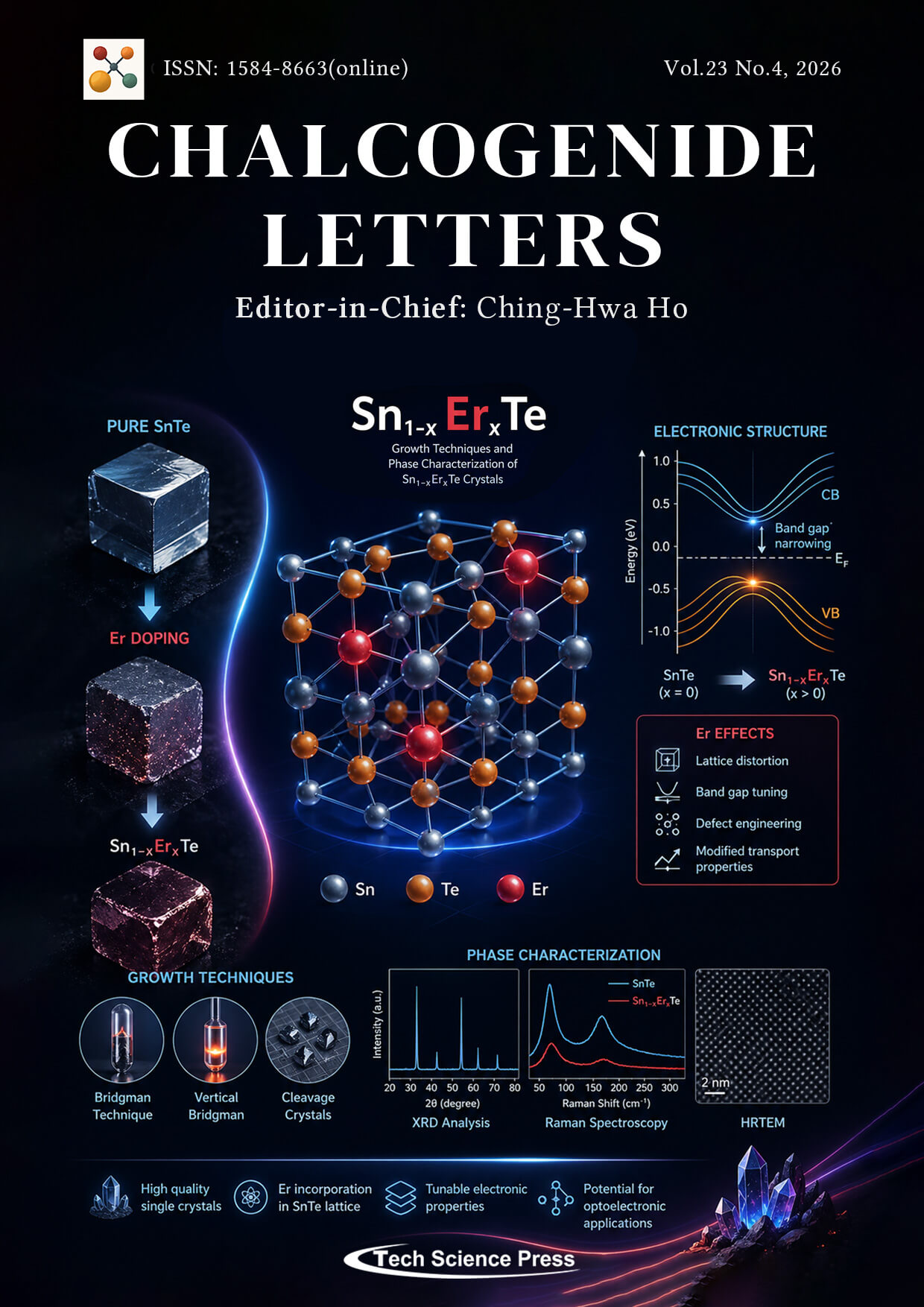
The development of advanced thermoelectric materials has attracted significant attention due to their potential for efficient energy conversion and sustainable energy technologies. Among these materials, tin telluride (SnTe) has emerged as a promising lead-free alternative; however, its performance is often limited by its intrinsic electronic structure and high carrier concentration.
In this study, the modification of SnTe through rare-earth doping is explored, focusing on the incorporation of erbium (Er) ions into the crystal lattice to form Sn₁₋ₓErₓTe compounds. The introduction of Er atoms induces notable changes in the lattice structure, leading to controlled lattice distortion, defect engineering, and modulation of carrier transport properties.
Crystal growth was achieved using advanced techniques such as the Bridgman and vertical Bridgman methods, enabling the production of high-quality single crystals. Structural and phase characterization were carried out using X-ray diffraction (XRD), Raman spectroscopy, and high-resolution transmission electron microscopy (HRTEM), confirming the successful incorporation of Er into the SnTe matrix and the preservation of crystalline integrity.
The electronic structure analysis reveals that Er doping contributes to band gap tuning and slight band gap narrowing, which enhances the thermoelectric performance by optimizing electrical conductivity and Seebeck coefficient. These modifications demonstrate the effectiveness of rare-earth doping as a strategy to tailor the electronic and structural properties of SnTe-based materials.
Overall, this work highlights the potential of Sn₁₋ₓErₓTe crystals as tunable thermoelectric materials with improved functional properties, offering перспектив opportunities for applications in energy harvesting and optoelectronic devices.
View this paper

 Login
Login Register
 Submit a Paper
 Propose a Special lssue