 Open Access
ARTICLE
Xiaomeng Chu1, Yihui Wu2,*, Guangyuan Wang3
Chalcogenide Letters, DOI:10.32604/cl.2026.088086
(This article belongs to the Special Issue: Functional Chalcogenides Materials for Electrochemical Energy Storage and Conversion)
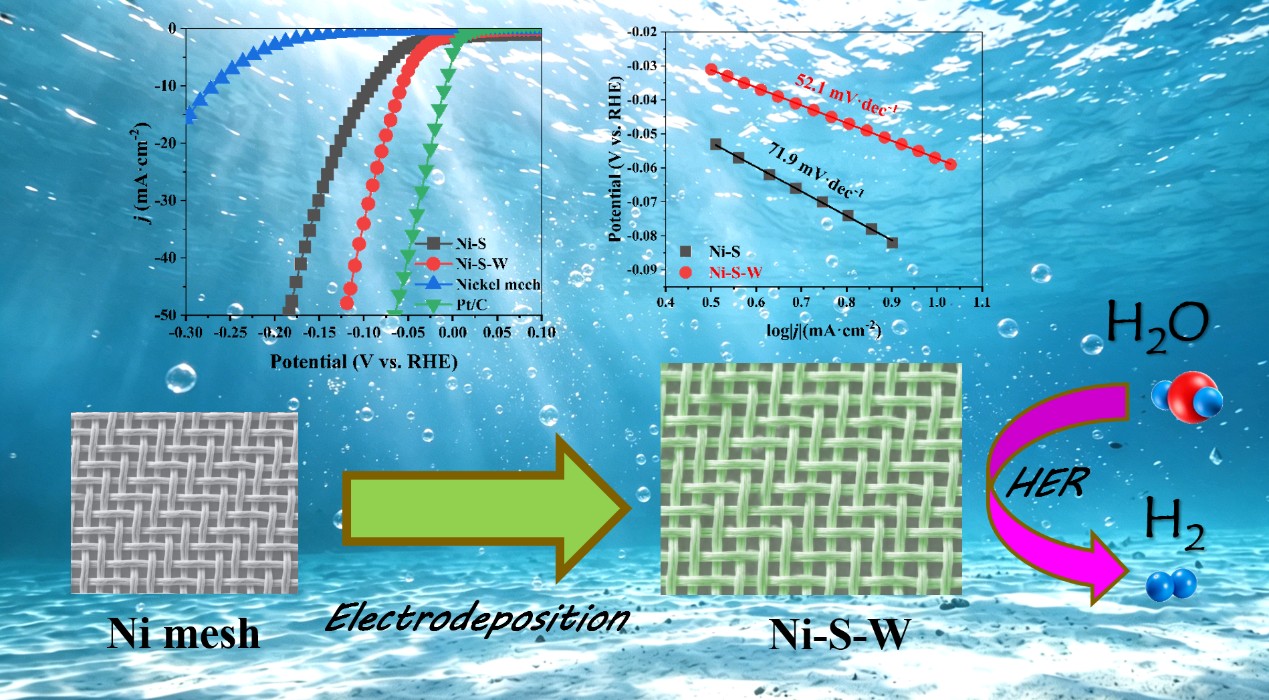
Abstract Electrocatalytic hydrogen evolution reaction (HER) underpins the scalable synthesis of renewable green hydrogen, yet conventional catalytic systems are constrained by overreliance on scarce noble metals, sluggish mass transport kinetics, and inefficient intermediate modulation. In this work, an efficient HER electrocatalyst with a WS2/Ni3S2 heterostructure was constructed through an electrodeposition strategy on nickel mesh. The WS2/Ni3S2 electrocatalyst shows an overpotential of 52 mV at a current density of 10 mA·cm−2, a small Tafel slope of 52.1 mV·dec−1, and a reduced charge transfer resistance (Rct = 22.80 Ω) in 1.0 M KOH electrolyte, as well as excellent stability. The More >
Graphic Abstract
Open Access
REVIEW
Jiantong Li1,*, Haiqiong Huang2
Chalcogenide Letters, DOI:10.32604/cl.2026.087705
(This article belongs to the Special Issue: Research and Application of Chalcogenide Semiconductor Materials in Gas Sensors)
Abstract This paper systematically introduces the latest research results on sulfide-based gas sensors for the detection of volatile substances in traditional Chinese medicine (TCM). WS2, SnS2 and MoS2 are 2D transition metal sulfides that have recently shown good results in the field of volatile organic compound (VOC) sensing, and particular attention is being paid to them. Based on relevant local and international studies, the gas-sensing mechanism, structural control strategy and application prospects of these materials in TCM volatile compound analysis have been carefully studied. Based on the above research, sulfide materials have a high specific surface area, many More >
Open Access
REVIEW
Neeru Dabas1,*, Naeem Mohammad2, Poonam Kumari2, Pooja Yadav1, Khushbu Jain1,3, Ambika Devi4, Pawan K. Khanna2,*
Chalcogenide Letters, DOI:10.32604/cl.2026.087576
Abstract Metal chalcogenide semiconductors (MX type; M = Zn/Cd/Sn/Sb/Mo/W/Ag/Cu/In, etc. & X = S, Se, Te) are immensely popular for a large variety of applications in electronics, optoelectronics, and catalysis. Their exploitation in the field of optoelectronics, where size-dependent optical properties have opened scope in the field of sensor technology, light-emitting devices, photovoltaics, energy technology, and the biomedical field, has made them immensely sought-after materials. In the field of biomedical sensors, such materials are an integral part of devices that are used for monitoring various parameters, including the respiratory health of human beings. Respiratory complexities are… More >
Open Access
ARTICLE
Ahmed Mostafa1,*, Samar Al-Shehri2, Azzah A. Alshehri3, A. Ashour4
Chalcogenide Letters, DOI:10.32604/cl.2026.083336
(This article belongs to the Special Issue: Chalcogenide Thin Films and Solar Cells for Optoelectronic Applications)
Abstract ABSTRACT: Interface engineering is an effective strategy for improving the efficiency and operational stability of thin-film photovoltaic devices. In this work, zinc sulfide/reduced graphene oxide (ZnS/RGO) nanocomposites (NCs) were synthesized using environmentally benign methods and incorporated as buffer layers into Glass/ITO/Cu2O/CdTe/ZnS–RGO/Al solar cells. X-ray diffraction (XRD) measurements confirmed the formation of phase-pure hexagonal ZnS, with crystallite sizes ranging from 18 to 26 nm. The introduction of RGO resulted in lattice microstrain values of (3.1–6.4) × 10−4, suggesting effective interfacial coupling within the composite structure. X-ray photoelectron spectroscopy (XPS) provided further evidence for the successful integration of… More >
Open Access
ARTICLE
Deevanshi Bhatt1, Naeem Mohammad1, Abhijit Dey2, Pawan K. Khanna1,*
Chalcogenide Letters, DOI:10.32604/cl.2026.088486
Abstract Amongst the promising transition-metal chalcogenides, nickel tellurides at nanoscale are widely recognized for their distinctive structural and electronic properties and multifunctional behavior that enables their use in a broad range of modern technologies. Nickel tellurides with customized properties can be produced by various techniques that include hydrothermal and solvothermal routes, being the most popular, etc. The present findings are based on direct synthesis of phase-pure nickel telluride, with varying nonstoichiometric compositions. The progress of the experiment was assessed by UV-visible spectroscopy, and the so-synthesized samples were named as DB-4 (NiTe2), DB-6 (Ni2Te3), and DB-7 (NiTe). The… More >

 Login
Login Register
 Submit a Paper
 Propose a Special lssue