Home / Journals / CL / Vol.23, No.6, 2026
Special Issues
cover

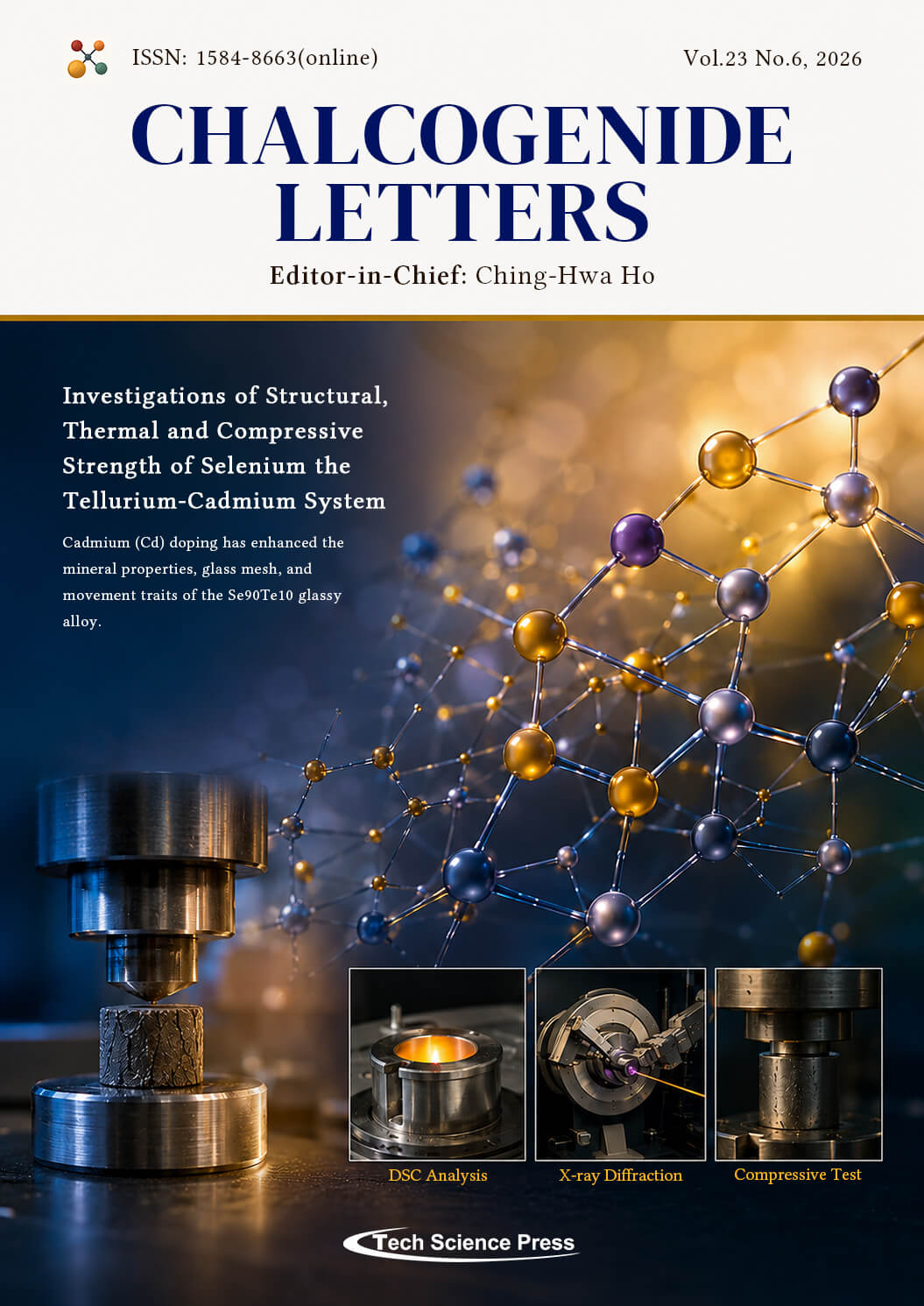
On the Cover

This study investigates the structural, thermal, and mechanical properties of Se–Te–Cd chalcogenide glassy alloys by introducing Cd doping into the Se₉₀Te₁₀ system. Through X-ray diffraction (XRD), differential scanning calorimetry (DSC), and compressive strength analysis, the work reveals the amorphous nature, crystallization behavior, and enhanced mechanical characteristics of the Cd-modified chalcogenide glasses. The findings provide valuable insights into the relationship between composition, structural stability, and thermal–mechanical performance of chalcogenide materials for potential functional applications.
The cover image was created by Chatgpt and contains no copyrighted elements or misleading representations.

View this paper

  • Open AccessOpen Access

    ARTICLE

    Room Temperature Ferromagnetism and Enhanced DC Conductivity in Cd0.9Cr0.1S Nanocrystalline Thin Films

    Nourah A. Alsobai1, Norah Alsairy2, A. Ashour3, A. M. Ismail4, Khaled M. Abdelbased5, Atef Ismail6,*
    Chalcogenide Letters, Vol.23, No.6, 2026, DOI:10.32604/cl.2026.083101 - 02 July 2026
    (This article belongs to the Special Issue: Chalcogenide Thin Films and Solar Cells for Optoelectronic Applications)
    Abstract This study presents a comparative investigation of the structural, DC electrical, and magnetic properties of pure cadmium sulfide (CdS) and 10% chromium-doped CdS (Cd0.9Cr0.1S) nanocrystalline thin films deposited by thermal evaporation. X-ray diffraction analysis confirmed the polycrystalline hexagonal (wurtzite) structure of both films with no detectable secondary phases. Upon Cr doping, the full width at half maximum (FWHM) of the principal diffraction peaks increased systematically, leading to a reduction in average crystallite size from 19.8 nm to 13.9 nm, accompanied by an increase in lattice strain (from 2.48 to 3.52) × 10−3 and dislocation density (from… More >

  • Open AccessOpen Access

    ARTICLE

    Synthesis and Characterization of Pulsed Laser Deposited CuxZn1−xS Thin Films Nanocomposite for Photosensor Application

    Hanaa I. Mohammed1, Eman M. Nasir2,*, Iqbal S. Naji2
    Chalcogenide Letters, Vol.23, No.6, 2026, DOI:10.32604/cl.2026.079657 - 02 July 2026
    Abstract Thin films of CuxZn1−xS nanocomposite with varying copper content (x = 0.3, 0.5, and 0.7) were successfully synthesized by the pulsed laser deposition (PLD) technique from their fabricated powders by the precipitation method for optoelectronic applications. The impact of Cu content on the film’s structural, morphological, optical, and electrical characteristics was investigated. Elemental composition analyses indicated that thin CZS films consisted only of their constituent elements and were free of any noted impurities. XRD patterns demonstrated that all as-grown thin films were polycrystalline in nature and adopted various planes and phases of CuS and ZnS binary… More >

  • Open AccessOpen Access

    ARTICLE

    Effect of PbO2 and Bi2O3 on the Physical, Optical, and Gamma-Ray Shielding Properties of Boro-Tellurite Glasses

    Aljawhara H. Almuqrin1, Manjunatha2, M. I. Sayyed3,4,5,*, Ashok Kumar6,7,*, A. S. Bennal8
    Chalcogenide Letters, Vol.23, No.6, 2026, DOI:10.32604/cl.2026.083065 - 02 July 2026
    Abstract The human exposure to hazardous ionizing radiation is increased due to the progression of nuclear technology across energy, medicine, and industrial sectors, etc. Developing transparent shielding materials is essential to overcome the structural and opacity limitations of traditional materials like concrete. The 30TeO2-xPbO2-xBi2O3-(70 − 2x)B2O3 (x = 10, 12, 14 and 16 mol%) glasses are prepared via the melt-quenching technique. The density (ρ) increases from 4.759 to 5.561 g cm−3 due to the incorporation of heavy metal oxides (HMOs). The molar volume (Vm) increases from 32.194 to 33.657 cm3 mol−1. The oxygen packing density (OPD) decreased from 80.761… More >

  • Open AccessOpen Access

    ARTICLE

    Investigations of Structural, Thermal and Compressive Strength of Selenium the Tellurium-Cadmium System

    R. Amin1,*, M. Rashad2,*, A. A. Abu-Sehly3, Taymour A. Hamdalla2, Ahmed S. Elshimy4
    Chalcogenide Letters, Vol.23, No.6, 2026, DOI:10.32604/cl.2026.077357 - 02 July 2026
    Abstract Cadmium (Cd) doping has enhanced the mineral properties, glass mesh, and movement traits of the Se90Te10 glassy alloy. The (Se90Te10)95Cd5 alloy has a strength 0.032 kN, accompanied by limited ductility, and displays brittle fracture behavior typical of amorphous chalcogenide glasses. (DSC) at varying heating rates was employed to examine the crystallization kinetics in bulk Se90Te10 and (Se90Te10)95Cd5 compositions; X-ray diffraction analysis was utilized to identify the crystalline structure of Se90Te10 and (Se90Te10)95Cd5, confirming the non-crystalline nature of both materials. Various kinetic frameworks were developed utilizing activation energies for glass transition and crystallization processes. “The Kissinger equation” was employed More >

  • Open AccessOpen Access

    ARTICLE

    First-Principles Study of the Structural, Mechanical, Lattice Dynamic, and Thermodynamic Properties of CuBS2 Semiconductor

    Dezi Li1, Linhua Xie2, Shunru Zhang1,*
    Chalcogenide Letters, Vol.23, No.6, 2026, DOI:10.32604/cl.2026.082939 - 02 July 2026
    Abstract Using first principles calculations, we have systematically studied the structural, elastic, mechanical, lattice dynamic, and thermodynamic properties of the CuBS2 semiconductor. The calculated structural parameters are in good agreement with the experimental values. The obtained elastic constants confirm that the compound is mechanically stable. The B/G ratio of CuBS2 indicating that this crystal possesses ductile characteristics. Using the ELATE software, 3D and 2D visualizations of anisotropic elastic properties, namely, the maximum and minimum values of Young’s modulus (E), shear modulus (G), linear compressibility (β), and Poisson’s ratio (ν), have been analyzed. Furthermore, we calculated the elastic anisotropy index (AU, AB,… More >

  • Open AccessOpen Access

    ARTICLE

    Properties of Bi2O2S Thin Films Produced by Chemical Bath Deposition at Different Immersion Bath Numbers

    Edgar G. Zamorano-Noriega1, María E. Martínez-Barbosa1,*, María L. Mota2, Ana B. López-Oyama3,4, Eugenio Rodríguez González5, Crescencio García-Guendulain6, Ramón Ochoa-Landín7, Fernando J. Sánchez-Rodríguez8,*, Santos J. Castillo3,*
    Chalcogenide Letters, Vol.23, No.6, 2026, DOI:10.32604/cl.2026.085590 - 02 July 2026
    Abstract The major challenge in developing efficient photovoltaic devices is achieving highlight absorption, optimal charge transport, and low recombination losses. In this work, the effect of the immersion bath numbers in the chemical bath deposition (CBD) technique on the properties of bismuth oxysulfide (Bi2O2S) thin films, as emergent materials, was studied. The films were synthesized under eco-friendly conditions, using a low-concentration bismuth nitrate precursor and thioacetamide as the sulfur source, and under basic conditions at moderate temperature, with a reaction time of 3 h. X-ray diffraction demonstrated the formation of a crystalline Bi2O2S phase, and the morphological… More >

Per Page:

Share Link